PUBLISHER: Mordor Intelligence | PRODUCT CODE: 2115093

PUBLISHER: Mordor Intelligence | PRODUCT CODE: 2115093
Professional Speaker - Market Share Analysis, Industry Trends & Statistics, Growth Forecasts (2026 - 2031)
According to Mordor Intelligence, the professional speaker market size was valued at USD 2.19 billion in 2025 and estimated to grow from USD 2.27 billion in 2026 to reach USD 2.69 billion by 2031, at a CAGR of 3.52% during the forecast period (2026-2031).
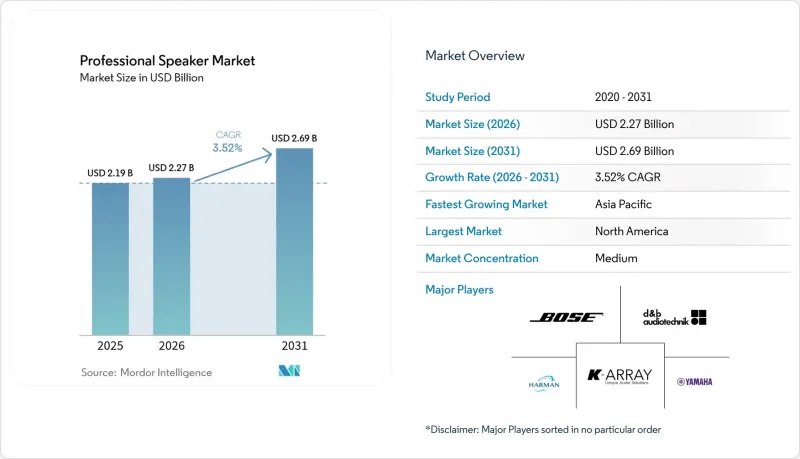
This report is Segmented by Product Type (Point Source Speaker System, and More), Amplification Method (Passive Pro Speaker Systems, and More), Connectivity (Wired, and More), Power Output (Below 500 W, and More), End-User (Corporates, Large Venues and Events, and More), Distribution Channel (Retail Stores, and More), and Geography. The Market Forecasts are Provided in Terms of Value (USD).
Global Professional Speaker Market Trends and Insights
Corporate AV Modernization Driving Premium Audio Adoption in North America
Enterprises are allocating 15-20% more meeting-room budgets to audio than in 2019, reflecting the direct link between sound quality and hybrid-work productivity. Distributed ceiling arrays are replacing front-of-room boxes to deliver consistent voice pickup regardless of seating position. Financial services firms lead uptake, with 78% of Fortune 500 banks implementing campus-wide upgrades that stress voice intelligibility and spatial audio capabilities. The trend lifts demand for networkable speakers that integrate natively with UC platforms and IT security policies. Integrators report double-digit growth in remote monitoring contracts that ensure uptime without on-site visits.
Rapid Proliferation of Hybrid and Virtual Events Requiring High-Performance Speaker Arrays
Event organizers are specifying audio systems able to serve both in-person and streamed audiences without duplicate signal chains. Networked protocols route multichannel feeds to broadcast encoders while maintaining low-latency reinforcement in the room. AI-driven mixers automatically compensate for acoustic changes and streaming codec losses, reducing engineering overhead. VR and AR adoption inside corporate showcases is accelerating demand for immersive arrays that support spatial audio objects. These requirements favor scalable line arrays with integrated DSP and tight phase coherence across coverage zones.
Supply Volatility of Neodymium Magnets Increasing BOM Costs
Neodymium price swings of 30-40% during 2024 eroded margins and forced rolling price lists. China controls about 85-90% of sintered NdFeB magnet output, exposing Western brands to geopolitical risk. The U.S. Department of Defense now requires domestic sourcing for military projects, encouraging firms such as MP Materials to open a Fort Worth facility capable of 1,000 tonnes annually. Manufacturers pursue three hedges: funding recycling programs that could cover up to 19% of magnet demand by 2030, investing in alternative ferrite blends for mid-tier products, and negotiating long-term contracts with diversified suppliers.
Other drivers and restraints analyzed in the detailed report include:
- Government Investments in Smart-City Convention Infrastructure Across Asia
- Rising Demand for Immersive Audio in eSports Arenas Globally
- Venue-Noise Regulations Limiting High-SPL Deployments in Europe
For complete list of drivers and restraints, kindly check the Table Of Contents.
Segment Analysis
Line arrays accounted for 57.85% of the professional speaker market in 2025, reflecting their scalability and even coverage across varied venue geometries. Their use has expanded from touring to fixed corporate auditoriums where reconfigurable layouts demand adaptable vertical dispersion. Subwoofers are projected to grow at 4.12% CAGR to 2031 as immersive content and EDM-centric entertainment raise low-frequency expectations. Point-source cabinets remain favored in smaller installations that value simplicity and lower cost, while slim column arrays win projects with stringent aesthetic constraints.
The professional speaker market size for line arrays is projected to approach USD 1.56 billion by 2031 at the current growth trajectory. Manufacturers are blending line-array directional control with point-source coherence, creating compact hybrids suited to multipurpose halls. Waveguide software now simulates coverage zones in minutes, shortening design cycles. Neodymium driver shortages elevate the appeal of dual-coil ferrite alternatives refined to cut weight by 20% without compromising sensitivity. Precision manufacturing, including 3-D printed phase plugs, is improving high-frequency response uniformity.
Powered-speaker systems captured 67.55% revenue share in 2025 and will expand fastest at 3.63% CAGR through 2031. Users gain simplified wiring, factory-matched components, and native DSP that tunes performance to room acoustics. Passive boxes persist in large touring rigs that benefit from centralized rack amplification for quick swap-outs, yet their share keeps shrinking as powered packages narrow weight and cost gaps.
The professional speaker market size generated by powered models surpassed USD 1.48 billion in 2025 and is set to exceed USD 1.83 billion by 2031. Class-D modules deliver over 1,000 W from cabinets weighing less than 15 kg, opening mobile use cases that once required truck-loaded racks. Battery-powered variants now cover corporate breakouts and street festivals, supported by energy-dense lithium packs and efficient sleep-modes. Powersoft's majority stake in K-Array illustrates the strategic significance of integrated amplification platforms, enabling end-to-end solutions that fuse loudspeakers, DSP, and network monitoring.
Complete Report Scope:
- By Product Type
- Point Source Speaker Systems
- Line Array Speaker Systems
- Subwoofers
- Other Product Types
- By Amplification Method
- Passive Professional Speaker Systems
- Powered Speaker Systems
- By Connectivity
- Wired
- Wireless
- Hybrid (Wired + Wireless)
- By Power Output (Watts)
- Below 500 W
- 500 - 1000 W
- Above 1000 W
- By End-User
- Corporates
- Large Venues and Events
- Educational Institutions
- Government and Military
- Studio and Broadcasting
- Hospitality
- Other Sectors
- By Distribution Channel
- Direct OEM Manufacturing and Integration
- Retail Stores
- Online Sales Channels
- By Geography
- North America
- United States
- Canada
- Mexico
- Europe
- Germany
- United Kingdom
- France
- Italy
- Spain
- Nordics (Denmark, Sweden, Norway, Finland)
- Rest of Europe
- Asia-Pacific
- China
- Japan
- South Korea
- India
- Southeast Asia
- Australia
- Rest of Asia-Pacific
- South America
- Brazil
- Argentina
- Rest of South America
- Middle East
- GCC
- Turkey
- Rest of Middle East
- Africa
- South Africa
- Nigeria
- Rest of Africa
- North America
Geography Analysis
North America led the professional speaker market with 33.95% revenue share in 2025 as corporations overhauled meeting spaces and live-touring activity rebounded. U.S. unit sales of high-power systems for touring and permanent installs surged 54% in 2024, supported by early adoption of networked audio protocols that simplify large-scale deployments. Canadian venues follow similar patterns, upgrading legacy rigs to meet stricter occupational sound exposure standards.
Asia Pacific is the fastest-growing geography, expected to post a 4.17% CAGR through 2031 as public investments fuel convention-center construction across China, India, and Southeast Asia. China alone earmarked USD 15 billion for tier-two and tier-three city convention centers through 2027, with audio comprising up to 12% of technology budgets. The region's pro-AV revenue is projected to reach USD 66.44 billion by 2029 at a 5.54% CAGR. India's commercial real-estate boom and government push for international expo hubs provide an additional catalyst, while Japan and South Korea focus on immersive systems for cultural venues and theme parks.
Europe holds a steady share but grapples with stringent noise regulations that cap SPL and drive demand for directional dispersion. Germany, the UK, and Scandinavia now require outdoor events to remain below 96 dB(A), prompting accelerated adoption of beam-steering arrays. Southern Europe invests in festival infrastructure to stimulate tourism, yet installations must balance output with community tolerance.
The Middle East, though smaller, exhibits robust growth as Saudi Arabia and the UAE roll out multipurpose entertainment complexes integral to economic-diversification plans. Africa and Latin America remain early-stage markets, yet smart-city pilots in Kenya and Brazil suggest latent demand once macroeconomic conditions stabilize.
- Harman International (Samsung)
- Bose Corporation
- Yamaha Corporation
- L-Acoustics
- D&B Audiotechnik
- Music Tribe (Behringer, Midas)
- Loud Audio (Mackie, EAW)
- Meyer Sound Laboratories
- QSC, LLC
- RCF Group
- Adamson Systems Engineering
- Electro-Voice (Bosch)
- Bowers and Wilkins
- B&C Speakers
- Martin Audio
- K-Array
- Genelec
- Fohhn Audio
- Peavey Electronics
- Carlson Audio Systems
- Sony Corporation
- Nady Systems
- Renkus-Heinz
- Alcons Audio
Additional Benefits:
- The market estimate (ME) sheet in Excel format
- 3 months of analyst support
TABLE OF CONTENTS
1 INTRODUCTION
- 1.1 Study Assumptions and Market Definition
- 1.2 Scope of the Study
2 RESEARCH METHODOLOGY
3 EXECUTIVE SUMMARY
4 MARKET LANDSCAPE
- 4.1 Market Overview
- 4.2 Market Drivers
- 4.2.1 Corporate AV Modernization Driving Premium Audio Adoption in North America
- 4.2.2 Rapid Proliferation of Hybrid and Virtual Events Requiring High-Performance Speaker Arrays
- 4.2.3 Government Investments in Smart-City Convention Infrastructure Across Asia
- 4.2.4 Rising Demand for Immersive Audio in eSports Arenas Globally
- 4.2.5 Tourism-Led Construction of Multipurpose Entertainment Venues in the Middle East
- 4.2.6 OEM Preference for Powered and Networked Speakers in Recording Studios
- 4.3 Market Restraints
- 4.3.1 Supply Volatility of Neodymium Magnets Increasing BOM Costs
- 4.3.2 Venue-Noise Regulations Limiting High-SPL Deployments in Europe
- 4.3.3 Prolonged Replacement Cycles Across Education Sector in Emerging Markets
- 4.3.4 Design Complexity for True-Wireless Synchronization of Large Arrays
- 4.4 Industry Ecosystem Analysis
- 4.5 Technological Outlook
- 4.6 Porter's Five Forces Analysis
- 4.6.1 Bargaining Power of Suppliers
- 4.6.2 Bargaining Power of Consumers
- 4.6.3 Threat of New Entrants
- 4.6.4 Threat of Substitutes
- 4.6.5 Intensity of Competitive Rivalry
5 MARKET SIZE AND GROWTH FORECASTS (VALUES)
- 5.1 By Product Type
- 5.1.1 Point Source Speaker Systems
- 5.1.2 Line Array Speaker Systems
- 5.1.3 Subwoofers
- 5.1.4 Other Product Types
- 5.2 By Amplification Method
- 5.2.1 Passive Professional Speaker Systems
- 5.2.2 Powered Speaker Systems
- 5.3 By Connectivity
- 5.3.1 Wired
- 5.3.2 Wireless
- 5.3.3 Hybrid (Wired + Wireless)
- 5.4 By Power Output (Watts)
- 5.4.1 Below 500 W
- 5.4.2 500 - 1000 W
- 5.4.3 Above 1000 W
- 5.5 By End-User
- 5.5.1 Corporates
- 5.5.2 Large Venues and Events
- 5.5.3 Educational Institutions
- 5.5.4 Government and Military
- 5.5.5 Studio and Broadcasting
- 5.5.6 Hospitality
- 5.5.7 Other Sectors
- 5.6 By Distribution Channel
- 5.6.1 Direct OEM Manufacturing and Integration
- 5.6.2 Retail Stores
- 5.6.3 Online Sales Channels
- 5.7 By Geography
- 5.7.1 North America
- 5.7.1.1 United States
- 5.7.1.2 Canada
- 5.7.1.3 Mexico
- 5.7.2 Europe
- 5.7.2.1 Germany
- 5.7.2.2 United Kingdom
- 5.7.2.3 France
- 5.7.2.4 Italy
- 5.7.2.5 Spain
- 5.7.2.6 Nordics (Denmark, Sweden, Norway, Finland)
- 5.7.2.7 Rest of Europe
- 5.7.3 Asia-Pacific
- 5.7.3.1 China
- 5.7.3.2 Japan
- 5.7.3.3 South Korea
- 5.7.3.4 India
- 5.7.3.5 Southeast Asia
- 5.7.3.6 Australia
- 5.7.3.7 Rest of Asia-Pacific
- 5.7.4 South America
- 5.7.4.1 Brazil
- 5.7.4.2 Argentina
- 5.7.4.3 Rest of South America
- 5.7.5 Middle East
- 5.7.5.1 GCC
- 5.7.5.2 Turkey
- 5.7.5.3 Rest of Middle East
- 5.7.6 Africa
- 5.7.6.1 South Africa
- 5.7.6.2 Nigeria
- 5.7.6.3 Rest of Africa
- 5.7.1 North America
6 COMPETITIVE LANDSCAPE
- 6.1 Market Concentration
- 6.2 Strategic Moves
- 6.3 Market Share Analysis
- 6.4 Company Profiles (includes Global level Overview, Market level overview, Core Segments, Financials, Strategic Information, Market Rank/Share, Products and Services, Recent Developments)
- 6.4.1 Harman International (Samsung)
- 6.4.2 Bose Corporation
- 6.4.3 Yamaha Corporation
- 6.4.4 L-Acoustics
- 6.4.5 D&B Audiotechnik
- 6.4.6 Music Tribe (Behringer, Midas)
- 6.4.7 Loud Audio (Mackie, EAW)
- 6.4.8 Meyer Sound Laboratories
- 6.4.9 QSC, LLC
- 6.4.10 RCF Group
- 6.4.11 Adamson Systems Engineering
- 6.4.12 Electro-Voice (Bosch)
- 6.4.13 Bowers and Wilkins
- 6.4.14 B&C Speakers
- 6.4.15 Martin Audio
- 6.4.16 K-Array
- 6.4.17 Genelec
- 6.4.18 Fohhn Audio
- 6.4.19 Peavey Electronics
- 6.4.20 Carlson Audio Systems
- 6.4.21 Sony Corporation
- 6.4.22 Nady Systems
- 6.4.23 Renkus-Heinz
- 6.4.24 Alcons Audio
7 MARKET OPPORTUNITIES AND FUTURE OUTLOOK
- 7.1 White-Space and Unmet-Need Assessment

