PUBLISHER: Mordor Intelligence | PRODUCT CODE: 2114627

PUBLISHER: Mordor Intelligence | PRODUCT CODE: 2114627
Biodegradable Polymer Coated Urea - Market Share Analysis, Industry Trends & Statistics, Growth Forecasts (2026 - 2031)
According to Mordor Intelligence, the biodegradable polymer coated urea market size was valued at USD 1.12 billion in 2025 and estimated to grow from USD 1.2 billion in 2026 to reach USD 1.69 billion by 2031, at a CAGR of 7.08% during the forecast period (2026-2031).
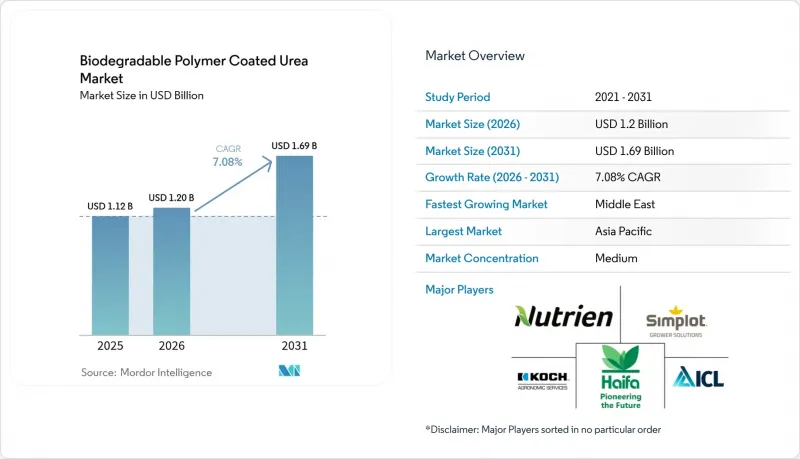
This report is Segmented by Crop Type (Grains and Cereals, Pulses and Oilseeds, Commercial Crops, and More), by Polymer Type (Polylactic Acid, Polycaprolactone, Starch-Based Polymers, and More), by Application Method (Broadcast Spreading, Fertigation, and More), and by Geography (North America, Asia-Pacific, South America, and More). The Market Forecasts are Provided in Terms of Value (USD).
Global Biodegradable Polymer Coated Urea Market Trends and Insights
Regulatory Push for Nitrogen-Use-Efficiency Fertilizers
Amendments to the European Union Nitrates Directive in 2024 capped on-farm nitrogen application at 170 kg per hectare, compelling growers to adopt controlled-release inputs that curb volatilization. Germany followed by pledging a 29% ammonia-emission cut by 2030, creating a direct pull for slow-release formulations that demonstrate lower atmospheric losses. China mirrored this stance by requiring large farming enterprises to certify nitrogen-use efficiency, anchoring demand in a market responsible for nearly one-third of global urea consumption. These synchronized mandates elevate the biodegradable polymer coated urea market as a compliance tool rather than an optional premium input. Consequently, distributors now bundle regulatory advisory services with coated urea contracts, signaling that policy enforcement will remain a durable demand driver over the medium term.
Surge in Specialty Crop Acreage in Asia-Pacific
Asia-Pacific fruit and vegetable exports rose sharply in 2024, with Vietnam alone posting USD 6.8 billion in shipments, a 22% year-on-year gain. Specialty growers in Thailand, Vietnam, and the Philippines command price premiums that offset the cost differential between coated and conventional urea. Because export destinations enforce strict residue limits, producers use controlled-release inputs to minimize late-season nitrate spikes. This calculus anchors the biodegradable polymer coated urea market in high-value crops, even as field-crop penetration remains limited. Over time, secondary spillovers into floriculture and protected cultivation are likely, given aligned quality and environmental requirements.
High Price Premiums Over Conventional Urea
Conventional granular urea averaged USD 425 per metric ton in 2024, whereas bio-degradable polymer coated grades traded between USD 1,200 and USD 1,400, reflecting higher manufacturing and polymer feedstock costs. For low-margin field crops, yield gains of 10-15% rarely outweigh such premiums, confining adoption mainly to high-value horticulture or subsidy-backed acreage. Although carbon-credit revenue and labor savings partially offset the gap, sticker-shock remains a formidable hurdle, particularly in markets with limited credit access. Suppliers have responded by launching smaller pack sizes and seasonal discount programs, but these measures only marginally ease cost concerns.
Other drivers and restraints analyzed in the detailed report include:
- Farmer Incentives Under 4R Nutrient Stewardship Programs
- Breakthroughs in Bio-Polymer Micro-Encapsulation
- Regulatory Ambiguity Around Biodegradable Claims
For complete list of drivers and restraints, kindly check the Table Of Contents.
Segment Analysis
Grains and cereals held a 45.30% share of the biodegradable polymer coated urea market size in 2025, a function of sheer acreage despite cost headwinds. Within this broad segment, adoption concentrates in high-nitrogen cereals like rice and corn, where controlled release delivers measurable yield bumps. Conversely, fruits and vegetables expand at a 10.22% CAGR to 2031 as growers aim for residue compliance in export markets and exploit the value uplift stemming from higher produce grades. Premium crops such as durian, dragon fruit, and table grapes achieve revenue densities above USD 15,000 per hectare, enabling rapid payback on coated-urea investments. Pulses and oilseeds show moderate uptake because biological nitrogen fixation partially offsets synthetic input needs, though growers in rotation systems appreciate the benefit of synchronizing nutrient availability with peak legume demand. Turf and ornamentals, though niche, remain a steady market due to urban landscaping mandates that cap nutrient run-off in municipal areas.
The fruits and vegetables cohort illustrates why the biodegradable polymer coated urea market resonates with specialty agriculture. Precision nutrient timing reduces physiological disorders and cosmetic blemishes, enhancing pack-out rates and export acceptance. Growers integrate coated urea within fertigation programs to align nitrogen supply with critical growth phases, halving application trips and lowering labor costs. For grains, adoption hinges on policy incentives and carbon-credit stacking rather than yield economics alone, underscoring variable penetration across crop types.
Complete Report Scope:
- By Crop Type
- Grains and Cereals
- Pulses and Oilseeds
- Commercial Crops
- Fruits and Vegetables
- Turf and Ornamentals
- By Polymer Type
- Polylactic Acid (PLA)
- Polycaprolactone (PCL)
- Starch-based Polymers
- Other Biodegradable Polymers
- By Application Method
- Broadcast Spreading
- Fertigation
- Foliar Application
- By Geography
- North America
- United States
- Canada
- Mexico
- Rest of North America
- Europe
- Germany
- United Kingdom
- France
- Netherlands
- Russia
- Rest of Europe
- Asia-Pacific
- China
- Japan
- India
- Australia
- Rest of Asia-Pacific
- South America
- Brazil
- Argentina
- Rest of South America
- Middle East
- Saudi Arabia
- Turkey
- Rest of Middle East
- Africa
- South Africa
- Egypt
- Rest of Africa
- North America
Geography Analysis
Asia-Pacific sustained a 37.50% revenue share of the biodegradable polymer coated urea market in 2025, bolstered by government modernization programs that subsidize controlled-release inputs and tie them to irrigation upgrades. China's provincial eco-agriculture zones reimburse up to 50% of coated-urea costs, embedding nitrogen-use efficiency into performance metrics for local extension officers. India's Pradhan Mantri Krishi Sinchayee Yojana links drip-irrigation grants with nutrient-delivery targets, galvanizing fertigation-based adoption. High specialty-crop density across Vietnam, Thailand, and the Philippines reinforces regional demand by aligning revenue potential with premium input costs.
The Middle East is the fastest-growing regional cluster, poised for a 9.56% CAGR through 2031, underpinned by food-security strategies and acute water scarcity. Saudi Arabia earmarked USD 8 billion for sustainable farming technologies under Vision 2030, prioritizing efficient fertilizers that curtail water evaporation losses. The United Arab Emirates advances vertical-farming complexes that specify controlled-release urea for closed-loop hydroponic systems where nutrient precision determines overall system economics. While limited arable land caps absolute volume, the high per-hectare spend elevates regional value contribution to the global biodegradable polymer coated urea market.
North America and Europe remain mature but steady adopters, advancing at 6.05% and 5.28% CAGRs, respectively. Both regions rely on environmental compliance and carbon-market integration to justify input premiums. USDA cost-share programs, coupled with calcium ammonium nitrate restrictions in nitrate-vulnerable zones across the European Union, sustain baseline demand. Africa, with an 8.73% CAGR, showcases donor-funded pilots that blend fertilizer access with soil-health restoration, though logistics gaps and limited farmer education continue to dampen scalability. Collectively, geographic diversification shields the biodegradable polymer coated urea market from regional policy reversals and price shocks.
- Nutrien Ltd
- Koch Agronomic Services LLC
- ICL Specialty Fertilizers Ltd
- J. R. Simplot Company
- Haifa Chemicals Ltd
- Yara International ASA
- Kingenta Ecological Engineering Co., Ltd.
- The Mosaic Company
- SQM S.A.
- OCP S.A.
- Compo Expert GmbH
- Hanfeng Evergreen Inc.
- DeltaChem GmbH
- Pursell Agritech LLC
- Florikan ESA LLC
Additional Benefits:
- The market estimate (ME) sheet in Excel format
- 3 months of analyst support
TABLE OF CONTENTS
1 Introduction
- 1.1 Study Assumptions and Market Definition
- 1.2 Scope of the Study
2 Research Methodology
3 Executive Summary
4 Market Landscape
- 4.1 Market Overview
- 4.2 Market Drivers
- 4.2.1 Regulatory push for nitrogen use-efficiency fertilizers
- 4.2.2 Surge in specialty crop acreage in Asia-Pacific
- 4.2.3 Farmer incentives under 4R nutrient-stewardship programs
- 4.2.4 Breakthroughs in bio-polymer micro-encapsulation
- 4.2.5 Carbon-credit monetization for slow-release fertilizers
- 4.2.6 Corporate net-zero procurement of low NO fertilizers
- 4.3 Market Restraints
- 4.3.1 High price premiums over conventional urea
- 4.3.2 Regulatory ambiguity around biodegradable claims
- 4.3.3 Enzyme-coated urea as a low-cost substitute
- 4.3.4 Supply-chain dependency on bio-polymer feedstocks
- 4.4 Regulatory Landscape
- 4.5 Technological Outlook
- 4.6 Porter's Five Forces Analysis
- 4.6.1 Threat of New Entrants
- 4.6.2 Bargaining Power of Suppliers
- 4.6.3 Bargaining Power of Buyers
- 4.6.4 Threat of Substitutes
- 4.6.5 Intensity of Competitive Rivalry
5 Market Size and Growth Forecasts (Value, USD)
- 5.1 By Crop Type
- 5.1.1 Grains and Cereals
- 5.1.2 Pulses and Oilseeds
- 5.1.3 Commercial Crops
- 5.1.4 Fruits and Vegetables
- 5.1.5 Turf and Ornamentals
- 5.2 By Polymer Type
- 5.2.1 Polylactic Acid (PLA)
- 5.2.2 Polycaprolactone (PCL)
- 5.2.3 Starch-based Polymers
- 5.2.4 Other Biodegradable Polymers
- 5.3 By Application Method
- 5.3.1 Broadcast Spreading
- 5.3.2 Fertigation
- 5.3.3 Foliar Application
- 5.4 By Geography
- 5.4.1 North America
- 5.4.1.1 United States
- 5.4.1.2 Canada
- 5.4.1.3 Mexico
- 5.4.1.4 Rest of North America
- 5.4.2 Europe
- 5.4.2.1 Germany
- 5.4.2.2 United Kingdom
- 5.4.2.3 France
- 5.4.2.4 Netherlands
- 5.4.2.5 Russia
- 5.4.2.6 Rest of Europe
- 5.4.3 Asia-Pacific
- 5.4.3.1 China
- 5.4.3.2 Japan
- 5.4.3.3 India
- 5.4.3.4 Australia
- 5.4.3.5 Rest of Asia-Pacific
- 5.4.4 South America
- 5.4.4.1 Brazil
- 5.4.4.2 Argentina
- 5.4.4.3 Rest of South America
- 5.4.5 Middle East
- 5.4.5.1 Saudi Arabia
- 5.4.5.2 Turkey
- 5.4.5.3 Rest of Middle East
- 5.4.6 Africa
- 5.4.6.1 South Africa
- 5.4.6.2 Egypt
- 5.4.6.3 Rest of Africa
- 5.4.1 North America
6 Competitive Landscape
- 6.1 Market Concentration
- 6.2 Strategic Moves
- 6.3 Market Share Analysis
- 6.4 Company Profiles (Includes Global Level Overview, Market Level Overview, Core Segments, Financials as Available, Strategic Information, Market Rank/Share for Key Companies, Products and Services, and Recent Developments)
- 6.4.1 Nutrien Ltd
- 6.4.2 Koch Agronomic Services LLC
- 6.4.3 ICL Specialty Fertilizers Ltd
- 6.4.4 J. R. Simplot Company
- 6.4.5 Haifa Chemicals Ltd
- 6.4.6 Yara International ASA
- 6.4.7 Kingenta Ecological Engineering Co., Ltd.
- 6.4.8 The Mosaic Company
- 6.4.9 SQM S.A.
- 6.4.10 OCP S.A.
- 6.4.11 Compo Expert GmbH
- 6.4.12 Hanfeng Evergreen Inc.
- 6.4.13 DeltaChem GmbH
- 6.4.14 Pursell Agritech LLC
- 6.4.15 Florikan ESA LLC
7 Market Opportunities and Future Outlook

