PUBLISHER: Mordor Intelligence | PRODUCT CODE: 2114630

PUBLISHER: Mordor Intelligence | PRODUCT CODE: 2114630
Intraoperative Neuromonitoring - Market Share Analysis, Industry Trends & Statistics, Growth Forecasts (2026 - 2031)
According to Mordor Intelligence, the intraoperative neuromonitoring market size is expected to grow from USD 3.65 billion in 2025 to USD 3.84 billion in 2026 and is forecast to reach USD 4.93 billion by 2031 at 5.14% CAGR over 2026-2031.
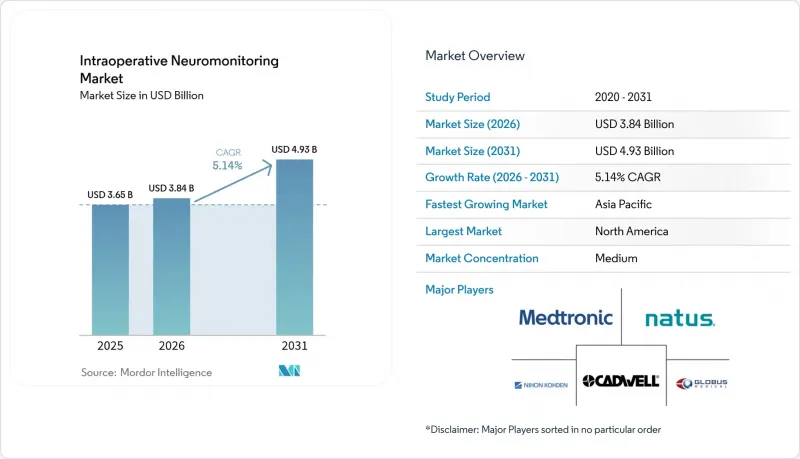
This report is Segmented by Product & Services (Systems, and Accessories & Consumables, Services), Source Type (Insource Monitoring and Outsource Monitoring), Monitoring Modality (Somatosensory Evoked Potentials, and More), Surgical Application (Spinal Surgery, Neurosurgery and More), End User (Hospitals and More), and Geography. The Market Forecasts are Provided in Terms of Value (USD).
Global Intraoperative Neuromonitoring Market Trends and Insights
Rising Chronic-Disease Burden & Surgical Volumes
Complex spine, vascular, and neurosurgical case volumes are climbing by roughly 4-5% each year as populations age and diabetes prevalence increases, exposing more patients to iatrogenic nerve-injury risk . Surgeons now view multimodal monitoring as a core safety measure rather than an optional safeguard. The intraoperative neuromonitoring market consequently benefits whenever payers broaden coverage, as seen in CMS's 2024 decision to reimburse monitoring during select cardiovascular procedures. Hospital credentialing committees have responded by embedding monitoring into perioperative checklists, effectively transforming discretionary spend into a fixed operating cost. The pattern holds across North America and Western Europe, where malpractice-premium discounts reward documented monitoring use. As procedure counts rise, consumable turnover accelerates, compounding revenue growth for electrode manufacturers.
Mandatory Risk-Mitigation Policies by Hospitals & Insurers
Liability carriers increasingly tie malpractice premiums to documented use of neuromonitoring in high-risk specialties. A 2025 American Association of Neurological Surgeons survey showed that 62% of neurosurgeons receive lower premiums when hospitals record routine multimodal monitoring . Joint Commission National Patient Safety Goals issued in 2024 encourage real-time neural surveillance for surgeries with nerve-injury rates above 1%, reinforcing institutional compliance requirements. These intertwined financial and accreditation pressures speed technology adoption more than clinical evidence alone. Facilities unable to meet internal monitoring targets often outsource, fueling service-provider growth.
High Capital & Service Cost of IONM Systems
Comprehensive suites list between USD 80,000 and USD 150,000, numbers that strain community-hospital budgets, while per-case outsourced fees can exceed USD 1,500 . In India, only 22% of tertiary centers had access to multimodal monitoring in 2024. Consumable costs further inhibit uptake, with single-use electrode sets priced at USD 15-25. Although leasing and subscription schemes defer cash outlays, they require predictable surgical volumes that many facilities cannot guarantee, subtracting 0.6 percentage points from forecast CAGR.
Other drivers and restraints analyzed in the detailed report include:
- Expansion of Third-Party IONM Service Networks
- Outpatient/ASC Shift Driving Portable & Remote IONM
- Shortage of Certified Neurophysiologists
For complete list of drivers and restraints, kindly check the Table Of Contents.
Segment Analysis
Systems generated 75.8% of 2025 revenue, underscoring the capital-intensive nature of integrated multimodal consoles that underpin the intraoperative neuromonitoring market size for hospital buyers. Consumables, however, are rising at a 6.08% CAGR through 2031 as single-use needle electrodes become standard under 2024 CDC guidelines advocating disposables to prevent prion transmission.
Cadwell's USD 18 electrode set undercut incumbent prices by 25%, catalyzing uptake among cost-sensitive ASCs. Vendors now bundle replenishment kits, software updates, and remote support into subscription packages, shifting revenue toward predictable recurring flows and locking customers into proprietary consumable ecosystems.
Wireless hubs and tablet-based interfaces shrink footprints in crowded theaters. Inomed's Bluetooth electrode arrays eliminate cable clutter, a user-centric feature that appeals to multi-modality cases. Medtronic's subscription model pairs its base station with monthly shipments of sterilized electrodes and cloud analytics, embedding consumables in operating budgets. As disposable volumes climb, the intraoperative neuromonitoring market share of consumables is set to widen, particularly in ASC networks that favor low-inventory, infection-controlled workflows.
Insourced programs held 59.4% of 2025 revenue, concentrated in academic centers that leverage internal neurophysiologist teams to train residents and conduct research. Outsourced monitoring is expanding at a 7.25% CAGR, bridging gaps for community hospitals performing fewer than 200 monitored cases annually. A Journal of Healthcare Management study found outsourced programs cut per-case costs by 18% versus insourced alternatives at low-volume facilities. Assure Holdings' acquisition spree in 2025 extended coverage to 400 hospitals across 14 states, exemplifying consolidation trends that raise the intraoperative neuromonitoring market size accessible to mid-tier institutions.
Remote-supervision technology allows a single board-certified neurophysiologist to oversee four concurrent surgeries, relieving workforce constraints. Nevertheless, large spine centers still justify dedicated in-house teams where annual volumes exceed 600 procedures, preserving an insourced stronghold. Moving forward, payer pressure to trim capital budgets and the maturation of vendor networks will keep outsourcing growth ahead of insourcing, gradually shifting intraoperative neuromonitoring market share toward variable-cost service models.
Complete Report Scope:
- By Product & Services
- Systems
- Accessories & Consumables
- Services
- By Source Type
- Insourced Monitoring
- Outsourced Monitoring
- By Monitoring Modality
- Somatosensory Evoked Potentials (SSEPs)
- Motor Evoked Potentials (MEPs)
- Electroencephalography (EEG)
- Electromyography (EMG)
- Auditory & Visual EPs (BAEPs, VEPs)
- By Surgical Application
- Spinal Surgery
- Neurosurgery
- Orthopedic Surgery
- ENT & Thyroid Surgery
- Vascular & Cardiovascular Surgery
- Other Complex Procedures
- By End-User
- Hospitals
- Speciality Clinics
- Ambulatory Surgical Centers (ASCs)
- By Geography
- North America
- United States
- Canada
- Mexico
- Europe
- Germany
- United Kingdom
- France
- Italy
- Spain
- Rest of Europe
- Asia-Pacific
- China
- India
- Japan
- South Korea
- Australia
- Rest of Asia-Pacific
- Middle East and Africa
- GCC
- South Africa
- Rest of Middle East and Africa
- South America
- Brazil
- Argentina
- Rest of South America
- North America
Geography Analysis
North America generated 43.4% of 2025 revenue, supported by Medicare reimbursement, Joint Commission standards, and the broad reach of outsourced service networks. The United States dominates spending, while Canada limits adoption to academic centers under single-payer budget caps. Mexico remains nascent, although private hospital chains are investing to attract medical tourists.
Europe follows, with Germany, the United Kingdom, and France leading penetration, thanks to national reimbursement for defined spinal and intracranial indications. Germany's statutory insurers cover neuromonitoring in deformity correction, ensuring consistent usage. The United Kingdom's 2024 NICE guidance endorsed monitoring for complex spine surgery, likely to lift utilization in NHS trusts under capital-tight constraints. Southern Europe lags as hospitals prioritize imaging and robotic systems ahead of neuromonitoring.
Asia-Pacific is the fastest-growing region at 7.11% CAGR. China's Healthy China 2030 initiative funds tertiary hospital upgrades that require neuromonitoring capability. India's private chains, such as Apollo Hospitals, install multimodal suites to attract domestic and international patients. Japan's aging demographic drives spine-procedure demand, benefiting domestic vendor Nihon Kohden. The Middle East concentrates adoption in Gulf Cooperation Council countries building flagship medical cities, whereas Africa and South America progress more slowly due to fragmented reimbursement and capital shortfalls.
- Accurate Monitoring
- Alpha Omega Engineering
- Assure Holdings Corp.
- Axis Neuromonitoring
- Cadwell Industries
- Checkpoint Surgical
- Computational Diagnostics
- Dr Langer Medical
- Globus Medical
- IntraNerve Neuroscience
- Medsurant Monitoring
- Medtronic
- Natus Medical
- NCC Medical Co. Ltd.
- NeuroMonitoring Technologies
- NeuroStyle Pte Ltd.
- NeuroVision Medical Products
- NeuroWave Systems
- Nihon Kohden
- SafePassage Neuromonitoring
- Sentient Medical Systems
- SpecialtyCare Inc.
Additional Benefits:
- The market estimate (ME) sheet in Excel format
- 3 months of analyst support
TABLE OF CONTENTS
1 Introduction
- 1.1 Study Assumptions & Market Definition
- 1.2 Scope of the Study
2 Research Methodology
3 Executive Summary
4 Market Landscape
- 4.1 Market Overview
- 4.2 Market Drivers
- 4.2.1 Rising Chronic-Disease Burden & Surgical Volumes
- 4.2.2 Mandatory Risk-Mitigation Policies By Hospitals & Insurers
- 4.2.3 Expansion Of Third-Party IONM Service Networks
- 4.2.4 Outpatient/ASC Shift Driving Portable & Remote IONM
- 4.2.5 Convergence With Robotic, AR & Navigation Platforms
- 4.2.6 AI-Driven Real-Time Quantitative Neuro-Mapping
- 4.3 Market Restraints
- 4.3.1 High Capital & Service Cost of IONM Systems
- 4.3.2 Shortage Of Certified Neurophysiologists
- 4.3.3 Fragmented Reimbursement in Emerging Economies
- 4.3.4 Value-For-Money Scrutiny Limiting Routine-Use Guidelines
- 4.4 Supply-Chain Analysis
- 4.5 Regulatory Landscape
- 4.6 Technological Outlook
- 4.7 Porter's Five Forces
- 4.7.1 Bargaining Power of Suppliers
- 4.7.2 Bargaining Power of Buyers
- 4.7.3 Threat of New Entrants
- 4.7.4 Threat of Substitutes
- 4.7.5 Intensity of Competitive Rivalry
5 Market Size & Growth Forecasts (Value / USD)
- 5.1 By Product & Services
- 5.1.1 Systems
- 5.1.2 Accessories & Consumables
- 5.1.3 Services
- 5.2 By Source Type
- 5.2.1 Insourced Monitoring
- 5.2.2 Outsourced Monitoring
- 5.3 By Monitoring Modality
- 5.3.1 Somatosensory Evoked Potentials (SSEPs)
- 5.3.2 Motor Evoked Potentials (MEPs)
- 5.3.3 Electroencephalography (EEG)
- 5.3.4 Electromyography (EMG)
- 5.3.5 Auditory & Visual EPs (BAEPs, VEPs)
- 5.4 By Surgical Application
- 5.4.1 Spinal Surgery
- 5.4.2 Neurosurgery
- 5.4.3 Orthopedic Surgery
- 5.4.4 ENT & Thyroid Surgery
- 5.4.5 Vascular & Cardiovascular Surgery
- 5.4.6 Other Complex Procedures
- 5.5 By End-User
- 5.5.1 Hospitals
- 5.5.2 Speciality Clinics
- 5.5.3 Ambulatory Surgical Centers (ASCs)
- 5.6 By Geography
- 5.6.1 North America
- 5.6.1.1 United States
- 5.6.1.2 Canada
- 5.6.1.3 Mexico
- 5.6.2 Europe
- 5.6.2.1 Germany
- 5.6.2.2 United Kingdom
- 5.6.2.3 France
- 5.6.2.4 Italy
- 5.6.2.5 Spain
- 5.6.2.6 Rest of Europe
- 5.6.3 Asia-Pacific
- 5.6.3.1 China
- 5.6.3.2 India
- 5.6.3.3 Japan
- 5.6.3.4 South Korea
- 5.6.3.5 Australia
- 5.6.3.6 Rest of Asia-Pacific
- 5.6.4 Middle East and Africa
- 5.6.4.1 GCC
- 5.6.4.2 South Africa
- 5.6.4.3 Rest of Middle East and Africa
- 5.6.5 South America
- 5.6.5.1 Brazil
- 5.6.5.2 Argentina
- 5.6.5.3 Rest of South America
- 5.6.1 North America
6 Competitive Landscape
- 6.1 Market Concentration
- 6.2 Market Share Analysis
- 6.3 Company Profiles (includes Global-level Overview, Market-level Overview, Core Segments, Financials as available, Strategic Information, Market Rank/Share for key companies, Products, and Recent Developments)
- 6.3.1 Accurate Monitoring
- 6.3.2 Alpha Omega Engineering
- 6.3.3 Assure Holdings Corp.
- 6.3.4 Axis Neuromonitoring
- 6.3.5 Cadwell Industries
- 6.3.6 Checkpoint Surgical
- 6.3.7 Computational Diagnostics Inc.
- 6.3.8 Dr Langer Medical
- 6.3.9 Globus Medical Inc
- 6.3.10 IntraNerve Neuroscience
- 6.3.11 Medsurant Monitoring
- 6.3.12 Medtronic plc
- 6.3.13 Natus Medical Inc.
- 6.3.14 NCC Medical Co. Ltd.
- 6.3.15 NeuroMonitoring Technologies
- 6.3.16 NeuroStyle Pte Ltd.
- 6.3.17 NeuroVision Medical Products
- 6.3.18 NeuroWave Systems Inc.
- 6.3.19 Nihon Kohden Corporation
- 6.3.20 SafePassage Neuromonitoring
- 6.3.21 Sentient Medical Systems
- 6.3.22 SpecialtyCare Inc.
7 Market Opportunities & Future Outlook
- 7.1 White-Space & Unmet-Need Assessment

