PUBLISHER: Mordor Intelligence | PRODUCT CODE: 2114639

PUBLISHER: Mordor Intelligence | PRODUCT CODE: 2114639
Drilling Tools - Market Share Analysis, Industry Trends & Statistics, Growth Forecasts (2026 - 2031)
According to Mordor Intelligence, the drilling tools market size is expected to grow from USD 9.25 billion in 2025 to USD 9.68 billion in 2026 and is forecast to reach USD 12.17 billion by 2031 at 4.68% CAGR over 2026-2031.
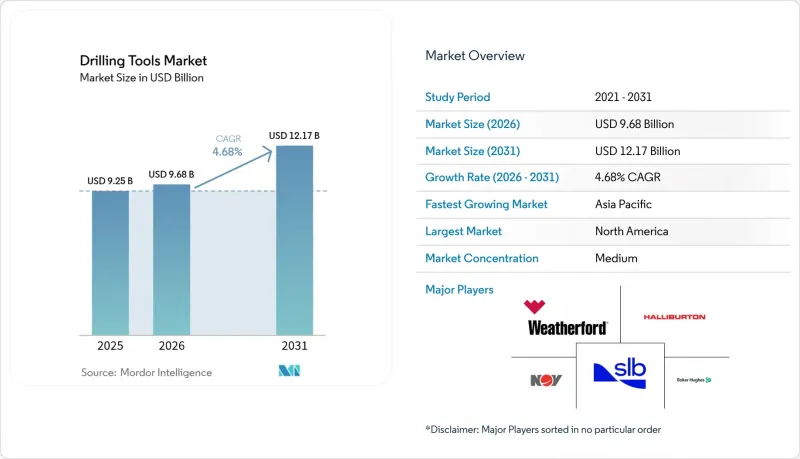
This report is Segmented by Type (Drill Bit, Drill Pipe, Drill Collar, Drill Reamer and Stabilizer, Drill Swivel, and Other Tools), Application (Development and Production Drilling, Geothermal Drilling, and More), Location of Deployment (Onshore and Offshore), End-User (Oil and Gas Operators, Geothermal Developers, and More), and Geography (North America, Europe, Asia-Pacific, South America, and More).
Global Drilling Tools Market Trends and Insights
Upstream CAPEX Rebound Post-Pandemic
Global oil and gas investment is set to increase by 22% between 2025 and 2030, reversing three years of capital restraint and renewing demand for high-performance drilling tools, according to the International Energy Forum. In North America, Gulf of Mexico operators sanctioned multi-billion-dollar projects such as Chevron's Anchor, which require 20,000 psi-rated equipment and validate the economic case for top-tier drill strings. Middle East national oil companies are likewise reviving infill drilling campaigns aimed at sustaining production quotas. This CAPEX upturn favors tools that deliver measurable rig-time savings, prompting suppliers to bundle rotary steerable systems with digital well-planning platforms. Service agreements are increasingly linking remuneration to improvements in penetration rates, a model that incentivizes continuous product upgrades. Taken together, an improving spend outlook, efficiency mandates, and contractual innovation provide sustained pull for the drilling tools market.
Shale Well Complexity Driving Demand for Advanced Drill Bits
Horizontal laterals now exceed 20,000 ft in premier US shale plays, subjecting drill bits to harsher vibration and cuttings-bed challenges AMERICAN OIL & GAS REPORTER. PDC cutters with advanced thermal-stable diamond and optimized face geometries extend run lengths under such regimes, enabling a single bit to drill multiple intervals NOV. Meanwhile, AI-driven platforms, such as Halliburton's LOGIX, analyze real-time torque data to preempt stick-slip, increasing lifting penetration rates by up to 30%. Argentina's Vaca Muerta and Australia's Cooper Basin replicate these design imperatives as they scale horizontal programs. Premium bit pricing, therefore, remains resilient, supporting the segment's 32.3% revenue contribution to the drilling tools market.
Volatile Crude-Oil Prices Impacting Drilling Budgets
WTI spot prices slipped below USD 70/bbl in early 2025, prompting US independents to trim their planned spending to USD 60.1 billion, 4% lower than the prior guidance. When budgets tighten, non-core exploration wells are deferred, curbing near-term orders for standard drill pipe and collars. Conversely, operators continue to pay premiums for tools that shorten cycle times, sustaining top-end demand even in price troughs. Suppliers that diversify into geothermal or CCS projects gain partial insulation from oil-price swings, tempering but not eliminating the drag on the drilling tools market.
Other drivers and restraints analyzed in the detailed report include:
- Expansion of Deep- and Ultra-Deepwater Projects
- Increasing Geothermal Drilling Investments
- Stringent Environmental Regulations on Drilling Operations
For complete list of drivers and restraints, kindly check the Table Of Contents.
Segment Analysis
Drill bits generated USD 2.96 billion in 2025, equal to 31.98% of the drilling tools market size, underscoring their pivotal role in well economics. Continued adoption of thermally stable PDC cutters and real-time imaging at the bit face allows operators to achieve single-run curves in interbedded formations, reducing connection time and NPT. OEMs capture price premiums by packaging bits with digital advisory software that recommends rotary speed and weight-on-bit adjustments in real time.
The "Other Tools" category-jars, shock subs, mud motors, and rotary steerable systems-will outpace overall growth at an 7.72% CAGR. Halliburton's iCruise and Baker Hughes' AutoTrak generate dynamic steering corrections that cut slide-rotate cycles, while SLB's Suppressor dampening tool mitigates torsional oscillation by more than 60%. That performance edge justifies higher day rates, despite budget pressure, and anchors robust revenue expansion for full-suite providers.
Development and production drilling accounted for 51.45% of 2025 revenue, reflecting operators' focus on brownfield optimization and resource recovery. Multi-well pad designs and batch drilling intensify tool utilization, driving steady orders for drill pipe, reamers, and downhole vibration absorbers. Exploration drilling, although cyclical, gains strategic importance in frontier deepwater blocks sanctioned by major oil companies seeking to renew their portfolios.
Geothermal wells represent the fastest floor-count addition, advancing at a 9.21% CAGR as governments fund superhot rock pilots. Carbon-capture injection wells form a smaller but fast-scaling niche, where directional profiles require abrasion-resistant bottom-hole assemblies capable of handling dense CO2 muds. The positive spill-over broadens the customer mix and offsets oil price-driven volatility, adding resilience to the drilling tools market.
Complete Report Scope:
- By Tool Type
- Drill Bit
- Drill Pipe
- Drill Collar
- Drill Reamer and Stabilizer
- Drill Swivel
- Other Tools (Jars, Shock Subs, Mud Motors, RSS)
- By Application
- Exploration Drilling
- Development and Production Drilling
- Workover and Well Intervention
- Geothermal Drilling
- CCS and Injection Wells
- By Location of Deployment
- Onshore
- Offshore
- By End-User
- Oil and Gas Operators
- National Oil Companies
- Independent EandP
- Drilling Contractors
- Geothermal Developers
- Mining Exploration Firms
- By Geography
- North America
- United States
- Canada
- Mexico
- Europe
- Germany
- United Kingdom
- Norway
- Russia
- Rest of Europe
- Asia-Pacific
- China
- India
- South Korea
- ASEAN Countries
- Rest of Asia-Pacific
- South America
- Brazil
- Argentina
- Colombia
- Rest of South America
- Middle East and Africa
- Saudi Arabia
- United Arab Emirates
- Qatar
- South Africa
- Egypt
- Nigeria
- Rest of Middle East and Africa
- North America
Geography Analysis
North America generated 32.75% of 2025 revenue, driven by record Permian horizontal footage and resilient Gulf of Mexico deepwater campaigns. The region's advanced logistics and digital drilling ecosystem keeps equipment utilization high, even as capital discipline tempers rig additions. Federal methane rules and state-level setback regulations pressure smaller operators, yet the supermajors' adoption of triple-frac completion methods is increasing drill-pipe torque requirements and sustaining premium-tool demand.
Asia-Pacific leads growth at a 6.18% CAGR through 2031. China's national firms drive deep onshore targets in the Tarim and Sichuan basins, demanding abrasion-resistant PDC bits and high-temperature mud motors. Indonesia pursues geothermal baseload projects, while Australia's critical-mineral exploration creates a fresh pull for coring bits compatible with HP hard-rock drilling. Collectively, these trends expand the drilling tools market footprint across both hydrocarbon and renewable value chains.
Europe, anchored by Norway and the UK, maintains tooling demand via brownfield tie-backs and a surge of CCS wells under the North Sea Transition Deal. The Middle East and Africa capitalize on low breakeven reservoirs and state-sponsored capacity expansions, though political risk occasionally delays purchase orders. South America, buoyed by Brazil's pre-salt, channels large integrated contracts to SLB and Baker Hughes, concentrating market share within a handful of vendors. The combined regional dynamics underscore a gradual shift from volume-led to efficiency-led purchasing.
- NOV Inc.
- Halliburton Company
- Schlumberger Limited
- Baker Hughes Company
- Weatherford International PLC
- Hunting PLC
- Rival Downhole Tools
- United Drilling Tools Ltd.
- Drilling Tools International
- Cougar Drilling Solutions
- Varel International Energy Services
- Sandvik AB (Rock Tools)
- Tenaris S.A.
- Tercel Oilfield Products
- Rubicon Oilfield International
- Nabors Industries Ltd.
- Drillmec S.p.A.
- Expro Group Holdings
- Vallourec S.A.
- Zhongyuan Special Steel
Additional Benefits:
- The market estimate (ME) sheet in Excel format
- 3 months of analyst support
TABLE OF CONTENTS
1 Introduction
- 1.1 Study Assumptions & Market Definition
- 1.2 Scope of the Study
2 Research Methodology
3 Executive Summary
4 Market Landscape
- 4.1 Market Overview
- 4.2 Market Drivers
- 4.2.1 Upstream CAPEX rebound post-pandemic
- 4.2.2 Shale well complexity driving demand for advanced drill bits
- 4.2.3 Expansion of deep- and ultra-deepwater projects
- 4.2.4 Increasing geothermal drilling investments
- 4.2.5 Carbon-capture & storage (CCS) injection well programs
- 4.2.6 Rising demand for critical-mineral exploration drilling
- 4.3 Market Restraints
- 4.3.1 Volatile crude-oil prices impacting drilling budgets
- 4.3.2 Stringent environmental regulations on drilling operations
- 4.3.3 Supply-chain disruptions for high-spec drill pipes & bits
- 4.3.4 Skilled-labor shortage for digital drilling systems
- 4.4 Supply-Chain Analysis
- 4.5 Regulatory Landscape
- 4.6 Technological Outlook
- 4.7 Porter's Five Forces
- 4.7.1 Bargaining Power of Suppliers
- 4.7.2 Bargaining Power of Buyers
- 4.7.3 Threat of New Entrants
- 4.7.4 Threat of Substitutes
- 4.7.5 Intensity of Competitive Rivalry
5 Market Size & Growth Forecasts
- 5.1 By Tool Type
- 5.1.1 Drill Bit
- 5.1.2 Drill Pipe
- 5.1.3 Drill Collar
- 5.1.4 Drill Reamer and Stabilizer
- 5.1.5 Drill Swivel
- 5.1.6 Other Tools (Jars, Shock Subs, Mud Motors, RSS)
- 5.2 By Application
- 5.2.1 Exploration Drilling
- 5.2.2 Development and Production Drilling
- 5.2.3 Workover and Well Intervention
- 5.2.4 Geothermal Drilling
- 5.2.5 CCS and Injection Wells
- 5.3 By Location of Deployment
- 5.3.1 Onshore
- 5.3.2 Offshore
- 5.4 By End-User
- 5.4.1 Oil and Gas Operators
- 5.4.2 National Oil Companies
- 5.4.3 Independent EandP
- 5.4.4 Drilling Contractors
- 5.4.5 Geothermal Developers
- 5.4.6 Mining Exploration Firms
- 5.5 By Geography
- 5.5.1 North America
- 5.5.1.1 United States
- 5.5.1.2 Canada
- 5.5.1.3 Mexico
- 5.5.2 Europe
- 5.5.2.1 Germany
- 5.5.2.2 United Kingdom
- 5.5.2.3 Norway
- 5.5.2.4 Russia
- 5.5.2.5 Rest of Europe
- 5.5.3 Asia-Pacific
- 5.5.3.1 China
- 5.5.3.2 India
- 5.5.3.3 South Korea
- 5.5.3.4 ASEAN Countries
- 5.5.3.5 Rest of Asia-Pacific
- 5.5.4 South America
- 5.5.4.1 Brazil
- 5.5.4.2 Argentina
- 5.5.4.3 Colombia
- 5.5.4.4 Rest of South America
- 5.5.5 Middle East and Africa
- 5.5.5.1 Saudi Arabia
- 5.5.5.2 United Arab Emirates
- 5.5.5.3 Qatar
- 5.5.5.4 South Africa
- 5.5.5.5 Egypt
- 5.5.5.6 Nigeria
- 5.5.5.7 Rest of Middle East and Africa
- 5.5.1 North America
6 Competitive Landscape
- 6.1 Market Concentration
- 6.2 Strategic Moves (M&A, Partnerships, PPAs)
- 6.3 Market Share Analysis (Market Rank/Share for key companies)
- 6.4 Company Profiles (includes Global level Overview, Market level overview, Core Segments, Financials as available, Strategic Information, Products & Services, and Recent Developments)
- 6.4.1 NOV Inc.
- 6.4.2 Halliburton Company
- 6.4.3 Schlumberger Limited
- 6.4.4 Baker Hughes Company
- 6.4.5 Weatherford International PLC
- 6.4.6 Hunting PLC
- 6.4.7 Rival Downhole Tools
- 6.4.8 United Drilling Tools Ltd.
- 6.4.9 Drilling Tools International
- 6.4.10 Cougar Drilling Solutions
- 6.4.11 Varel International Energy Services
- 6.4.12 Sandvik AB (Rock Tools)
- 6.4.13 Tenaris S.A.
- 6.4.14 Tercel Oilfield Products
- 6.4.15 Rubicon Oilfield International
- 6.4.16 Nabors Industries Ltd.
- 6.4.17 Drillmec S.p.A.
- 6.4.18 Expro Group Holdings
- 6.4.19 Vallourec S.A.
- 6.4.20 Zhongyuan Special Steel
7 Market Opportunities & Future Outlook
- 7.1 White-space & Unmet-Need Assessment

