PUBLISHER: Mordor Intelligence | PRODUCT CODE: 2114667

PUBLISHER: Mordor Intelligence | PRODUCT CODE: 2114667
Adalimumab Drugs - Market Share Analysis, Industry Trends & Statistics, Growth Forecasts (2026 - 2031)
According to Mordor Intelligence, the adalimumab market size was valued at USD 14.96 billion in 2025 and estimated to grow from USD 15.72 billion in 2026 to reach USD 20.09 billion by 2031, at a CAGR of 5.05% during the forecast period (2026-2031).
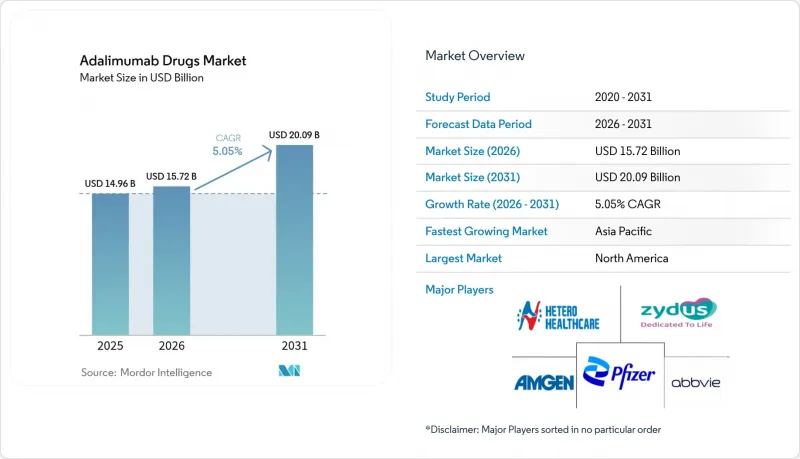
This report is Segmented by Product Type (Biologics, Biosimilars), Indication (Rheumatoid Arthritis, Psoriatic Arthritis, Ankylosing Spondylitis, Crohn's Disease, Ulcerative Colitis, Plaque Psoriasis, and More), Distribution Channel (Hospital Pharmacies, Retail Pharmacies, Online Pharmacies), and Geography (North America, Europe, and More). The Market Forecasts are Provided in Terms of Value (USD).
Global Adalimumab Drugs Market Trends and Insights
Loss of Humira Exclusivity Spurring Biosimilar Launches
A synchronized wave of FDA approvals has placed 10+ biosimilars on U.S. shelves within eighteen months of Humira's patent cliff, cutting pre-rebate prices by up to 80% and tripling prescription volume for preferred biosimilars under major PBMs. Updated interchangeability guidance issued in June 2024 shaved 18-24 months off development cycles, reducing capital requirements and lowering entry barriers. Simlandi secured first-to-market interchangeability for the high-concentration 40 mg/0.4 mL strength that covers 88% of U.S. dispenses, briefly restoring pricing leverage for its sponsors. Nevertheless, subsequent designations for Yuflyma and Hyrimoz eliminated this exclusivity buffer inside twelve months, intensifying price erosion. Parallel direct-purchase models-exemplified by Blue Shield of California's USD 525 monthly dose agreement-demonstrate purchaser appetite for bypassing PBM spreads.
Escalating Global Autoimmune Disease Prevalence
The global rheumatoid arthritis population is adding 2-3% annually, psoriasis cases have climbed 15% since 2020, and inflammatory bowel disease diagnoses in developing economies are rising by 5-7% per year. Increased disease surveillance, improved diagnostic imaging, and longer life expectancy collectively expand biologic-eligible cohorts. Long-term registries reveal 40-50% mortality reduction when TNF-a inhibitors are initiated early, reinforcing first-line biologic placement in treatment guidelines. Asia-Pacific's underdiagnosed patient pool is transitioning into treated prevalence as reimbursement reforms fund specialty care, unlocking substantive volume growth. Emerging indications such as non-infectious uveitis and juvenile idiopathic arthritis further widen usage scenarios, sustaining addressable demand despite competitive biologic classes.
Premium Pricing in Low-Income Markets
In many developing economies a single monthly adalimumab dose exceeds the average household income, leading to treatment discontinuation or complete non-initiation. Government drug budgets allocate under 5% to specialty pharmaceuticals, restricting coverage to a fraction of clinically eligible patients. Biosimilar manufacturing locally has yet to unlock meaningful discounts, with compliance overheads keeping unit costs at 60-70% of originator levels. Parallel import risks deter tiered-pricing schemes that could otherwise broaden affordability. Without structured health technology assessment pathways, reimbursement committees struggle to justify budget diversion toward biologics, elongating access latency and flattening uptake curves.
Other drivers and restraints analyzed in the detailed report include:
- Increasing Specialty-Pharmacy Penetration in the U.S.
- Patient-Friendly Autoinjector Upgrades Enhancing Adherence
- Cold-Chain Bottlenecks in Emerging Markets
For complete list of drivers and restraints, kindly check the Table Of Contents.
Segment Analysis
Biosimilars captured escalating volume yet Humira still held 67.62% adalimumab market share in 2025 thanks to entrenched physician preference programs and copay assistance. The vigorous 5.62% CAGR projected for biosimilars illustrates payer leverage following interchangeable approvals that authorize pharmacy-level substitution without prescriber intervention. Competitive focus centers on high-concentration, citrate-free formulations, the presentation that accounts for nearly nine in every ten U.S. injections. Simlandi's initial exclusivity window temporarily raised its net realized price, but follow-on entrants such as Yuflyma quickly nullified this premium, reinstating downward pricing momentum. Quallent Pharmaceuticals' private-label platform aggregates multisource supply, enabling employers to procure unbranded adalimumab at less than one-quarter of Humira's 2023 net price. On a global scale, unbranded biosimilars already account for 15-20% of adalimumab market size in large-payer tenders, signaling an irreversible commoditization trend.
Manufacturers pursue differentiation via device ecosystems and wrap-around patient services rather than molecular variance. Electromechanical reusable autoinjectors bundled with digital adherence monitoring offer tangible clinical benefits that justify modest price premiums over discount biosimilars lacking such integrations. AbbVie's strategic pivot toward novel mechanisms-most visibly IL-23 blockade with Skyrizi and JAK1 selectivity with Rinvoq-aims to protect franchise earnings as adalimumab revenue slides. Despite pipeline promise, cross-indication uptake of next-generation assets partially cannibalizes Humira demand, amplifying biosimilar growth headroom. Regulatory shifts that shorten approval timelines by nearly two years further embolden new entrants, ensuring sustained competitive churn through 2031.
Complete Report Scope:
- By Product Type
- Biologics (Humira)
- Biosimilars
- By Indication
- Rheumatoid Arthritis
- Psoriatic Arthritis
- Ankylosing Spondylitis
- Crohn's Disease
- Ulcerative Colitis
- Plaque Psoriasis
- Hidradenitis Suppurativa
- Juvenile Idiopathic Arthritis
- Uveitis
- Others
- By Distribution Channel
- Hospital Pharmacies
- Retail Pharmacies
- Online Pharmacies
- By Geography
- North America
- United States
- Canada
- Mexico
- Europe
- Germany
- United Kingdom
- France
- Italy
- Spain
- Rest of Europe
- Asia-Pacific
- China
- India
- Japan
- South Korea
- Australia
- Rest of Asia-Pacific
- South America
- Brazil
- Argentina
- Rest of South America
- Middle East and Africa
- GCC
- South Africa
- Rest of Middle East and Africa
- North America
Geography Analysis
North America generated 55.64% of 2025 revenue and remains the axis of competitive disruption owing to payer-driven biosimilar substitution rules. Four biosimilars now hold interchangeability status, introducing automatic pharmacy-level substitution and compressing brand loyalty cycles. Specialty-pharmacy proliferation ensures robust cold-chain stewardship and real-time clinical monitoring, supporting continued high biologic utilization despite intensified price negotiations. Yet transparency mandates and state-level reference-pricing bills apply incremental pressure on net-price realization, prompting manufacturers to refine contracting tactics around documented outcome guarantees.
Europe adopts sophisticated value-based arrangements, with health technology assessment agencies tying reimbursement to dermatology severity scale improvements or rheumatology composite scores. Tender-driven procurement has pushed biosimilar penetration above 25% in Germany, the Netherlands, and France, while Italy and Spain lag due to slower formulary updates. Physician reluctance to switch stable patients persists, though national switching mandates in Scandinavian states display adherence rates exceeding 85% within twelve months of policy enactment. Centralized regulatory reviews under the EMA's streamlined biosimilar pathway now permit dossier acceptance in as little as 150 days, shaving roughly one year off historic timelines.
Asia-Pacific records the highest regional growth at a 5.71% CAGR, fueled by rising middle-class insurance coverage and public tender reforms that favor domestically produced biosimilars. China's volume-based procurement rounds have slashed adalimumab prices by upward of 75%, igniting demand elasticity that offsets unit margin contraction. Japan's super-aged demographic underpins consistent baseline use, while Australia's Pharmaceutical Benefits Scheme guarantees predictable reimbursement cycles attractive to multinational suppliers. India exemplifies a dual-track market: urban tertiary centers exhibit adoption rates approaching OECD averages, whereas rural districts remain supply constrained by inadequate cold-chain infrastructure. Across Southeast Asia, coordinated ASEAN regulatory convergence aims to fast-track biosimilar approvals, potentially aligning national reviews within a two-year window and magnifying regional demand uplift.
- Abbvie
- Alvotech
- Amgen
- Bio-Thera Solutions Ltd.
- Biogen
- Boehringer Ingelheim Intl. GmbH
- Celltrion
- Coherus Biosciences
- Dr. Reddy's Laboratories Ltd.
- Fresenius
- Lupin
- Organon
- Pfizer
- Reliance Life Sciences Pvt. Ltd.
- Samsung Bioepis Co., Ltd.
- Sandoz Group AG
- Shanghai Henlius Biotech Inc.
- Stada Arzneimittel
- Viatris
- Zydus Lifesciences Ltd.
Additional Benefits:
- The market estimate (ME) sheet in Excel format
- 3 months of analyst support
TABLE OF CONTENTS
1 Introduction
- 1.1 Study Assumptions & Market Definition
- 1.2 Scope of the Study
2 Research Methodology
3 Executive Summary
4 Market Landscape
- 4.1 Market Overview
- 4.2 Market Drivers
- 4.2.1 Loss of Humira exclusivity spurring biosimilar launches
- 4.2.2 Escalating global autoimmune disease prevalence
- 4.2.3 Increasing specialty-pharmacy penetration in the U.S.
- 4.2.4 Patient-friendly autoinjector upgrades enhancing adherence
- 4.2.5 Value-based contracting gaining traction in Europe
- 4.2.6 Government tender reforms in Asia-Pacific boosting biosimilar uptake
- 4.3 Market Restraints
- 4.3.1 Premium pricing of biologics in low-income markets
- 4.3.2 Interchangeability hurdles for biosimilars in the U.S.
- 4.3.3 Cold-chain bottlenecks in emerging markets
- 4.3.4 Physician reluctance to switch stable patients in Asia-Pacific
- 4.4 Value / Supply-Chain Analysis
- 4.5 Regulatory Landscape
- 4.6 Technological Outlook
- 4.7 Porter's Five Forces
- 4.7.1 Bargaining Power of Buyers
- 4.7.2 Bargaining Power of Suppliers
- 4.7.3 Threat of New Entrants
- 4.7.4 Threat of Substitutes
- 4.7.5 Competitive Rivalry
5 Market Size & Growth Forecasts (Value)
- 5.1 By Product Type
- 5.1.1 Biologics (Humira)
- 5.1.2 Biosimilars
- 5.2 By Indication
- 5.2.1 Rheumatoid Arthritis
- 5.2.2 Psoriatic Arthritis
- 5.2.3 Ankylosing Spondylitis
- 5.2.4 Crohn's Disease
- 5.2.5 Ulcerative Colitis
- 5.2.6 Plaque Psoriasis
- 5.2.7 Hidradenitis Suppurativa
- 5.2.8 Juvenile Idiopathic Arthritis
- 5.2.9 Uveitis
- 5.2.10 Others
- 5.3 By Distribution Channel
- 5.3.1 Hospital Pharmacies
- 5.3.2 Retail Pharmacies
- 5.3.3 Online Pharmacies
- 5.4 By Geography
- 5.4.1 North America
- 5.4.1.1 United States
- 5.4.1.2 Canada
- 5.4.1.3 Mexico
- 5.4.2 Europe
- 5.4.2.1 Germany
- 5.4.2.2 United Kingdom
- 5.4.2.3 France
- 5.4.2.4 Italy
- 5.4.2.5 Spain
- 5.4.2.6 Rest of Europe
- 5.4.3 Asia-Pacific
- 5.4.3.1 China
- 5.4.3.2 India
- 5.4.3.3 Japan
- 5.4.3.4 South Korea
- 5.4.3.5 Australia
- 5.4.3.6 Rest of Asia-Pacific
- 5.4.4 South America
- 5.4.4.1 Brazil
- 5.4.4.2 Argentina
- 5.4.4.3 Rest of South America
- 5.4.5 Middle East and Africa
- 5.4.5.1 GCC
- 5.4.5.2 South Africa
- 5.4.5.3 Rest of Middle East and Africa
- 5.4.1 North America
6 Competitive Landscape
- 6.1 Market Concentration
- 6.2 Market Share Analysis
- 6.3 Company Profiles (includes Global level Overview, Market level overview, Core Segments, Financials as available, Strategic Information, Market Rank/Share for key companies, Products & Services, and Recent Developments)
- 6.3.1 AbbVie Inc.
- 6.3.2 Alvotech
- 6.3.3 Amgen Inc.
- 6.3.4 Bio-Thera Solutions Ltd.
- 6.3.5 Biogen Inc.
- 6.3.6 Boehringer Ingelheim Intl. GmbH
- 6.3.7 Celltrion Inc.
- 6.3.8 Coherus BioSciences, Inc.
- 6.3.9 Dr. Reddy's Laboratories Ltd.
- 6.3.10 Fresenius Kabi AG
- 6.3.11 Lupin Limited
- 6.3.12 Organon & Co.
- 6.3.13 Pfizer Inc.
- 6.3.14 Reliance Life Sciences Pvt. Ltd.
- 6.3.15 Samsung Bioepis Co., Ltd.
- 6.3.16 Sandoz Group AG
- 6.3.17 Shanghai Henlius Biotech Inc.
- 6.3.18 Stada Arzneimittel AG
- 6.3.19 Viatris Inc.
- 6.3.20 Zydus Lifesciences Ltd.
7 Market Opportunities & Future Outlook
- 7.1 White-space & Unmet-Need Assessment

