PUBLISHER: Mordor Intelligence | PRODUCT CODE: 2114676

PUBLISHER: Mordor Intelligence | PRODUCT CODE: 2114676
Contact Lens Solution - Market Share Analysis, Industry Trends & Statistics, Growth Forecasts (2026 - 2031)
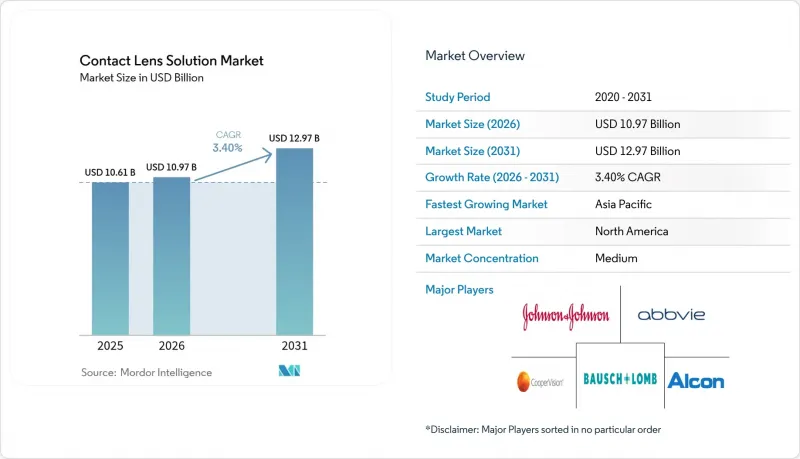
According to Mordor Intelligence, contact lens solution market size in 2026 is estimated at USD 10.97 billion, growing from 2025 value of USD 10.61 billion with 2031 projections showing USD 12.97 billion, growing at 3.4% CAGR over 2026-2031.
This report is Segmented by Solution Type (Multi-Purpose Solutions, Hydrogen-Peroxide Systems, and More), Contact-Lens Material (Silicone-Hydrogel Lenses, and More), Packaging Volume (<=120 ML, and More), Distribution Channel (Retail Pharmacies & Optical Stores, and More), and Geography (North America, Europe, Asia-Pacific, and More). The Market Forecasts are Provided in Terms of Value (USD).
Global Contact Lens Solution Market Trends and Insights
Growing Prevalence of Refractive Errors
Rising myopia, hyperopia, and astigmatism now account for 42% of vision impairment worldwide, a trend expected to place 4.7 billion people in need of correction by 2050. The United States alone is projected to reach 44.5 million myopic citizens by mid-century, with prevalence highest among African and Hispanic populations. This epidemiological momentum enlarges the contact lens solution market by expanding the wearer base and by spurring demand for formulations tailored to orthokeratology and myopia-control lenses that require enhanced protein removal. Education-linked myopia growth in emerging economies further tilts future consumption toward Asia-Pacific. As governments recognize myopia as a public-health challenge, reimbursement frameworks may broaden, lifting uptake of premium peroxide and specialty solutions.
Digital-Device-Linked Dry Eye Fueling Hygiene Product Sales
Nearly 70% of U.S. adults suffer digital eye strain, and 99% of symptomatic users actively seek relief, translating screen-time exposure into higher solution turnover and a surge in rewetting drops. Reduced blinking from prolonged device use destabilizes the tear film and accelerates lipid deposition on lenses, prompting more frequent cleaning cycles. A 2024 Bausch + Lomb survey found 75% of dry-eye sufferers regard symptoms as bothersome, yet many are unaware that lens-care products can alleviate discomfort. Manufacturers respond with moisture-rich formulas containing humectants and anti-inflammatory agents that specifically target digitally induced dryness, driving premiumization within the contact lens solution market.
Shift to No-Solution Daily Disposables
Daily disposable lenses eliminate the need for cleaning liquids and therefore divert spend away from the contact lens solution market. Brands position dailies as more hygienic and convenient, and clinical data confirm lower infection rates relative to reusable lenses. Scale economics are narrowing the cost gap, making daily disposables accessible to younger demographics who favor simplicity. As these cohorts mature, base-year demand for solutions could plateau unless care-fluid makers innovate around adjunct products such as rewetting drops and substrate-compatible cleaners for specialty
Other drivers and restraints analyzed in the detailed report include:
- Aging Population Demanding Safer Disinfection Regimes
- Regulatory Push Toward Preservative-Free Formulations
- Environmental Scrutiny of Single-Use Plastic Bottles
For complete list of drivers and restraints, kindly check the Table Of Contents.
Segment Analysis
Multi-purpose mixes controlled 62.42% of the contact lens solution market size in 2025 as the all-in-one proposition remains convenient for most wearers. Yet peroxide systems are riding a 6.33% CAGR to 2031 as practitioners favor their preservative-free profile and 99.9% antiviral efficacy.
Adoption accelerates in elder cohorts and in geographies with stringent sterility guidelines, pushing manufacturers to expand peroxide portfolios despite handling-time barriers. Meanwhile, protein remover tablets lose relevance as modern silicone-hydrogels resist deposits, and saline remains niche for rinsing. Market leaders bundle surfactant cleaners with peroxide kits to retain users within proprietary ecosystems, deepening brand loyalty in the contact lens solution market.
Silicone-hydrogel wearers generated 52.41% of solution demand in 2025, cementing the material's central role in driving formulation R&D. Rigid gas-permeable applications, while smaller, are growing 5.85% annually because orthokeratology lenses use specialized overnight care regimens that command premium liquids.
Solution chemists address silicone's lipid attraction by adding amphiphilic agents that lift oils without compromising lens hydrophilicity, while RGP fluids focus on high-viscosity wetting layers to maintain overnight comfort. Specialty scleral and drug-eluting materials create further micro-niches, widening the product matrix that sustains revenue growth in the contact lens solution market.
Complete Report Scope:
- By Solution Type
- Multi-purpose Solutions
- Hydrogen-Peroxide Systems
- Saline & Daily Cleaners
- Enzymatic Protein Removers
- Other Solution Types
- By Contact-Lens Material
- Silicone-Hydrogel Lenses
- Hydrogel / Soft Lenses
- Rigid Gas-Permeable (RGP)
- Others
- By Packaging Volume
- <=120 mL
- 121-300 mL
- >300 mL
- By Distribution Channel
- Retail Pharmacies & Optical Stores
- E-commerce Platforms
- Hospitals & Eye-Care Clinics
- By Geography
- North America
- United States
- Canada
- Mexico
- Europe
- Germany
- United Kingdom
- France
- Italy
- Spain
- Rest of Europe
- Asia-Pacific
- China
- Japan
- India
- Australia
- South Korea
- Rest of Asia-Pacific
- Middle East & Africa
- GCC
- South Africa
- Rest of Middle East & Africa
- South America
- Brazil
- Argentina
- Rest of South America
- North America
Geography Analysis
North America led with 37.62% market share in 2025, supported by clear FDA pathways, employer-based insurance, and high lens penetration. Growth moderates as daily disposables cannibalize multipurpose volumes, but peroxide upgrades cushion revenue. Canada mirrors U.S. regulatory frameworks, allowing cross-border supply optimization even amid currency swings.
Asia-Pacific drives the fastest 8.61% CAGR through 2031 on myopia's meteoric rise and a burgeoning middle class eager for premium eye-care products. China's pending 2027 NMPA reforms should expedite approvals, while Japan commands price premiums for specialty fluids compatible with drug-releasing lenses. India combines demographic youth with growing screen time, positioning it as a long-term demand node for moisture-rich solutions.
Europe posts stable mid-single-digit gains, navigating Medical Device Regulation complexities and the 2025/40 packaging law that forces bottle redesigns. Western markets are mature, yet Eastern Europe offers room for penetration as disposable incomes climb. The region serves as a test bed for recycled-content bottle innovation that could later diffuse to other regions, reinforcing Europe's strategic role in the global contact lens solution market.
- Alcon
- Bausch Health
- Johnson & Johnson Vision Care
- The Cooper Companies
- Menicon
- Abbvie
- Avizor
- Contamac
- Hoya Corp.
- Carl Zeiss
- FreshKon
- CLB Vision
- Oculus Optikgerate
- Clearlab
- OcuSoft
- Opti-Free (Alcon brand)
- Blink-N-Clean (J&J brand)
- PentaVision
- Progent (Menicon brand)
Additional Benefits:
- The market estimate (ME) sheet in Excel format
- 3 months of analyst support
TABLE OF CONTENTS
1 Introduction
- 1.1 Study Assumptions & Market Definition
- 1.2 Scope of the Study
2 Research Methodology
3 Executive Summary
4 Market Landscape
- 4.1 Market Overview
- 4.2 Market Drivers
- 4.2.1 Growing Prevalence of Refractive Errors
- 4.2.2 Digital-Device-Linked Dry-Eye Fueling Hygiene Product Sales
- 4.2.3 Aging Population Demanding Safer Disinfection Regimes
- 4.2.4 Regulatory Push Toward Preservative-Free Formulations
- 4.2.5 Drug-Releasing Soft Lenses Requiring Compat-ible Care Fluids
- 4.2.6 Rise in Daily-Disposable Lens Adoption Boosting Ancillary Purchases
- 4.3 Market Restraints
- 4.3.1 Shift To No-Solution Daily Disposables
- 4.3.2 Environmental Scrutiny of Single-Use Plastic
- 4.3.3 Bottles Growing Share of Ortho-K Overnight Lenses
- 4.3.4 Volatile Supply of Medical-Grade Hydrogen-Peroxide
- 4.4 Porter's Five Forces Analysis
- 4.4.1 Threat of New Entrants
- 4.4.2 Bargaining Power of Buyers
- 4.4.3 Bargaining Power of Suppliers
- 4.4.4 Threat of Substitutes
- 4.4.5 Intensity of Competitive Rivalry
5 Market Size & Growth Forecasts (Value in USD)
- 5.1 By Solution Type
- 5.1.1 Multi-purpose Solutions
- 5.1.2 Hydrogen-Peroxide Systems
- 5.1.3 Saline & Daily Cleaners
- 5.1.4 Enzymatic Protein Removers
- 5.1.5 Other Solution Types
- 5.2 By Contact-Lens Material
- 5.2.1 Silicone-Hydrogel Lenses
- 5.2.2 Hydrogel / Soft Lenses
- 5.2.3 Rigid Gas-Permeable (RGP)
- 5.2.4 Others
- 5.3 By Packaging Volume
- 5.3.1 <=120 mL
- 5.3.2 121-300 mL
- 5.3.3 >300 mL
- 5.4 By Distribution Channel
- 5.4.1 Retail Pharmacies & Optical Stores
- 5.4.2 E-commerce Platforms
- 5.4.3 Hospitals & Eye-Care Clinics
- 5.5 By Geography
- 5.5.1 North America
- 5.5.1.1 United States
- 5.5.1.2 Canada
- 5.5.1.3 Mexico
- 5.5.2 Europe
- 5.5.2.1 Germany
- 5.5.2.2 United Kingdom
- 5.5.2.3 France
- 5.5.2.4 Italy
- 5.5.2.5 Spain
- 5.5.2.6 Rest of Europe
- 5.5.3 Asia-Pacific
- 5.5.3.1 China
- 5.5.3.2 Japan
- 5.5.3.3 India
- 5.5.3.4 Australia
- 5.5.3.5 South Korea
- 5.5.3.6 Rest of Asia-Pacific
- 5.5.4 Middle East & Africa
- 5.5.4.1 GCC
- 5.5.4.2 South Africa
- 5.5.4.3 Rest of Middle East & Africa
- 5.5.5 South America
- 5.5.5.1 Brazil
- 5.5.5.2 Argentina
- 5.5.5.3 Rest of South America
- 5.5.1 North America
6 Competitive Landscape
- 6.1 Market Concentration
- 6.2 Market Share Analysis
- 6.3 Company Profiles (includes Global level Overview, Market-level Overview, Core Segments, Financials, Strategic Information, Market Rank/Share, Products & Services, Recent Developments)
- 6.3.1 Alcon
- 6.3.2 Bausch & Lomb Incorporated
- 6.3.3 Johnson & Johnson Vision Care
- 6.3.4 CooperVision, Inc.
- 6.3.5 Menicon
- 6.3.6 Allergan (AbbVie)
- 6.3.7 Avizor
- 6.3.8 Contamac
- 6.3.9 Hoya Corp.
- 6.3.10 Carl Zeiss Meditec
- 6.3.11 FreshKon
- 6.3.12 CLB Vision
- 6.3.13 Oculus Optikgerate
- 6.3.14 Clearlab
- 6.3.15 OcuSoft
- 6.3.16 Opti-Free (Alcon brand)
- 6.3.17 Blink-N-Clean (J&J brand)
- 6.3.18 PentaVision
- 6.3.19 Progent (Menicon brand)
7 Market Opportunities & Future Outlook
- 7.1 White-Space & Unmet-Need Assessment

