PUBLISHER: Mordor Intelligence | PRODUCT CODE: 2114677

PUBLISHER: Mordor Intelligence | PRODUCT CODE: 2114677
Male Hypogonadism - Market Share Analysis, Industry Trends & Statistics, Growth Forecasts (2026 - 2031)
According to Mordor Intelligence, male hypogonadism market size in 2026 is estimated at USD 3.58 billion, growing from 2025 value of USD 3.41 billion with 2031 projections showing USD 4.54 billion, growing at 4.86% CAGR over 2026-2031.
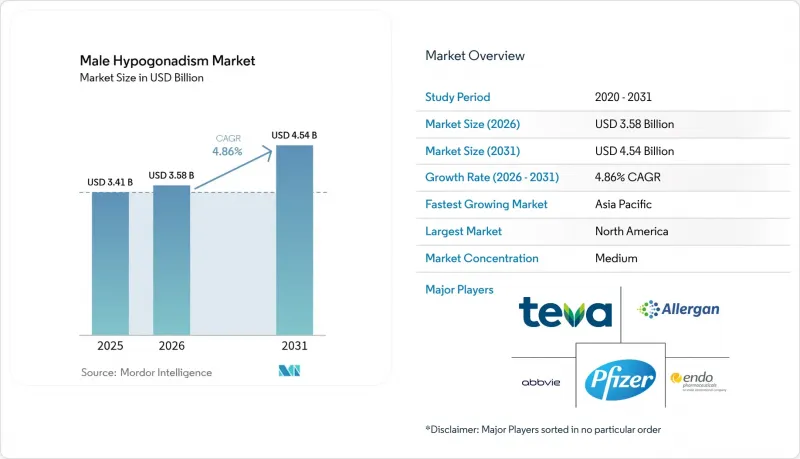
This report is Segmented by Therapy Type (Testosterone Replacement Therapy, Gonadotropin-Releasing Hormone Therapy), Route of Administration (Injectable, Oral, Others), Application (Kallmann Syndrome, Klinefelter's Syndrome, Pituitary Disorders, Other Applications), and Geography (North America, Europe, Asia-Pacific, and More). The Market Forecasts are Provided in Terms of Value (USD).
Global Male Hypogonadism Market Trends and Insights
Rising Global Prevalence of Testosterone-Deficiency Diagnoses
Automated free-testosterone assays cleared in 2025 report results in 48 minutes and improve detection accuracy in obese patients with low sex-hormone-binding globulin . Clear diagnostic algorithms and wider physician training reduce historical under-screening, raising the number of confirmed cases. Payers now view early therapy as cost-effective because untreated hypogonadism drives metabolic and cardiovascular comorbidities. As screening becomes routine for men over 40, the diagnosed population feeding into the male hypogonadism market keeps enlarging.
Rapid Uptake of Long-Acting Injectable & Oral Testosterone Formulations
Oral testosterone undecanoate normalizes hormone levels in 87.8% of patients without dose titration. Subcutaneous autoinjectors such as Xyosted simplify self-administration, cut clinic visits, and reduce injection-site reactions. Long-acting intramuscular products given every 10-14 weeks stabilize serum curves and improve adherence. Firms owning advanced delivery patents-Antares Pharma alone holds 26 U.S. autoinjector patents valid through 2038-protect pricing power and sustain expansion. These innovations underpin volume growth across all mature regions of the male hypogonadism market.
Cardio-vascular & Prostate-Cancer Safety Concerns
The TRAVERSE trial met non-inferiority on major cardiac events, leading to February 2025 FDA label updates, yet higher pulmonary embolism and atrial-fibrillation signals require continued blood-pressure surveillance . European regulators still recommend conservative use until more long-term outcomes surface . Mandatory prostate screening raises patient costs and perceptions of risk, tempering uptake in otherwise eligible populations and dampening near-term male hypogonadism market growth.
Other drivers and restraints analyzed in the detailed report include:
- Growing Use of Tele-Endocrinology & Direct-to-Consumer Online Pharmacies
- Ageing/Obesity Co-Morbidity Funnel Enlarging the Treatable Pool
- Stringent US & EU REMS / Controlled-Substance Regulations
For complete list of drivers and restraints, kindly check the Table Of Contents.
Segment Analysis
Testosterone replacement therapy commanded 80.57% of 2025 revenue, reinforcing its status as the first-line option for most etiologies. Injectables, patches, gels, and newly approved oral capsules anchor broad clinical familiarity, giving TRT a scale advantage within the male hypogonadism market. Gonadotropin-releasing hormone (GnRH) therapy, however, is advancing at a 5.42% CAGR on the appeal of fertility preservation in younger men.
Combination regimens that pair TRT with hCG or GnRH are gaining academic interest for optimizing spermatogenesis and symptom relief. Military research showing testosterone undecanoate's efficacy in extreme-stress environments opens a path for performance maintenance indications. Continued patent activity around micro-encapsulation and lymphatic-absorption enhancers is likely to shape competitive positioning and sustain mid-term growth across both categories in the male hypogonadism market.
Complete Report Scope:
- By Therapy Type
- Testosterone Replacement Therapy
- Gonadotropin-Releasing Hormone Therapy
- Human Chorionic Gonadotropin (hCG)
- Follicle-Stimulating Hormone (FSH)
- Gonadotropin-Releasing Hormone (GnRH)
- Other Gonadotropin Therapies
- By Route of Administration
- Injectable
- Oral
- Others
- By Application
- Kallmann Syndrome
- Klinefelter's Syndrome
- Pituitary Disorders
- Other Applications
- By Geography
- North America
- United States
- Canada
- Mexico
- Europe
- Germany
- United Kingdom
- France
- Italy
- Spain
- Rest of Europe
- Asia-Pacific
- China
- Japan
- India
- Australia
- South Korea
- Rest of Asia-Pacific
- Middle East and Africa
- GCC
- South Africa
- Rest of Middle East and Africa
- South America
- Brazil
- Argentina
- Rest of South America
- North America
Geography Analysis
North America generated 40.79% of global sales in 2025 on the back of generous insurance coverage, telehealth penetration, and the post-label-change rebound in testosterone prescribing. The United States alone saw prescription volumes triple versus 2014 baselines, illustrating how regulatory clarity and digital health infrastructure accelerate therapy uptake. Cannibalization of older topical formulations by autoinjectors and orals is underway yet additive to total dollars, supporting steady male hypogonadism market growth.
Europe displays balanced forward momentum as guideline harmonization and payer willingness to fund quality-of-life therapies offset more conservative cardiovascular safety positions. EMA monitoring frameworks emphasize confirmed biochemical deficiency before initiation, channeling volumes toward certified specialty clinics. Supply scarcities in select EU states sparked cross-border pharmacy transactions that, while temporary, showcased latent demand elasticity within the male hypogonadism market size.
Asia-Pacific is the fastest-rising region at a 5.55% CAGR through 2031. Aging populations in Japan, South Korea, and urban China, coupled with expanding obesity prevalence, create sizable addressable cohorts. Local launches of oral undecanoate products sidestep injection-related stigma, while national military-fitness programs amplify screening. Market penetration remains low in tier-2 cities, leaving ample runway for future expansion of the male hypogonadism market.
- Abbvie
- Bayer
- Endo International
- Pfizer
- Teva Pharmaceutical Industries
- Eli Lilly and Company
- Ferring Pharmaceuticals
- Sun Pharmaceuticals Industries
- Merck
- Abbvie
- Clarus Therapeutics
- Antares Pharma
- Lupin
- Sandoz ( Novartis AG )
- Mylan N.V. (Viatris)
- Acerus Pharmaceuticals
- Upsher-Smith Laboratories
- Besins Healthcare
- Aspen Pharmacare
- Endocrine Technologies, Inc.
- Theramex
Additional Benefits:
- The market estimate (ME) sheet in Excel format
- 3 months of analyst support
TABLE OF CONTENTS
1 Introduction
- 1.1 Study Assumptions & Market Definition
- 1.2 Scope of the Study
2 Research Methodology
3 Executive Summary
4 Market Landscape
- 4.1 Market Overview
- 4.2 Market Drivers
- 4.2.1 Rising Global Prevalence Of Testosterone-Deficiency Diagnoses
- 4.2.2 Rapid Uptake Of Long-Acting Injectable & Oral Testosterone Formulations
- 4.2.3 Growing Use Of Tele-Endocrinology & Direct-To-Consumer (DTC) Online Pharmacies
- 4.2.4 Ageing/Obesity Co-Morbidity Funnel Enlarging The Treatable Pool
- 4.2.5 Payer Shift Toward Covering Hypogonadism As A Quality-Of-Life Disorder
- 4.2.6 Military & Sports-Medicine Screening Programmes In Emerging Markets
- 4.3 Market Restraints
- 4.3.1 Cardio-Vascular & Prostate-Cancer Safety Concerns
- 4.3.2 Stringent US & EU REMS / Controlled-Substance Regulations
- 4.3.3 Supply Instability Of API Testosterone & Compounded Products
- 4.3.4 Social-Media-Driven OTC Misuse Prompting Tighter Oversight
- 4.4 Regulatory Landscape
- 4.5 Porter's Five Forces Analysis
- 4.5.1 Threat of New Entrants
- 4.5.2 Bargaining Power of Buyers
- 4.5.3 Bargaining Power of Suppliers
- 4.5.4 Threat of Substitutes
- 4.5.5 Intensity of Competitive Rivalry
5 Market Size & Growth Forecasts (Value, USD)
- 5.1 By Therapy Type
- 5.1.1 Testosterone Replacement Therapy
- 5.1.2 Gonadotropin-Releasing Hormone Therapy
- 5.1.2.1 Human Chorionic Gonadotropin (hCG)
- 5.1.2.2 Follicle-Stimulating Hormone (FSH)
- 5.1.2.3 Gonadotropin-Releasing Hormone (GnRH)
- 5.1.2.4 Other Gonadotropin Therapies
- 5.2 By Route of Administration
- 5.2.1 Injectable
- 5.2.2 Oral
- 5.2.3 Others
- 5.3 By Application
- 5.3.1 Kallmann Syndrome
- 5.3.2 Klinefelter's Syndrome
- 5.3.3 Pituitary Disorders
- 5.3.4 Other Applications
- 5.4 By Geography
- 5.4.1 North America
- 5.4.1.1 United States
- 5.4.1.2 Canada
- 5.4.1.3 Mexico
- 5.4.2 Europe
- 5.4.2.1 Germany
- 5.4.2.2 United Kingdom
- 5.4.2.3 France
- 5.4.2.4 Italy
- 5.4.2.5 Spain
- 5.4.2.6 Rest of Europe
- 5.4.3 Asia-Pacific
- 5.4.3.1 China
- 5.4.3.2 Japan
- 5.4.3.3 India
- 5.4.3.4 Australia
- 5.4.3.5 South Korea
- 5.4.3.6 Rest of Asia-Pacific
- 5.4.4 Middle East and Africa
- 5.4.4.1 GCC
- 5.4.4.2 South Africa
- 5.4.4.3 Rest of Middle East and Africa
- 5.4.5 South America
- 5.4.5.1 Brazil
- 5.4.5.2 Argentina
- 5.4.5.3 Rest of South America
- 5.4.1 North America
6 Competitive Landscape
- 6.1 Market Concentration
- 6.2 Market Share Analysis
- 6.3 Company Profiles (includes Global-level Overview, Market-level Overview, Core Segments, Financials, Strategic Info, Market Rank/Share, Products & Services, Recent Developments)
- 6.3.1 AbbVie Inc.
- 6.3.2 Bayer AG
- 6.3.3 Endo International plc
- 6.3.4 Pfizer Inc.
- 6.3.5 Teva Pharmaceutical Industries Ltd.
- 6.3.6 Eli Lilly and Company
- 6.3.7 Ferring Holding SA
- 6.3.8 Sun Pharmaceutical Industries Ltd.
- 6.3.9 Merck & Co., Inc.
- 6.3.10 Allergan plc
- 6.3.11 Clarus Therapeutics
- 6.3.12 Antares Pharma
- 6.3.13 Lupin Ltd.
- 6.3.14 Sandoz ( Novartis AG )
- 6.3.15 Mylan N.V. (Viatris)
- 6.3.16 Acerus Pharmaceuticals
- 6.3.17 Upsher-Smith Laboratories
- 6.3.18 Besins Healthcare
- 6.3.19 Aspen Pharmacare
- 6.3.20 Endocrine Technologies, Inc.
- 6.3.21 Theramex
7 Market Opportunities & Future Outlook
- 7.1 White-space & Unmet-Need Assessment

