PUBLISHER: Mordor Intelligence | PRODUCT CODE: 2114691

PUBLISHER: Mordor Intelligence | PRODUCT CODE: 2114691
Omega-3 Ingredients - Market Share Analysis, Industry Trends & Statistics, Growth Forecasts (2026 - 2031)
According to Mordor Intelligence, the omega-3 ingredients market size was valued at USD 3.12 billion in 2025 and estimated to grow from USD 3.46 billion in 2026 to reach USD 5.75 billion by 2031, at a CAGR of 10.74% during the forecast period (2026-2031).
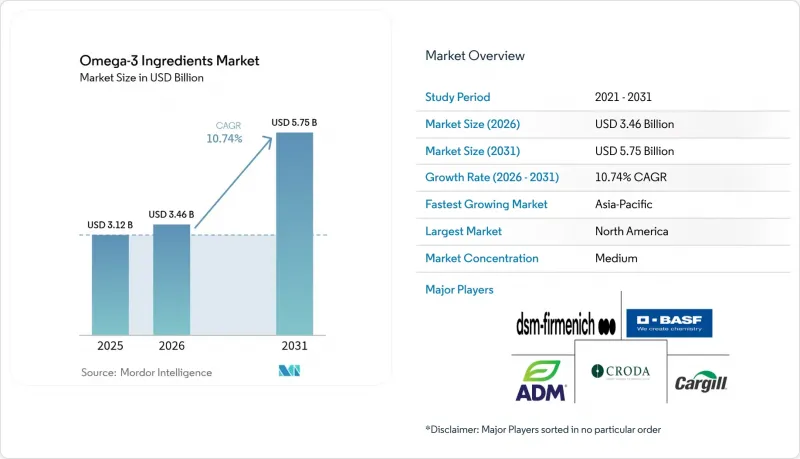
This report is Segmented by Source (Marine-Derived, Plant, and Algae-Derived), Form (Oil, Concentrates, Powder), Application (Dietary Supplements, Functional Food and Beverage, Infant Nutrition, and More), and Geography (North America, Europe, Asia-Pacific, South America, Middle East, and Africa). The Market Forecasts are Provided in Terms of Value (USD) and Volume(Tons).
Global Omega-3 Ingredients Market Trends and Insights
Rising Demand Driven by Aquaculture Industry
As aquaculture expands, demand surges for omega-3-rich feed ingredients, bolstering the global omega-3 market. Global fisheries and aquaculture production have reached record highs, with aquaculture now leading in aquatic output, and a growing share of that output is directed towards human consumption. This shift prompts ingredient manufacturers to adjust their production and sourcing strategies to meet the feed industry's evolving demands. In response, major producers of fish oil and algae-based omega-3s are increasing capacities, especially for high-purity EPA and DHA formulations crucial for aquafeeds. Feed developers prioritize these omega-3s, acknowledging their importance in enhancing fish health, growth performance, and nutritional quality. With limited growth in capture fisheries, omega-3 suppliers are adopting sustainable sourcing methods, like using fish-processing by-products and cultivating algae, to meet industry demands. The rapid growth of aquaculture in Asia, particularly in China and Southeast Asia, boosts demand for omega-3s, not only in animal feed but also in human nutrition. This trend highlights aquaculture's shift from a niche sector to a dominant force, reshaping the omega-3 market and spurring innovations in sustainable sourcing and global expansion.
Increasing Consumer Spending on Preventive Healthcare Products
As consumers increasingly prioritize preventive healthcare, the global omega-3 ingredients market is witnessing a surge. More individuals now view omega-3 supplementation as a proactive wellness measure rather than a mere afterthought. In 2024, for instance, Oziva Plant-Based Omega 369 made its debut, catering to wellness enthusiasts with its vegan omega-3s. This move underscores formulators' responsiveness to the rising demand for plant-based preventive nutrition. Similarly, Nordic Naturals Omega 3 expanded its offerings with new daily wellness capsules, spotlighting heart and brain health in tune with evolving consumer perspectives. Ingredient companies are also innovating, with FrieslandCampina Ingredients introducing micro-encapsulated omega-3 powders for bakery and dairy fortification, paving the way for omega-3s to be integrated into everyday foods beyond traditional capsules. The surge in omega-3 adoption aligns with broader trends in healthcare spending. In the United States, health expenditure increased by 7.5% in 2023 to USD 4.9 trillion, marking one of the highest growth rates since 2003 . This heightened focus on health investment underscores consumers' willingness to allocate resources toward preventive measures, including omega-3 supplementation. Digital health apps and personalized nutrition platforms are further propelling this trend, offering customized omega-3 plans linked to biomarker monitoring and cognitive health outcomes. Sustainability-focused brands are also driving market growth by promoting algae-derived DHA/EPA blends as premium preventive-health options.
High Cost of Production
Global market growth for omega-3 ingredients, especially those derived from algae and premium fish oils, is being hampered by high production costs. In 2023, numerous manufacturers of supplements and infant formulas encountered production delays, attributing them to costly algae oil inputs. This surge in costs not only inflated the prices of fortified formulations but also restricted their reach in mainstream markets. Ingredient suppliers grappled with heightened expenses stemming from microalgae cultivation and the sophisticated extraction and purification processes. These processes are essential to ensure stability, purity, and adherence to regulatory standards. For instance, industry players like DSM-Firmenich and Corbion underscored that while striving for high-purity DHA/EPA production, they faced a notable spike in manufacturing costs. This was due to their commitment to sustainability and clean-label standards. Such cost pressures inevitably reflect in the prices of end products. This scenario poses a challenge for smaller supplement brands and developers of functional foods, hindering their competitiveness and slowing their market penetration, especially in price-sensitive regions. As demand for omega-3 ingredients surges, the industry is confronted with the challenge of high production costs. This has led to a concerted effort to seek out technological innovations and alternative sourcing strategies, aiming to enhance scalability and affordability without sacrificing quality.
Other drivers and restraints analyzed in the detailed report include:
- Rising Demand for Omega-3 in Maternal Health, Pregnancy, and Child Development
- Sustainable Cultivation of Algal-Based Omega-3 Sources
- Environmental Concerns, Including Overfishing
For complete list of drivers and restraints, kindly check the Table Of Contents.
Segment Analysis
Marine-derived omega-3 ingredients command a dominant 80.20% share of the global market, bolstered by established supply chains and consumer familiarity with fish oil products. Anchovy-based omega-3, the frontrunner in the marine segment, benefits from Peru's robust fishing industry, consistently delivering high volumes of EPA and DHA oils for dietary supplements and functional foods worldwide. Industry giants like BASF and DSM invest heavily in sourcing and refining marine oils, guaranteeing quality for large-scale production. While salmon-derived oils find premium applications in nutraceuticals and clinical nutrition, cod liver oil maintains a niche in traditional Northern European markets, aligning with historical consumption patterns.
Algae-derived omega-3 ingredients, boasting a CAGR of 9.62%, emerge as the fastest-growing segment, propelled by sustainability concerns and regulatory pressures to safeguard marine ecosystems. Veramaris, for instance, has scaled up the commercial production of high-purity DHA oils, catering to both global supplements and infant nutrition markets. Leveraging green algae for its high DHA yields, producers are differentiating products in preventive health formulations. Meanwhile, red algae is being investigated for its unique fatty acid profiles, and brown algae offers a versatile EPA-DHA ratio for general supplementation. Producers like Corbion are adopting closed-loop cultivation systems, enhancing scalability and consistency, and addressing the seasonal and environmental challenges of marine sources. These innovations, paired with a surge in sustainability-driven consumer demand, are propelling the adoption of algae-based ingredients, further enriching the already established marine-dominated market.
Complete Report Scope:
- By Source
- Marine-derived
- Anchovy
- Cod Liver
- Menhaden
- Tuna
- Sardine
- Salmon
- Other Species
- Plant and Algae- Derived
- Green Algae
- Red Algae
- Brown Algae
- Blue-Green Algae
- Marine-derived
- By Form
- Oil
- Concentrates
- Powder
- By Application
- Dietary Supplements
- Functional Food and Beverage
- Infant Nutrition
- Clinical and Medical Nutrition
- Pharmaceuticals
- Pet Food and Animal Feed
- By Geography
- North America
- United States
- Canada
- Mexico
- Rest of North America
- Europe
- Germany
- United Kingdom
- Italy
- France
- Spain
- Netherlands
- Poland
- Belgium
- Sweden
- Rest of Europe
- Asia-Pacific
- China
- India
- Japan
- Australia
- Indonesia
- South Korea
- Thailand
- Singapore
- Rest of Asia-Pacific
- South America
- Brazil
- Argentina
- Colombia
- Chile
- Peru
- Rest of South America
- Middle East and Africa
- South Africa
- Saudi Arabia
- United Arab Emirates
- Nigeria
- Egypt
- Morocco
- Turkey
- Rest of Middle East and Africa
- North America
Geography Analysis
In 2025, North America commands a dominant 34.55% share of the global omega-3 ingredients market. This leadership is bolstered by mature regulatory frameworks, an advanced healthcare system, and a populace well-versed in health matters. Preventive healthcare practices are deeply ingrained in the region, with medical professionals widely endorsing omega-3 supplements as integral to dietary guidelines. In the U.S., FDA-sanctioned health claims, coupled with insurance backing for specific clinical applications, fuel robust demand in both consumer and clinical nutrition arenas. Meanwhile, Canada's efficient regulations on natural health products pave the way for innovative formulations and labeling. This enables firms to promote specialized omega-3 offerings, underscoring their validated health advantages.
Asia-Pacific is on a rapid ascent, projected to grow at a 9.62% CAGR through 2031. This surge is largely attributed to swift advancements in aquaculture and a burgeoning awareness of health among consumers. China is at the forefront, bolstering its aquaculture supply chain while nurturing a growing appetite for fortified foods and supplements. Japan, with its aging population, shows a pronounced preference for cognitive health products, driving steady demand for premium DHA formulations. Concurrently, India's burgeoning nutraceutical industry and robust pharmaceutical sector present lucrative avenues for cost-effective omega-3 production. Australia and Singapore are carving out roles as pivotal distribution and innovation centers for algae-derived omega-3s, signaling a regional pivot towards sustainable sourcing and localized production.
Regions like Europe, South America, and the Middle East and Africa are witnessing steady growth, albeit at a more tempered pace, influenced by varying regulatory landscapes and market maturity. Europe's market trajectory is shaped by the European Food Safety Authority's stringent quality benchmarks and a pronounced emphasis on sustainability, which in turn fuels algae-centric innovations. South America's advantage lies in its closeness to marine resources, notably Peru's anchovy fisheries. Countries like Brazil and Argentina are gradually amplifying domestic consumption, primarily through initiatives centered on fortified foods. In the Middle East and Africa, while public health initiatives and collaborations with global nutrition entities are broadening awareness and accessibility, the fragmented nature of distribution networks poses challenges to wider market reach.
- DSM-Firmenich
- BASF SE
- Croda International Plc
- Aker BioMarine ASA
- Cargill, Incorporated
- GC Rieber VivoMega AS
- Golden Omega S.A.
- KD Pharma Group SA
- Pelagia AS
- Polaris SA
- Stepan Company
- Corbion N.V.
- Archer Daniels Midland Company
- Veramaris Inc.
- Nufarm Limited
- Solutex GC SL
- Kerry Group Plc
- Fermentalg SAS
- Arctic Nutrition AS
- Novotech Nutraceuticals Inc.
Additional Benefits:
- The market estimate (ME) sheet in Excel format
- 3 months of analyst support
TABLE OF CONTENTS
1 INTRODUCTION
- 1.1 Study Assumptions and Market Definition
- 1.2 Scope of the Study
2 RESEARCH METHODOLOGY
3 EXECUTIVE SUMMARY
4 MARKET LANDSCAPE
- 4.1 Market Overview
- 4.2 Market Drivers
- 4.2.1 Rising Demand Driven by Aquaculture Industry
- 4.2.2 Increasing consumer spending on preventive healthcare products
- 4.2.3 Regulatory endorsements by governments for omega-3, including EPA and DHA
- 4.2.4 Rising demand for omega-3 in maternal health, pregnancy, and child development
- 4.2.5 Technological advancements in omega-3 extraction
- 4.2.6 Sustainable cultivation of algal-based omega-3 sources
- 4.3 Market Restraints
- 4.3.1 High cost of production
- 4.3.2 Environmental concerns, including overfishing
- 4.3.3 Raw material price fluctuation
- 4.3.4 Regulatory complexities and varying standards across regions
- 4.4 Supply Chain Analysis
- 4.5 Regulatory Landscape
- 4.6 Technological Outlook
- 4.7 Porter's Five Forces
- 4.7.1 Threat of New Entrants
- 4.7.2 Bargaining Power of Buyers/Consumers
- 4.7.3 Bargaining Power of Suppliers
- 4.7.4 Threat of Substitute Products
- 4.7.5 Intensity of Competitive Rivalry
5 MARKET SIZE AND GROWTH FORECASTS (VALUE/ VOLUME)
- 5.1 By Source
- 5.1.1 Marine-derived
- 5.1.1.1 Anchovy
- 5.1.1.2 Cod Liver
- 5.1.1.3 Menhaden
- 5.1.1.4 Tuna
- 5.1.1.5 Sardine
- 5.1.1.6 Salmon
- 5.1.1.7 Other Species
- 5.1.2 Plant and Algae- Derived
- 5.1.2.1 Green Algae
- 5.1.2.2 Red Algae
- 5.1.2.3 Brown Algae
- 5.1.2.4 Blue-Green Algae
- 5.1.1 Marine-derived
- 5.2 By Form
- 5.2.1 Oil
- 5.2.2 Concentrates
- 5.2.3 Powder
- 5.3 By Application
- 5.3.1 Dietary Supplements
- 5.3.2 Functional Food and Beverage
- 5.3.3 Infant Nutrition
- 5.3.4 Clinical and Medical Nutrition
- 5.3.5 Pharmaceuticals
- 5.3.6 Pet Food and Animal Feed
- 5.4 By Geography
- 5.4.1 North America
- 5.4.1.1 United States
- 5.4.1.2 Canada
- 5.4.1.3 Mexico
- 5.4.1.4 Rest of North America
- 5.4.2 Europe
- 5.4.2.1 Germany
- 5.4.2.2 United Kingdom
- 5.4.2.3 Italy
- 5.4.2.4 France
- 5.4.2.5 Spain
- 5.4.2.6 Netherlands
- 5.4.2.7 Poland
- 5.4.2.8 Belgium
- 5.4.2.9 Sweden
- 5.4.2.10 Rest of Europe
- 5.4.3 Asia-Pacific
- 5.4.3.1 China
- 5.4.3.2 India
- 5.4.3.3 Japan
- 5.4.3.4 Australia
- 5.4.3.5 Indonesia
- 5.4.3.6 South Korea
- 5.4.3.7 Thailand
- 5.4.3.8 Singapore
- 5.4.3.9 Rest of Asia-Pacific
- 5.4.4 South America
- 5.4.4.1 Brazil
- 5.4.4.2 Argentina
- 5.4.4.3 Colombia
- 5.4.4.4 Chile
- 5.4.4.5 Peru
- 5.4.4.6 Rest of South America
- 5.4.5 Middle East and Africa
- 5.4.5.1 South Africa
- 5.4.5.2 Saudi Arabia
- 5.4.5.3 United Arab Emirates
- 5.4.5.4 Nigeria
- 5.4.5.5 Egypt
- 5.4.5.6 Morocco
- 5.4.5.7 Turkey
- 5.4.5.8 Rest of Middle East and Africa
- 5.4.1 North America
6 COMPETITIVE LANDSCAPE
- 6.1 Market Concentration
- 6.2 Strategic Moves
- 6.3 Market Share Analysis
- 6.4 Company Profiles (includes Global level Overview, Market level overview, Core Segments, Financials as available, Strategic Information, Market Rank/Share for key companies, Products and Services, and Recent Developments)
- 6.4.1 DSM-Firmenich
- 6.4.2 BASF SE
- 6.4.3 Croda International Plc
- 6.4.4 Aker BioMarine ASA
- 6.4.5 Cargill, Incorporated
- 6.4.6 GC Rieber VivoMega AS
- 6.4.7 Golden Omega S.A.
- 6.4.8 KD Pharma Group SA
- 6.4.9 Pelagia AS
- 6.4.10 Polaris SA
- 6.4.11 Stepan Company
- 6.4.12 Corbion N.V.
- 6.4.13 Archer Daniels Midland Company
- 6.4.14 Veramaris Inc.
- 6.4.15 Nufarm Limited
- 6.4.16 Solutex GC SL
- 6.4.17 Kerry Group Plc
- 6.4.18 Fermentalg SAS
- 6.4.19 Arctic Nutrition AS
- 6.4.20 Novotech Nutraceuticals Inc.
7 MARKET OPPORTUNITIES AND FUTURE OUTLOOK

