PUBLISHER: Mordor Intelligence | PRODUCT CODE: 2122876

PUBLISHER: Mordor Intelligence | PRODUCT CODE: 2122876
Middle East And Africa Omega-3 Products - Market Share Analysis, Industry Trends & Statistics, Growth Forecasts (2026 - 2031)
According to Mordor Intelligence, the Middle East and Africa Omega-3 products market size was valued at USD 568.76 million in 2025 and is estimated to grow from USD 603.56 million in 2026 to reach USD 954.12 million by 2031, registering a compound annual growth rate (CAGR) of 9.59% during 2026-2031.
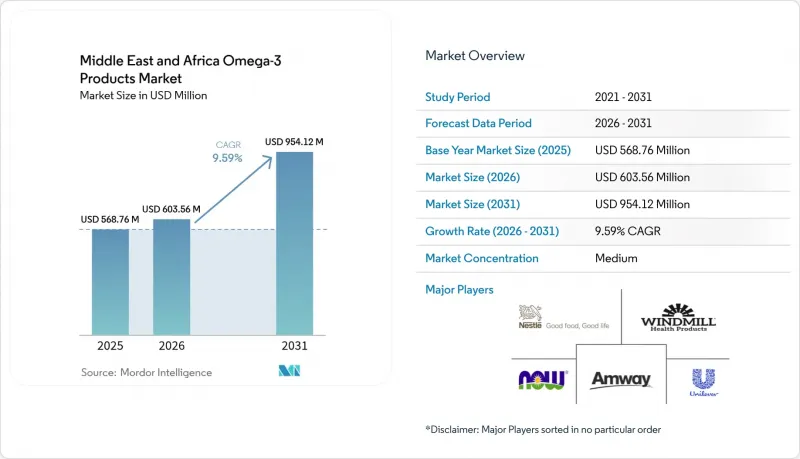
This report is Segmented by Product Type (Dietary Supplements, Functional Food and Beverages, Infant Nutrition, and More), Source (Marine-Based, Plant-Based, Algae-Based), Distribution Channel (Hypermarkets/Supermarkets, Health Stores, Online Retail, and More), and Geography (South Africa, Saudi Arabia, Nigeria, Egypt, and More). Market Forecasts are Provided in Value (USD Million).
Middle East And Africa Omega-3 Products Market Trends and Insights
Expansion of algae-based fermentation for vegan omega-3 supply
The expansion of algae-based fermentation for vegan omega-3 production is becoming a significant driver in the Middle East and Africa omega-3 products market. This method offers a stable, non-marine source of DHA and EPA, aligning with regional dietary preferences and sustainability objectives. Cultivating microalgae in controlled fermentation tanks eliminates issues associated with fish-derived sources, such as odors, heavy-metal contamination, and dependence on marine resources. This makes algal-based omega-3 suitable for halal, vegetarian, and clean-label formulations, which are in high demand in Gulf countries and urban African markets. Local nutraceutical companies and contract manufacturers are increasingly utilizing algal oil to produce plant-based capsules, gummies, and fortified foods. Additionally, international suppliers are collaborating with regional distributors to reduce reliance on imported fish oil. The technology enables year-round production in arid climates, where aquaculture supply chains are limited, thereby improving product availability. This has encouraged brands to introduce vegan prenatal, pediatric, and lifestyle supplements, expanding the consumer base for omega-3 products in the region.
Growing incidence of cardiovascular and lipid disorders
The rising prevalence of cardiovascular and lipid disorders is a key driver of the Middle East and Africa omega-3 products market. Healthcare professionals are increasingly recommending EPA and DHA intake to aid in triglyceride management and support overall heart health. High incidences of hypertension, obesity, and dyslipidemia in Gulf countries and urban African populations have prompted physicians, cardiology clinics, and pharmacies to promote omega-3 capsules as part of long-term wellness strategies rather than short-term supplementation. Consequently, consumers are incorporating daily fish oil or algal oil products into preventive care routines, alongside dietary modifications and medical treatments. This medical endorsement has enhanced trust in the efficacy of omega-3 products, driving demand for both prescription-adjacent nutraceuticals and over-the-counter heart-health supplements across the region. According to the 2024 Health Determinants Statistics Publication by The General Authority for Statistics (GASTAT) for Saudi Arabia, the obesity rate among individuals aged 15 and above is 23.1%, while 45.1% of this age group are classified as overweight. Furthermore, the prevalence of obesity among children aged 2 to 14 years is 14.6%, with 33.3% of children in this age group being overweight.
Volatile fish oil prices increasing raw material costs
Volatile fish oil prices, which increase raw material costs, serve as a restraint on the Middle East and Africa omega-3 products market. This is primarily because most regional manufacturers depend heavily on imported marine oils. Fluctuations in global fish catches, climate conditions, and shipping expenses often drive up input costs, compelling supplement brands to either raise retail prices or accept reduced profit margins. Higher retail prices can deter regular consumption in price-sensitive markets, limiting market penetration beyond urban areas. Additionally, procurement uncertainties complicate long-term contracts for softgel and fortified food producers, delaying product launches and making companies hesitant to expand their omega-3 product portfolios.
Other drivers and restraints analyzed in the detailed report include:
- Premium supplement offerings using high-strength fish oils
- Aging population driving higher demand for omega-3 supplements
- Import and labeling inconsistencies across GCC markets
For complete list of drivers and restraints, kindly check the Table Of Contents.
Segment Analysis
Dietary supplements accounted for 55.63% of the market share in 2025; however, functional foods and beverages are projected to grow at a CAGR of 11.77% through 2031. The demand for omega-3 supplements in the Middle East and Africa is driven by increasing preventive healthcare practices, with consumers regularly using capsules or syrups to support heart, brain, and joint health. Medical professionals, including doctors and pharmacists, often recommend EPA and DHA for managing triglyceride levels and maintaining cognitive function, enhancing product credibility and encouraging repeat purchases. The growth of sports nutrition and the active-aging population further promotes daily consumption for recovery and mobility support. Additionally, halal-certified, odor-controlled, and plant-based algal formulations have broadened the appeal of these products to a more diverse consumer base. Furthermore, the expansion of e-commerce pharmacies and cross-border supplement retail has improved access to international brands, facilitating adoption even in areas beyond major metropolitan centers.
Omega-3 functional foods and beverages are gaining traction in the region as consumers increasingly prefer incorporating nutrition into their daily diets rather than relying on separate supplements. Products such as dairy items, bakery goods, and ready-to-drink beverages enriched with DHA are becoming more popular due to their convenience and suitability for consumption by all age groups, particularly children and pregnant women. Government nutrition guidelines promoting early-life brain development have encouraged the fortification of milk and cereals. Additionally, clean-label trends are driving manufacturers to use algal oil as an alternative to marine-derived ingredients. Supermarkets and modern retail chains are dedicating more shelf space to fortified staples, making omega-3 intake a routine part of daily eating habits rather than a specialized or medicinal purchase.
Complete Report Scope:
- By Product Type
- Dietary Supplements
- Functional Food and Beverages
- Infant Nutrition
- Pharmaceuticals
- Others
- By Source
- Marine-Based
- Fish
- Krill
- Others
- Plant-Based
- Algae-Based
- Marine-Based
- By Distribution Channel
- Hypermarkets/Supermarkets
- Health Stores
- Online Retail Channel
- Other Distribution Channels
- Geography
- South Africa
- Saudi Arabia
- United Arab Emirates
- Nigeria
- Egypt
- Morocco
- Turkey
- Rest of Middle East and Africa
List of Companies Covered in this Report:
- BASF SE
- DSM-Firmenich
- Croda International Plc
- GC Rieber VivoMega
- Golden Omega
- Epax Norway
- Cargill Health Technologies
- Orkla Health
- Abbott Laboratories
- Amway Nutrilite
- Herbalife Nutrition
- Unilever PLC
- NOW Health Group, Inc.
- Windmill Health Products
- Nestle SA
- Reckitt (Mead Johnson EnfaDHA)
- Seven Seas Ltd.
- Nuseed Nutriterra
- Polaris SAS
- KD Pharma Group
Additional Benefits:
- The market estimate (ME) sheet in Excel format
- 3 months of analyst support
TABLE OF CONTENTS
1 INTRODUCTION
- 1.1 Study Assumptions and Market Definition
- 1.2 Scope of the Study
2 RESEARCH METHODOLOGY
3 EXECUTIVE SUMMARY
4 MARKET LANDSCAPE
- 4.1 Market Overview
- 4.2 Market Drivers
- 4.2.1 Increase in fortified food and beverage launches by global brands
- 4.2.2 Government-supported DHA fortification in prenatal and infant nutrition
- 4.2.3 Expansion of algae-based fermentation for vegan omega-3 supply
- 4.2.4 Growing incidence of cardiovascular and lipid disorders
- 4.2.5 Premium supplement offerings using high-strength fish oils
- 4.2.6 Aging population driving higher demand for omega-3 supplements
- 4.3 Market Restraints
- 4.3.1 Volatile fish oil prices increasing raw material costs
- 4.3.2 Import and labeling inconsistencies across GCC markets
- 4.3.3 Consumer shift to lower-cost alpha-linolenic acid (ALA) alternatives
- 4.3.4 Strict regulations for health claims and approvals
- 4.4 Supply Chain Analysis
- 4.5 Regulatory and Technological Outlook
- 4.6 Porter's Five Forces Analysis
- 4.6.1 Threat of New Entrants
- 4.6.2 Bargaining Power of Buyers
- 4.6.3 Bargaining Power of Suppliers
- 4.6.4 Threat of Substitutes
- 4.6.5 Intensity of Competitive Rivalry
5 MARKET SIZE AND GROWTH FORECAST (VALUE)
- 5.1 By Product Type
- 5.1.1 Dietary Supplements
- 5.1.2 Functional Food and Beverages
- 5.1.3 Infant Nutrition
- 5.1.4 Pharmaceuticals
- 5.1.5 Others
- 5.2 By Source
- 5.2.1 Marine-Based
- 5.2.1.1 Fish
- 5.2.1.2 Krill
- 5.2.1.3 Others
- 5.2.2 Plant-Based
- 5.2.3 Algae-Based
- 5.2.1 Marine-Based
- 5.3 By Distribution Channel
- 5.3.1 Hypermarkets/Supermarkets
- 5.3.2 Health Stores
- 5.3.3 Online Retail Channel
- 5.3.4 Other Distribution Channels
- 5.4 Geography
- 5.4.1 South Africa
- 5.4.2 Saudi Arabia
- 5.4.3 United Arab Emirates
- 5.4.4 Nigeria
- 5.4.5 Egypt
- 5.4.6 Morocco
- 5.4.7 Turkey
- 5.4.8 Rest of Middle East and Africa
6 COMPETITIVE LANDSCAPE
- 6.1 Most Adopted Strategies
- 6.2 Market Ranking Analysis
- 6.3 Company Profiles (includes Global level Overview, Market level overview, Core Segments, Financials (if available), Strategic Information, Market Rank for key companies, Products and, and Recent Developments)
- 6.3.1 BASF SE
- 6.3.2 DSM-Firmenich
- 6.3.3 Croda International Plc
- 6.3.4 GC Rieber VivoMega
- 6.3.5 Golden Omega
- 6.3.6 Epax Norway
- 6.3.7 Cargill Health Technologies
- 6.3.8 Orkla Health
- 6.3.9 Abbott Laboratories
- 6.3.10 Amway Nutrilite
- 6.3.11 Herbalife Nutrition
- 6.3.12 Unilever PLC
- 6.3.13 NOW Health Group, Inc.
- 6.3.14 Windmill Health Products
- 6.3.15 Nestle SA
- 6.3.16 Reckitt (Mead Johnson EnfaDHA)
- 6.3.17 Seven Seas Ltd.
- 6.3.18 Nuseed Nutriterra
- 6.3.19 Polaris SAS
- 6.3.20 KD Pharma Group
7 MARKET OPPORTUNITIES AND FUTURE OUTLOOK

