PUBLISHER: Mordor Intelligence | PRODUCT CODE: 2114699

PUBLISHER: Mordor Intelligence | PRODUCT CODE: 2114699
Cutter Staplers - Market Share Analysis, Industry Trends & Statistics, Growth Forecasts (2026 - 2031)
According to Mordor Intelligence, the cutter staplers market size is expected to grow from USD 2.14 billion in 2025 to USD 2.31 billion in 2026 and is forecast to reach USD 3.35 billion by 2031 at 7.74% CAGR over 2026-2031.
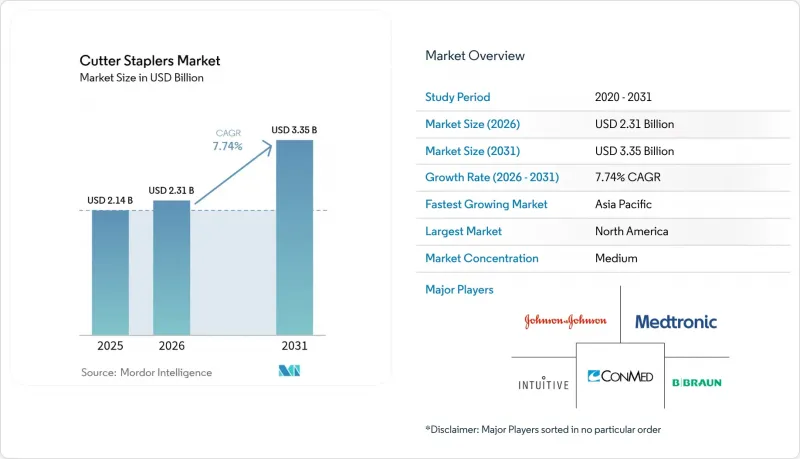
This report is Segmented by Product Type (Endo Cutter Stapler, Open Cutter Stapler, Others), Mechanism (Manual, Powered), Surgical Approach (Open Surgery, Minimally Invasive Surgery), Usability (Disposable, Reusable), End-User (Hospitals, Ambulatory Surgical Centers, Other End-Users), and Geography (North America, Europe, Asia-Pacific, and More). The Market Forecasts are Provided in Terms of Value (USD).
Global Cutter Staplers Market Trends and Insights
Growing Adoption of Minimally Invasive Surgery
Laparoscopic techniques now dominate many specialties, with appendicectomy utilization rising from 83% to 95% between 2013 and 2022 in advanced markets. Surgeons prefer staplers over sutures because staple lines reduce tissue trauma and accelerate recovery. Powered platforms trim thoracic operating time by 21 minutes and save USD 8,249 per case, strengthening the economic argument. Robotics magnifies this benefit, demonstrated by FDA-cleared single-port staplers that resolve access limitations. Curriculum changes in residency programs reinforce device familiarity, cementing long-term growth prospects for the cutter staplers market.
Rise in Bariatric & Metabolic Surgeries
United States bariatric volumes climbed 6.5% from 2021 to 2022, surpassing 280,000 procedures. Sleeve gastrectomy now constitutes 57.4% of cases, standardizing stapler needs around gastric transection. Robot-assisted workflows, which already represent 30% of metabolic surgeries, demand staplers tailored to robotic articulation. Manufacturers profit from economies of scale as procedure uniformity allows high-volume reload production. With eligible surgical candidates treated at only 1%, the cutter staplers market retains vast expansion runway as payer approvals broaden.
Infection Risks & Product Recalls
The FDA logged more than 41,000 stapler-related adverse events between 2011 and 2018, including 366 deaths. Recent Class I recalls, such as Covidien's TriStaple 2.0 Black reload, underscore manufacturing vulnerabilities. Hidden malfunction reports stored in non-public databases erode clinician confidence and complicate purchasing decisions. Pending Class II requirements mandate pre-market submissions and performance testing, favoring companies with robust design-control systems. Market leaders channel R&D funds toward redundant safety sensors and user-alert features to rebuild trust.
Other drivers and restraints analyzed in the detailed report include:
- Technological Advances in Powered & Articulating Staplers
- Shift Toward Outpatient GI Stapling in ASCs
- Alternative Closure Technologies
For complete list of drivers and restraints, kindly check the Table Of Contents.
Segment Analysis
Endo cutter staplers accounted for 45.81% of the cutter staplers market share in 2025 and are scaling at an 7.92% CAGR as laparoscopic and robotic procedures proliferate. Their slim, articulating jaws navigate confined pelvic and thoracic spaces, making them indispensable in bariatric, colorectal, and thoracic oncology cases. Open cutters remain essential for trauma surgery where speed trumps port access, but volume growth is subdued due to declining open case mix. Specialized circular and custom staplers serve niche reconstructions such as low rectal anastomoses, maintaining modest but stable demand.
Manufacturers race to differentiate endo models through torque-controlled firing and adaptive compression. Intuitive Surgical's SP SureForm 45 integrates SmartFire sensors that adjust staple height 1,000 times per second, reducing leak risk. Johnson & Johnson data confirm a 47% leak reduction with the newest ECHELON Linear Cutter compared to previous generations. Hospitals value unified platforms that share reload colors and ergonomics across open and endo lines, simplifying staff training and inventory.
Manual devices held 62.55% of the cutter staplers market size in 2025, reflecting decades of clinical familiarity and lower upfront cost. Yet powered units post the fastest 8.64% CAGR as surgeons prioritize reproducible staple formation in thick or variable tissue. A Chinese health-economic study showed powered reloads reduced adverse event management costs by ¥1,653 per case, outweighing higher purchase price. This evidence accelerates hospital conversion in high-acuity disciplines.
R&D efforts center on grip-enhancing tip designs and stepper-motor firing that delivers uniform compression. Trials reveal 73% fewer hemostasis-related complications with powered ECHELON devices relative to manual equivalents. As robotic consoles expand, powered handles with hands-free attachment further appeal to surgeons seeking ergonomic relief during lengthy procedures. Manual staplers continue serving low-resource environments and uncomplicated resections, preserving a sizeable yet shrinking portion of the cutter staplers market.
Complete Report Scope:
- By Product Type
- Endo Cutter Stapler
- Open Cutter Stapler
- Others
- By Mechanism
- Manual
- Powered
- By Surgical Approach
- Open Surgery
- Minimally Invasive Surgery
- By Usability
- Disposable
- Reusable
- By End-User
- Hospitals
- Ambulatory Surgical Centers
- Other End-Users
- By Geography
- North America
- United States
- Canada
- Mexico
- Europe
- Germany
- United Kingdom
- France
- Italy
- Spain
- Rest of Europe
- Asia-Pacific
- China
- India
- Japan
- Australia
- South Korea
- Rest of Asia-Pacific
- Middle East and Africa
- GCC
- South Africa
- Rest of Middle East and Africa
- South America
- Brazil
- Argentina
- Rest of South America
- North America
Geography Analysis
North America generated 34.11% of global revenue in 2025, supported by mature reimbursement and early technology adoption. Regional CAGR of 7.15% hinges on continued conversion to powered reloads and the Class II regulatory shift favoring quality-driven suppliers. Hospital consolidation amplifies purchasing leverage, prompting vendors to package multi-year service plans and training.
Asia-Pacific records the swiftest 8.41% CAGR, reflecting investments in surgical infrastructure across China, India, and ASEAN states. India's medical device market is forecast at USD 50 billion by 2025, albeit 70% import-dependent, offering foreign manufacturers growth with appropriate price-tiering. China's localization policies encourage joint ventures and technology transfer, while Japan's hospitals prioritize premium-powered systems. Brazil, under ANVISA rules that accept certain US or EU approvals, streamlines entry for incumbents yet maintains stringent post-market audits.
Europe ranks second, with a 7.65% CAGR through 2031, propelled by aging demographics and evidence-based procurement. EU sustainability directives impose recycling targets that progressively influence single-use selection. Clinical societies publish guidance that emphasizes staple line integrity, raising the bar for post-market surveillance data. Suppliers fostering registries and real-world studies strengthen positioning. The Middle East and Africa lag but present pockets of demand aligned with national health insurance rollouts. Public tenders favor cost-effective reusable kits, compelling vendors to support regional refurbishing centers. Collectively, these dynamics ensure sustained global expansion for the cutter staplers market.
- B. Braun
- Changzhou Ankang Medical
- Ezisurg Medical Co., Ltd.
- Frankenman International Ltd.
- Intuitive Surgical
- Johnson & Johnson
- Lepu Medical
- Locamed
- Medtronic
- Meril Life Sciences
- Panther Healthcare
- Purple Surgical
- Reach Surgical Inc.
- Stryker
- Surkon Medical
- Teleflex
- Victor Medical Instruments
- Waston Medical Corporation
- WELLMEDHZ CO., LTD.
- Zhejiang Geyi Medical Instrument
Additional Benefits:
- The market estimate (ME) sheet in Excel format
- 3 months of analyst support
TABLE OF CONTENTS
1 Introduction
- 1.1 Study Assumptions & Market Definition
- 1.2 Scope of the Study
2 Research Methodology
3 Executive Summary
4 Market Landscape
- 4.1 Market Overview
- 4.2 Market Drivers
- 4.2.1 Growing Adoption of Minimally Invasive Surgery
- 4.2.2 Rise in Bariatric & Metabolic Surgeries
- 4.2.3 Technological Advances in Powered & Articulating Staplers
- 4.2.4 Shift Toward Outpatient GI Stapling in ASCs
- 4.2.5 Integration with Surgical Robotics Platforms
- 4.2.6 Demand for Reusable Staplers in Low-Resource Markets
- 4.3 Market Restraints
- 4.3.1 Infection Risks & Product Recalls
- 4.3.2 Alternative Closure Technologies
- 4.3.3 Titanium Price Volatility
- 4.3.4 Sustainability-Driven Scrutiny on Single-Use Devices
- 4.4 Supply Chain Analysis
- 4.5 Regulatory Landscape
- 4.6 Technological Outlook
- 4.7 Porter's Five Forces Analysis
- 4.7.1 Threat of New Entrants
- 4.7.2 Bargaining Power of Buyers
- 4.7.3 Bargaining Power of Suppliers
- 4.7.4 Threat of Substitutes
- 4.7.5 Competitive Rivalry
5 Market Size & Growth Forecasts (Value)
- 5.1 By Product Type
- 5.1.1 Endo Cutter Stapler
- 5.1.2 Open Cutter Stapler
- 5.1.3 Others
- 5.2 By Mechanism
- 5.2.1 Manual
- 5.2.2 Powered
- 5.3 By Surgical Approach
- 5.3.1 Open Surgery
- 5.3.2 Minimally Invasive Surgery
- 5.4 By Usability
- 5.4.1 Disposable
- 5.4.2 Reusable
- 5.5 By End-User
- 5.5.1 Hospitals
- 5.5.2 Ambulatory Surgical Centers
- 5.5.3 Other End-Users
- 5.6 By Geography
- 5.6.1 North America
- 5.6.1.1 United States
- 5.6.1.2 Canada
- 5.6.1.3 Mexico
- 5.6.2 Europe
- 5.6.2.1 Germany
- 5.6.2.2 United Kingdom
- 5.6.2.3 France
- 5.6.2.4 Italy
- 5.6.2.5 Spain
- 5.6.2.6 Rest of Europe
- 5.6.3 Asia-Pacific
- 5.6.3.1 China
- 5.6.3.2 India
- 5.6.3.3 Japan
- 5.6.3.4 Australia
- 5.6.3.5 South Korea
- 5.6.3.6 Rest of Asia-Pacific
- 5.6.4 Middle East and Africa
- 5.6.4.1 GCC
- 5.6.4.2 South Africa
- 5.6.4.3 Rest of Middle East and Africa
- 5.6.5 South America
- 5.6.5.1 Brazil
- 5.6.5.2 Argentina
- 5.6.5.3 Rest of South America
- 5.6.1 North America
6 Competitive Landscape
- 6.1 Market Concentration
- 6.2 Competitive Benchmarking
- 6.3 Market Share Analysis
- 6.4 Company Profiles (includes Global level Overview, Market level overview, Core Segments, Financials as available, Strategic Information, Market Rank/Share for key companies, Products & Services, and Recent Developments)
- 6.4.1 B. Braun Melsungen AG
- 6.4.2 Changzhou Ankang Medical
- 6.4.3 Ezisurg Medical Co., Ltd.
- 6.4.4 Frankenman International Ltd.
- 6.4.5 Intuitive Surgical
- 6.4.6 Johnson & Johnson Services, Inc.
- 6.4.7 Lepu Medical
- 6.4.8 Locamed
- 6.4.9 Medtronic plc
- 6.4.10 Meril Life Sciences
- 6.4.11 Panther Healthcare
- 6.4.12 Purple Surgical
- 6.4.13 Reach Surgical Inc.
- 6.4.14 Stryker Corporation
- 6.4.15 Surkon Medical
- 6.4.16 Teleflex Incorporated
- 6.4.17 Victor Medical Instruments
- 6.4.18 Waston Medical Corporation
- 6.4.19 WELLMEDHZ CO., LTD.
- 6.4.20 Zhejiang Geyi Medical Instrument
7 Market Opportunities & Future Outlook
- 7.1 White-Space & Unmet-Need Assessment

