PUBLISHER: Mordor Intelligence | PRODUCT CODE: 2122598

PUBLISHER: Mordor Intelligence | PRODUCT CODE: 2122598
Surgical Stapler - Market Share Analysis, Industry Trends & Statistics, Growth Forecasts (2026 - 2031)
According to Mordor Intelligence, the surgical stapler market size was valued at USD 6.24 billion in 2025 and is estimated to grow from USD 6.68 billion in 2026 to reach USD 9.43 billion by 2031, at a CAGR of 7.15% during the forecast period (2026-2031).
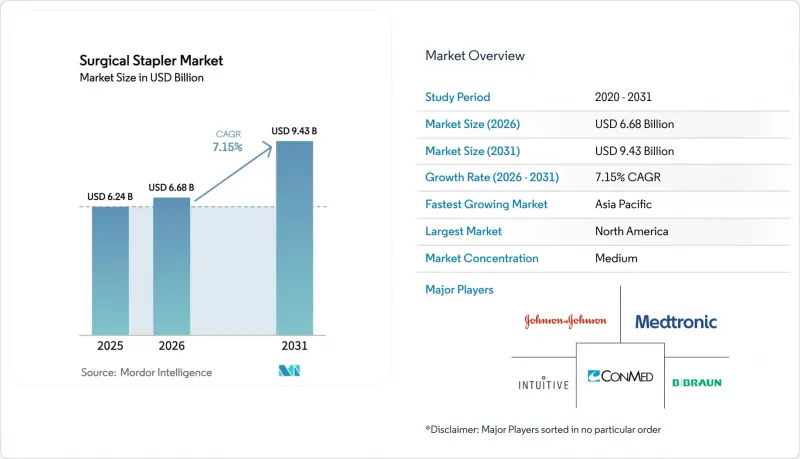
This report is Segmented by Product (Linear Stapler, Circular Stapler, and More), Mechanism (Manual, Powered), Usability (Disposable, Re-Usable), Application (Abdominal & Gastrointestinal Surgery, Bariatric & Metabolic Surgery, and More), End-User (Hospitals, and More), and Geography (North America, Europe, Asia-Pacific, and More). The Market Forecasts are Provided in Terms of Value (USD).
Global Surgical Stapler Market Trends and Insights
Integration With Robotic-Assisted Surgery Platforms
Robotic consoles anchor multi-year purchasing agreements that lock stapler demand into proprietary ecosystems. In April 2025, the SureForm 45 stapler received FDA clearance for exclusive use on da Vinci Xi and X systems, and instruments-and-accessories revenue climbed 19% in 2024 as utilization rose. Hospitals hesitate to introduce third-party staplers because compatibility alerts can void service contracts. Comparable strategies underlie Medtronic's Hugo platform and Ethicon's involvement in the Verb collaboration. Regulatory frameworks such as the FDA 510(k) pathway and the EU Medical Device Regulation add high documentation hurdles for every new instrument-platform pairing, reinforcing incumbent advantages. As a result, independent manufacturers face shrinking addressable volume unless they secure robotic partnerships or concentrate on open and laparoscopic niches.
Rapid Adoption of Powered and Reloadable Staplers
Powered devices bring motorized articulation that delivers uniform compression over thick or heterogeneous tissue. Ethicon's Echelon 4000, introduced in June 2025, shortened firing time significantly in sleeve-gastrectomy trials and lowered incomplete-staple events. Reloadable handles reduce per-case consumable cost significantly and support sustainability targets by limiting full-instrument disposal. Yet strict cleaning validation is mandatory to avoid biofilm accumulation, which deters smaller ASCs without automated reprocessing lines. European chemical-substances disclosure rules further raise compliance overhead, helping large manufacturers that already run comprehensive quality-management systems.
Other drivers and restraints analyzed in the detailed report include:
- Rising Preference for Minimally Invasive Procedures
- Hospital ESG Mandates Favoring Reusable Cartridge Systems
- Next-Gen Bio-Adhesive Sealants Reducing Mechanical Stapling Need
- Concentrated Titanium Supply Volatility
For complete list of drivers and restraints, kindly check the Table Of Contents.
Segment Analysis
The laparoscopic segment is projected to advance at 8.82% CAGR, eclipsing linear devices that nonetheless maintained 39.8% share in 2025. Intuitive Surgical's 8 mm SureForm 30 brings colorectal resections through smaller ports, easing recovery times. Circular staplers, critical for end-to-end anastomoses, incorporate adaptive firing to shrink leak rates by 15-20%. Skin staplers face substitution by tissue adhesives that improve cosmesis in elective cases. Penetration of laparoscopic staplers into thoracic and bariatric indications positions this category as the largest contributor to incremental surgical stapler market revenue through 2031.
Low-acuity appendectomy and hernia repairs sustain demand for cost-sensitive linear devices in emerging nations. Yet where robotic consoles dominate, proprietary laparoscopic staplers lock hospitals into closed consumable ecosystems. The surgical stapler market size for laparoscopic systems is expected to approach USD 4 billion by 2031 as reimbursement favors minimally invasive approaches.
Powered systems are projected to generate a 7.44% CAGR through 2031, outpacing the overall surgical stapler market. Manual units still represented 63.2% of the market in 2025 because their lower purchase cost aligns with budget-constrained facilities. Powered devices such as Echelon 4000 feature motorized articulation that keeps compression uniform in tissue exceeding 15 mm thickness. The surgical stapler market share for manual models will erode as litigation concerns intensify; the FDA recorded thousands of misfire complaints attributable to variable hand force. Yet emerging economies that rely on capital-light acquisition strategies will maintain manual demand.
Robotic ecosystems amplify powered uptake. Intuitive Surgical's SureForm 45 integrates exclusively with da Vinci systems, illustrating how platform bundling anchors consumable sales. Start-ups lacking direct console access must therefore position manual or semi-powered lines where hospitals value cost savings over incremental precision. The surgical stapler industry continues to monitor ISO 13485 usability requirements, which raise entry thresholds for newcomers.
Complete Report Scope:
- By Product
- Linear Stapler
- Circular Stapler
- Laparoscopic (Endoscopic) Staplers
- Skin Stapler
- By Mechanism
- Manual
- Powered
- By Usability
- Disposable
- Re-usable
- By Application
- Abdominal & Gastrointestinal Surgery
- Bariatric & Metabolic Surgery
- Obstetrics & Gynecology
- Cardiac & Thoracic Surgery
- Orthopedic & Trauma
- Other Surgical Applications
- By End-User
- Hospitals
- Ambulatory Surgical Centres
- Specialty Clinics
- Geography
- North America
- United States
- Canada
- Mexico
- Europe
- Germany
- United Kingdom
- France
- Italy
- Spain
- Rest of Europe
- Asia-Pacific
- China
- Japan
- India
- Australia
- South Korea
- Rest of Asia-Pacific
- Middle East and Africa
- GCC
- South Africa
- Rest of Middle East and Africa
- South America
- Brazil
- Argentina
- Rest of South America
- North America
Geography Analysis
North America maintained a 39.4% share in 2025 through a large installed robotic base, premium pricing on powered devices, and well-funded malpractice coverage that rewards sensor-rich systems. The expansion of outpatient knee replacement eligibility in 2024 is shifting volumes to ASCs, compressing inpatient stapler spend but unlocking new disposable demand. Canada's single-payer negotiations and Mexico's medical-tourism niche create divergent sub-regional price points.
Asia-Pacific is projected to post the highest 8.31% CAGR to 2031. China hosts more than 100 domestic robotic-surgery manufacturers, and provincial tenders have reduced device pricing steeply. Local producers like Meril Life Sciences and Grena are leveraging cost advantages to gain share, forcing multinationals to localize production or cede volume. Japan's regulator subjects new staplers to lengthy clinical audits, moderating near-term growth but protecting established suppliers. India's dual structure of urban corporate hospitals and rural clinics results in simultaneous demand for powered and manual units.
Europe combines stringent ESG directives with aggressive price consolidation. The EU Medical Device Regulation enforces post-market surveillance that elevates compliance costs, while joint procurement initiatives aggregate buying power and pressure margins. Germany's diagnosis-related-group system values time-saving powered staplers, whereas U.K. hospitals weigh carbon-footprint metrics heavily in tender scoring. The Middle East and Africa remain early-stage, although Gulf Cooperation Council states fund premium robotic programs aimed at medical tourists. South America shows polarized adoption: public hospitals favor manual devices to manage budgets, while private institutions in Brazil and Chile introduce powered articulating heads for oncology and bariatric procedures.
- 3M (Solventum)
- B. Braun
- Becton Dickinson & Co.
- Conmed
- EziSurg Medical
- Frankenman International
- Grena
- Intuitive Surgical
- Johnson & Johnson
- Lexington Medical
- Medtronic
- Meril Life Sciences
- Purple Surgical
- Reach Surgical Inc.
- Smiths Group
- Standard Bariatrics
- Stryker
- Surgnova Healthcare
- Teleflex
- Zimmer Biomet
Additional Benefits:
- The market estimate (ME) sheet in Excel format
- 3 months of analyst support
TABLE OF CONTENTS
1 Introduction
- 1.1 Study Assumptions & Market Definition
- 1.2 Scope of the Study
2 Research Methodology
3 Executive Summary
4 Market Landscape
- 4.1 Market Overview
- 4.2 Market Drivers
- 4.2.1 Integration With Robotic-Assisted Surgery Platforms
- 4.2.2 Rapid Adoption of Powered & Reloadable Staplers
- 4.2.3 Rising Preference for Minimally Invasive Procedures
- 4.2.4 Hospital ESG Mandates Favoring Reusable Cartridge Systems
- 4.2.5 AI-Driven "Smart" Staplers Are Reducing Intraoperative Error.
- 4.2.6 Localized Titanium Additive-Manufacturing Cutting Logistics Cost 30 %+
- 4.3 Market Restraints
- 4.3.1 Next-Gen Bio-Adhesive Sealants Reduce the Need for Mechanical Stapling
- 4.3.2 Post-Operative Leakage & Infection Litigations
- 4.3.3 Concentrated Titanium Supply Volatility
- 4.3.4 Centralized Procurement in China & EU Slashing Asps 40 %+
- 4.4 Value / Supply-Chain Analysis
- 4.5 Regulatory Landscape
- 4.6 Technological Outlook
- 4.7 Porter's Five Forces
- 4.7.1 Bargaining Power of Buyers
- 4.7.2 Bargaining Power of Suppliers
- 4.7.3 Threat of New Entrants
- 4.7.4 Threat of Substitute Products
- 4.7.5 Intensity of Competitive Rivalry
5 Market Size & Growth Forecasts (Value)
- 5.1 By Product
- 5.1.1 Linear Stapler
- 5.1.2 Circular Stapler
- 5.1.3 Laparoscopic (Endoscopic) Staplers
- 5.1.4 Skin Stapler
- 5.2 By Mechanism
- 5.2.1 Manual
- 5.2.2 Powered
- 5.3 By Usability
- 5.3.1 Disposable
- 5.3.2 Re-usable
- 5.4 By Application
- 5.4.1 Abdominal & Gastrointestinal Surgery
- 5.4.2 Bariatric & Metabolic Surgery
- 5.4.3 Obstetrics & Gynecology
- 5.4.4 Cardiac & Thoracic Surgery
- 5.4.5 Orthopedic & Trauma
- 5.4.6 Other Surgical Applications
- 5.5 By End-User
- 5.5.1 Hospitals
- 5.5.2 Ambulatory Surgical Centres
- 5.5.3 Specialty Clinics
- 5.6 Geography
- 5.6.1 North America
- 5.6.1.1 United States
- 5.6.1.2 Canada
- 5.6.1.3 Mexico
- 5.6.2 Europe
- 5.6.2.1 Germany
- 5.6.2.2 United Kingdom
- 5.6.2.3 France
- 5.6.2.4 Italy
- 5.6.2.5 Spain
- 5.6.2.6 Rest of Europe
- 5.6.3 Asia-Pacific
- 5.6.3.1 China
- 5.6.3.2 Japan
- 5.6.3.3 India
- 5.6.3.4 Australia
- 5.6.3.5 South Korea
- 5.6.3.6 Rest of Asia-Pacific
- 5.6.4 Middle East and Africa
- 5.6.4.1 GCC
- 5.6.4.2 South Africa
- 5.6.4.3 Rest of Middle East and Africa
- 5.6.5 South America
- 5.6.5.1 Brazil
- 5.6.5.2 Argentina
- 5.6.5.3 Rest of South America
- 5.6.1 North America
6 Competitive Landscape
- 6.1 Market Concentration
- 6.2 Market Share Analysis
- 6.3 Company Profiles (includes Global level Overview, Market level overview, Core Segments, Financials as available, Strategic Information, Market Rank/Share for key companies, Products & Services, and Recent Developments)
- 6.3.1 3M (Solventum)
- 6.3.2 B. Braun Melsungen AG
- 6.3.3 Becton Dickinson & Co.
- 6.3.4 ConMed Corporation
- 6.3.5 EziSurg Medical
- 6.3.6 Frankenman International
- 6.3.7 Grena Ltd.
- 6.3.8 Intuitive Surgical Inc.
- 6.3.9 Johnson & Johnson (Ethicon)
- 6.3.10 Lexington Medical
- 6.3.11 Medtronic plc
- 6.3.12 Meril Life Sciences
- 6.3.13 Purple Surgical
- 6.3.14 Reach Surgical Inc.
- 6.3.15 Smith & Nephew plc
- 6.3.16 Standard Bariatrics
- 6.3.17 Stryker Corporation
- 6.3.18 Surgnova Healthcare
- 6.3.19 Teleflex Incorporated
- 6.3.20 Zimmer Biomet Holdings
7 Market Opportunities & Future Outlook
- 7.1 White-space & Unmet-Need Assessment

