PUBLISHER: Mordor Intelligence | PRODUCT CODE: 2114710

PUBLISHER: Mordor Intelligence | PRODUCT CODE: 2114710
Cerebrospinal Fluid Management - Market Share Analysis, Industry Trends & Statistics, Growth Forecasts (2026 - 2031)
According to Mordor Intelligence, the cerebrospinal fluid management market size was valued at USD 1.74 billion in 2025 and estimated to grow from USD 1.83 billion in 2026 to reach USD 2.36 billion by 2031, at a CAGR of 5.19% during the forecast period (2026-2031).
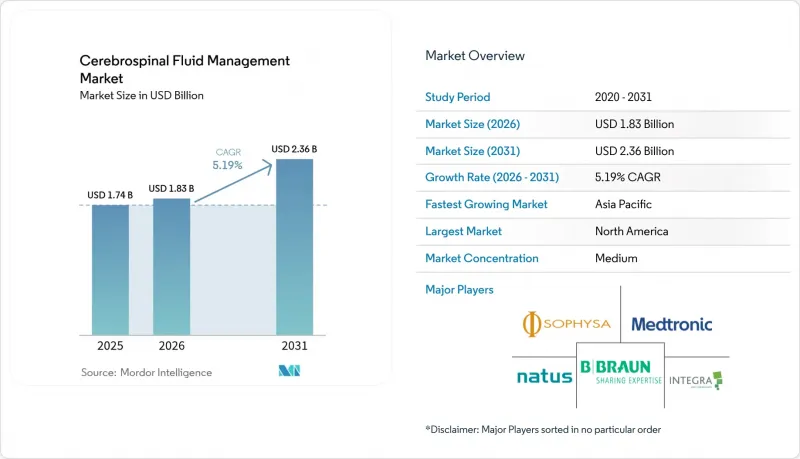
This report is Segmented by Product (Shunts, External Ventricular Drainage Systems, Intracranial Pressure Monitoring Devices, Accessories & Consumables), Patient Age Group (Pediatric 0-17 Yrs, Adult 18-64 Yrs, Geriatric 65+ Yrs), End User (Hospitals, and More), and Geography (North America, Europe, Asia-Pacific, and More). The Market Forecasts are Provided in Terms of Value (USD).
Global Cerebrospinal Fluid Management Market Trends and Insights
Increasing Burden of Hydrocephalus & Intracranial Hypertension
Globally, normal pressure hydrocephalus affects 1.5% of people aged 70 years, underscoring a large pool of undiagnosed candidates for intervention. The disease now encompasses glymphatic dysregulation and venous outflow disturbances, pushing clinicians toward multimodal monitoring approaches. In low- and middle-income regions, post-infectious etiologies still account for 10.7% of pediatric cases, creating region-specific product demand. Shunt infections cost a median USD 28,686 per episode, so payers increasingly endorse technologies that cut revision risk. Health systems have expanded screening and multidisciplinary clinics, yet unmet need remains significant, enabling steady expansion of the cerebrospinal fluid management market.
Growing Adoption of Minimally Invasive Neuro-Endoscopy & Shuntless ETV/CPC
Endoscopic third ventriculostomy with choroid plexus cauterization shows 76% 6-month success in multi-center cohorts. Infection rates drop markedly compared with shunting, and dependence on lifelong hardware is eliminated. In post-fetal myelomeningocele repair, ETV/CPC records 17% failure versus 86% for ventriculoperitoneal shunts, extending median time to failure to 17.5 months. Surgeons now leverage HD endoscopes and flexible instruments that broaden the eligible age window, though outcomes still hinge on operator training. With payers rewarding lower revision incidence, demand for endoscopic solutions is rising in the cerebrospinal fluid management market.
High Revision and Failure Rates of Traditional Shunt Systems
Failure approaches 40% within 12 months, largely due to blockage, infection, or disconnection. One pediatric center reported 31.2% total failures, with revision shunts faring worse than initial procedures. Each infection episode costs USD 28,686, and patients undergo an average of 10 lifetime revisions. Antibiotic-impregnated catheters now cut infection from 4.0% to 1.2%, yet mechanical occlusion persists as a dominant issue. ReFlow flushing catheters reduced revisions from 14 down to 1 over 4 years in early cohorts, offering partial relief.
Other drivers and restraints analyzed in the detailed report include:
- Advances in Smart Programmable Shunts with Telemetric ICP Monitoring
- Rising Geriatric Population Susceptible to Normal Pressure Hydrocephalus
- Lack of Neurosurgical Capacity in Low-Income Regions
For complete list of drivers and restraints, kindly check the Table Of Contents.
Segment Analysis
Shunts generated 65.25% of revenue in 2025, underscoring their entrenched role in cerebrospinal fluid diversion. Ventriculoperitoneal models lead volume demand, though adjustable valves are expanding quickest as clinicians prioritize non-surgical pressure tweaks. Intracranial pressure monitoring devices, growing at a 6.78% CAGR, are benefitting from bundled sales with programmable valves, thereby enlarging the overall cerebrospinal fluid management market. External ventricular drains continue as critical tools in trauma and post-infectious cases, supporting a steady accessories business for antibiotic-coated catheters.
Endovascular shunting concepts led by CereVasc aim to shorten hospital stays and enable outpatient implantation, but large-scale adoption hinges on pivotal trial outcomes. Accessories such as flushing adapters are creating preventive maintenance niches and could lengthen device lifecycles. The cerebrospinal fluid management market size for shunt consumables is expected to track the installed base, providing recurring revenue even as next-generation solutions emerge.
Complete Report Scope:
- By Product
- Shunts
- By Valve
- Adjustable Valve Shunts
- Monopressure / Fixed Valve Shunts
- By Type
- Ventriculoperitoneal (VP) Shunts
- Ventriculoatrial (VA) Shunts
- Lumboperitoneal (LP) Shunts
- Ventriculopleural (VPL) Shunts
- By Valve
- External Ventricular Drainage (EVD) Systems
- Intracranial Pressure (ICP) Monitoring Devices
- Accessories & Consumables
- Shunts
- By Patient Age Group
- Pediatric (0-17 yrs)
- Adult (18-64 yrs)
- Geriatric (65+ yrs)
- By End User
- Hospitals
- Ambulatory Surgical Centers
- Specialty Clinics & Neurology Centers
- By Geography
- North America
- United States
- Canada
- Mexico
- Europe
- Germany
- United Kingdom
- France
- Italy
- Spain
- Rest of Europe
- Asia-Pacific
- China
- Japan
- India
- Australia
- South Korea
- Rest of Asia-Pacific
- Middle East & Africa
- GCC
- South Africa
- Rest of Middle East & Africa
- South America
- Brazil
- Argentina
- Rest of South America
- North America
Geography Analysis
North America held 37.28% of 2025 revenue on the back of advanced reimbursement frameworks, dense neurosurgical networks, and early uptake of telemetric valves. The United States hosts multiple FDA breakthrough projects, accelerating introduction of next-generation implants and consolidating regional leadership in the cerebrospinal fluid management market. Canada benefits from universal coverage that funds shunt replacements but lags in AI diagnostic adoption.
Europe ranks second, with Germany exhibiting a 48% rise in normal pressure hydrocephalus diagnoses, signaling improved detection rather than incidence shift. National health systems finance programmable valves extensively, though procurement cycles favor multi-year tenders that can slow product refresh rates. United Kingdom centers are piloting outpatient ETV clinics, reinforcing the continent's tilt toward minimally invasive care.
Asia-Pacific is the fastest-growing region at 7.02% CAGR, driven by China's hospital expansion and Japan's rapid aging. Post-infectious hydrocephalus still burdens South and South-East Asia, sustaining demand for low-cost ventriculoperitoneal shunts. Simultaneously, high-income subregions like South Korea procure telemetric valves, broadening the regional cerebrospinal fluid management market. Government capacity-building programs that sponsor fellowship training are gradually reducing surgeon shortages.
Latin America shows moderate progress as Brazilian tertiary centers adopt antibiotic catheters, yet heterogeneous reimbursement limits uniform technology diffusion. Middle East and Africa face acute workforce scarcity, with Central Africa averaging one neurosurgeon per 2.2 million people. International aid missions, public-private partnerships, and low-cost device innovations are vital to expand access. Collective efforts are expected to narrow the treatment gap and spur incremental market growth.
- Medtronic
- B. Braun
- Integra LifeSciences Holdings Corp.
- Sophysa SA
- Natus Medical
- Aesculap Inc. (B. Braun)
- Spiegelberg
- Miethke GmbH & Co. KG
- Fuji Systems Corp.
- Moller Medical GmbH
- CereVasc Inc.
- Adeor Medical
- G. SURGIWEAR Ltd
- Phoenix Medical Systems
- DePuy Synthes
- Codman Neuro (Integra)
- Dispomedica GmbH
- Raumedic
- Tokibo Co., Ltd.
- Mindray Bio-Medical Electronics
Additional Benefits:
- The market estimate (ME) sheet in Excel format
- 3 months of analyst support
TABLE OF CONTENTS
1 Introduction
- 1.1 Study Assumptions & Market Definition
- 1.2 Scope of the Study
2 Research Methodology
3 Executive Summary
4 Market Landscape
- 4.1 Market Overview
- 4.2 Market Drivers
- 4.2.1 Increasing Burden of Hydrocephalus & Intracranial Hypertension
- 4.2.2 Growing Adoption of Minimally Invasive Neuro-Endoscopy & Shuntless ETV/CPC
- 4.2.3 Advances in Smart Programmable Shunts with Telemetric ICP Monitoring
- 4.2.4 Rising Geriatric Population Susceptible to Normal-Pressure Hydrocephalus
- 4.2.5 Expanding Reimbursement for CSF Diversion Procedures in Emerging Markets
- 4.2.6 Emerging Endovascular eShunt & Reflow Devices Reducing Revision Surgeries
- 4.3 Market Restraints
- 4.3.1 High Revision and Failure Rates of Traditional Shunt Systems
- 4.3.2 Lack of Neurosurgical Capacity in Low-Income Regions
- 4.3.3 Infection Risk Associated with External Ventricular Drainage
- 4.3.4 Supply-Chain Dependency on Silicone & Rare-Earth Magnets for Valve Assemblies
- 4.4 Porter's Five Forces Analysis
- 4.4.1 Threat of New Entrants
- 4.4.2 Bargaining Power of Buyers
- 4.4.3 Bargaining Power of Suppliers
- 4.4.4 Threat of Substitutes
- 4.4.5 Intensity of Competitive Rivalry
5 Market Size & Growth Forecasts (Value in USD)
- 5.1 By Product
- 5.1.1 Shunts
- 5.1.1.1 By Valve
- 5.1.1.1.1 Adjustable Valve Shunts
- 5.1.1.1.2 Monopressure / Fixed Valve Shunts
- 5.1.1.2 By Type
- 5.1.1.2.1 Ventriculoperitoneal (VP) Shunts
- 5.1.1.2.2 Ventriculoatrial (VA) Shunts
- 5.1.1.2.3 Lumboperitoneal (LP) Shunts
- 5.1.1.2.4 Ventriculopleural (VPL) Shunts
- 5.1.1.1 By Valve
- 5.1.2 External Ventricular Drainage (EVD) Systems
- 5.1.3 Intracranial Pressure (ICP) Monitoring Devices
- 5.1.4 Accessories & Consumables
- 5.1.1 Shunts
- 5.2 By Patient Age Group
- 5.2.1 Pediatric (0-17 yrs)
- 5.2.2 Adult (18-64 yrs)
- 5.2.3 Geriatric (65+ yrs)
- 5.3 By End User
- 5.3.1 Hospitals
- 5.3.2 Ambulatory Surgical Centers
- 5.3.3 Specialty Clinics & Neurology Centers
- 5.4 By Geography
- 5.4.1 North America
- 5.4.1.1 United States
- 5.4.1.2 Canada
- 5.4.1.3 Mexico
- 5.4.2 Europe
- 5.4.2.1 Germany
- 5.4.2.2 United Kingdom
- 5.4.2.3 France
- 5.4.2.4 Italy
- 5.4.2.5 Spain
- 5.4.2.6 Rest of Europe
- 5.4.3 Asia-Pacific
- 5.4.3.1 China
- 5.4.3.2 Japan
- 5.4.3.3 India
- 5.4.3.4 Australia
- 5.4.3.5 South Korea
- 5.4.3.6 Rest of Asia-Pacific
- 5.4.4 Middle East & Africa
- 5.4.4.1 GCC
- 5.4.4.2 South Africa
- 5.4.4.3 Rest of Middle East & Africa
- 5.4.5 South America
- 5.4.5.1 Brazil
- 5.4.5.2 Argentina
- 5.4.5.3 Rest of South America
- 5.4.1 North America
6 Competitive Landscape
- 6.1 Market Concentration
- 6.2 Market Share Analysis
- 6.3 Company Profiles (includes Global level Overview, Market level overview, Core Segments, Financials as available, Strategic Information, Market Rank/Share for key companies, Products & Services, and Recent Developments)
- 6.3.1 Medtronic
- 6.3.2 B. Braun Melsungen AG
- 6.3.3 Integra LifeSciences Holdings Corp.
- 6.3.4 Sophysa SA
- 6.3.5 Natus Medical Inc.
- 6.3.6 Aesculap Inc. (B. Braun)
- 6.3.7 Spiegelberg GmbH & Co. KG
- 6.3.8 Miethke GmbH & Co. KG
- 6.3.9 Fuji Systems Corp.
- 6.3.10 Moller Medical GmbH
- 6.3.11 CereVasc Inc.
- 6.3.12 Adeor Medical AG
- 6.3.13 G. SURGIWEAR Ltd
- 6.3.14 Phoenix Medical Systems Pvt Ltd
- 6.3.15 DePuy Synthes
- 6.3.16 Codman Neuro (Integra)
- 6.3.17 Dispomedica GmbH
- 6.3.18 Raumedic AG
- 6.3.19 Tokibo Co., Ltd.
- 6.3.20 Mindray Bio-Medical Electronics
7 Market Opportunities & Future Outlook
- 7.1 White-space & Unmet-need Assessment

