PUBLISHER: Mordor Intelligence | PRODUCT CODE: 2114716

PUBLISHER: Mordor Intelligence | PRODUCT CODE: 2114716
Anti-Slip Coatings - Market Share Analysis, Industry Trends & Statistics, Growth Forecasts (2026 - 2031)
According to Mordor Intelligence, the anti-slip coatings market size was valued at USD 172.81 million in 2025 and estimated to grow from USD 179.78 million in 2026 to reach USD 218.98 million by 2031, at a CAGR of 4.03% during the forecast period (2026-2031).
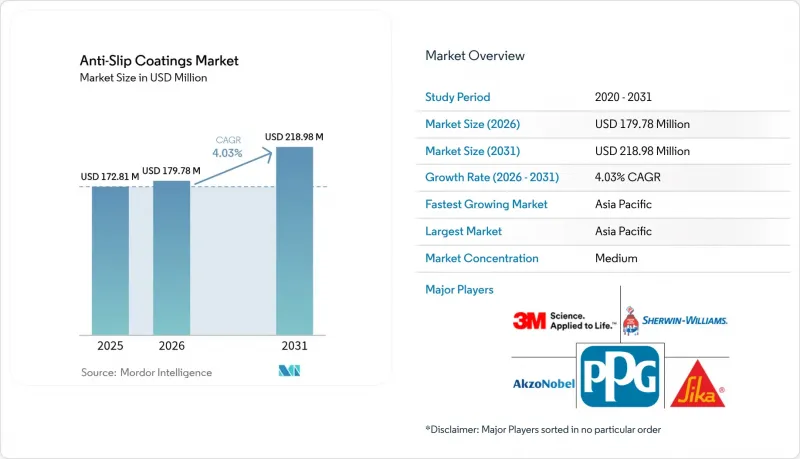
This report Segments the Industry by Resin Type (Epoxy, Polyurethane, Acrylic, and Other Resin Types), Technology (Water-Based, and Solvent-Based), Application (Residential, Commercial, Industrial, and Other Applications), and Geography (Asia-Pacific, North America, Europe, South America, and Middle East and Africa). The Market Forecasts are Provided in Terms of Value (USD).
Global Anti-Slip Coatings Market Trends and Insights
Expanding Use Across Smart & Automated Manufacturing Floors
Automated factories now specify flooring that can tolerate continual robotic traffic, rolling loads, and aggressive sanitation while preserving stable friction values. Plant engineers have found that many legacy epoxy finishes interfere with electromagnetic sensors or degrade after repeated peroxide clean-downs, leading to unscheduled shutdowns. Hybrid polyaspartic systems that pair slip resistance with electrostatic discharge protection are gaining favor because they cure rapidly and support full production restart within hours. In Asia-Pacific's electronics clusters, downtime costs have climbed sharply, making the incremental price of premium coatings less significant than the risk of line interruption. As a result, procurement teams increasingly reference preset "smart floor" performance templates that bundle anti-slip, ESD, and chemical-resistance metrics into a single specification.
Stricter Workplace-Safety Codes & Insurance Mandates
The Occupational Safety and Health Administration now issues penalties topping USD 15,000 per serious slip-and-fall breach, while insurers offer double-digit premium discounts to sites that install certified non-skid finishes. Settlement payouts of USD 50,000-100,000 per claim are common, so facility owners calculate that a USD 5-8 per ft2 coating expense pays for itself after averting even one incident. Safety auditors also require documented coefficient-of-friction testing, pushing demand for products that ship with certification packages. These compliance dynamics quickly convert optional upgrades into mandatory capital items, especially in retail chains and logistics centers that face heavy foot traffic.
Stringent Environment Regulations
The Environmental Protection Agency plans to restrict N-Methyl-2-pyrrolidone and several PFAS surfactants, compelling formulators to re-engineer legacy lines at a cost uptick of 15-25%. Water-based options solve VOC hurdles but sometimes need extra build coats, which lengthen installation schedules and raise labor invoices. Firms with deep R&D pipelines can absorb these transitions, whereas small regional suppliers may exit the market or become acquisition targets.
Other drivers and restraints analyzed in the detailed report include:
- Rising Retro-fit Demand from Aging Commercial Infrastructure
- Construction Boom in Asia-Pacific and Middle-East
- Raw-Material (Epoxy, PU) Price Volatility
For complete list of drivers and restraints, kindly check the Table Of Contents.
Segment Analysis
Epoxy finishes generated 43.62% of the anti-slip coatings market size for resin systems. They retain appeal because they bond tenaciously to concrete, endure chemicals, and accept varied aggregate blends that raise friction under wet oils. Yet, growth momentum is shifting toward other resin categories that deliver rapid return-to-service, lower temperature cure, or UV reliability that basic epoxies cannot match. Polyaspartic blends cure within two hours, letting automotive plants resume fork-truck routes before the next shift, while hybrid urethane-acrylic systems stretch enough to bridge micro-cracks in suspended slabs.
From 2026 to 2031, other resin types are projected to advance at a 4.74% CAGR, the highest among resin families. Hospitals and data centers prefer them because they emit ultra-low odor and release workers faster. Suppliers now bundle nonslip silica into pre-weighted cartridges, simplifying field ratios and reducing installer error. As specification writers value performance over commodity cost, niche resin innovators secure reference listings that were once the exclusive domain of epoxy giants, reshaping the competitive narrative inside the anti-slip coatings market.
Complete Report Scope:
- By Resin Type
- Epoxy
- Polyurethane
- Acrylic
- Other Resin Types (Polyaspartic, etc.)
- By Technology
- Water-based
- Solvent-based
- By Application
- Residential
- Commercial
- Industrial (Includes Marine)
- Other Applications (Transportation Infrastructure, Sports, Leisure)
- By Geography
- Asia-Pacific
- China
- India
- Japan
- South Korea
- Australia and New Zealand
- Rest of APAC
- North America
- United States
- Canada
- Mexico
- Europe
- Germany
- United Kingdom
- France
- Italy
- Russia
- Rest of Europe
- South America
- Brazil
- Argentina
- Rest of South America
- Middle East and Africa
- Saudi Arabia
- UAE
- South Africa
- Rest of Middle East and Africa
- Asia-Pacific
Geography Analysis
Asia-Pacific generated the largest regional revenue, leveraging a 44.35% share in 2025 and advancing at a 4.82% CAGR through 2031. Mass rail, semiconductor fab, and megahospital projects in China and India specify premium non-skid surfaces that integrate with automated guided vehicles. The Association of Southeast Asian Nations is standardizing safety codes in line with ISO friction norms, lifting baseline requirements, and pushing municipal tenders toward branded products.
North America trails in absolute size but benefits from extensive retrofit cycles across logistics warehouses, supermarkets, and healthcare campuses. Stringent OSHA enforcement and mid-western winter hazards keep demand resilient even during construction slowdowns. End users often bundle slip resistance with antimicrobial ratings, favoring hybrid chemistries that answer both criteria.
Europe maintains mature adoption levels driven by insurer stipulations, yet growth stems from heritage building upgrades where contractors seek breathable water-borne solutions that protect historic substrates. Middle Eastern and African markets remain smaller but display outsized growth rates as stadiums, metros, and tourism assets emerge. Specifications here emphasize UV durability and thermal shock resistance, giving polyurethane hybrids an edge.
- 3M
- Akzo Nobel N.V.
- Anti-Slip Anywhere
- Axalta Coating Systems, LLC
- FloorSlip Limited
- Flowcrete Group Ltd.
- Hempel A/S
- Henkel AG & Co. KGaA
- ICP Group
- Jotun
- Mapei S.p.A.
- Nippon Paint Marine Coatings Co., Ltd.
- PPG Industries Inc.
- Rust-Oleum Corporation
- Sika AG
- The Sherwin-Williams Company
Additional Benefits:
- The market estimate (ME) sheet in Excel format
- 3 months of analyst support
TABLE OF CONTENTS
1 Introduction
- 1.1 Study Assumptions and Market Definition
- 1.2 Scope of the Study
2 Research Methodology
3 Executive Summary
4 Market Landscape
- 4.1 Market Overview
- 4.2 Market Drivers
- 4.2.1 Expanding Use Across Smart and Automated Manufacturing Floors
- 4.2.2 Stricter Workplace-Safety Codes and Insurance Mandates
- 4.2.3 Rising Retro-Fit Demand from Aging Commercial Infrastructure
- 4.2.4 Construction Boom in Asia-Pacific and Middle-East
- 4.2.5 Anti-Slip Hybrid Coatings Gaining Healthcare Traction
- 4.3 Market Restraints
- 4.3.1 Stringent Environment Regulations
- 4.3.2 Raw-Material (Epoxy, PU) Price Volatility
- 4.3.3 Competition from Embedded Textured Flooring and Tapes
- 4.4 Value Chain Analysis
- 4.5 Porter's Five Forces
- 4.5.1 Threat of New Entrants
- 4.5.2 Bargaining Power of Buyers
- 4.5.3 Bargaining Power of Suppliers
- 4.5.4 Threat of Substitutes
- 4.5.5 Degree of Competition
5 Market Size and Growth Forecast
- 5.1 By Resin Type
- 5.1.1 Epoxy
- 5.1.2 Polyurethane
- 5.1.3 Acrylic
- 5.1.4 Other Resin Types (Polyaspartic, etc.)
- 5.2 By Technology
- 5.2.1 Water-based
- 5.2.2 Solvent-based
- 5.3 By Application
- 5.3.1 Residential
- 5.3.2 Commercial
- 5.3.3 Industrial (Includes Marine)
- 5.3.4 Other Applications (Transportation Infrastructure, Sports, Leisure)
- 5.4 By Geography
- 5.4.1 Asia-Pacific
- 5.4.1.1 China
- 5.4.1.2 India
- 5.4.1.3 Japan
- 5.4.1.4 South Korea
- 5.4.1.5 Australia and New Zealand
- 5.4.1.6 Rest of APAC
- 5.4.2 North America
- 5.4.2.1 United States
- 5.4.2.2 Canada
- 5.4.2.3 Mexico
- 5.4.3 Europe
- 5.4.3.1 Germany
- 5.4.3.2 United Kingdom
- 5.4.3.3 France
- 5.4.3.4 Italy
- 5.4.3.5 Russia
- 5.4.3.6 Rest of Europe
- 5.4.4 South America
- 5.4.4.1 Brazil
- 5.4.4.2 Argentina
- 5.4.4.3 Rest of South America
- 5.4.5 Middle East and Africa
- 5.4.5.1 Saudi Arabia
- 5.4.5.2 UAE
- 5.4.5.3 South Africa
- 5.4.5.4 Rest of Middle East and Africa
- 5.4.1 Asia-Pacific
6 Competitive Landscape
- 6.1 Market Concentration
- 6.2 Strategic Moves
- 6.3 Market Share(%)/Ranking Analysis
- 6.4 Company Profiles (includes Global level Overview, Market level overview, Core Segments, Financials as available, Strategic Information, Market Rank/Share, Products and Services, Recent Developments)
- 6.4.1 3M
- 6.4.2 Akzo Nobel N.V.
- 6.4.3 Anti-Slip Anywhere
- 6.4.4 Axalta Coating Systems, LLC
- 6.4.5 FloorSlip Limited
- 6.4.6 Flowcrete Group Ltd.
- 6.4.7 Hempel A/S
- 6.4.8 Henkel AG & Co. KGaA
- 6.4.9 ICP Group
- 6.4.10 Jotun
- 6.4.11 Mapei S.p.A.
- 6.4.12 Nippon Paint Marine Coatings Co., Ltd.
- 6.4.13 PPG Industries Inc.
- 6.4.14 Rust-Oleum Corporation
- 6.4.15 Sika AG
- 6.4.16 The Sherwin-Williams Company
7 Market Opportunities and Future Outlook
- 7.1 White-space and Unmet-Need Assessment
- 7.2 Development of High Efficient Anti-Slip Coatings

