PUBLISHER: Mordor Intelligence | PRODUCT CODE: 2124052

PUBLISHER: Mordor Intelligence | PRODUCT CODE: 2124052
Anti-slip Additives - Market Share Analysis, Industry Trends & Statistics, Growth Forecasts (2026 - 2031)
According to Mordor Intelligence, the anti-slip additives market size was valued at USD 477.96 million in 2025 and estimated to grow from USD 498.69 million in 2026 to reach USD 616.28 million by 2031, at a CAGR of 4.33% during the forecast period (2026-2031).
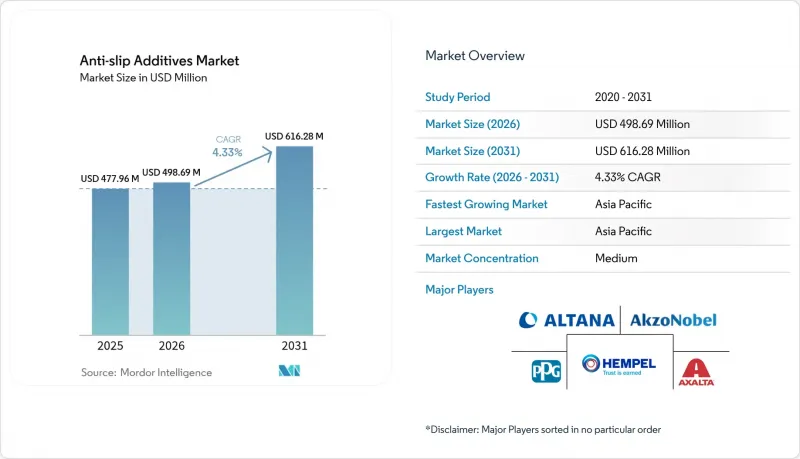
This report is Segmented by Additive Type (Aluminum Oxide, Silica, and Others), Additive Nature (Powder, Aggregate, and Mix), Application (Buildings and Construction, Industrial Flooring, Marine, and Others), and Geography (Asia-Pacific, North America, Europe, South America, and Middle-East and Africa). The Market Forecasts are Provided in Terms of Value (USD).
Global Anti-slip Additives Market Trends and Insights
Growing Demand for Industrial Flooring Safety
Slips, trips, and falls rank as the second-leading cause of workplace fatalities in general industry, prompting regulators to tighten surface-traction mandates. Rising workers' compensation premiums further encourage manufacturers to install high-performance coatings that sustain friction over the full maintenance cycle. In response, suppliers are engineering synthetic grains that embed evenly within epoxies or polyurethane screeds to achieve a balance of coefficient of friction and esthetic finish. End users increasingly integrate such solutions at the design stage rather than reacting to incidents, reflecting a wider shift toward risk-managed operations. As a result, industrial flooring remains the largest pull-through channel for the Anti-Slip Additives market.
Expansion of APAC Construction Sector
Aggressive infrastructure spending across China, India, and the ASEAN bloc is injecting steady volume into the Anti-Slip Additives market. Public procurement guidelines now specify slip-resistant pavement and transit concourse finishes, stimulating recurring orders for broadcast quartz and silica blends. Rapid urbanization raises pedestrian density, intensifying wear on floor surfaces and accelerating refurbishment cycles. Contractors value additives that disperse quickly in cementitious toppings and self-leveling mortars because jobsite timelines are compressed. Multinational owners of logistics hubs and regional manufacturing plants also impose global safety codes, multiplying addressable demand beyond classical public works. Consequently, Asia-Pacific simultaneously hosts the largest base and the fastest growth trajectory.
VOC and Hazardous-Substance Regulations
The US National AIM Rule fixes a 400 g/l VOC ceiling for floor coatings, while certain state codes enforce even tighter thresholds, compelling reformulation toward water-borne or 100% solid systems. European REACH and local PFAS phase-out directives add complexity, evidenced by Micro Powders' decision to terminate PTFE-based grades by end-2025. Compliance accelerates research and development expenditure and lengthens qualification cycles, especially for small and mid-size producers. Although regulation ultimately steers users toward cleaner chemistries, near-term uncertainty can defer capital projects, temporarily muting order flow in the Anti-Slip Additives market.
Other drivers and restraints analyzed in the detailed report include:
- Marine-Deck Safety Compliance
- Nanoparticle-Enabled Durability Upgrades
- Raw-Material Price Volatility
For complete list of drivers and restraints, kindly check the Table Of Contents.
Segment Analysis
Aluminum oxide held 47.25% revenue share in 2025, underscoring its entrenched status among plant engineers who prize hardness and abrasion resistance for fork-truck aisles and loading bays. The segment's maturity stems from proven field data and widespread distributor availability, giving purchasing managers confidence in predictable slip performance over multi-year maintenance cycles.
Yet silica is advancing at a market-leading 5.05% CAGR as precipitated and fumed variants leverage superior oil-absorption and low specific gravity to deliver the required surface profile at lower addition rates. PPG indicates that its precipitated silica can carry more than 40 times the weight of traditional bulking agents, translating into thinner yet efficient coatings. The shift also aligns with environmental preferences because silica grades typically exhibit benign regulatory profiles compared with certain metal oxides.
Complete Report Scope:
- By Additive Type
- Aluminum Oxide
- Silica
- Others
- By Additive Nature
- Powder
- Aggregate
- Mix
- By Application
- Buildings and Construction
- Industrial Flooring
- Marine
- Others
- By Geography
- Asia-Pacific
- China
- India
- Japan
- South Korea
- ASEAN
- Rest of Asia-Pacific
- North America
- United States
- Canada
- Mexico
- Europe
- Germany
- United Kingdom
- France
- Italy
- Spain
- Russia
- Rest of Europe
- South America
- Brazil
- Argentina
- Rest of South America
- Middle-East and Africa
- Saudi Arabia
- South Africa
- Rest of Middle-East and Africa
- Asia-Pacific
Geography Analysis
Asia-Pacific retained 56.62% revenue in 2025 and is forecast to expand at 4.62% CAGR, cementing its dual status as largest and fastest region. Surging investments in public infrastructure and mega-factory complexes anchor steady demand for floor coatings that integrate anti-slip powders at the batch stage.
North America and Europe each retain robust baseline demand anchored in regulatory discipline. The US National AIM Rule meshes with UL floor-slip testing to enforce low-VOC thresholds and friction certification. European directives require documented slip resistance in hospitals and rail terminals, steering specifiers toward certified coarse-texture systems. Although volume growth is slower, margin structures remain attractive because clients emphasize premium durability and environmental labels.
The Middle-East and Africa and South America deliver emerging upside. Gulf states' airport and offshore complex expansions specify non-skid walkways to mitigate heat-related surface smoothness. In South America, resource-driven economies invest in safer mineral-processing and port facilities, sustaining additive orders despite broader economic swings. Collectively, these regions inject diversification into the Anti-Slip Additives market, buffering suppliers against demand plateaus in mature territories.
- Akzo Nobel N.V.
- ALTANA
- Ampacet Corporation
- Arkema
- Associated Chemical
- Axalta Coating Systems, LLC
- BASF
- Evonik Industries AG
- Hempel A/S
- Jotun
- PPG Industries Inc.
- Pro Chem Inc.
- Rust-Oleum Corporation
- SAICOS COLOUR GmbH
- Sika AG
- The Sherwin-Williams Company
Additional Benefits:
- The market estimate (ME) sheet in Excel format
- 3 months of analyst support
TABLE OF CONTENTS
1 Introduction
- 1.1 Study Assumptions and Market Definition
- 1.2 Scope of the Study
2 Research Methodology
3 Executive Summary
4 Market Landscape
- 4.1 Market Overview
- 4.2 Market Drivers
- 4.2.1 Growing Demand for Industrial Flooring Safety
- 4.2.2 Expansion of APAC Construction Sector
- 4.2.3 Marine-Deck Safety Compliance
- 4.2.4 Nanoparticle-Enabled Durability Upgrades
- 4.2.5 Phase-Out of PFAS Drives Bio-Based Alternatives
- 4.3 Market Restraints
- 4.3.1 VOC and Hazardous-Substance Regulations
- 4.3.2 Raw-Material Price Volatility
- 4.3.3 Shift to Textured Polymer Flooring
- 4.4 Value Chain Analysis
- 4.5 Porter's Five Forces
- 4.5.1 Bargaining Power of Suppliers
- 4.5.2 Bargaining Power of Buyers
- 4.5.3 Threat of New Entrants
- 4.5.4 Threat of Substitutes
- 4.5.5 Degree of Competition
5 Market Size and Growth Forecasts (Value)
- 5.1 By Additive Type
- 5.1.1 Aluminum Oxide
- 5.1.2 Silica
- 5.1.3 Others
- 5.2 By Additive Nature
- 5.2.1 Powder
- 5.2.2 Aggregate
- 5.2.3 Mix
- 5.3 By Application
- 5.3.1 Buildings and Construction
- 5.3.2 Industrial Flooring
- 5.3.3 Marine
- 5.3.4 Others
- 5.4 By Geography
- 5.4.1 Asia-Pacific
- 5.4.1.1 China
- 5.4.1.2 India
- 5.4.1.3 Japan
- 5.4.1.4 South Korea
- 5.4.1.5 ASEAN
- 5.4.1.6 Rest of Asia-Pacific
- 5.4.2 North America
- 5.4.2.1 United States
- 5.4.2.2 Canada
- 5.4.2.3 Mexico
- 5.4.3 Europe
- 5.4.3.1 Germany
- 5.4.3.2 United Kingdom
- 5.4.3.3 France
- 5.4.3.4 Italy
- 5.4.3.5 Spain
- 5.4.3.6 Russia
- 5.4.3.7 Rest of Europe
- 5.4.4 South America
- 5.4.4.1 Brazil
- 5.4.4.2 Argentina
- 5.4.4.3 Rest of South America
- 5.4.5 Middle-East and Africa
- 5.4.5.1 Saudi Arabia
- 5.4.5.2 South Africa
- 5.4.5.3 Rest of Middle-East and Africa
- 5.4.1 Asia-Pacific
6 Competitive Landscape
- 6.1 Market Concentration
- 6.2 Strategic Moves
- 6.3 Market Share (%)/ Ranking Analysis
- 6.4 Company Profiles (includes Global level Overview, Market level overview, Core Segments, Financials as available, Strategic Information, Market Rank/Share for key companies, Products and Services, and Recent Developments)
- 6.4.1 Akzo Nobel N.V.
- 6.4.2 ALTANA
- 6.4.3 Ampacet Corporation
- 6.4.4 Arkema
- 6.4.5 Associated Chemical
- 6.4.6 Axalta Coating Systems, LLC
- 6.4.7 BASF
- 6.4.8 Evonik Industries AG
- 6.4.9 Hempel A/S
- 6.4.10 Jotun
- 6.4.11 PPG Industries Inc.
- 6.4.12 Pro Chem Inc.
- 6.4.13 Rust-Oleum Corporation
- 6.4.14 SAICOS COLOUR GmbH
- 6.4.15 Sika AG
- 6.4.16 The Sherwin-Williams Company
7 Market Opportunities and Future Outlook
- 7.1 White-space and Unmet-need Assessment

