PUBLISHER: Mordor Intelligence | PRODUCT CODE: 2114720

PUBLISHER: Mordor Intelligence | PRODUCT CODE: 2114720
Concrete Bonding Agent - Market Share Analysis, Industry Trends & Statistics, Growth Forecasts (2026 - 2031)
According to Mordor Intelligence, the concrete bonding agent market size is expected to grow from 5.48 Million tons in 2025 to 5.79 Million tons in 2026 and is forecast to reach 7.61 Million tons by 2031 at 5.62% CAGR over 2026-2031.
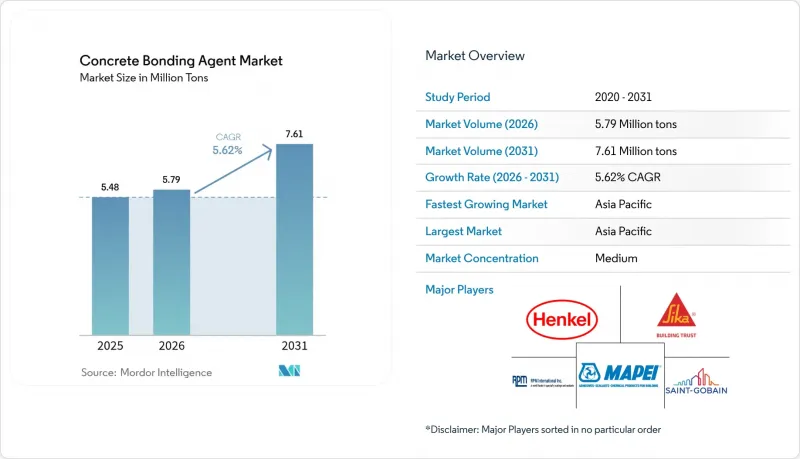
This report is Segmented by Bonding Agent Type (Cementitious Latex-Based and Epoxy-Based), Technology (One-Component and Two-Component Systems), Application (Repairing, Flooring, and More), End-User Industry (Residential and Non-Residential), and Geography (Asia-Pacific, North America, Europe, South America, and Middle East and Africa). The Market Forecasts are Provided in Terms of Volume (tons).
Global Concrete Bonding Agent Market Trends and Insights
Surge in Concrete Repair & Rehabilitation Projects
Municipal agencies that built roads, bridges, and flood-control dams in the 1960s and 1970s now face end-of-life deterioration, so they prioritize rehabilitation that can extend service lives by 20-30 years . The Third Avenue Bridge case in New York proved that targeted overlays using latex-modified concrete can add five decades of durability at one-fifth the replacement cost. Agencies adopt asset-management protocols that quantify whole-life cost, and those models consistently rank advanced bonding agents ahead of basic patching mortars because adhesion failure leads to rework. Insurance underwriters also weigh in; many now require documented interface testing before they approve coverage for capital-intensive bridges and tunnels. As owners embed such specifications, the concrete bonding agents market keeps widening its addressable base across both public and private portfolios.
Rapid Urban Infra-upgrading Mandates
Cities from Mumbai to Manila are retrofitting transport corridors to lift resilience scores and reduce congestion, an effort funded through public-private partnerships that stipulate strict uptime metrics. Because rehab work occurs in live traffic zones, contractors prefer bonding agents that cure fast, adhere to damp substrates, and remain compatible with Portland cement so that standard crews can handle installation. China's 2025 policy documents pivot away from adding greenfield highways toward reinforcing existing structures against seismic and flood risks. This reshaped demand pattern favors polymer-rich formulations that boost flexural strength without altering concrete's thermal expansion profile. Suppliers report double-digit sales growth in spray-applied acrylics designed for narrow nighttime maintenance windows on subways and elevated rail viaducts.
Price Volatility of Epoxy & Latex Feedstocks
Styrene-butadiene rubber and bisphenol-A-based epoxy rely on petroleum derivatives whose prices swing with refinery turnarounds and geopolitical disruptions. During 2024, high-performance latex reached USD 1,654 per ton, eroding contractor margins in low-bid environments. Emerging markets often delay bridge deck overlays when feedstock spikes push procurement beyond budget ceilings. To hedge risk, formulators explore bio-based epoxies derived from cashew nutshell liquid, yet scale remains nascent and costs vary with crop yields. Forward-buy contracts offer partial relief but require healthy balance sheets that smaller distributors lack. The volatility therefore curbs near-term volume growth in price-sensitive segments of the concrete bonding agents market.
Other drivers and restraints analyzed in the detailed report include:
- Compatibility With Portland & Blended Cements
- Proliferation of Ready-Mix Repair Mortars
- Low Contractor Awareness in Emerging Markets
For complete list of drivers and restraints, kindly check the Table Of Contents.
Segment Analysis
Latex-modified, cement-compatible agents accounted for 53.62% of 2025 volume, the largest slice within the Concrete Bonding Agents market share. The same cohort is on a 6.39% CAGR path, rendering it both the dominant and fastest-growing class. This rare dual positioning reflects latex chemistry that marries workability with mechanical uplift: scanning electron microscopy reveals three-dimensional polymer films that bridge voids and blunt micro-crack propagation. Field data from the Virginia Department of Transportation show 22-26 year service lives for latex overlays versus 15-19 years for unmodified systems. Epoxy-based products keep a firm presence in chemically aggressive or structurally critical environments such as wastewater headworks and offshore platforms.
Performance considerations steer procurement. Latex agents yield higher elongation, easing stress concentrations caused by thermal cycling on wide deck plates, whereas epoxies excel in compressive zones that demand extreme shear transfer. VOC regulation trends favor water-borne latex, yet next-generation low-odor epoxies aim to re-balance the equation. Suppliers increasingly bundle both chemistries in modular systems, letting contractors pair a latex primer with an epoxy topcoat to optimize adhesion and chemical resistance. This hybrid approach expands the concrete bonding agents market because owners get specification flexibility without adding stock keeping unit (SKU) complexity.
One-component products held 64.05% of 2025 shipments and remain the mainstay for everyday patching and floor screeding. These pre-mixed liquids or powders need only water or mechanical stirring, limiting job-site errors. Two-component kits, although just 35.95% by volume, show a brisk 6.18% CAGR because they unlock higher bond strengths above 3 MPa and resist cyclic loading on heavily trafficked viaducts. The differential speaks to user segmentation: smaller contractors gravitate to single-bag convenience, while infrastructure specialists budget extra labor time for mixing precision.
Innovation is trimming the hassle gap. Foil-pack cartridges now keep resin and hardener separate until on-site extrusion into static mixers, shaving set-up time by 30% while cutting waste. Rapid-cure two-component epoxies can hit traffic-ready strength in one hour, a boon for overnight runway slab repairs at busy airports. Meanwhile, sensor-enabled packaging that changes color when mixing is incomplete may soon migrate from premium to mid-tier price points. As such features spread, two-component adoption could accelerate, further expanding the concrete bonding agents market size in value terms even if unit volumes stay modest.
Complete Report Scope:
- By Bonding Agent Type
- Cementitious Latex-based
- Epoxy-based
- By Technology
- One-component
- Two-component Systems
- By Application
- Repairing
- Flooring
- Decorative
- Other Applications (Waterproofing & Damp-proofing, etc.)
- By End-User Industry
- Residential
- Non-Residential
- By Geography
- Asia-Pacific
- China
- Japan
- India
- South Korea
- ASEAN Countries
- Rest of Asia-Pacific
- North America
- United States
- Canada
- Mexico
- Europe
- Germany
- United Kingdom
- France
- Italy
- Spain
- Russia
- NORDIC Countries
- Rest of Europe
- South America
- Brazil
- Argentina
- Rest of South America
- Middle East and Africa
- Saudi Arabia
- South Africa
- Rest of Middle East and Africa
- Asia-Pacific
Geography Analysis
Asia-Pacific anchored 46.55% of global market volume share in 2025 and is pacing toward a 6.12% CAGR through 2031, magnifying the Concrete Bonding Agents market footprint across China, India, Indonesia, and the Philippines. China's infrastructure outlays, while moderating, now emphasize seismic retrofits and carbon reduction, which require high-performance bonding agents to integrate recycled aggregates without compromising adhesion. India's USD 134 billion 2024/25 allocation accelerates projects under the Gati Shakti corridor, compelling contractors to adopt rapid-cure primers that can turn lanes back to traffic overnight.
North America remains a technology testbed, buoyed by the USD 1.2 trillion Infrastructure Investment and Jobs Act that channels funds into bridge rehabilitation, dam spillway enlargement, and port berth reinforcement. California's Air Resources Board tightened VOC caps to 30 g/L for architectural adhesives in 2024, nudging suppliers toward water-borne dispersion and higher-solids epoxy blends. Progressive Epoxy Polymers introduced a solvent-free deck overlay that cures at 5°C, aiming at winter-maintenance windows in the Upper Midwest.
Europe commands a sophisticated user base demanding tight emission profiles and proof-tested structural performance. The 17.4% drop in Great Britain's generic ready-mix deliveries masks a switch toward bespoke repair mortars with factory-certified binder-polymer ratios. Saint-Gobain-Fosroc now controls production nodes in the United Kingdom and United Arab Emirates, letting it funnel European know-how into Gulf petrochemical refurbishments that require fire-retardant epoxy primers. Southern Europe's seismic retrofit programs invite viscous thixotropic agents that cling to vertical columns without sag, an area where Italian labs drive formulation advances. South America and the Middle East & Africa trail in aggregate volume but post double-digit growth pockets. Brazil's port concession upgrades deploy polymer-rich grouts under crane rails. Such region-specific technical needs broaden adoption corridors for the Concrete Bonding Agents market.
- Ardex Group
- ChemCo Systems Inc.
- Garon Products Inc.
- Henkel AG & Co. KGaA
- MAPEI S.p.A.
- Meridian Adhesives Group
- Pidilite Industries Limited
- RPM International Inc.
- Saint-Gobain
- Sika AG
- The Euclid Chemical Company
- W. R. Grace & Co
Additional Benefits:
- The market estimate (ME) sheet in Excel format
- 3 months of analyst support
TABLE OF CONTENTS
1 Introduction
- 1.1 Study Assumptions & Market Definition
- 1.2 Scope of the Study
2 Research Methodology
3 Executive Summary
4 Market Landscape
- 4.1 Market Overview
- 4.2 Market Drivers
- 4.2.1 Surge in Concrete Repair & Rehabilitation Projects
- 4.2.2 Rapid Urban Infra-upgrading Mandates
- 4.2.3 Compatibility With Portland & Blended Cements
- 4.2.4 Proliferation of Ready-mix Repair Mortars
- 4.2.5 Increasing Demand for Nano-silica-enhanced Bonding Chemistries
- 4.3 Market Restraints
- 4.3.1 Price Volatility of Epoxy & Latex Feedstocks
- 4.3.2 Low Contractor Awareness in Emerging Markets
- 4.3.3 Carbon-footprint Scrutiny of Polymer Dispersions
- 4.4 Value Chain Analysis
- 4.5 Porter's Five Forces
- 4.5.1 Bargaining Power of Suppliers
- 4.5.2 Bargaining Power of Buyers
- 4.5.3 Threat of New Entrants
- 4.5.4 Threat of Substitutes
- 4.5.5 Degree of Competition
5 Market Size & Growth Forecasts (Volume)
- 5.1 By Bonding Agent Type
- 5.1.1 Cementitious Latex-based
- 5.1.2 Epoxy-based
- 5.2 By Technology
- 5.2.1 One-component
- 5.2.2 Two-component Systems
- 5.3 By Application
- 5.3.1 Repairing
- 5.3.2 Flooring
- 5.3.3 Decorative
- 5.3.4 Other Applications (Waterproofing & Damp-proofing, etc.)
- 5.4 By End-User Industry
- 5.4.1 Residential
- 5.4.2 Non-Residential
- 5.5 By Geography
- 5.5.1 Asia-Pacific
- 5.5.1.1 China
- 5.5.1.2 Japan
- 5.5.1.3 India
- 5.5.1.4 South Korea
- 5.5.1.5 ASEAN Countries
- 5.5.1.6 Rest of Asia-Pacific
- 5.5.2 North America
- 5.5.2.1 United States
- 5.5.2.2 Canada
- 5.5.2.3 Mexico
- 5.5.3 Europe
- 5.5.3.1 Germany
- 5.5.3.2 United Kingdom
- 5.5.3.3 France
- 5.5.3.4 Italy
- 5.5.3.5 Spain
- 5.5.3.6 Russia
- 5.5.3.7 NORDIC Countries
- 5.5.3.8 Rest of Europe
- 5.5.4 South America
- 5.5.4.1 Brazil
- 5.5.4.2 Argentina
- 5.5.4.3 Rest of South America
- 5.5.5 Middle East and Africa
- 5.5.5.1 Saudi Arabia
- 5.5.5.2 South Africa
- 5.5.5.3 Rest of Middle East and Africa
- 5.5.1 Asia-Pacific
6 Competitive Landscape
- 6.1 Market Concentration
- 6.2 Strategic Moves
- 6.3 Market Share(%)/Ranking Analysis
- 6.4 Company Profiles (includes Global level Overview, Market level overview, Core Segments, Financials as available, Strategic Information, Market Rank/Share for key companies, Products & Services, and Recent Developments)
- 6.4.1 Ardex Group
- 6.4.2 ChemCo Systems Inc.
- 6.4.3 Garon Products Inc.
- 6.4.4 Henkel AG & Co. KGaA
- 6.4.5 MAPEI S.p.A.
- 6.4.6 Meridian Adhesives Group
- 6.4.7 Pidilite Industries Limited
- 6.4.8 RPM International Inc.
- 6.4.9 Saint-Gobain
- 6.4.10 Sika AG
- 6.4.11 The Euclid Chemical Company
- 6.4.12 W. R. Grace & Co
7 Market Opportunities & Future Outlook
- 7.1 White-space & Unmet-Need Assessment
- 7.2 Eco-Friendly and Low-VOC Concrete Bonding Agents

