PUBLISHER: Mordor Intelligence | PRODUCT CODE: 2114769

PUBLISHER: Mordor Intelligence | PRODUCT CODE: 2114769
Image Guided Therapy System - Market Share Analysis, Industry Trends & Statistics, Growth Forecasts (2026 - 2031)
According to Mordor Intelligence, the image guided therapy system market size is expected to grow from USD 5.39 billion in 2025 to USD 5.67 billion in 2026 and is forecast to reach USD 7.27 billion by 2031 at 5.12% CAGR over 2026-2031.
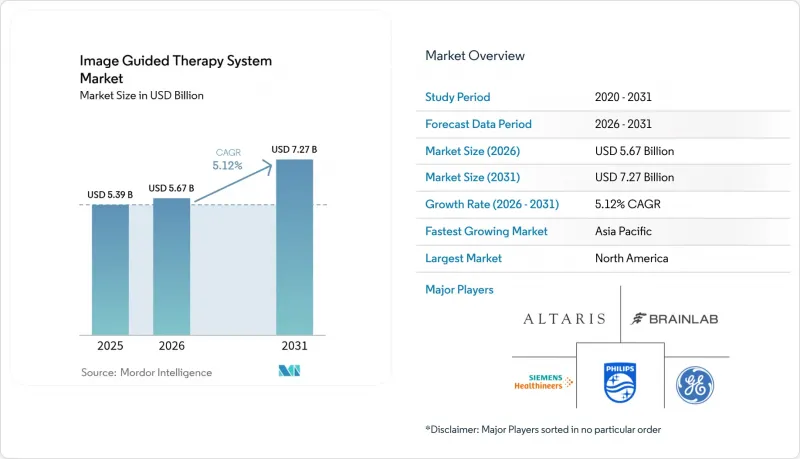
This report Segments the Industry Into by Product Type (Ultrasound Systems, and More), by Technology (Electromagnetic Navigation, and More), by Application (Neurosurgery, and More), by End-User (Hospitals and Clinics, Ambulatory Surgery Centers, Others), by Modality Portability (Fixed Systems, and More) and Geography. The Market Sizes and Forecasts are Provided in Terms of Value (USD).
Global Image Guided Therapy System Market Trends and Insights
Growing geriatric population
Patients aged 65+ now constitute the fastest-growing surgical cohort, prompting wider adoption of precise electromagnetic navigation that limits tissue trauma and speeds recovery. MRI-guided focused ultrasound lets fragile elders avoid open craniotomy for essential tremor, improving quality-adjusted life years while trimming readmissions. Health-system budget holders recognize that upfront imaging costs offset downstream postoperative expenses.
Rising burden of chronic diseases
Cardiovascular, oncologic and neurologic disorders collectively drive over 70% of deaths worldwide, making repeatable, image-guided interventions essential. Deep-learning ECG analytics reach 95% accuracy in detecting structural heart disease, fueling earlier referrals to catheter-based repair guided by real-time 3D imaging . Fiscal strain from chronic illness sharpens the case for technologies that reduce lifelong care volumes.
High capital cost of integrated systems
Comprehensive suites that blend navigation, robotics and AI imaging cost USD 1-3 million plus 15-20% annual service fees, deterring mid-tier hospitals with thin margins. Leasing and outcome-based contracts soften this barrier but cannot erase scale advantages enjoyed by academic centers.
Other drivers and restraints analyzed in the detailed report include:
- Rapid shift to minimally invasive, image-guided procedures
- Expansion of hybrid operating rooms in tertiary hospitals
- Regulatory convergence enabling multi-modality interoperability
- Radiation & electromagnetic exposure concerns
For complete list of drivers and restraints, kindly check the Table Of Contents.
Segment Analysis
Endoscopes retained 33.02% of the Image Guided Therapy System market in 2025 as their flexibility spans gastroenterology, urology and pulmonology. Hospitals integrate electromagnetic tracking probes through existing endoscope channels, trimming incremental spend. MRI systems, though smaller in volume, are forecast to expand 5.60% annually as focused ultrasound, laser ablation and deep-brain neuromodulation migrate into real-time MRI suites. Vendors now offer intra-operative 1.5 T magnets with robotic accessories that pivot seamlessly between scan and incision.
Ultrasound platforms gain momentum among ambulatory centers because portable carts need lower room shielding and cost fractions of fixed CT. X-ray C-arms stay vital for high-volume angiography despite radiation scrutiny. Hybrids such as PET-MRI tackle oncology staging in single sessions, blurring lines between diagnostic and therapeutic imaging.
Electromagnetic navigation commanded 29.94% revenue in 2025 owing to line-of-sight independence and sub-millimeter accuracy in spine and cranial work. Segment revenue hit USD 1.61 billion, representing the highest slice of the Image Guided Therapy System market size that year. Robotic-assisted imaging guidance is poised to climb 6.13% CAGR through 2031 as AI route-planning and automated drilling cut operating times.
Real-time 3D/4D AI visualization halves targeting error versus manual fluoroscopy, according to multicenter trials. Augmented reality headsets project CT data onto the surgical field, refining implant alignment. Optical trackers remain economical for orthopedic extremity work yet lose precision in deep cavities.
Complete Report Scope:
- By Product Type
- Ultrasound Systems
- Endoscopes
- Magnetic Resonance Imaging (MRI)
- X-ray Fluoroscopy / C-arms
- Positron Emission Tomography (PET)
- Single-Photon Emission CT (SPECT)
- Others
- By Technology
- Electromagnetic Navigation
- Robotic-assisted Imaging Guidance
- AI-Enhanced Real-time 3D/4D Imaging
- Augmented / Mixed-Reality Visualization
- Optical & Laser-based Tracking
- By Application
- Neurosurgery
- Cardiac Surgery & Structural Heart
- Orthopedic & Spine
- Urology
- Oncology & Ablation
- Others
- By End-user
- Hospitals and Clinics
- Ambulatory Surgery Centers
- Others
- By Modality Portability
- Fixed Systems
- Mobile C-arms
- Hand-held / Portable
- By Geography
- North America
- United States
- Canada
- Mexico
- Europe
- Germany
- United Kingdom
- France
- Italy
- Spain
- Rest of Europe
- Asia-Pacific
- China
- Japan
- India
- Australia
- South Korea
- Rest of Asia-Pacific
- Middle East & Africa
- GCC
- South Africa
- Rest of Middle East & Africa
- South America
- Brazil
- Argentina
- Rest of South America
- North America
Geography Analysis
North America led with 45.18% revenue in 2025 as academic health systems, supportive reimbursement and dense vendor presence speed adoption. The FDA's 2024 cybersecurity final rule clarified premarket requirements, letting suppliers certify multi-modality suites more quickly. U.S. venture investment in surgical robotics surpassed USD 2 billion in 2024, intensifying domestic competition. While payers pressure hospitals to justify capital spend, consolidation affords network-wide rollouts that spread cost over higher procedure volumes.
Asia-Pacific is projected to rise 6.55% CAGR through 2031. China's public-hospital reform funnels budget toward high-end imaging, and the Healthy China 2030 plan subsidizes minimally invasive cardiology labs. Japan's super-aged society raises demand for low-trauma therapy; local makers pioneer MRI-compatible robotics that fit small urban hospitals. India's private chains deploy portable ultrasound and navigation bundles to tap medical tourism, while Korea combines domestic manufacturing strength with heavy R&D tax incentives.
Europe remains a technology proving ground under the Medical Device Regulation. Health-technology assessment agencies such as NICE evaluate cost-utility, nudging suppliers to document outcome gains. Germany hosts clusters of mid-sized imaging OEMs that supply modular components worldwide. EU AI Act rules, effective 2025, require transparent algorithm logs for surgical guidance software, lengthening validation cycles yet offering first-mover advantage for compliant vendors . Elsewhere, Brazil and Saudi Arabia upgrade trauma networks with hybrid cath-lab-OR complexes, opening late-adopter avenues.
- Siemens Healthineers
- GE Healthcare
- Koninklijke Philips
- Medtronic
- Brain Lab
- Stryker
- Olympus
- Karl Storz
- Canon
- Varian (Siemens)
- Accuray
- Intuitive Surgical
- Zimmer Biomet
- Smiths Group
- Insightec
- FUJIFILM
- Esaote
- Shenzhen Mindray Bio-Medical
- Clarius Mobile Health
- Hyperfine
- Novarad (VisAR)
Additional Benefits:
- The market estimate (ME) sheet in Excel format
- 3 months of analyst support
TABLE OF CONTENTS
1 Introduction
- 1.1 Study Assumptions & Market Definition
- 1.2 Scope of the Study
2 Research Methodology
3 Executive Summary
4 Market Landscape
- 4.1 Market Overview
- 4.2 Market Drivers
- 4.2.1 Growing geriatric population
- 4.2.2 Rising burden of chronic diseases
- 4.2.3 Rapid shift to minimally-invasive, image-guided procedures
- 4.2.4 Expansion of hybrid operating rooms in tertiary hospitals
- 4.2.5 Regulatory convergence enabling multi-modality interoperability
- 4.2.6 VC funding surge for MRI/US-guided robotics & ablation platforms
- 4.3 Market Restraints
- 4.3.1 High capital cost of integrated systems
- 4.3.2 Radiation & electromagnetic exposure concerns
- 4.3.3 Shortage of hybrid-OR-trained specialists
- 4.3.4 Cyber-security & data-integration hurdles for connected devices
- 4.4 Value / Supply-Chain Analysis
- 4.5 Regulatory Landscape
- 4.6 Technological Outlook
- 4.7 Porter's Five Forces Analysis
- 4.7.1 Threat of New Entrants
- 4.7.2 Bargaining Power of Buyers
- 4.7.3 Bargaining Power of Suppliers
- 4.7.4 Threat of Substitutes
- 4.7.5 Intensity of Competitive Rivalry
5 Market Size & Growth Forecasts (Value, USD)
- 5.1 By Product Type
- 5.1.1 Ultrasound Systems
- 5.1.2 Endoscopes
- 5.1.3 Magnetic Resonance Imaging (MRI)
- 5.1.4 X-ray Fluoroscopy / C-arms
- 5.1.5 Positron Emission Tomography (PET)
- 5.1.6 Single-Photon Emission CT (SPECT)
- 5.1.7 Others
- 5.2 By Technology
- 5.2.1 Electromagnetic Navigation
- 5.2.2 Robotic-assisted Imaging Guidance
- 5.2.3 AI-Enhanced Real-time 3D/4D Imaging
- 5.2.4 Augmented / Mixed-Reality Visualization
- 5.2.5 Optical & Laser-based Tracking
- 5.3 By Application
- 5.3.1 Neurosurgery
- 5.3.2 Cardiac Surgery & Structural Heart
- 5.3.3 Orthopedic & Spine
- 5.3.4 Urology
- 5.3.5 Oncology & Ablation
- 5.3.6 Others
- 5.4 By End-user
- 5.4.1 Hospitals and Clinics
- 5.4.2 Ambulatory Surgery Centers
- 5.4.3 Others
- 5.5 By Modality Portability
- 5.5.1 Fixed Systems
- 5.5.2 Mobile C-arms
- 5.5.3 Hand-held / Portable
- 5.6 By Geography
- 5.6.1 North America
- 5.6.1.1 United States
- 5.6.1.2 Canada
- 5.6.1.3 Mexico
- 5.6.2 Europe
- 5.6.2.1 Germany
- 5.6.2.2 United Kingdom
- 5.6.2.3 France
- 5.6.2.4 Italy
- 5.6.2.5 Spain
- 5.6.2.6 Rest of Europe
- 5.6.3 Asia-Pacific
- 5.6.3.1 China
- 5.6.3.2 Japan
- 5.6.3.3 India
- 5.6.3.4 Australia
- 5.6.3.5 South Korea
- 5.6.3.6 Rest of Asia-Pacific
- 5.6.4 Middle East & Africa
- 5.6.4.1 GCC
- 5.6.4.2 South Africa
- 5.6.4.3 Rest of Middle East & Africa
- 5.6.5 South America
- 5.6.5.1 Brazil
- 5.6.5.2 Argentina
- 5.6.5.3 Rest of South America
- 5.6.1 North America
6 Competitive Landscape
- 6.1 Market Concentration
- 6.2 Market Share Analysis
- 6.3 Company Profiles (includes Global level Overview, Market level overview, Core Segments, Financials as available, Strategic Information, Market Rank/Share for key companies, Products & Services, and Recent Developments)
- 6.3.1 Siemens Healthineers
- 6.3.2 GE HealthCare
- 6.3.3 Koninklijke Philips N.V.
- 6.3.4 Medtronic plc
- 6.3.5 Brainlab AG
- 6.3.6 Stryker Corporation
- 6.3.7 Olympus Corporation
- 6.3.8 KARL STORZ SE & Co. KG
- 6.3.9 Canon Medical Systems
- 6.3.10 Varian (Siemens)
- 6.3.11 Accuray Inc.
- 6.3.12 Intuitive Surgical
- 6.3.13 Zimmer Biomet
- 6.3.14 Smith & Nephew
- 6.3.15 Insightec
- 6.3.16 FUJIFILM Healthcare
- 6.3.17 Esaote SpA
- 6.3.18 Shenzhen Mindray Bio-Medical
- 6.3.19 Clarius Mobile Health
- 6.3.20 Hyperfine
- 6.3.21 Novarad (VisAR)
7 Market Opportunities & Future Outlook
- 7.1 White-space & Unmet-need Assessment

