PUBLISHER: Mordor Intelligence | PRODUCT CODE: 2114782

PUBLISHER: Mordor Intelligence | PRODUCT CODE: 2114782
Acromegaly Treatment - Market Share Analysis, Industry Trends & Statistics, Growth Forecasts (2026 - 2031)
According to Mordor Intelligence, acromegaly treatment market size in 2026 is estimated at USD 1.87 billion, growing from 2025 value of USD 1.75 billion with 2031 projections showing USD 2.63 billion, growing at 7.05% CAGR over 2026-2031.
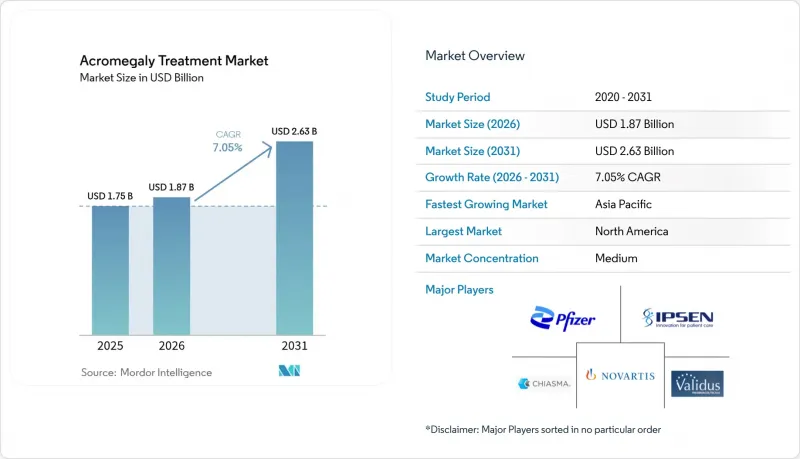
This report is Segmented by Product Type (Somatostatin Analogs, Growth Hormone Receptor Antagonists, Dopamine Agonists, and Other Product Types), Distribution Channel (Hospital Pharmacies, Retail Pharmacies, and Online Pharmacies), and Geography (North America, Europe, Asia-Pacific, and More). The Market Forecasts are Provided in Terms of Value (USD).
Global Acromegaly Treatment Market Trends and Insights
Rising Prevalence of Growth Hormone-Secreting Pituitary Adenomas
The global incidence of acromegaly now approaches 0.38 per 100,000 person-years, and prevalence has reached 5.9 per 100,000 population. High-resolution MRI and sensitive IGF-1 assays shorten diagnostic delays and uncover latent cases, especially among middle-aged adults. A European registry tracking 3,173 patients reported a median diagnostic age of 43.5 years for men and 46.4 years for women, with noted delays in female cohorts. As the recognized patient base expands, manufacturers are scaling production capacity and broadening compassionate-use programs, while insurers model higher long-term spending on endocrine disorders.
Earlier Diagnosis from Endocrine Society Guideline Uptake
The 14th Acromegaly Consensus shifted the confirmatory threshold to IGF-1 levels 1.3 times above the upper normal limit, removing the need for routine GH suppression tests. Specialized centers now report a compressed diagnostic lag of 5-7 years versus the previous 10-12-year average. Earlier intervention expands the acromegaly treatment market by adding patients who previously progressed to advanced disease states. Laboratories offering same-day IGF-1 testing see double-digit revenue gains, and multidisciplinary clinics integrate sleep-apnea and diabetes screenings to flag high-risk individuals sooner.
Post-Injection Fibrosis & Lipoatrophy Limiting Depot Compliance
Long-term use of injectable somatostatin analogs leads to injection-site reactions in up to 20% of patients, with 5-8% developing significant fibrosis or lipoatrophy that forces regimen changes. Oral octreotide capsules deliver a 65% biochemical response without these complications but introduce challenges such as variable absorption and the need for twice-daily dosing. Clinicians now rotate injection sites more aggressively and consider early oral switchovers for high-risk profiles, yet real-world adherence data indicate continued attrition that erodes potential acromegaly treatment market size gains.
Other drivers and restraints analyzed in the detailed report include:
- Transition Toward Long-Acting Depot Formulations in Europe
- Orphan-Drug Incentives Accelerating R&D Funding
- Pegvisomant-Induced Liver Enzyme Elevations Necessitating Monitoring
For complete list of drivers and restraints, kindly check the Table Of Contents.
Segment Analysis
Somatostatin analogs accounted for 54.30% of acromegaly treatment market share in 2025, anchored by Somatuline (lanreotide) revenue of USD 1,121.3 million. The segment benefits from broad guideline endorsements as first-line medical therapy and from depot innovations that enhance patient convenience. Growth hormone receptor antagonists held a smaller slice of the acromegaly treatment market size but are set to grow at 9.15% CAGR through 2031 as pegvisomant and pipeline entrants demonstrate high biochemical normalization rates. Oral nonpeptide agents such as paltusotine showed 83% IGF-1 control in PATHFNDR-1, signaling future shifts in prescribing patterns toward once-daily oral therapy.
Pipeline activity is reshaping competitive dynamics. CAM2029 offers once-monthly subcutaneous delivery with patient-enabled autoinjectors, improving adherence and reducing clinic visits. Developers are also exploring antisense RNA and GHRH receptor blockade to penetrate refractory disease niches. As these modalities reach late-stage trials, the acromegaly treatment industry may witness a redistribution of revenue streams, with oral and self-administered products capturing share from hospital-administered injectables.
Complete Report Scope:
- By Product Type
- Somatostatin Analogs
- Growth Hormone Receptor Antagonists
- Dopamine Agonists
- Other Product Types
- By Distribution Channel
- Hospital Pharmacies
- Retail Pharmacies
- Online Pharmacies
- Geography
- North America
- United States
- Canada
- Mexico
- Europe
- Germany
- United Kingdom
- France
- Italy
- Spain
- Rest of Europe
- Asia-Pacific
- China
- Japan
- India
- Australia
- South Korea
- Rest of Asia-Pacific
- Middle East & Africa
- GCC
- South Africa
- Rest of Middle East & Africa
- South America
- Brazil
- Argentina
- Rest of South America
- North America
Geography Analysis
North America remains the anchor for the acromegaly treatment market, holding 42.60% share in 2025. Approximately 27,000 diagnosed patients reside in the United States, with 11,000 receiving pharmacologic intervention. The Inflation Reduction Act introduced a USD 2,000 cap on Medicare Part D out-of-pocket drug costs, improving adherence prospects for seniors. Academic centers in Boston, Houston, and Los Angeles are early adopters of oral somatostatin receptor agonists, accelerating physician experience curves and influencing guideline updates across the region.
Europe ranks second by revenue, driven by widespread use of long-acting depots and robust specialist networks. Surveyed Pituitary Tumor Centers of Excellence reported that 48.9% of patients are on medical therapy, with first-generation somatostatin receptor ligands as the preferred option for nearly half the cohort. Health technology assessment bodies such as NICE and IQWiG scrutinize incremental clinical value, leading to active price negotiations but also fostering uptake of cost-effective depot innovations. EMA approval cycles remain predictable, supporting steady expansion of the acromegaly treatment market size in large economies such as Germany, France, and Italy.
The Asia Pacific acromegaly treatment market is projected to grow at an 7.95% CAGR through 2031. China, Japan, and South Korea account for the bulk of regional volume, thanks to rising specialist density and expanded private insurance coverage. Thailand's rare-disease audit showed only 46.8% of recommended medicines registered and just 22.93% listed as essential, underscoring lingering access gaps. India's USD 574.5 million Production Linked Incentive scheme aims to localize manufacturing for complex injectables, which could cut costs and widen availability. As regional governments roll out universal health programs, demand for affordable depot and oral therapies will lift the overall acromegaly treatment market.
- Pfizer
- Novartis
- Ipsen
- Recordati S.p.A.
- Amryt Pharma plc
- Crinetics Pharmaceuticals Inc.
- Ionis Pharmaceuticals
- Amolyt Pharma
- Camurus AB
Additional Benefits:
- The market estimate (ME) sheet in Excel format
- 3 months of analyst support
TABLE OF CONTENTS
1 Introduction
- 1.1 Study Assumptions & Market Definition
- 1.2 Scope of the Study
2 Research Methodology
3 Executive Summary
4 Market Landscape
- 4.1 Market Overview
- 4.2 Market Drivers
- 4.2.1 Rising Prevalence of GH-Secreting Pituitary Adenomas
- 4.2.2 Earlier Diagnosis from Endocrine-Society Guideline Uptake
- 4.2.3 Transition Toward Long-Acting Depot Formulations in Europe
- 4.2.4 Orphan-Drug Incentives Accelerating R&D Funding
- 4.2.5 Growing Adoption of MRI-Guided Trans-Sphenoidal Surgery Creating Adjuvant Demand
- 4.2.6 Expansion of National Rare-Disease Reimbursement Lists (China, Brazil, GCC)
- 4.3 Market Restraints
- 4.3.1 Post-Injection Fibrosis & Lipoatrophy Limiting Depot Compliance
- 4.3.2 Pegvisomant-Induced Liver Enzyme Elevations Necessitating Monitoring
- 4.3.3 Limited Specialist Centers in Low-Income Africa & Caribbean Nations
- 4.3.4 High Annual Therapy Cost (> USD 250 K) Constraining Payer Budgets
- 4.4 Regulatory Outlook
- 4.5 Porter's Five Forces Analysis
- 4.5.1 Threat of New Entrants
- 4.5.2 Bargaining Power of Buyers / Consumers
- 4.5.3 Bargaining Power of Suppliers
- 4.5.4 Threat of Substitute Products
- 4.5.5 Intensity of Competitive Rivalry
5 Market Size & Growth Forecasts (Value, USD)
- 5.1 By Product Type
- 5.1.1 Somatostatin Analogs
- 5.1.2 Growth Hormone Receptor Antagonists
- 5.1.3 Dopamine Agonists
- 5.1.4 Other Product Types
- 5.2 By Distribution Channel
- 5.2.1 Hospital Pharmacies
- 5.2.2 Retail Pharmacies
- 5.2.3 Online Pharmacies
- 5.3 Geography
- 5.3.1 North America
- 5.3.1.1 United States
- 5.3.1.2 Canada
- 5.3.1.3 Mexico
- 5.3.2 Europe
- 5.3.2.1 Germany
- 5.3.2.2 United Kingdom
- 5.3.2.3 France
- 5.3.2.4 Italy
- 5.3.2.5 Spain
- 5.3.2.6 Rest of Europe
- 5.3.3 Asia-Pacific
- 5.3.3.1 China
- 5.3.3.2 Japan
- 5.3.3.3 India
- 5.3.3.4 Australia
- 5.3.3.5 South Korea
- 5.3.3.6 Rest of Asia-Pacific
- 5.3.4 Middle East & Africa
- 5.3.4.1 GCC
- 5.3.4.2 South Africa
- 5.3.4.3 Rest of Middle East & Africa
- 5.3.5 South America
- 5.3.5.1 Brazil
- 5.3.5.2 Argentina
- 5.3.5.3 Rest of South America
- 5.3.1 North America
6 Competitive Landscape
- 6.1 Market Concentration
- 6.2 Strategic Moves
- 6.3 Market Share Analysis
- 6.4 Company Profiles (includes Global level Overview, Market level overview, Core Segments, Financials as available, Strategic Information, Market Rank/Share for key companies, Products & Services, and Recent Developments)
- 6.4.1 Pfizer Inc.
- 6.4.2 Novartis AG
- 6.4.3 Ipsen SA
- 6.4.4 Recordati S.p.A.
- 6.4.5 Amryt Pharma plc
- 6.4.6 Crinetics Pharmaceuticals Inc.
- 6.4.7 Ionis Pharmaceuticals Inc.
- 6.4.8 Amolyt Pharma
- 6.4.9 Camurus AB
7 Market Opportunities & Future Outlook
- 7.1 White-Space & Unmet-Need Assessment

