PUBLISHER: Mordor Intelligence | PRODUCT CODE: 2114803

PUBLISHER: Mordor Intelligence | PRODUCT CODE: 2114803
Frozen Snacks - Market Share Analysis, Industry Trends & Statistics, Growth Forecasts (2026 - 2031)
According to Mordor Intelligence, the frozen snacks market size was valued at USD 146.22 billion in 2025 and is estimated to grow from USD 154.71 billion in 2026 and is forecast to reach USD 202.52 billion by 2031, registering a compound annual growth rate (CAGR) of 5.53% during 2026-2031.
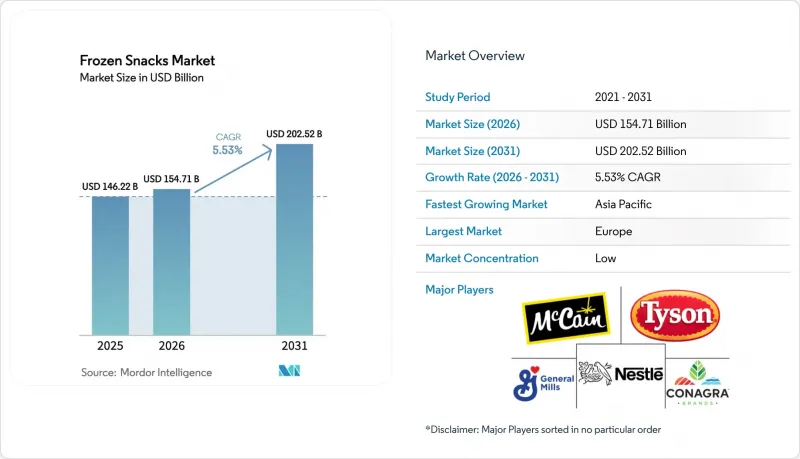
This report is Segmented by Product Type (Potato-Based Snacks, Pizza Snacks, Meat-Based Snacks, Baked Snacks, Dairy-Based Snacks, Plant-Based Snacks, and Others), Distribution Channel (Retail and Foodservice), and Geography (North America, Europe, Asia-Pacific, South America, Middle East and Africa). Market Forecasts are Provided in Value (USD) and Volume (Tonnes).
Global Frozen Snacks Market Trends and Insights
Growing urban preference for convenient, ready-to-eat meal options
The increasing urban preference for convenient, ready-to-eat meal options is a key driver of the global frozen snacks market's growth. As urbanization accelerates, daily routines become more fast-paced and structured, leaving limited time for traditional cooking. Urban consumers, particularly working professionals and students, are increasingly opting for foods that are quick to prepare without compromising on taste or variety. Frozen snacks meet this demand by offering minimal preparation time and consistent quality. Additionally, smaller living spaces and the prevalence of nuclear households encourage the purchase of portion-controlled, easy-to-store food products. The availability of appliances such as microwaves and air fryers further simplifies the preparation process. Moreover, exposure to diverse cuisines in metropolitan areas boosts the demand for frozen versions of popular street foods and international snack options. According to the World Bank Group, the global urban population represented approximately 58% of the total population in 2024, underscoring the expanding consumer base for convenient food solutions and driving the global demand for frozen snacks.
Expansion of cold-chain infrastructure and online grocery platforms
The expansion of cold-chain infrastructure and online grocery platforms is a significant factor driving growth in the global frozen snacks market. Frozen products rely on consistent temperature control throughout the supply chain, from manufacturing to final delivery. Advances in refrigerated transportation, warehousing, and last-mile delivery now enable companies to distribute products across broader geographic regions without compromising quality. The growth of online grocery and quick-commerce platforms has further fueled demand by allowing consumers to conveniently order frozen snacks for home delivery, often within hours, overcoming previous challenges related to spoilage risks. Retailers and logistics providers are increasingly investing in temperature-controlled storage and insulated packaging, making frozen products as accessible as fresh foods in both urban and semi-urban areas. For example, according to the India Brand Equity Foundation, India had over 8,689 cold storage facilities with a combined capacity of approximately 39.6 million metric tonnes as of August 2024. Uttar Pradesh accounted for about 38% of this capacity, followed by West Bengal at 15% and Gujarat at 10%. Such infrastructure development enhances product availability, extends shelf life during transit, and boosts consumer confidence, thereby driving global frozen snack consumption.
Consumer concerns related to health and high sodium intake
Health concerns and high sodium intake are key restraints on the global frozen snacks market, as consumers increasingly prioritize nutritional content and long-term wellness. Many frozen snack products depend on salt and preservatives to ensure flavor stability and extend shelf life, resulting in higher sodium levels compared to freshly prepared foods. Rising awareness of diet-related health issues, such as hypertension and cardiovascular diseases, has prompted consumers to reduce their intake of processed foods and scrutinize nutrition labels before purchasing. Health-conscious individuals, including parents, are opting to consume frozen snacks less frequently or are shifting to fresh, minimally processed alternatives. The perception of frozen snacks as indulgent rather than nutritious discourages repeat purchases, compelling manufacturers to reformulate products and introduce healthier options. However, until such changes are widely adopted, health and sodium concerns will continue to limit market growth.
Other drivers and restraints analyzed in the detailed report include:
- Introduction of clean-label and plant-based product innovations
- Rapid growth of QSR and organized foodservice outlets
- Fluctuating energy and transportation expenses
For complete list of drivers and restraints, kindly check the Table Of Contents.
Segment Analysis
Potato-based snacks accounted for 32.62% of the market share in 2025, driven by their widespread taste appeal, affordability, and adaptability across various cultures. Products like fries, wedges, and hash browns are commonly used in households and quick-service restaurants due to their quick cooking time, minimal preparation requirements, and compatibility with diverse cuisines. The rising popularity of air fryers and home entertainment has further boosted at-home consumption. Additionally, large-scale potato cultivation ensures a steady supply of raw materials and competitive pricing. Their consistent texture and flavor after freezing make potato snacks a dependable comfort food option, encouraging repeat purchases worldwide.
Plant-based snacks are projected to grow at a CAGR of 6.13% through 2031. The demand for plant-based frozen snacks is increasing, driven by a growing preference for healthier and sustainable dietary options, as well as a rise in flexitarian and vegan consumers. Consumers are looking for convenient, plant-based alternatives to meat-based appetizers that offer comparable taste and texture. This has prompted brands to innovate with ingredients such as legumes, vegetables, and grain proteins. Factors such as clean-label preferences, environmental consciousness, and animal welfare concerns are further supporting the adoption of these products. Additionally, the expansion of retail distribution and diversification of foodservice menus are introducing these snacks to a broader audience. Combined, the focus on nutrition and ethical consumption is fueling the global demand for plant-based frozen snacks.
Complete Report Scope:
- By Product Type
- Potato-based Snacks
- Pizza Snacks
- Meat-based Snacks
- Baked Snacks
- Dairy-based Snacks
- Plant-based Snacks
- Others
- By Distribution Channel
- Retail
- Supermarkets / Hypermarkets
- Convenience Stores
- Online Retail Stores
- Discounters & Club Stores
- Others
- Foodservice
- Quick-Service Restaurants (QSR)
- Full-Service Restaurants
- Institutional Catering
- Retail
- By Geography
- North America
- United States
- Canada
- Mexico
- Rest of North America
- Europe
- Germany
- United Kingdom
- Italy
- France
- Spain
- Netherlands
- Poland
- Belgium
- Sweden
- Rest of Europe
- Asia-Pacific
- China
- India
- Japan
- Australia
- Indonesia
- South Korea
- Thailand
- Singapore
- Rest of Asia-Pacific
- South America
- Brazil
- Argentina
- Colombia
- Chile
- Peru
- Rest of South America
- Middle East and Africa
- South Africa
- Saudi Arabia
- United Arab Emirates
- Nigeria
- Egypt
- Morocco
- Turkey
- Rest of Middle East and Africa
- North America
Geography Analysis
Europe accounted for 32.49% of the frozen snacks market in 2025, driven by well-established cold-chain systems and strong consumer familiarity with frozen foods, rooted in historical food-security practices. Major Western European economies, including Germany, the United Kingdom, and France, lead regional demand. Discount retailers significantly contribute to market growth by offering competitively priced private-label products. Environmental regulations targeting refrigerants are prompting retailers and logistics providers to upgrade refrigeration infrastructure, leading to increased capital investments while enhancing energy efficiency. In Southern Europe, countries such as Italy and Spain are emerging as growth markets due to urban lifestyles that reduce time spent on home cooking. Additionally, the Netherlands and Belgium serve as key distribution hubs, benefiting from advanced logistics networks and port access. Central and Northern European countries are witnessing steady adoption, supported by rising incomes and sustainability-focused policies promoting efficient cold-chain operations.
The Asia-Pacific region is projected to grow at a CAGR of 6.37% from 2026 to 2031, driven by factors such as rapid urbanization, a growing middle-class population, and substantial investments in cold-chain logistics, which are extending access to frozen foods beyond major urban areas. In China and India, shifting lifestyles, the prevalence of apartment living, and the rise of digital commerce are contributing to the normalization of routine frozen snack purchases. Japan's convenience-store culture supports consistent consumption, particularly among aging consumers who prefer small, easy-to-prepare portions. In Australia, there is a strong demand for imported frozen products, while Southeast Asian countries are emerging as manufacturing hubs as multinational companies increase production capacity to serve regional markets. South Korea is benefiting from the global popularity of its cuisine, which is driving international demand for traditional snack formats. Meanwhile, Singapore serves as a regional redistribution center, supported by its advanced storage and transportation infrastructure.
North America is a mature market, led by the United States, where quick-service restaurants and modern cooking appliances drive frozen snack consumption. Canada grows steadily with domestic production and retail partnerships, while Mexico expands rapidly due to retail modernization and rising purchasing power. Manufacturers face margin pressures from imported ingredient costs and health-focused regulations, favoring larger companies with strong R&D capabilities. South America holds a smaller market share, led by Brazil and Argentina with their meat-processing industries. Demand grows as retail infrastructure and refrigeration improve in countries like Chile and Colombia. The Middle East and Africa region grows gradually, driven by South Africa, Saudi Arabia, and the United Arab Emirates, where modern retail and expatriate populations boost demand. The United Arab Emirates also acts as a redistribution hub.
- Nestle SA
- McCain Foods Limited
- Conagra Brands Inc.
- Tyson Foods Inc.
- BRF SA
- Ajinomoto Co. Inc.
- General Mills Inc.
- Nomad Foods
- The Kraft Heinz Company
- Lamb Weston Holdings Inc.
- JBS SA
- Dr. Oetker GmbH
- Schwan Food Company
- Amy's Kitchen Inc.
- Bellisio Foods Inc.
- Kellanova (Kellogg)
- Unilever PLC
- Farm Frites International BV
- Aviko BV
- J.R. Simplot Company
Additional Benefits:
- The market estimate (ME) sheet in Excel format
- 3 months of analyst support
TABLE OF CONTENTS
1 INTRODUCTION
- 1.1 Study Assumptions and Market Definition
- 1.2 Scope of the Study
2 RESEARCH METHODOLOGY
3 EXECUTIVE SUMMARY
4 MARKET LANDSCAPE
- 4.1 Market Overview
- 4.2 Market Drivers
- 4.2.1 Growing urban preference for convenient, ready-to-eat meal options
- 4.2.2 Expansion of cold-chain infrastructure and online grocery platforms
- 4.2.3 Rapid growth of QSR and organized foodservice outlets
- 4.2.4 Rising adoption of air fryers in households
- 4.2.5 Increasing popularity of international street-food styles
- 4.2.6 Introduction of clean-label and plant-based product innovations
- 4.3 Market Restraints
- 4.3.1 Consumer concerns related to health and high sodium intake
- 4.3.2 Fluctuating energy and transportation expenses
- 4.3.3 Stricter freezer efficiency and carbon-emission regulations
- 4.3.4 Tariff pressures on specialty ingredients in 2025
- 4.4 Supply Chain Analysis
- 4.5 Regulatory Landscape
- 4.6 Technological Outlook
- 4.7 Porter's Five Forces
- 4.7.1 Threat of New Entrants
- 4.7.2 Bargaining Power of Buyers
- 4.7.3 Bargaining Power of Suppliers
- 4.7.4 Threat of Substitutes
- 4.7.5 Competitive Rivalry
5 MARKET SIZE AND GROWTH FORECASTS (VALUE AND VOLUME)
- 5.1 By Product Type
- 5.1.1 Potato-based Snacks
- 5.1.2 Pizza Snacks
- 5.1.3 Meat-based Snacks
- 5.1.4 Baked Snacks
- 5.1.5 Dairy-based Snacks
- 5.1.6 Plant-based Snacks
- 5.1.7 Others
- 5.2 By Distribution Channel
- 5.2.1 Retail
- 5.2.1.1 Supermarkets / Hypermarkets
- 5.2.1.2 Convenience Stores
- 5.2.1.3 Online Retail Stores
- 5.2.1.4 Discounters & Club Stores
- 5.2.1.5 Others
- 5.2.2 Foodservice
- 5.2.2.1 Quick-Service Restaurants (QSR)
- 5.2.2.2 Full-Service Restaurants
- 5.2.2.3 Institutional Catering
- 5.2.1 Retail
- 5.3 By Geography
- 5.3.1 North America
- 5.3.1.1 United States
- 5.3.1.2 Canada
- 5.3.1.3 Mexico
- 5.3.1.4 Rest of North America
- 5.3.2 Europe
- 5.3.2.1 Germany
- 5.3.2.2 United Kingdom
- 5.3.2.3 Italy
- 5.3.2.4 France
- 5.3.2.5 Spain
- 5.3.2.6 Netherlands
- 5.3.2.7 Poland
- 5.3.2.8 Belgium
- 5.3.2.9 Sweden
- 5.3.2.10 Rest of Europe
- 5.3.3 Asia-Pacific
- 5.3.3.1 China
- 5.3.3.2 India
- 5.3.3.3 Japan
- 5.3.3.4 Australia
- 5.3.3.5 Indonesia
- 5.3.3.6 South Korea
- 5.3.3.7 Thailand
- 5.3.3.8 Singapore
- 5.3.3.9 Rest of Asia-Pacific
- 5.3.4 South America
- 5.3.4.1 Brazil
- 5.3.4.2 Argentina
- 5.3.4.3 Colombia
- 5.3.4.4 Chile
- 5.3.4.5 Peru
- 5.3.4.6 Rest of South America
- 5.3.5 Middle East and Africa
- 5.3.5.1 South Africa
- 5.3.5.2 Saudi Arabia
- 5.3.5.3 United Arab Emirates
- 5.3.5.4 Nigeria
- 5.3.5.5 Egypt
- 5.3.5.6 Morocco
- 5.3.5.7 Turkey
- 5.3.5.8 Rest of Middle East and Africa
- 5.3.1 North America
6 COMPETITIVE LANDSCAPE
- 6.1 Market Concentration
- 6.2 Strategic Moves
- 6.3 Market Share Analysis
- 6.4 Company Profiles (includes Global level Overview, Market level overview, Core Segments, Financials (if available), Strategic Information, Market Share for key companies, Products, and Recent Developments)
- 6.4.1 Nestle SA
- 6.4.2 McCain Foods Limited
- 6.4.3 Conagra Brands Inc.
- 6.4.4 Tyson Foods Inc.
- 6.4.5 BRF SA
- 6.4.6 Ajinomoto Co. Inc.
- 6.4.7 General Mills Inc.
- 6.4.8 Nomad Foods
- 6.4.9 The Kraft Heinz Company
- 6.4.10 Lamb Weston Holdings Inc.
- 6.4.11 JBS SA
- 6.4.12 Dr. Oetker GmbH
- 6.4.13 Schwan Food Company
- 6.4.14 Amy's Kitchen Inc.
- 6.4.15 Bellisio Foods Inc.
- 6.4.16 Kellanova (Kellogg)
- 6.4.17 Unilever PLC
- 6.4.18 Farm Frites International BV
- 6.4.19 Aviko BV
- 6.4.20 J.R. Simplot Company
7 MARKET OPPORTUNITIES AND FUTURE OUTLOOK

