PUBLISHER: Mordor Intelligence | PRODUCT CODE: 2114845

PUBLISHER: Mordor Intelligence | PRODUCT CODE: 2114845
Complex Regional Pain Syndrome - Market Share Analysis, Industry Trends & Statistics, Growth Forecasts (2026 - 2031)
According to Mordor Intelligence, the complex regional pain syndrome market size is expected to grow from USD 119.44 million in 2025 to USD 122.57 million in 2026 and is forecast to reach USD 139.46 million by 2031 at 2.62% CAGR over 2026-2031.
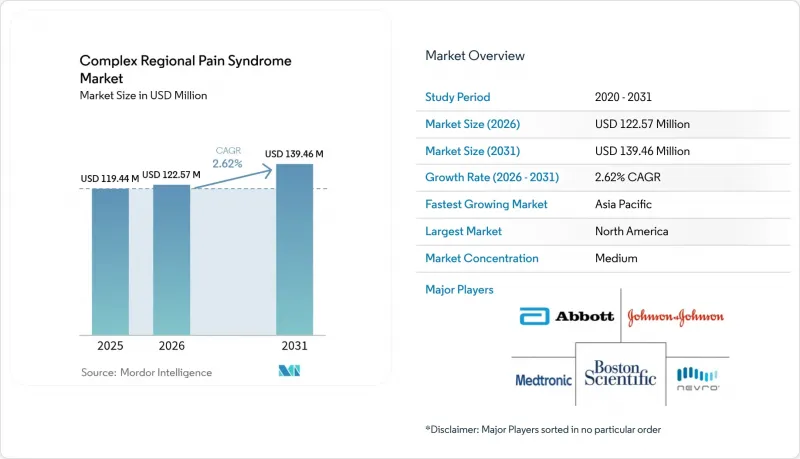
This report is Segmented by Disease Type (CRPS I, CRPS II, CRPS-NOS), Therapy Type (Drugs, Neuromodulation, Surgical Sympathectomy, Others), Age Group (Adults, Pediatric, Geriatric), Disease Stage (Early Stage CRPS, Late Stage CRPS), and Geography (North America, Europe, Asia-Pacific, Middle East and Africa, South America). The Market Forecasts are Provided in Terms of Value (USD).
Global Complex Regional Pain Syndrome Market Trends and Insights
Rising Incidence Following Orthopedic & Trauma Surgeries
Insurance data covering 85,862 orthopedic procedures documented a 0.34% CRPS rate overall, with upper-limb operations carrying a 0.60% risk and lower-limb surgery 0.20% . Distal radius fractures remain a focal concern, registering CRPS-I rates up to 37% in prospective series. Global population aging drives higher fracture and joint-replacement volumes, enlarging the Complex Regional Pain Syndrome market as new cases emerge. Diagnostic delays in pediatrics still range from 4 to 90 days, underscoring unmet clinical education needs. Broader application of Budapest criteria, together with imaging advances, is expected to improve early detection and further expand documented prevalence.
The Growing Chronic Pain Population Seeking Long-Term Relief
Chronic pain affects nearly 30% of US adults and imposes USD 500-600 billion in annual economic costs, intensifying demand for durable, non-opioid solutions. Surveyed Korean patients reported 48.07% unmet rehabilitation needs, emphasizing deficits beyond analgesia, such as memory and weight management support. Cognitive and social burdens heighten interest in mechanism-based treatments that target neuro-immune dysregulation rather than masking symptoms. Biomarker research involving microRNAs and inflammatory mediators paves the way for personalized regimens and underpins wider adoption of precision-guided neuromodulation . These shifts align with payer incentives to curb opioid use, reinforcing steady uptake within the Complex Regional Pain Syndrome market.
Low Disease Awareness in Emerging Economies
International clinician surveys cite fragmented care pathways and shortage of pain specialists as root causes of delayed CRPS diagnosis across Europe. Ecuador's public hospitals exemplify resource scarcity, frequently lacking local anesthetics and palliative medicines because of fiscal constraints. Nordic and German pediatric centers manage only a handful of CRPS cases yearly, with 43% lacking dedicated multidisciplinary teams. Absence of standardized training perpetuates misdiagnosis, allowing symptoms to progress and limiting early-stage intervention. Consequently, latent demand remains sizable yet unrealized in many territories, restraining Complex Regional Pain Syndrome market expansion.
Other drivers and restraints analyzed in the detailed report include:
- Expanding Adoption of Closed-Loop & DRG Neuromodulation
- Favorable Reimbursement Updates for Implantable SCS in the US & EU
- High Upfront Cost of Neuromodulation Devices & Limited Payor Coverage
For complete list of drivers and restraints, kindly check the Table Of Contents.
Segment Analysis
CRPS I accounted for 64.02% of Complex Regional Pain Syndrome market share in 2025, anchored by its higher post-trauma prevalence. Clinic registries show women aged 50-70 represent nearly 70% of new CRPS I diagnoses, reinforcing predictable demand in orthopedics and rehabilitation settings. CRPS II, once termed causalgia, posts the quickest 3.32% CAGR as improved imaging pinpoints nerve injury and eligibility for DRG stimulation expands.
Historically, limited objective diagnostics masked CRPS II incidence, but PET/MRI visualization of Sigma-1 receptors now raises detection accuracy. Breath-analysis "electronic nose" studies demonstrating 81% diagnostic precision further promise earlier subtype confirmation. Personalized protocols based on inflammatory and vasomotor profiles enable mechanism-aligned therapy selection, bolstering future revenue diversity in the Complex Regional Pain Syndrome market.
Drug therapy retained 47.35% of Complex Regional Pain Syndrome market size in 2025, yet neuromodulation leads growth at 3.33% CAGR. Common analgesics, including NSAIDs and opioids, show limited CRPS efficacy, prompting physicians to escalate quickly to interventional solutions.
Neuromodulation's clinical traction stems from strong responder data, such as 81.2% success with DRG devices. Medtronic's closed-loop Inceptiv and Abbott's Proclaim systems shape competitive dynamics by offering adaptive or disease-specific programming. The January 2025 FDA nod for suzetrigine introduced the first NaV1.8 inhibitor for acute pain, though its chronic use profile remains under review. Stem-cell protocols funded by a USD 5.5 million NIH grant target neuro-immune modulation and could provide the first disease-modifying option, illustrating the technology breadth now fueling the Complex Regional Pain Syndrome market.
Complete Report Scope:
- By Disease Type
- CRPS I
- CRPS II
- CRPS-NOS
- By Therapy Type
- Drugs
- Analgesics
- Antidepressants
- Corticosteroids
- Others
- Neuromodulation
- Spinal Cord Stimulation (SCS)
- Dorsal Root Ganglion Stimulation
- Surgical Sympathectomy
- Others
- Drugs
- By Age Group
- Adults
- Pediatric
- Geriatric
- By Disease Stage
- Early Stage CRPS
- Late Stage CRPS
- By Geography
- North America
- United States
- Canada
- Mexico
- Europe
- Germany
- United Kingdom
- France
- Italy
- Spain
- Rest of Europe
- Asia-Pacific
- China
- Japan
- India
- Australia
- South Korea
- Rest of Asia-Pacific
- Middle East and Africa
- GCC
- South Africa
- Rest of Middle East and Africa
- South America
- Brazil
- Argentina
- Rest of South America
- North America
Geography Analysis
North America led with 41.88% of the Complex Regional Pain Syndrome market in 2025 owing to sophisticated care networks, high surgical volumes, and payer coverage for DRG and spinal stimulation. Recent FDA approvals of AI-enabled systems further enhance therapeutic options. Canada mirrors US practice patterns, leveraging provincial plans to reimburse Abbott's neuromodulation suite. Mexico remains nascent as infrastructure and specialist density evolve, signaling upside once training and reimbursement mature.
Europe exhibits mature but uneven adoption. Germany integrates CRPS care within structured pain centers, whereas Nordic countries report pediatric resource gaps despite national health coverage. Brexit-era policy changes only modestly affect device approval timelines, and continental reimbursement remains comparatively generous. Nonetheless, surveys reveal fragmented pathways and delayed referrals, suggesting operational-not regulatory-barriers curb full market realization.
Asia-Pacific is the fastest-growing region at 3.45% CAGR, propelled by expanding middle-class access to surgery and diagnostic imaging. Still, large treatment gaps persist in emerging economies where pain services are scarce. Traditional remedies, including Chinese herbal preparations for CRPS foot pain, coexist with modern implants. Australia and Japan act as regional technology bellwethers, adopting closed-loop stimulators soon after US launch. Long-term upside remains tied to payer reform and specialist training, keeping the Complex Regional Pain Syndrome market outlook robust yet varied across the continent.
- Abbott Laboratories
- Boston Scientific
- Medtronic
- Johnson & Johnson
- Pfizer
- GlaxoSmithKline
- Viatris
- Nevro
- ICU Medical
- Sanofi
- Novartis
- Eli Lilly and Company
- AstraZeneca
- Teva Pharmaceutical Industries
- Grunenthal GmbH
- Purdue Pharma
- Soin Therapeutics (JanOne)
- PharmaTher Holdings
- Sorrento Therapeutics
- Vertex Pharmaceuticals
Additional Benefits:
- The market estimate (ME) sheet in Excel format
- 3 months of analyst support
TABLE OF CONTENTS
1 Introduction
- 1.1 Study Assumptions & Market Definition
- 1.2 Scope of the Study
2 Research Methodology
3 Executive Summary
4 Market Landscape
- 4.1 Market Overview
- 4.2 Market Drivers
- 4.2.1 Rising Incidence Following Orthopedic & Trauma Surgeries
- 4.2.2 The growing Chronic Pain Population Seeking Long-Term Relief
- 4.2.3 Expanding Adoption of Closed-Loop & DRG Neuromodulation
- 4.2.4 Favorable Reimbursement Updates for Implantable SCS In the US & EU
- 4.2.5 Auto-Immune Insights Driving IVIG & Mab Pipeline Activity
- 4.2.6 Wearable Biosensors Enabling Objective Pain Biomarkers
- 4.3 Market Restraints
- 4.3.1 Low Disease Awareness in Emerging Economies
- 4.3.2 High Upfront Cost of Neuromodulation Devices & Limited Payor Coverage
- 4.3.3 Regulatory Caution Over Psychedelic-Based Analgesics
- 4.3.4 Semiconductor & Battery Supply Constraints for Next-Gen Implants
- 4.4 Regulatory Landscape
- 4.5 Technological Outlook
- 4.6 Porters Five Forces Analysis
- 4.6.1 Threat of New Entrants
- 4.6.2 Bargaining Power of Buyers
- 4.6.3 Bargaining Power of Suppliers
- 4.6.4 Threat of Substitutes
- 4.6.5 Intensity of Competitive Rivalry
5 Market Size & Growth Forecasts (Value, USD)
- 5.1 By Disease Type
- 5.1.1 CRPS I
- 5.1.2 CRPS II
- 5.1.3 CRPS-NOS
- 5.2 By Therapy Type
- 5.2.1 Drugs
- 5.2.1.1 Analgesics
- 5.2.1.2 Antidepressants
- 5.2.1.3 Corticosteroids
- 5.2.1.4 Others
- 5.2.2 Neuromodulation
- 5.2.2.1 Spinal Cord Stimulation (SCS)
- 5.2.2.2 Dorsal Root Ganglion Stimulation
- 5.2.3 Surgical Sympathectomy
- 5.2.4 Others
- 5.2.1 Drugs
- 5.3 By Age Group
- 5.3.1 Adults
- 5.3.2 Pediatric
- 5.3.3 Geriatric
- 5.4 By Disease Stage
- 5.4.1 Early Stage CRPS
- 5.4.2 Late Stage CRPS
- 5.5 By Geography
- 5.5.1 North America
- 5.5.1.1 United States
- 5.5.1.2 Canada
- 5.5.1.3 Mexico
- 5.5.2 Europe
- 5.5.2.1 Germany
- 5.5.2.2 United Kingdom
- 5.5.2.3 France
- 5.5.2.4 Italy
- 5.5.2.5 Spain
- 5.5.2.6 Rest of Europe
- 5.5.3 Asia-Pacific
- 5.5.3.1 China
- 5.5.3.2 Japan
- 5.5.3.3 India
- 5.5.3.4 Australia
- 5.5.3.5 South Korea
- 5.5.3.6 Rest of Asia-Pacific
- 5.5.4 Middle East and Africa
- 5.5.4.1 GCC
- 5.5.4.2 South Africa
- 5.5.4.3 Rest of Middle East and Africa
- 5.5.5 South America
- 5.5.5.1 Brazil
- 5.5.5.2 Argentina
- 5.5.5.3 Rest of South America
- 5.5.1 North America
6 Competitive Landscape
- 6.1 Market Concentration
- 6.2 Market Share Analysis
- 6.3 Company Profiles (includes Global level Overview, Market level overview, Core Segments, Financials as available, Strategic Information, Market Rank/Share for key companies, Products & Services, and Recent Developments)
- 6.3.1 Abbott
- 6.3.2 Boston Scientific Corporation
- 6.3.3 Medtronic
- 6.3.4 Johnson & Johnson
- 6.3.5 Pfizer Inc.
- 6.3.6 GSK plc
- 6.3.7 Viatris Inc.
- 6.3.8 Nevro Corp.
- 6.3.9 ICU Medical
- 6.3.10 Sanofi
- 6.3.11 Novartis AG
- 6.3.12 Eli Lilly & Co.
- 6.3.13 AstraZeneca
- 6.3.14 Teva Pharmaceutical Industries
- 6.3.15 Grunenthal GmbH
- 6.3.16 Purdue Pharma
- 6.3.17 Soin Therapeutics (JanOne)
- 6.3.18 PharmaTher Holdings
- 6.3.19 Sorrento Therapeutics
- 6.3.20 Vertex Pharmaceuticals
7 Market Opportunities & Future Outlook
- 7.1 White-space & Unmet-need Assessment

