PUBLISHER: Mordor Intelligence | PRODUCT CODE: 2114849

PUBLISHER: Mordor Intelligence | PRODUCT CODE: 2114849
Clean Coal Technology - Market Share Analysis, Industry Trends & Statistics, Growth Forecasts (2026 - 2031)
According to Mordor Intelligence, clean coal technology market size in 2026 is estimated at USD 4.85 billion, growing from 2025 value of USD 4.57 billion with 2031 projections showing USD 6.52 billion, growing at 6.12% CAGR over 2026-2031.
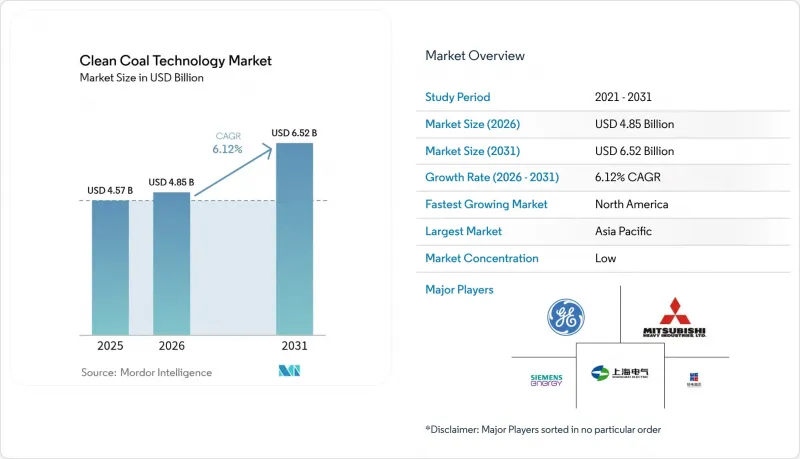
This report is Segmented by Technology (Subcritical, Supercritical, Ultra-Supercritical, Circulating Fluidized Bed Combustion, Oxy-Fuel Combustion, and More), Component (Equipment and Services), End-User Industry (Power Utilities, Iron and Steel, Cement, Chemicals and Fertilizers, and District Heating), and Geography (North America, Europe, Asia-Pacific, South America, and Middle East and Africa).
Global Clean Coal Technology Market Trends and Insights
Stricter Emission Norms Accelerating Adoption of HELE Plants
Global regulators now require existing coal units to achieve significant CO2 reduction milestones, triggering immediate demand for supercritical and ultra-supercritical retrofits. The U.S. Environmental Protection Agency's 2024 rule requires 90% capture by 2032 or retirement by 2039, effectively prioritizing HELE upgrades over conventional refurbishments. China's September 2024 directive emphasizes advanced combustion and management practices to curb pollutants while maintaining grid reliability. Europe treats HELE as a transitional asset class that bridges near-term security needs and 2050 net-zero targets. Utilities thus favor efficiency-centric investments where renewables alone cannot yet guarantee 24/7 service. The result is a growing project pipeline for high-efficiency boilers, turbines, and associated CCUS integration across mature and developing grids.
Government Incentives & Tax Credits for CCUS Retrofits
Public-sector funding is reshaping the commercial calculus for carbon capture and storage. The United States offers up to USD 85 per ton via 45Q, while the Department of Energy earmarked USD 1.3 billion for plant-scale capture projects in 2024. Canada committed CAD 21.5 million (USD 15.8 million) in 2025 to develop transport and storage hubs in Alberta. The European Union's Innovation Fund allocated EUR 220 million to cement-sector capture initiatives, indicating technology spillovers beyond power generation. With improved internal rates of return, private investors are allocating increasing capital to retrofit programs, thereby accelerating commercialization timelines. These incentives jointly lower financial risk and encourage developers to scale pilot plants into full commercial operations.
Rapid Cost Declines of Solar-Plus-Storage Alternatives
Falling costs in solar photovoltaics and battery storage squeeze the value proposition of certain coal upgrades. Lazard's 2024 LCOE study shows that renewables are widening their cost advantage, although baseload needs keep coal competitive in grid stability roles. Higher interest rates have slowed some renewable energy buildouts; however, financing costs in developing markets remain a pivotal determinant of technology choice, as evidenced by peer-reviewed research in Nature Energy. Water requirements also factor in: CCUS integration can raise plant water consumption, a disadvantage in arid regions. Nonetheless, coal facilities continue to deliver dispatchable power and high-temperature process heat, maintaining their relevance despite the momentum of renewable energy.
Other drivers and restraints analyzed in the detailed report include:
- Surging Baseload Demand in Emerging Asia Requiring Coal Fleet Upgrades
- Hydrogen-Ready Retrofits of USC Boilers
- ESG-Driven Financing Constraints for New Coal Projects
For complete list of drivers and restraints, kindly check the Table Of Contents.
Segment Analysis
Ultra-supercritical systems registered the quickest uptake at an 17.26% CAGR through 2031, benefiting from efficiencies that surpass 45% and cut fuel consumption per kilowatt-hour. Supercritical platforms maintained their leadership position with a 44.02% share of the Clean Coal Technology market in 2025, supported by proven supply chains and lower integration risk. Circulating fluidized bed units remain popular in markets handling variable coal grades, offering intrinsic sulfur capture that eases environmental compliance. The Clean Coal Technology market size for IGCC and oxy-fuel configurations is poised for gradual acceleration as carbon capture mandates ramp up, with GE Vernova's Edwardsport IGCC plant highlighting operational viability and steady emissions performance. Post-combustion retrofit packages, especially modular solid-sorbent and amine systems, offer faster deployment for plants constrained by boiler refurbish windows.
Subcritical technology, constrained by efficiencies of around 35%, continues to cede ground; yet, units under 300 MW still find acceptance in emerging areas that require low-complexity builds. The technology mix is also shaped by fuel transport logistics and local emission norms, prompting many operators to adopt circulating fluidized bed combustion for flexible fuel portfolios. Oxy-fuel and chemical looping pilots underscore future-readiness but await broader cost improvements. Overall, innovation in high-temperature materials and digital-twin predictive models continues to enhance the Clean Coal Technology market, enabling life-extension pathways and incremental emission reductions without compromising grid reliability.
Complete Report Scope:
- By Technology
- Subcritical
- Supercritical
- Ultra-supercritical
- Circulating Fluidized Bed Combustion (CFB)
- Integrated Gasification Combined Cycle (IGCC)
- Oxy-fuel Combustion
- Post-combustion Capture Retrofits
- By Component
- Equipment
- Boilers and Furnaces
- Steam Turbines and Generators
- Pollution-control Systems (FGD, SCR, etc.)
- Carbon-capture Systems
- Control and Instrumentation
- Services
- Engineering, Procurement and Construction (EPC)
- Operations and Maintenance (OandM)
- Equipment
- By End-User Industry
- Power Utilities
- Iron and Steel
- Cement
- Chemicals and Fertilizers
- District Heating
- By Geography
- North America
- United States
- Canada
- Mexico
- Europe
- Germany
- United Kingdom
- France
- Italy
- NORDIC Countries
- Russia
- Rest of Europe
- Asia-Pacific
- China
- India
- Japan
- South Korea
- ASEAN Countries
- Rest of Asia-Pacific
- South America
- Brazil
- Argentina
- Rest of South America
- Middle East and Africa
- Saudi Arabia
- United Arab Emirates
- South Africa
- Egypt
- Rest of Middle East and Africa
- North America
Geography Analysis
The Asia-Pacific region commanded 38.85% of 2025 revenue, thanks to extensive modernization programs in China and India that support rapid industrial growth while aligning with updated efficiency mandates. National policies encourage retrofit over retirement, so operators pursue supercritical and ultra-supercritical conversions alongside first-wave CCUS pilots. Government facilitation in permitting and grid tariff adjustments further accelerates the adoption of advanced equipment within the Clean Coal Technology market.
North America ranks as the fastest-growing region, with an 8.12% projected CAGR through 2031, driven by the United States' generous 45Q credit, USD 1.3 billion in federal funding, and Canadian provincial incentives for capture and storage infrastructure. Demonstration projects such as Louisiana's USD 4.5 billion clean-energy complex illustrate the scale of private capital willing to co-invest under supportive policy frameworks. These measures reduce risk premiums and catalyze a robust EPC and services ecosystem.
Europe presents a mixed outlook: outright coal phase-outs proceed in some Western markets, yet selective CCUS retrofits emerge in nations balancing security-of-supply concerns. The EU Innovation Fund's EUR 220 million disbursement to multiple projects underscores its commitment to capturing technology across cement, waste-to-energy, and legacy coal assets. South American, Middle Eastern, and African markets are adopting a more cautious stance due to capital scarcity and evolving policy environments, although industrial users in Brazil and South Africa are evaluating CCUS for steel and chemicals applications amid tightening carbon-border measures. Overall, regional divergences create a mosaic of opportunity sets that vendors must address via flexible offerings.
- General Electric Company
- Siemens Energy AG
- Mitsubishi Heavy Industries Ltd
- Harbin Electric Co Ltd
- Shanghai Electric Group Co Ltd
- Dongfang Electric Corporation
- Babcock & Wilcox Enterprises Inc
- Alstom SA
- KBR Inc
- Shell PLC
- Doosan Enerbility Co Ltd
- Fluor Corporation
- Exxon Mobil Corporation
- Andritz AG
- Bharat Heavy Electricals Ltd (BHEL)
- Sumitomo SHI FW
- Hitachi Zosen Corporation
- NET Power LLC
- Linde plc
Additional Benefits:
- The market estimate (ME) sheet in Excel format
- 3 months of analyst support
TABLE OF CONTENTS
1 Introduction
- 1.1 Study Assumptions & Market Definition
- 1.2 Scope of the Study
2 Research Methodology
3 Executive Summary
4 Market Landscape
- 4.1 Market Overview
- 4.2 Market Drivers
- 4.2.1 Stricter emission norms accelerating adoption of HELE plants
- 4.2.2 Government incentives & tax credits for CCUS retrofits
- 4.2.3 Surging baseload demand in emerging Asia requiring coal fleet upgrades
- 4.2.4 Hydrogen-ready retrofits of USC boilers
- 4.2.5 Synthetic fuel co-firing mandates in Japan & South Korea
- 4.2.6 Advanced process-control software boosting plant thermal efficiency
- 4.3 Market Restraints
- 4.3.1 Rapid cost declines of solar-plus-storage alternatives
- 4.3.2 ESG-driven financing constraints for new coal projects
- 4.3.3 Global shortage of nickel-based alloys for AUSC plants
- 4.3.4 Water-stress limits in key coal basins
- 4.4 Supply-Chain Analysis
- 4.5 Regulatory Landscape
- 4.6 Technological Outlook
- 4.7 Porter's Five Forces
- 4.7.1 Bargaining Power of Suppliers
- 4.7.2 Bargaining Power of Consumers
- 4.7.3 Threat of New Entrants
- 4.7.4 Threat of Substitutes
- 4.7.5 Intensity of Competitive Rivalry
5 Market Size & Growth Forecasts
- 5.1 By Technology
- 5.1.1 Subcritical
- 5.1.2 Supercritical
- 5.1.3 Ultra-supercritical
- 5.1.4 Circulating Fluidized Bed Combustion (CFB)
- 5.1.5 Integrated Gasification Combined Cycle (IGCC)
- 5.1.6 Oxy-fuel Combustion
- 5.1.7 Post-combustion Capture Retrofits
- 5.2 By Component
- 5.2.1 Equipment
- 5.2.1.1 Boilers and Furnaces
- 5.2.1.2 Steam Turbines and Generators
- 5.2.1.3 Pollution-control Systems (FGD, SCR, etc.)
- 5.2.1.4 Carbon-capture Systems
- 5.2.1.5 Control and Instrumentation
- 5.2.2 Services
- 5.2.2.1 Engineering, Procurement and Construction (EPC)
- 5.2.2.2 Operations and Maintenance (OandM)
- 5.2.1 Equipment
- 5.3 By End-User Industry
- 5.3.1 Power Utilities
- 5.3.2 Iron and Steel
- 5.3.3 Cement
- 5.3.4 Chemicals and Fertilizers
- 5.3.5 District Heating
- 5.4 By Geography
- 5.4.1 North America
- 5.4.1.1 United States
- 5.4.1.2 Canada
- 5.4.1.3 Mexico
- 5.4.2 Europe
- 5.4.2.1 Germany
- 5.4.2.2 United Kingdom
- 5.4.2.3 France
- 5.4.2.4 Italy
- 5.4.2.5 NORDIC Countries
- 5.4.2.6 Russia
- 5.4.2.7 Rest of Europe
- 5.4.3 Asia-Pacific
- 5.4.3.1 China
- 5.4.3.2 India
- 5.4.3.3 Japan
- 5.4.3.4 South Korea
- 5.4.3.5 ASEAN Countries
- 5.4.3.6 Rest of Asia-Pacific
- 5.4.4 South America
- 5.4.4.1 Brazil
- 5.4.4.2 Argentina
- 5.4.4.3 Rest of South America
- 5.4.5 Middle East and Africa
- 5.4.5.1 Saudi Arabia
- 5.4.5.2 United Arab Emirates
- 5.4.5.3 South Africa
- 5.4.5.4 Egypt
- 5.4.5.5 Rest of Middle East and Africa
- 5.4.1 North America
6 Competitive Landscape
- 6.1 Market Concentration
- 6.2 Strategic Moves (M&A, Partnerships, PPAs)
- 6.3 Market Share Analysis (Market Rank/Share for key companies)
- 6.4 Company Profiles (includes Global level Overview, Market level overview, Core Segments, Financials as available, Strategic Information, Products & Services, and Recent Developments)
- 6.4.1 General Electric Company
- 6.4.2 Siemens Energy AG
- 6.4.3 Mitsubishi Heavy Industries Ltd
- 6.4.4 Harbin Electric Co Ltd
- 6.4.5 Shanghai Electric Group Co Ltd
- 6.4.6 Dongfang Electric Corporation
- 6.4.7 Babcock & Wilcox Enterprises Inc
- 6.4.8 Alstom SA
- 6.4.9 KBR Inc
- 6.4.10 Shell PLC
- 6.4.11 Doosan Enerbility Co Ltd
- 6.4.12 Fluor Corporation
- 6.4.13 Exxon Mobil Corporation
- 6.4.14 Andritz AG
- 6.4.15 Bharat Heavy Electricals Ltd (BHEL)
- 6.4.16 Sumitomo SHI FW
- 6.4.17 Hitachi Zosen Corporation
- 6.4.18 NET Power LLC
- 6.4.19 Linde plc
7 Market Opportunities & Future Outlook
- 7.1 White-space & Unmet-need Assessment

