PUBLISHER: Mordor Intelligence | PRODUCT CODE: 2114860

PUBLISHER: Mordor Intelligence | PRODUCT CODE: 2114860
Boat And Ship Telematics - Market Share Analysis, Industry Trends & Statistics, Growth Forecasts (2026 - 2031)
According to Mordor Intelligence, the boat and Ship Telematics market size is expected to grow from USD 5.56 billion in 2025 to USD 6.08 billion in 2026 and is forecast to reach USD 9.51 billion by 2031 at 9.38% CAGR over 2026-2031.
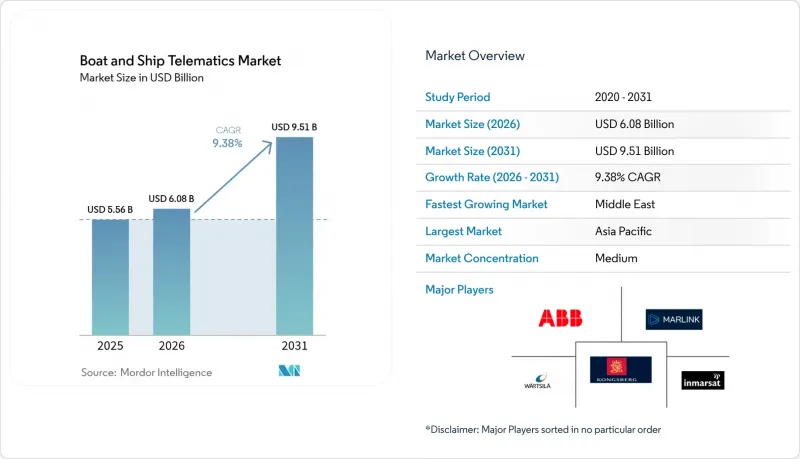
This report is Segmented by Application (Commercial, Private and Recreational, and More), Function (Navigation, Communication, and More), Component (Hardware, and More), Vessel Type (Cargo and Container Ships, and More), Communication Technology (Satellite, and More), and Geography. The Market Forecasts are Provided in Terms of Value (USD).
Global Boat And Ship Telematics Market Trends and Insights
Real-Time Fleet-Wide Visibility Demand
Operators now integrate multi-sensor platforms that track position, fuel burn, and cargo status each minute. Weathernews processes routing data from 5,000 ships monthly, enabling managers to reroute around storms and slash operating costs by up to 15% . IoT devices funnel data through satellite and 5G pipelines into cloud dashboards where analytics flag anomalies before they escalate. The result is a shift from reactive to proactive decisions that protect schedules and margins. Autonomous-vessel trials intensify this need by requiring continuous situational awareness for safe remote control.
Stringent IMO/SOLAS Compliance Push
Revised SOLAS Chapter IV obliges all cargo ships over 300 GT to transmit identity and position every six hours, widening the addressable boat and ship telematics market . LRIT subscribers exceeded 46,000 vessels in 2024, generating strong demand for secure L-band channels. Compliance now extends to cyber-risk audits and emissions reporting, pushing owners toward integrated platforms that automatically log Carbon Intensity Indicator scores for regulators.
High CAPEX and Bandwidth Costs
Full-suite installations can top USD 50,000 per ship when VSAT, 5G modems, sensors, and crew training are rolled together. Monthly data fees above USD 10,000 strain budgets of operators running slim margins. Although LEO competition is pushing tariffs down, new antennas and network-management software still require capital that many small firms postpone, slowing penetration of the boat and ship telematics market.
Other drivers and restraints analyzed in the detailed report include:
- Satellite-IoT Coverage Expansion
- AI-Powered Predictive Maintenance Value
- Maritime Cyber-Risk Exposure
For complete list of drivers and restraints, kindly check the Table Of Contents.
Segment Analysis
Commercial vessels accounted for 47.12% of the boat and ship telematics market share in 2025 as cargo lines adopted mandatory tracking and fuel-optimization suites. Higher bunker prices pushed owners to integrate weather-routing algorithms that saved up to 15% on voyage costs, converting telematics from compliance expense to a profit lever. The defense segment, though smaller, is expanding at an 11.02% CAGR as navies roll out uncrewed surface vessels that depend on encrypted sensor backhauls. Thales' Tacticos system now equips 25 navies, illustrating how military demand accelerates secure data-fusion capabilities. Passenger and leisure craft follow suit, with insurers offering lower premiums for connected yachts, deepening consumer adoption.
The boat and ship telematics market size for commercial operators is projected to advance steadily as ports enforce digital document exchange and emissions logging. Meanwhile, defense budgets earmark funds for integrated threat detection, propelling the specialized software layer. Recreational adoption remains fragmented yet is gathering pace as platforms like Yacht Sentinel report thousands of new activations each quarter.
Communication services held 37.88% of the boat and ship telematics market revenue in 2025, reflecting the basic need for dependable links between ship and shore. Hybrid terminals that auto-switch among L-band, Ku-band, and cellular channels minimize blackouts and cost spikes. Data-collection and analytics functions display the fastest 9.87% CAGR due to AI modules that transform raw engine feeds into predictive alerts. Kongsberg Digital's Vessel Insight funnels signals from hundreds of sensors into unified dashboards that chart fuel, trim, and maintenance risk. Navigation and monitoring tools piggyback on this expanding data pipe, driving multipurpose deployment aboard workboats and cruise ships.
Elevated fuel standards will continue to shift spending toward analytics that fine-tune hull and route performance. As a result, the boat and ship telematics market size devoted to advanced analytics is on track to double before 2031, squeezing pure-play communication margins and nudging suppliers toward value-added software.
Complete Report Scope:
- By Application
- Commercial
- Private/Recreational
- Defense and Security
- By Function
- Navigation
- Communication
- Monitoring and Diagnostics
- Data Collection and Analytics
- By Component
- Hardware
- Sensors and Antennas
- On-board Terminals
- Software and Platforms
- Hardware
- By Vessel Type
- Cargo and Container Ships
- Tankers
- Passenger and Cruise
- Workboats and Offshore Support
- Yachts & Leisure Craft
- By Communication Technology
- Satellite (LEO/MEO/GEO)
- Cellular/5G
- Hybrid and Mesh Networks
- By Geography
- North America
- United States
- Canada
- Rest of North America
- South America
- Brazil
- Argentina
- Rest of South America
- Europe
- United Kingdom
- Germany
- France
- Spain
- Italy
- Russia
- Rest of Europe
- Asia-Pacific
- China
- Japan
- India
- South Korea
- Indonesia
- Malaysia
- Australia
- New Zealand
- Rest of Asia-Pacific
- Middle East & Africa
- Saudi Arabia
- United Arab Emirates
- Egypt
- Turkey
- South Africa
- Rest of Middle East and Africa
- North America
Geography Analysis
Asia-Pacific retained the largest 36.55% of the boat and ship telematics market share in 2025 as China's RCEP-aligned digital transformation and Singapore's smart-port investments made connected-vessel capabilities a de facto operating standard. Public-private projects link 5G coastal corridors with low-earth-orbit satellites, giving fleets continuous coverage from berth to mid-ocean and supporting real-time fuel-efficiency apps that cut bunker consumption by up to 15%. Japan and South Korea pilot autonomous coastal carriers that need sub-50 ms latency, adding demand for multi-sensor gateways and cyber-secure clouds. Australia and New Zealand reinforce the region's leadership by mandating emissions-tracking uploads before port entry, which pushes smaller operators to adopt subscription-based telematics platforms. As a result, Asia-Pacific's boat and ship telematics market size is projected to widen its lead through 2030, even as growth moderates from double-digit rates.
The Middle East and Africa post the fastest 9.95% CAGR to 2031, helped by the UAE's AI-enabled logistics corridors and Saudi Arabia's Vision 2030 spending on new deep-water terminals. Gulf operators also leverage hybrid satellite 5G bundles that cut data costs by 40%, making enterprise-grade connectivity accessible to midsize fleets. In Africa, South Africa and Nigeria deploy coastal surveillance nets that blend AIS, radar, and drone feeds, stimulating demand for modular hardware kits that integrate with cloud analytics. As oil majors resume offshore exploration, workboat owners across Angola and Ghana adopt predictive-maintenance software to minimize downtime in remote fields.
Europe and North America show steady replacement demand as regulations tighten on carbon intensity and cyber-risk management. Norway's autonomous-tug trials and Baltic 5G ferry corridors keep the regions at the forefront of technology pilots, even though overall spending rises at mid-single-digit rates. South America gradually scales telematics as Brazilian port-community systems require voyage-data uploads before pilotage, while Pacific Alliance nations co-invest in satellite gateways that improve coverage along high-current routes. Collectively, these trailing regions ensure the boat and ship telematics market continues to diversify geographically, reducing over-reliance on any single trade lane and encouraging vendors to localize support hubs and pricing models.
- Technoton
- Applied Satellite Technology Ltd (AST MSL)
- Sentinel Marine Solutions (Sentinel d.o.o.)
- Cybernetica AS
- Traxens SA
- Metocean Solutions
- Market Spectrum Inc.
- Kongsberg Digital Ltd.
- ABB Marine & Ports Ltd. (ABB Ltd.)
- Wartsila Corporation
- Rolls-Royce Power Systems AG
- Marlink SAS
- Inmarsat Global Limited
- ORBCOMM Inc.
- Garmin Ltd. (Garmin Marine)
- Navico Group (Simrad/B&G)
Additional Benefits:
- The market estimate (ME) sheet in Excel format
- 3 months of analyst support
TABLE OF CONTENTS
1 Introduction
- 1.1 Study Assumptions & Market Definition
- 1.2 Scope of the Study
2 Research Methodology
3 Executive Summary
4 Market Landscape
- 4.1 Market Overview
- 4.2 Market Drivers
- 4.2.1 Real-Time Fleet-Wide Visibility Demand
- 4.2.2 Stringent IMO/SOLAS Compliance Push
- 4.2.3 Satellite-Iot Coverage Expansion
- 4.2.4 Growth In Global Seaborne Trade
- 4.2.5 Insurance Premium Incentives for Connected Vessels
- 4.2.6 AI-Powered Predictive Maintenance Value
- 4.3 Market Restraints
- 4.3.1 High Cap-Ex and Bandwidth Costs
- 4.3.2 Maritime Cyber-Risk Exposure
- 4.3.3 Shortage of Maritime Data Scientists
- 4.3.4 RF Spectrum Congestion In Busy Sea-Lanes
- 4.4 Value / Supply-Chain Analysis
- 4.5 Regulatory Landscape
- 4.6 Technological Outlook
- 4.7 Porter's Five Forces
- 4.7.1 Threat of New Entrants
- 4.7.2 Bargaining Power of Buyers
- 4.7.3 Bargaining Power of Suppliers
- 4.7.4 Threat of Substitutes
- 4.7.5 Intensity of Rivalry
5 Market Size & Growth Forecasts (Value, USD)
- 5.1 By Application
- 5.1.1 Commercial
- 5.1.2 Private/Recreational
- 5.1.3 Defense and Security
- 5.2 By Function
- 5.2.1 Navigation
- 5.2.2 Communication
- 5.2.3 Monitoring and Diagnostics
- 5.2.4 Data Collection and Analytics
- 5.3 By Component
- 5.3.1 Hardware
- 5.3.1.1 Sensors and Antennas
- 5.3.1.2 On-board Terminals
- 5.3.2 Software and Platforms
- 5.3.1 Hardware
- 5.4 By Vessel Type
- 5.4.1 Cargo and Container Ships
- 5.4.2 Tankers
- 5.4.3 Passenger and Cruise
- 5.4.4 Workboats and Offshore Support
- 5.4.5 Yachts & Leisure Craft
- 5.5 By Communication Technology
- 5.5.1 Satellite (LEO/MEO/GEO)
- 5.5.2 Cellular/5G
- 5.5.3 Hybrid and Mesh Networks
- 5.6 By Geography
- 5.6.1 North America
- 5.6.1.1 United States
- 5.6.1.2 Canada
- 5.6.1.3 Rest of North America
- 5.6.2 South America
- 5.6.2.1 Brazil
- 5.6.2.2 Argentina
- 5.6.2.3 Rest of South America
- 5.6.3 Europe
- 5.6.3.1 United Kingdom
- 5.6.3.2 Germany
- 5.6.3.3 France
- 5.6.3.4 Spain
- 5.6.3.5 Italy
- 5.6.3.6 Russia
- 5.6.3.7 Rest of Europe
- 5.6.4 Asia-Pacific
- 5.6.4.1 China
- 5.6.4.2 Japan
- 5.6.4.3 India
- 5.6.4.4 South Korea
- 5.6.4.5 Indonesia
- 5.6.4.6 Malaysia
- 5.6.4.7 Australia
- 5.6.4.8 New Zealand
- 5.6.4.9 Rest of Asia-Pacific
- 5.6.5 Middle East & Africa
- 5.6.5.1 Saudi Arabia
- 5.6.5.2 United Arab Emirates
- 5.6.5.3 Egypt
- 5.6.5.4 Turkey
- 5.6.5.5 South Africa
- 5.6.5.6 Rest of Middle East and Africa
- 5.6.1 North America
6 Competitive Landscape
- 6.1 Market Concentration
- 6.2 Strategic Moves
- 6.3 Market Share Analysis
- 6.4 Company Profiles (includes Global Level Overview, Market Level Overview, Core Segments, Financials as Available, Strategic Information, Market Rank/Share for Key Companies, Products and Services, SWOT Analysis, and Recent Developments)
- 6.4.1 Technoton
- 6.4.2 Applied Satellite Technology Ltd (AST MSL)
- 6.4.3 Sentinel Marine Solutions (Sentinel d.o.o.)
- 6.4.4 Cybernetica AS
- 6.4.5 Traxens SA
- 6.4.6 Metocean Solutions
- 6.4.7 Market Spectrum Inc.
- 6.4.8 Kongsberg Digital Ltd.
- 6.4.9 ABB Marine & Ports Ltd. (ABB Ltd.)
- 6.4.10 Wartsila Corporation
- 6.4.11 Rolls-Royce Power Systems AG
- 6.4.12 Marlink SAS
- 6.4.13 Inmarsat Global Limited
- 6.4.14 ORBCOMM Inc.
- 6.4.15 Garmin Ltd. (Garmin Marine)
- 6.4.16 Navico Group (Simrad/B&G)
7 Market Opportunities & Future Outlook

