PUBLISHER: Mordor Intelligence | PRODUCT CODE: 2114862

PUBLISHER: Mordor Intelligence | PRODUCT CODE: 2114862
Automotive Blockchain - Market Share Analysis, Industry Trends & Statistics, Growth Forecasts (2026 - 2031)
According to Mordor Intelligence, the automotive blockchain market size is expected to grow from USD 0.84 billion in 2025 to USD 1.05 billion in 2026 and is forecast to reach USD 3.26 billion by 2031 at 25.34% CAGR over 2026-2031.
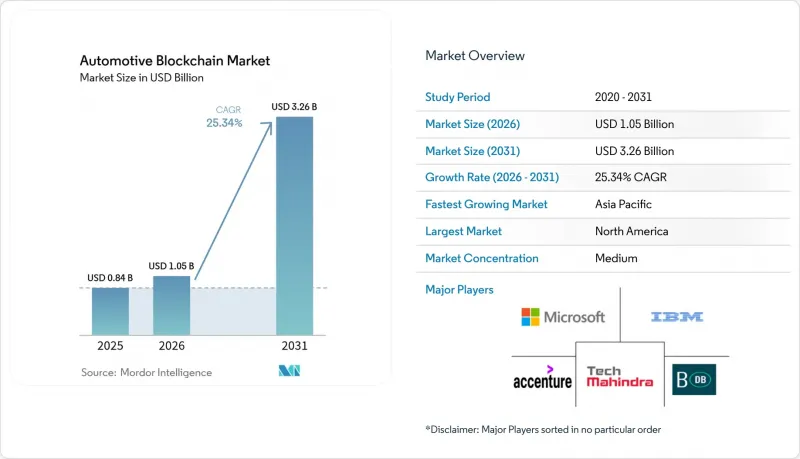
This report is Segmented by Application (Manufacturing, Supply Chain and Logistics, and More), End User (OEMs, Tier-1 Suppliers, and More), Blockchain Type (Public Blockchain, Private/Permissioned Blockchain, and More), Mobility Model (Personal Mobility, Shared Mobility, and More), Vehicle Type (Passenger Cars, and More), and Geography. The Market Forecasts are Provided in Terms of Value (USD).
Global Automotive Blockchain Market Trends and Insights
Battery Passport Regulations for EV Provenance
The European Union's 2027 battery passport rule makes blockchain indispensable for tracing every cathode, anode, and cell through a 15-year lifecycle. Volvo's EX90 passport records cobalt origin, recycled content, and CO2 output on a public-permissioned chain that meets anticipated EU audits three years early. Consultancy estimates place compliance spending at EUR 10-15 per passport, turning regulation into a service revenue stream for platform providers. Circulor's selective-disclosure design shields sensitive supplier data while proving provenance to regulators. Spill-over effects reach North America, where California tax credits could hinge on comparable documentation, bolstering the automotive blockchain market penetration among U.S. EV brands.
Supply-chain Transparency and Anti-counterfeit Push
Blockchain-enabled traceability reduces the USD 45 billion annual counterfeit-parts risk by replacing manual paperwork with an immutable data layer that spans thousands of suppliers. Renault's XCEED platform has already cut compliance-report processing time by 60% . Catena-X links more than 150 firms into a shared provenance network that converts fragmented supplier exchanges into continuous, verifiable data flows. These initiatives demonstrate that a distributed ledger can preserve competitive confidentiality while revealing tamper-proof part histories to regulators and customers. The result is a structural drop in warranty claims and audit costs, factors that strengthen the automotive blockchain market outlook. Consensus around open standards within Catena-X further lowers onboarding friction for new tier-n suppliers.
Scalability and Energy-Use Limits of Public Chains
Ethereum's 15 tps ceiling and Bitcoin's 120 TWh annual consumption make public chains ill-suited for millions of vehicle transactions. Layer-2 rollups improve throughput but introduce new attack surfaces that compromise safety-critical workloads. OEMs, therefore, lean on private networks, accepting reduced decentralization in exchange for latency under 500 ms. This trade-off somewhat constrains the public-chain portion of the automotive blockchain market yet accelerates investment in consortium-grade proof-of-stake solutions.
Other drivers and restraints analyzed in the detailed report include:
- Connected and Autonomous-Vehicle Data Security Needs
- OTA Software-update Liability Audit Requirements
- Regulatory Uncertainty for Cross-border Smart Contracts
For complete list of drivers and restraints, kindly check the Table Of Contents.
Segment Analysis
Supply-chain and logistics functions represented 39.95% of the automotive blockchain market in 2025, reflecting industry-wide urgency to authenticate parts and satisfy compliance filings. Immutable provenance records reduce warranty fraud and shorten recall look-up times. Vehicle and battery passports, while smaller today, register the fastest 30.12% CAGR because the 2027 EU mandates guarantee demand. Manufacturing, finance, insurance, and mobility-service niches each leverage the same ledger backbone but diverge in data-type requirements. The application mosaic signals that blockchain flexibility outweighs the additional implementation cost once multipurpose integrations begin.
Continuous data aggregation within supply chains unlocks predictive-maintenance alerts and environmental-footprint dashboards. Battery passport rollouts improve resale values by certifying remaining energy density, which feeds directly into loan underwriting. Insurance telematics delivers granular risk scores, lowering fraud losses and boosting margins. The automotive blockchain market size for vehicle and battery passport solutions is projected to widen as Asian governments consider copy-cat legislation. Supply-chain transparency therefore anchors today's revenue while regulatory passports fuel future cycles.
OEMs held 43.72% of spending in 2025, underpinning the automotive blockchain market through multi-plant deployments that track inbound material and outbound vehicle data. Their leadership stems from direct accountability for recalls and regulatory filings. Insurers, expanding at a 28.33% CAGR, use smart contracts to automate claims and embed real-time risk pricing. Tier-1 suppliers join ledgers to remain preferred partners in OEM scoring programs that reward verified sustainability metrics.
Mobility-service operators rely on transparent smart-contract revenue splits, while dealerships authenticate parts to cut counterfeit incidences. Regulators and authorities view the same network as a compliance console, accessing tamper-proof logs without mandating additional reporting portals. The automotive blockchain market size captured by regulators grows in parallel with digital-title programs. Overall, diverse stakeholder engagement validates distributed-ledger return on investment far beyond the factory gate.
Complete Report Scope:
- By Application
- Manufacturing
- Supply Chain and Logistics
- Financing and Payments
- Insurance and Usage-Based
- Mobility Services
- Vehicle/Battery Passport
- Others
- By End User
- OEMs
- Tier-1 Suppliers
- Mobility-as-a-Service Providers
- Insurance Companies
- Vehicle Owners/Drivers
- Dealerships and Service Centers
- Regulators and Authorities
- By Blockchain Type
- Public Blockchain
- Private/Permissioned Blockchain
- Consortium Blockchain
- Hybrid Blockchain
- By Mobility Model
- Personal Mobility
- Shared Mobility
- Commercial and Logistics Fleet
- By Vehicle Type
- Passenger Cars
- Commercial Vehicles
- By Geography
- North America
- United States
- Canada
- Rest of North America
- South America
- Brazil
- Argentina
- Rest of South America
- Europe
- Germany
- United Kingdom
- France
- Italy
- Spain
- Rest of Europe
- Asia-Pacific
- China
- Japan
- India
- South Korea
- Rest of Asia-Pacific
- Middle East and Africa
- United Arab Emirates
- Saudi Arabia
- Egypt
- South Africa
- Rest of Middle East and Africa
- North America
Geography Analysis
North America accounted for 42.98% of the automotive blockchain market revenue in 2025 as state authorities digitized 42 million vehicle titles using permissioned ledgers. Federal supply-chain security directives that restrict non-allied components reinforce blockchain as a mandated verification backbone. The region enjoys proximity between automotive OEM headquarters and leading cloud-blockchain providers, accelerating proof-of-concept timelines. Continuous funding from Detroit venture capital further supports start-ups specializing in niche ledger services.
Asia-Pacific is on a 30.18% CAGR trajectory through 2031, anchored by China's 45% new-EV sales penetration and municipal blockchain development grants. Policies that permit Level 4 autonomy trials in more than 20 cities amplify demand for secure vehicle-to-everything communication protocols. South Korea and Japan have announced national autonomous-mobility roadmaps, channeling funds toward digital identity and compliance solutions. Regional battery-passport pilots ensure that local suppliers remain eligible for EU exports, reinforcing cross-continental market symbiosis.
Europe sustains momentum through binding battery passport rules that make blockchain compulsory by 2027. Germany legalized Level 4 autonomous driving in 2025, necessitating secure, tamper-proof software update records. The continent's OEMs collaborate within Catena-X to create an open yet confidential data-exchange standard, lowering duplicated investments. Government grants and Horizon-Europe funding anchor research into quantum-safe ledger protocols, positioning Europe as a standards-setter within the automotive blockchain market.
- IBM Corporation
- Microsoft Corporation
- Accenture plc
- Tech Mahindra Limited
- BigchainDB GmbH
- carVertical
- XAIN AG
- HCL Technologies Ltd.
- Helbiz
- NXM Labs Inc.
- RSK Labs
- Autoblock
- GEM
- SHIFTMobility Inc.
- Loyyal Corporation
- Bosch Group
- Continental AG
- BMW Group
- Ford Motor Company
- Renault Group
Additional Benefits:
- The market estimate (ME) sheet in Excel format
- 3 months of analyst support
TABLE OF CONTENTS
1 Introduction
- 1.1 Study Assumptions & Market Definition
- 1.2 Scope of the Study
2 Research Methodology
3 Executive Summary
4 Market Landscape
- 4.1 Market Overview
- 4.2 Market Drivers
- 4.2.1 Battery passport regulations for EV provenance
- 4.2.2 Supply-chain transparency and anti-counterfeit push
- 4.2.3 Connected and autonomous-vehicle data security needs
- 4.2.4 OTA software-update liability audit requirements
- 4.2.5 Web3 vehicle-wallet micropayments adoption
- 4.2.6 Circular-economy traceability incentives
- 4.3 Market Restraints
- 4.3.1 Scalability and energy-use limits of public chains
- 4.3.2 Regulatory uncertainty for cross-border smart contracts
- 4.3.3 Shortage of automotive-grade blockchain talent
- 4.3.4 OEM IP-leakage concerns in consortium blockchains
- 4.4 Value/Supply-Chain Analysis
- 4.5 Regulatory Landscape
- 4.6 Technological Outlook
- 4.7 Porter's Five Forces
- 4.7.1 Threat of New Entrants
- 4.7.2 Bargaining Power of Buyers
- 4.7.3 Bargaining Power of Suppliers
- 4.7.4 Threat of Substitute Products
- 4.7.5 Intensity of Competitive Rivalry
5 Market Size & Growth Forecasts (Value (USD))
- 5.1 By Application
- 5.1.1 Manufacturing
- 5.1.2 Supply Chain and Logistics
- 5.1.3 Financing and Payments
- 5.1.4 Insurance and Usage-Based
- 5.1.5 Mobility Services
- 5.1.6 Vehicle/Battery Passport
- 5.1.7 Others
- 5.2 By End User
- 5.2.1 OEMs
- 5.2.2 Tier-1 Suppliers
- 5.2.3 Mobility-as-a-Service Providers
- 5.2.4 Insurance Companies
- 5.2.5 Vehicle Owners/Drivers
- 5.2.6 Dealerships and Service Centers
- 5.2.7 Regulators and Authorities
- 5.3 By Blockchain Type
- 5.3.1 Public Blockchain
- 5.3.2 Private/Permissioned Blockchain
- 5.3.3 Consortium Blockchain
- 5.3.4 Hybrid Blockchain
- 5.4 By Mobility Model
- 5.4.1 Personal Mobility
- 5.4.2 Shared Mobility
- 5.4.3 Commercial and Logistics Fleet
- 5.5 By Vehicle Type
- 5.5.1 Passenger Cars
- 5.5.2 Commercial Vehicles
- 5.6 By Geography
- 5.6.1 North America
- 5.6.1.1 United States
- 5.6.1.2 Canada
- 5.6.1.3 Rest of North America
- 5.6.2 South America
- 5.6.2.1 Brazil
- 5.6.2.2 Argentina
- 5.6.2.3 Rest of South America
- 5.6.3 Europe
- 5.6.3.1 Germany
- 5.6.3.2 United Kingdom
- 5.6.3.3 France
- 5.6.3.4 Italy
- 5.6.3.5 Spain
- 5.6.3.6 Rest of Europe
- 5.6.4 Asia-Pacific
- 5.6.4.1 China
- 5.6.4.2 Japan
- 5.6.4.3 India
- 5.6.4.4 South Korea
- 5.6.4.5 Rest of Asia-Pacific
- 5.6.5 Middle East and Africa
- 5.6.5.1 United Arab Emirates
- 5.6.5.2 Saudi Arabia
- 5.6.5.3 Egypt
- 5.6.5.4 South Africa
- 5.6.5.5 Rest of Middle East and Africa
- 5.6.1 North America
6 Competitive Landscape
- 6.1 Market Concentration
- 6.2 Strategic Moves
- 6.3 Market Share Analysis
- 6.4 Company Profiles (Includes Global Level Overview, Market Level Overview, Core Segments, Financials as Available, Strategic Information, Market Rank/Share for Key Companies, Products and Services, SWOT Analysis, and Recent Developments)
- 6.4.1 IBM Corporation
- 6.4.2 Microsoft Corporation
- 6.4.3 Accenture plc
- 6.4.4 Tech Mahindra Limited
- 6.4.5 BigchainDB GmbH
- 6.4.6 carVertical
- 6.4.7 XAIN AG
- 6.4.8 HCL Technologies Ltd.
- 6.4.9 Helbiz
- 6.4.10 NXM Labs Inc.
- 6.4.11 RSK Labs
- 6.4.12 Autoblock
- 6.4.13 GEM
- 6.4.14 SHIFTMobility Inc.
- 6.4.15 Loyyal Corporation
- 6.4.16 Bosch Group
- 6.4.17 Continental AG
- 6.4.18 BMW Group
- 6.4.19 Ford Motor Company
- 6.4.20 Renault Group
7 Market Opportunities & Future Outlook
- 7.1 White-space & Unmet-Need Assessment

