PUBLISHER: Mordor Intelligence | PRODUCT CODE: 2114891

PUBLISHER: Mordor Intelligence | PRODUCT CODE: 2114891
Flame Retardants For Aerospace Plastics - Market Share Analysis, Industry Trends & Statistics, Growth Forecasts (2026 - 2031)
According to Mordor Intelligence, the flame retardants for aerospace plastics market size was valued at USD 33.65 million in 2025 and estimated to grow from USD 34.71 million in 2026 to reach USD 40.52 million by 2031, at a CAGR of 3.14% during the forecast period (2026-2031).
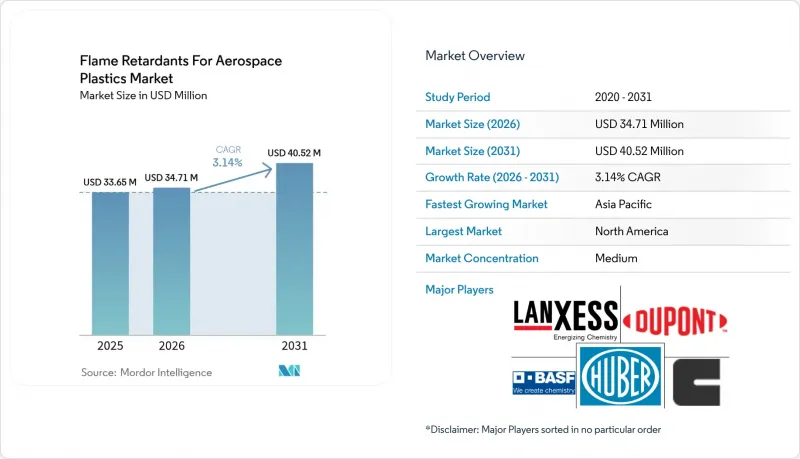
This report is Segmented by Product Type (Antimony Oxide, Aluminum Trihydrate, Magnesium Hydroxide, and More), Polymer Type (Carbon-Fibre-Reinforced Polymer, Polycarbonate, Thermoset Polyimides, and More), Aircraft Component (Interior Panels and Floorings, Wiring, Cables and Connectors, and More), and Geography (Asia-Pacific, North America, Europe, and More).
Global Flame Retardants For Aerospace Plastics Market Trends and Insights
Stringent Fire-Safety Regulations for Cabin and Structural Plastics
Aviation authorities have tightened material-level tests beyond FAR 25.853. In 2024, the FAA introduced more rigorous heat-release criteria for transport-category aircraft with over 20 seats, while EASA's 2025 halon-replacement guide requires extinguisher conversion by December 2025, indirectly raising barriers for interior plastics. OEMs now design to the most demanding global rule set because regional arbitrage is vanishing. Special conditions tied to novel fuel-tank layouts on aircraft such as the A321neo XLR highlight how new designs can trigger fresh fire-protection clauses. Retrofit mandates on in-service fleets combine with forward-fit requirements, ensuring that the flame retardants for the aerospace plastics market remain buoyed by both legacy and next-generation programs.
Rising Aircraft Production and Fleet Renewal Programmes
Boeing's backlog of more than 5,600 jets underpins a multi-year production climb, and its Q1 2025 guidance confirms 38 monthly 737 builds while projecting a step-up in 787 output to 7 per month. Each incremental aircraft contains more composite content than the platform it replaces, so flame-retardant consumption grows faster than airframe counts. Fleet-renewal imperatives aimed at fuel savings advance orders for high-composite narrow-body variants, and defense modernisation programs borrow identical chemistries, further expanding addressable volumes. This production-driven pull offsets the certification drag embedded in the flame retardants for the aerospace plastics market.
Volatile Antimony-Oxide Pricing and Supply Concentration in China
With China supplying around two-thirds of global capacity, the September 2024 export control shattered the security of supply for antimony trioxide, the single largest product segment at 37.28% share. U.S. import dependence exceeds 60%, and replacement sources in Tajikistan or Australia face 18-24-month aerospace qualification windows. Spot prices have jumped 100-200%, compelling OEMs to fast-track aluminum trihydrate and phosphorus systems despite the exhaustive test matrix each new additive must clear. Near-term volatility therefore drags on the flame retardants for the aerospace plastics market until alternative chemistries gain full certification.
Other drivers and restraints analyzed in the detailed report include:
- Shift Toward Lightweight Non-Metallic Airframes
- Transition to Halogen-Free Flame-Retardant Chemistries
- Toxicological Scrutiny of Legacy Brominated Systems
For complete list of drivers and restraints, kindly check the Table Of Contents.
Segment Analysis
Antimony oxide commands the largest slice of the flame retardants for the aerospace plastics market at 36.62% in 2025. However, China's export restrictions have made this leadership fragile, sparking 2-year price swings and spurring OEMs to certify aluminum trihydrate and magnesium hydroxide blends that release water endothermically and promote char at lower smoke toxicity. Other product types, which encapsulate these alternatives plus next-generation phosphorus compounds, are expected to clock a 3.99% CAGR through 2031-the fastest among all categories. Suppliers with broad portfolios capable of bridging the qualification gap are positioned to absorb share as antimony-centric lines confront scarcity. Notably, some organophosphorus compounds that graft onto polymer chains are being adopted because they curb additive migration and therefore prolong in-service fire performance.
The substitution race reshapes procurement hierarchies as OEMs seek single-source partners that can deliver multi-chemistry coverage. Start-ups advancing boron-nitrogen hybrids aim to combine flame suppression with smoke reduction, but certification inertia means incumbent suppliers with aerospace pedigrees still own the buying centre. Consequently, the flame retardants for aerospace plastics market remains an incumbent's game for now, albeit with clear incentive for diversification.
Complete Report Scope:
- By Product Type
- Antimony Oxide
- Aluminum Trihydrate (ATH)
- Magnesium Hydroxide
- Boron and Boron-Nitrogen Compounds
- Other Product Types (Phosphorus-based, etc.)
- By Polymer Type
- Carbon-Fibre-Reinforced Polymer (CFRP)
- Polycarbonate
- Thermoset Polyimides
- Polyether-ether-ketone (PEEK)
- Other Polymer Type (Polyether-ketone-ketone (PEKK), etc.)
- By Aircraft Component
- Interior Panels and Floorings
- Wiring, Cables and Connectors
- Structural Composites and Panels
- Seals, Gaskets and Ducting
- Coatings and Adhesives
- By Geography
- Asia-Pacific
- China
- Japan
- India
- South Korea
- ASEAN Countries
- Rest of Asia-Pacific
- North America
- United States
- Canada
- Mexico
- Europe
- Germany
- United Kingdom
- France
- Italy
- Spain
- Russia
- NORDIC Countries
- Rest of Europe
- South America
- Brazil
- Argentina
- Rest of South America
- Middle East and Africa
- Saudi Arabia
- South Africa
- Rest of Middle East and Africa
- Asia-Pacific
Geography Analysis
North America dominates with a 35.28% 2025 share, anchored by Boeing's Washington and South Carolina clusters and a robust supplier ecosystem capable of rapid material qualification. FAA advisory circulars offer transparent certification pathways, fostering early adoption of novel additives. Defense budgets layer incremental demand on top of commercial projects, further buttressing regional volumes. The flame retardants for the aerospace plastics market thus enjoy a dual-channel lift across civil and military build rates in the United States.
Asia-Pacific, though smaller, is the quickest-rising at 3.94% CAGR out to 2031. Chinese, Indian, and Japanese OEM programs are localising material supply, incentivising Western suppliers to form joint ventures that meet identical quality thresholds at a lower cost base. Government incentives-from China's commercial aviation development plan to India's production-linked schemes-make the region a magnet for new flame retardant manufacturing footprints. End-market growth also stems from regional carriers expanding narrow-body fleets, which translates into higher composite content per airframe and therefore higher additive intensity.
Europe brings environmental stringency to the fore. REACH registration and EASA halon-replacement deadlines are pushing OEMs toward halogen-free and even bio-based solutions, permitting suppliers to price at a premium for compliance assurance. Circular-economy pilots, especially around composite recycling, mean that any new flame retardant package must enable-not obstruct-material recovery. Consequently, European demand skews toward high-value additive systems, providing margin uplift within the global flame retardants for aerospace plastics market.
- ADEKA Corporation
- BASF SE
- Clariant
- DuPont
- Evonik Industries AG
- HUBER CORPORATION
- ICL
- Italmatch Chemicals S.p.A
- LANXESS
- Marshall Additive Technologies
- Nabaltec AG
- RTP Company
- SABIC
- Solvay
Additional Benefits:
- The market estimate (ME) sheet in Excel format
- 3 months of analyst support
TABLE OF CONTENTS
1 Introduction
- 1.1 Study Assumptions and Market Definition
- 1.2 Scope of the Study
2 Research Methodology
3 Executive Summary
4 Market Landscape
- 4.1 Market Overview
- 4.2 Market Drivers
- 4.2.1 Stringent fire-safety regulations for cabin and structural plastics
- 4.2.2 Rising aircraft production and fleet renewal programmes
- 4.2.3 Shift toward lightweight non-metallic airframes
- 4.2.4 Transition to halogen-free flame retardant chemistries
- 4.2.5 Expanded Use of 3D-Printed Aerospace Parts requiring flame retardants
- 4.3 Market Restraints
- 4.3.1 Volatile antimony-oxide pricing and supply concentration in China
- 4.3.2 Toxicological scrutiny of legacy brominated systems
- 4.3.3 Avaiability of alternatives like phenolic composites
- 4.4 Value Chain Analysis
- 4.5 Porter's Five Forces
- 4.5.1 Bargaining Power of Suppliers
- 4.5.2 Bargaining Power of Buyers
- 4.5.3 Threat of New Entrants
- 4.5.4 Threat of Substitutes
- 4.5.5 Degree of Competition
5 Market Size and Growth Forecasts (Value)
- 5.1 By Product Type
- 5.1.1 Antimony Oxide
- 5.1.2 Aluminum Trihydrate (ATH)
- 5.1.3 Magnesium Hydroxide
- 5.1.4 Boron and Boron-Nitrogen Compounds
- 5.1.5 Other Product Types (Phosphorus-based, etc.)
- 5.2 By Polymer Type
- 5.2.1 Carbon-Fibre-Reinforced Polymer (CFRP)
- 5.2.2 Polycarbonate
- 5.2.3 Thermoset Polyimides
- 5.2.4 Polyether-ether-ketone (PEEK)
- 5.2.5 Other Polymer Type (Polyether-ketone-ketone (PEKK), etc.)
- 5.3 By Aircraft Component
- 5.3.1 Interior Panels and Floorings
- 5.3.2 Wiring, Cables and Connectors
- 5.3.3 Structural Composites and Panels
- 5.3.4 Seals, Gaskets and Ducting
- 5.3.5 Coatings and Adhesives
- 5.4 By Geography
- 5.4.1 Asia-Pacific
- 5.4.1.1 China
- 5.4.1.2 Japan
- 5.4.1.3 India
- 5.4.1.4 South Korea
- 5.4.1.5 ASEAN Countries
- 5.4.1.6 Rest of Asia-Pacific
- 5.4.2 North America
- 5.4.2.1 United States
- 5.4.2.2 Canada
- 5.4.2.3 Mexico
- 5.4.3 Europe
- 5.4.3.1 Germany
- 5.4.3.2 United Kingdom
- 5.4.3.3 France
- 5.4.3.4 Italy
- 5.4.3.5 Spain
- 5.4.3.6 Russia
- 5.4.3.7 NORDIC Countries
- 5.4.3.8 Rest of Europe
- 5.4.4 South America
- 5.4.4.1 Brazil
- 5.4.4.2 Argentina
- 5.4.4.3 Rest of South America
- 5.4.5 Middle East and Africa
- 5.4.5.1 Saudi Arabia
- 5.4.5.2 South Africa
- 5.4.5.3 Rest of Middle East and Africa
- 5.4.1 Asia-Pacific
6 Competitive Landscape
- 6.1 Market Concentration
- 6.2 Strategic Moves
- 6.3 Market Share(%)/Ranking Analysis
- 6.4 Company Profiles (includes Global level Overview, Market level overview, Core Segments, Financials as available, Strategic Information, Market Rank/Share for key companies, Products and Services, and Recent Developments)
- 6.4.1 ADEKA Corporation
- 6.4.2 BASF SE
- 6.4.3 Clariant
- 6.4.4 DuPont
- 6.4.5 Evonik Industries AG
- 6.4.6 HUBER CORPORATION
- 6.4.7 ICL
- 6.4.8 Italmatch Chemicals S.p.A
- 6.4.9 LANXESS
- 6.4.10 Marshall Additive Technologies
- 6.4.11 Nabaltec AG
- 6.4.12 RTP Company
- 6.4.13 SABIC
- 6.4.14 Solvay
7 Market Opportunities and Future Outlook
- 7.1 White-space and Unmet-need Assessment

