PUBLISHER: Mordor Intelligence | PRODUCT CODE: 2114905

PUBLISHER: Mordor Intelligence | PRODUCT CODE: 2114905
Supercritical Fluid Chromatography - Market Share Analysis, Industry Trends & Statistics, Growth Forecasts (2026 - 2031)
According to Mordor Intelligence, supercritical fluid chromatography market size in 2026 is estimated at USD 1.86 billion, growing from 2025 value of USD 1.78 billion with 2031 projections showing USD 2.35 billion, growing at 4.71% CAGR over 2026-2031.
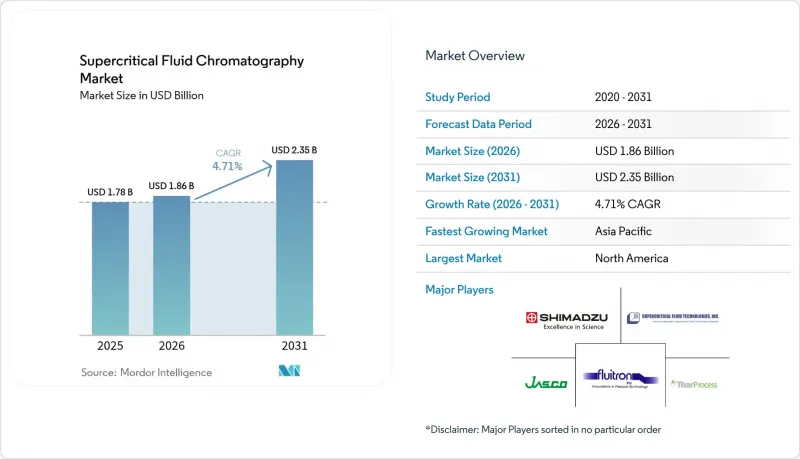
This report is Segmented by Type (Preparative SFC, Analytical SFC), Component (Instruments, Columns & Consumables, Software & Services), End-User (Research Laboratories, Pharmaceutical Industry, Cros & CDMOs, Others), and Geography (North America, Europe, Asia Pacific, Middle East & Africa, South America). The Market Forecasts are Provided in Terms of Value (USD).
Global Supercritical Fluid Chromatography Market Trends and Insights
Expansion of Green Analytical Chemistry Mandates
Heightened sustainability policies in Europe and the United States are reshaping laboratory investment priorities. Modern SFC systems cut organic-solvent use by up to 95% compared with HPLC, yet deliver equivalent resolution for pharmacopeial assays. Modified GAPI scoring, now common in European method-selection protocols, awards high ratings to CO2-based separations, prompting pharmaceutical QA groups to fund SFC upgrades. Equipment vendors report that green-metric compliance is now a decisive factor in over half of new instrument tenders, signaling a persistent capital-spending tailwind for the supercritical fluid chromatography market.
Growing Biopharma Demand for Chiral Separations
Enantiomer-specific drug development drives continuous demand for high-throughput chiral screening. Advances in polysaccharide-based stationary phases let SFC resolve multi-stereocenter APIs that frustrate traditional HPLC, cutting lead-optimization cycles by several weeks. Multiple FDA-approved chiral drugs during 2022-2024 relied on SFC data packages. CROs now market "SFC-first" discovery platforms, citing success rates above 80% for single-method chiral separations, stimulating recurring consumables sales across the supercritical fluid chromatography market.
Limited Detector Compatibility for Highly Polar Analytes
Electrospray efficiency declines when decompressed CO2 dilutes post-column flow, limiting trace-level detection of polar metabolites. Although make-up solvent interfaces improve sensitivity, they introduce cost and complexity that delay adoption in budget-constrained labs. Environmental analysts therefore maintain dual LC and SFC workflows, tempering incremental instrument orders in several supercritical fluid chromatography market subsegments.
Other drivers and restraints analyzed in the detailed report include:
- Rapid Screening Needs in Cannabis and Natural-Product QC
- Rising Adoption of Integrated LC-SFC Instrument Platforms
- High Capital Cost Versus UHPLC Alternatives
For complete list of drivers and restraints, kindly check the Table Of Contents.
Segment Analysis
In 2025, analytical configurations captured 55.62% of the supercritical fluid chromatography market share, reflecting widespread use in method-development and QC labs that require sub-ppm impurity profiling. The supercritical fluid chromatography market size for analytical platforms is projected to expand from USD 1.04 billion in 2026 to USD 1.28 billion by 2031 at a 4.26% CAGR. Robust validation guidance in ICH Q2(R2) reinforces long-term procurement commitments, while sub-2-µm particle compatibility delivers UHPSFC performance close to UHPLC.
Preparative systems, although smaller in absolute revenue, will outpace analytical units with a 4.62% CAGR. Gram-scale chiral purification for IND-enabling studies and growing natural-product processing underpin this trajectory. Larger column diameters and CO2 recycling loops have reduced per-gram solvent cost, anchoring SFC within continuous-manufacturing skids for oncology APIs, thereby lifting the preparative segment within the supercritical fluid chromatography market.
Complete Report Scope:
- By Type
- Preparative SFC
- Analytical SFC
- By Component
- Instruments
- Columns & Consumables
- Software & Services
- By End-User
- Research Laboratories
- Pharmaceutical Industry
- CROs & CDMOs
- Others
- By Geography
- North America
- United States
- Canada
- Mexico
- Europe
- Germany
- United Kingdom
- France
- Italy
- Spain
- Rest of Europe
- Asia Pacific
- China
- Japan
- India
- South Korea
- Australia
- Rest of Asia Pacific
- Middle East & Africa
- GCC
- South Africa
- Rest of Middle East & Africa
- South America
- Brazil
- Argentina
- Rest of South America
- North America
Geography Analysis
North America retained leadership with 36.05% of the supercritical fluid chromatography market share in 2025. The FDA's clear validation pathway, combined with expanding cannabis-testing requirements, drives routine SFC adoption in both regulated QC and third-party testing labs. Continuous-manufacturing pilots in monoclonal antibody plants further stoke demand for integrated PAT-ready SFC modules.
Europe follows closely, anchored by stringent solvent-reduction policies and Horizon research funding that underscores SFC's environmental credentials. EMA alignment with ICH Q14 has normalized SFC inclusion in CTD dossiers, ensuring sustained instrument refresh cycles among generic-drug makers. Elite universities in Germany and the Netherlands are upgrading core facilities with UHPSFC-MS units to meet lipidomics project loads, enriching the supercritical fluid chromatography market ecosystem.
Asia-Pacific is set to grow fastest at 4.98% CAGR, propelled by China's expanding API-export base and Japan's push for green-chemistry metrics in GMP audits. Shimadzu's Nexera UC Prep roll-out offers localized service networks, easing adoption risks for first-time users and amplifying preparative-scale penetration. Nonetheless, limited regional supply of specialty chiral columns and a scarcity of SFC-trained analysts temper near-term volumes, leaving a capacity gap that global consumables vendors are racing to fill.
- Waters Corporation
- Shimadzu
- Agilent Technologies
- JASCO Corporation
- Thar Process
- Bruker
- Supercritical Fluid Technologies Inc. (SFT)
- Fluitron
- Novasep (Siris)
- LEWA-Nikkiso
- SwissChromatography
- Merck KGaA (Supelco)
- YMC Co., Ltd.
- Phenomenex (Danaher)
- Scion Instruments
- Knauer Wissenschaftliche Gerate
- Aurora SFC Systems
- Trajan Scientific
- Applied Separations
- PerkinElmer
Additional Benefits:
- The market estimate (ME) sheet in Excel format
- 3 months of analyst support
TABLE OF CONTENTS
1 Introduction
- 1.1 Study Assumptions & Market Definition
- 1.2 Scope of the Study
2 Research Methodology
3 Executive Summary
4 Market Landscape
- 4.1 Market Overview
- 4.2 Market Drivers
- 4.2.1 Expansion of Green Analytical Chemistry Mandates
- 4.2.2 Growing Biopharma Demand For Chiral Separations
- 4.2.3 Rapid Screening Needs In Cannabis And Natural-Product QC
- 4.2.4 Rising Adoption of Integrated LC-SFC Instrument Platforms
- 4.2.5 Increasing Research Funding For Lipidomics And Metabolomics Workflows
- 4.2.6 Data-Driven Process Analytical Technology Integration In Continuous Manufacturing
- 4.3 Market Restraints
- 4.3.1 Limited Detector Compatibility For Highly Polar Analytes
- 4.3.2 High Capital Cost Versus UHPLC Alternatives
- 4.3.3 Shortage Of Skilled Supercritical Fluid Chromatography Analysts
- 4.3.4 Limited Availability Of Advanced Chiral Columns In Emerging Regions
- 4.4 Supply Chain Analysis
- 4.5 Regulatory Landscape
- 4.6 Technological Outlook
- 4.7 Porter's Five Forces Analysis
- 4.7.1 Threat of New Entrants
- 4.7.2 Bargaining Power of Buyers
- 4.7.3 Bargaining Power of Suppliers
- 4.7.4 Threat of Substitutes
- 4.7.5 Intensity of Competitive Rivalry
5 Market Size & Growth Forecasts (Value)
- 5.1 By Type
- 5.1.1 Preparative SFC
- 5.1.2 Analytical SFC
- 5.2 By Component
- 5.2.1 Instruments
- 5.2.2 Columns & Consumables
- 5.2.3 Software & Services
- 5.3 By End-User
- 5.3.1 Research Laboratories
- 5.3.2 Pharmaceutical Industry
- 5.3.3 CROs & CDMOs
- 5.3.4 Others
- 5.4 By Geography
- 5.4.1 North America
- 5.4.1.1 United States
- 5.4.1.2 Canada
- 5.4.1.3 Mexico
- 5.4.2 Europe
- 5.4.2.1 Germany
- 5.4.2.2 United Kingdom
- 5.4.2.3 France
- 5.4.2.4 Italy
- 5.4.2.5 Spain
- 5.4.2.6 Rest of Europe
- 5.4.3 Asia Pacific
- 5.4.3.1 China
- 5.4.3.2 Japan
- 5.4.3.3 India
- 5.4.3.4 South Korea
- 5.4.3.5 Australia
- 5.4.3.6 Rest of Asia Pacific
- 5.4.4 Middle East & Africa
- 5.4.4.1 GCC
- 5.4.4.2 South Africa
- 5.4.4.3 Rest of Middle East & Africa
- 5.4.5 South America
- 5.4.5.1 Brazil
- 5.4.5.2 Argentina
- 5.4.5.3 Rest of South America
- 5.4.1 North America
6 Competitive Landscape
- 6.1 Market Concentration
- 6.2 Market Share Analysis
- 6.3 Company Profiles (includes Global level Overview, Market level overview, Core Segments, Financials as available, Strategic Information, Market Rank/Share for key companies, Products & Services, and Recent Developments)
- 6.3.1 Waters Corporation
- 6.3.2 Shimadzu Scientific Instruments
- 6.3.3 Agilent Technologies
- 6.3.4 JASCO Corporation
- 6.3.5 Thar Process Inc.
- 6.3.6 Bruker Corporation
- 6.3.7 Supercritical Fluid Technologies Inc. (SFT)
- 6.3.8 Fluitron Inc.
- 6.3.9 Novasep (Siris)
- 6.3.10 LEWA-Nikkiso
- 6.3.11 SwissChromatography
- 6.3.12 Merck KGaA (Supelco)
- 6.3.13 YMC Co., Ltd.
- 6.3.14 Phenomenex (Danaher)
- 6.3.15 Scion Instruments
- 6.3.16 Knauer Wissenschaftliche Gerate
- 6.3.17 Aurora SFC Systems
- 6.3.18 Trajan Scientific
- 6.3.19 Applied Separations
- 6.3.20 PerkinElmer Inc.
7 Market Opportunities & Future Outlook
- 7.1 White-space & Unmet-need Assessment

