PUBLISHER: Roots Analysis | PRODUCT CODE: 2107336

PUBLISHER: Roots Analysis | PRODUCT CODE: 2107336
Chromatography Market By Type of Product, Type of Chromatography Instrument, Type of Liquid Chromatography, Component, Stationary Phase Format, End User, and Geographical Regions - Trends and Forecast Till 2035
CHROMATOGRAPHY MARKET: OVERVIEW
As per Roots Analysis, the global chromatography market is estimated to grow from USD 12.65 billion in the current year to USD 22.35 billion by 2035, reflecting a compound annual growth rate (CAGR) of approximately 6.53% during the forecast period.
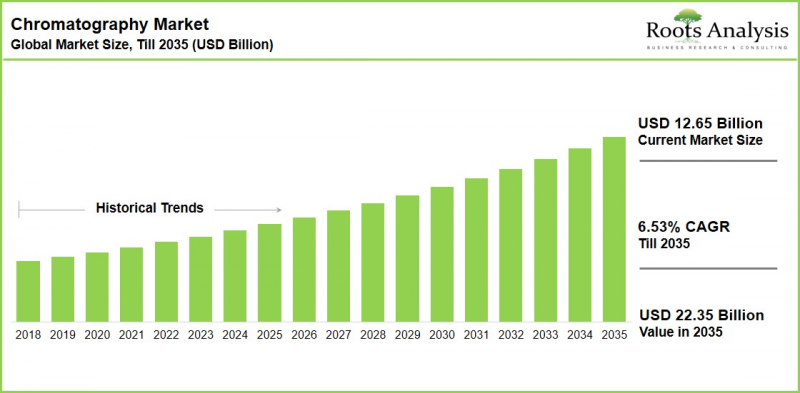
Chromatography Market: Growth and Trends
Chromatography remains the analytical backbone for separating, identifying, and purifying components within complex mixtures, since its introduction by Mikhail Tsvet in the early twentieth century. The method works by partitioning analytes between a moving mobile phase, liquid or gaseous, and a fixed stationary phase. This is a principle that has since been engineered into a wide family of instruments and consumables serving pharmaceutical, biotechnology, chemical, food, and petrochemical end users.
Demand for chromatography has increased across the pharmaceutical and biotechnology industries. This demand is driven by its essential role in qualitative and quantitative analysis for translational research, precision oncology, and vaccine and viral vector development. Looking ahead, chromatography is expected to see broader adoption in forensics and diagnostics. This expansion is supported by ongoing platform innovations that expand its applications across research and industrial development.
Growth Drivers: Factors Fueling Market Expansion
Continuous technology innovation is the primary growth factor of the market. Industry players are aiming to integrate artificial intelligence, advanced detection systems, and miniaturized formats to widen chromatography's applicability across research and industrial settings. On the other hand, the continuous chromatography platforms have improved throughput and lowered per-run operating costs.
In parallel, rising environmental scrutiny has accelerated demand for sustainable consumables, including green solvents and supercritical fluids such as carbon dioxide, positioning eco-efficient product lines as a meaningful commercial differentiator.
Further, consolidation activities, such as mergers and acquisitions are reinforcing the growth momentum. Merger and acquisition activity among chromatography providers has increased by approximately 4% annually over the past five years. Companies are increasingly using acquisitions to expand their instruments and consumable portfolios rather than relying on organic growth. Recent examples include the Waters and BD Biosciences merger, Hypha Labs' acquisition of Lucidity, and the Shimadzu-linked combination of Alsachim and Biomaneo.
Market Challenges: Critical Barriers Hindering Progress
Chromatography faces growing competition from alternative separation techniques, such as crystallization, ultrafiltration, membrane filtration, and high-pressure refolding, which offer faster or higher-throughput performance for specific applications. Notably, hyphenated systems, such as LC-MS and GC-MS, are more complex and require specialized expertise for method development, sample preparation, and data analysis. Limited access to skilled professionals continues to restrict their adoption, particularly in emerging markets.
Chromatography Market: Key Insights
The report delves into the current state of the chromatography market and identifies potential growth opportunities within the industry, particularly from a distributor and channel-partner perspective. Some key findings include:
- Clinical Diagnostics Integration (Waters & BD): Waters agreed to merge with BD's Biosciences & Diagnostic Solutions Business to embed Liquid Chromatography-Mass Spectrometry (LC-MS) into automated clinical diagnostics workflows.
- Regional Bioprocess Expansion (Shimadzu & Sepragen): Shimadzu secured exclusive distribution for Sepragen's bioprocess chromatography systems to capture commercial biomanufacturing downstream processing in India, Japan, South Korea, and Southeast Asia.
- Targeted Upstream Bioprocess Columns (Waters): Waters launched specialized Protein A affinity columns designed for real-time monitoring in biologic drug development to speed up downstream method optimization.
- Geographic Network Growth (Testa Analytical & Mazet & Co): Testa Analytical partnered with Mazet & Co to expand access to precision analytical liquid flow measurement devices across French-speaking Europe and North Africa.
- Shift to Prepacked & Sustainable Consumables: Vendors are prioritizing prepacked columns and bio-based/biodegradable packing media to eliminate labor-intensive manual column packing and align with corporate green chemistry initiatives.
- Hardware-to-Workflow Strategy: Market leaders are shifting from selling standalone LC/GC instruments toward offering complete, AI-automated ecosystems that bundle hyphenated systems (LC-MS/GC-MS), specialized columns, and compliance software.
Chromatography Market Segments
Roots Analysis segments the global chromatography opportunity across the following parameters:
By Type of Chromatography Product
- Instruments
- Consumables
- Other Products
By Type of Chromatography Instrument
- Liquid Chromatography Instruments
- Gas Chromatography Instruments
- Other Chromatography Instruments
By Type of Liquid Chromatography
- High Performance Liquid Chromatography (HPLC)
- Ultra-High Performance Liquid Chromatography (UHPLC)
- Size-Exclusion Chromatography
- Flash Chromatography
- Other Techniques
By Type of Chromatography Component
- Stationary Phase
- Mobile Phase
By Format of Stationary Phase
- Prepacked Columns
- Bottles / Bulk Resins
- Other Formats
By End User
- Pharmaceutical and Biotechnology Industries
- Academic and Research Institutes
- Other End Users
By Geographical Regions
- North America
- Europe
- Asia-Pacific
- Rest of the World
Chromatography Market: Key Segments Insight
Instruments Segment Leads the Market
Instruments currently account for the highest share of total chromatography market share. This highest share reflects their central role in separating, purifying, and identifying components within complex mixtures across both routine and advanced analytical workflows. Continued investment in more automated and miniaturized platforms is expected to maintain the dominance of this segment.
While the instruments segment is dominating the market, the consumables segment, comprising columns, resins, and mobile-phase reagents, is expected to grow at a higher CAGR during the forecast period. This unprecedented growth is due to the growing demand for customized and sustainable consumable formats such as biodegradable packing materials.
Liquid Chromatography Instruments Dominate Market
Liquid chromatography instruments currently capture highest share of the market. This growth is due to its effectiveness in separating polar and thermolabile compounds that are poorly suited to gas-phase methods. Within liquid chromatography specifically, HPLC remains the dominant technique, given its central role in meeting regulatory-grade analytical requirements for new drug approvals.
However, UHPLC is expected to grow fastest among liquid chromatography techniques, at a higher CAGR, as laboratories prioritize faster run times, sharper resolution, and greater sensitivity. On the other hand, gas chromatography is expected to grow at the fastest CAGR during the forecast period. This highest growth is supported by the relative cost-efficiency and ease of use of gas-based systems.
Stationary Phase Leads the Market, While Mobile Phase Gains Momentum
Among chromatography components, the stationary phase segment holds the largest share of the market. This dominance reflects its central function in achieving high-resolution, selective, and cost-efficient separations. The mobile phase segment is forecast to grow at a higher CAGR during the forecast period. This lucrative growth is driven by formulation advances and tighter integration with hyphenated techniques such as LC-MS and GC-MS that have raised mobile phase role in overall analytical performance.
Prepacked Columns Dominate Market
By format, prepacked columns lead by occupying the largest share of the market. Notably, this segment also registers the fastest CAGR during the forecast period. This dominance is largely because pre-assembled columns eliminate the time and labor associated with manual packing, shortening turnaround for chromatographic separations.
Pharmaceutical and Biotechnology Industries Dominate the Market
Pharmaceutical and biotechnology companies account for the largest share of chromatography market revenue. This highest share is driven by the technique's essential role in separating, identifying, and purifying biomolecules and chemical compounds during drug development and quality control.
Academic and research institutes represent the fastest growing end-user segment, at a projected higher CAGR during the forecast period. This potential growth is due to the expanding proteomics, metabolomics, and synthetic biology research that demands flexible, high-resolution analytical capacity.
North America Leads, While Asia-Pacific Emerges as the Fastest-Growing Region
According to our market projections, North America is likely to hold the largest share of global chromatography market revenue through 2035. This highest growth is supported by a dense concentration of established instrument and consumable providers, mature research infrastructure, and early adoption of AI-enabled and miniaturized chromatography systems.
Asia-Pacific is expected to grow at a higher CAGR during the forecast period. This growth is driven by expanding domestic pharmaceutical manufacturing in China, India, and Japan, along with the region's growing biologics CRO and CMO base, both of which rely heavily on chromatography for analytical and purification support.
Example Players in Chromatography Market
- Agilent Technologies
- Bio-Rad Laboratories
- Gilson
- JASCO
- MilliporeSigma
- Revvity (Previously known as PerkinElmer)
- Sartorius
- Shimadzu Scientific Instruments
- Thermo Fisher Scientific
CHROMATOGRAPHY MARKET: RESEARCH COVERAGE
- Market Sizing and Opportunity Analysis: In-depth revenue analysis across product type, instrument type, liquid chromatography technique, component, stationary phase format, end user, and geography.
- Competitive Landscape Assessment: The market landscape analysis provides information on close to 90 instrument providers and roughly 95 consumable providers by company size, headquarters location, product focus, and year of establishment.
- Company Profiles: Detailed profiles of leading players, covering company overview, product portfolio, and recent strategic initiatives.
- Patent Analysis: Review of patents filed and granted related to chromatography instruments and consumables, by jurisdiction, applicant type, and publication trend.
- Mergers and Acquisitions: A comprehensive assessment of merger and acquisition activity in the chromatography instruments and consumables market. The chapter analyzes deal trends by type, year, company ownership, and geography, including intercontinental, intracontinental, local, and international transactions.
- Market Impact Analysis: Consolidated view of drivers, restraints, opportunities, and challenges shaping near- and long-term market evolution.
Key Questions Answered in this Report
- Which companies currently lead the chromatography market?
- Which region holds the largest chromatography market share, and which is growing fastest?
- What are the key trends shaping chromatography adoption today?
- What factors will most influence market evolution through 2035?
- What are the primary barriers facing chromatography providers?
- What is the current and projected market size?
- What CAGR is the market expected to sustain through the forecast period?
- How is market opportunity distributed across product, instrument, and end-user segments?
Reasons to Buy this Report
This report has been specifically developed to support distributors, channel partners, and business development teams evaluating entry into the chromatography market.
- Provides comprehensive revenue projections for the overall market and each sub-segment, useful to both incumbents and new entrants.
- Gives stakeholders a clear view of drivers, restraints, opportunities, and challenges to support data-driven decision-making.
- Helps businesses identify and evaluate emerging opportunities across chromatography-adjacent sectors.
- Equips new entrants with the market context needed to build credible go-to-market strategies.
- Strengthens stakeholder communication through a shared, quantified view of the opportunity.
Additional Benefits
- Complementary Insights Pack
- Complementary PPT Insights Pack
- Complementary Excel Data Packs for all Analytical Modules in the Report
- 15% Free Content Customization
- Detailed Report Walkthrough Session with Research Team
- Free Updated report if the report is 6-12 months old or older
TABLE OF CONTENTS
1. PREFACE
- 1.1. Introduction
- 1.2. Project Objectives
- 1.3. Scope of the Report
- 1.4. Inclusions and Exclusions
- 1.5. Key Questions Answered
- 1.6. Chapter Outlines
2. RESEARCH METHODOLOGY
- 2.1. Chapter Overview
- 2.2. Research Assumptions
- 2.3. Project Methodology
- 2.4. Forecast Methodology
- 2.5. Robust Quality Control
- 2.6. Key Market Segmentations
- 2.7. Key Considerations
- 2.7.1. Demographics
- 2.7.2. Economic Factors
- 2.7.3. Government Regulations
- 2.7.4. Supply Chain
- 2.7.5. COVID Impact / Related Factors
- 2.7.6. Market Access
- 2.7.7. Healthcare Policies
- 2.7.8. Industry Consolidation
3. ECONOMIC AND OTHER PROJECT SPECIFIC CONSIDERATIONS
- 3.1. Chapter Overview
- 3.2. Market Dynamics
- 3.2.1. Time Period
- 3.2.1.1. Historical Trends
- 3.2.1.2. Current and Future Estimates
- 3.2.2. Currency Coverage
- 3.2.2.1. Overview of Major Currencies Affecting the Market
- 3.2.2.2. Impact of Currency Fluctuations on the Industry
- 3.2.3. Foreign Exchange Impact
- 3.2.3.1. Evaluation of Foreign Exchange Rates and Their Impact on Market
- 3.2.3.2. Strategies for Mitigating Foreign Exchange Risk
- 3.2.4. Recession
- 3.2.4.1. Historical Analysis of Past Recessions and Lessons Learnt
- 3.2.4.2. Assessment of Current Economic Conditions and Potential Impact on the Market
- 3.2.5. Inflation
- 3.2.5.1. Measurement and Analysis of Inflationary Pressures in the Economy
- 3.2.5.2. Potential Impact of Inflation on the Market Evolution
- 3.2.1. Time Period
4. EXECUTIVE SUMMARY
5. INTRODUCTION
- 5.1. Chapter Overview
- 5.2. Overview of Chromatography
- 5.3. Principle of Chromatography
- 5.4. Types of Chromatography
- 5.5. Applications of Chromatography
- 5.6. Future Perspectives
- 5.7. Concluding Remarks
6. CHROMATOGRAPHY INSTRUMENTS PROVIDERS MARKET LANDSCAPE
- 6.1. Chapter Overview
- 6.2. Chromatography Instrument Providers: Overall Market Landscape
- 6.2.1. Analysis by Year of Establishment
- 6.2.2. Analysis by Company Size
- 6.2.3. Analysis by Location of Headquarters
- 6.2.4. Analysis by Company Size and Location of Headquarters
- 6.2.5. Analysis by Chromatography Instrument Offered
- 6.2.6. Analysis by Type of Mobile Phase Used
- 6.2.7. Analysis by Type of Chromatography Consumables Offered
- 6.2.8. Analysis by Scale of Operation
- 6.2.9. Analysis by Type of Industry Served
7. CHROMATOGRAPHY INSTRUMENTS PROVIDERS: COMPANY COMPETITIVENESS ANALYSIS
- 7.1. Chapter Overview
- 7.2. Assumptions and Key Parameters
- 7.3. Methodology
- 7.4. Chromatography Instrument Providers: Company Competitiveness Analysis
- 7.4.1. Small Companies Providing Chromatography Instruments
- 7.4.2. Mid-sized Companies Providing Chromatography Instruments
- 7.4.3. Large Companies Providing Chromatography Instruments
- 7.4.4. Very Large Companies Providing Chromatography Instruments
8. CHROMATOGRAPHY CONSUMABLES PROVIDERS MARKET LANDSCAPE
- 8.1. Chapter Overview
- 8.2. Chromatography Consumables Providers: Overall Market Landscape
- 8.2.1. Analysis by Year of Establishment
- 8.2.2. Analysis by Company Size
- 8.2.3. Analysis by Location of Headquarters
- 8.2.4. Analysis by Company Size and Location of Headquarters
- 8.2.5. Analysis by Type of Separation Technique Used
- 8.2.6. Analysis by Type of Solid Phase Offered
- 8.2.7. Analysis by Type of Consumable Format Offered
- 8.2.8. Analysis by Type of Analyte
- 8.2.9. Analysis by Application Area of Chromatography Consumables
9. COMPANY PROFILES
- 9.1. Chapter Overview
- 9.2. Agilent Technologies
- 9.2.1. Company Overview
- 9.2.2. Chromatography Product Portfolio
- 9.2.3. Recent Developments and Future Outlook
- 9.3. Bio-Rad Laboratories
- 9.3.1. Company Overview
- 9.3.2. Chromatography Product Portfolio
- 9.3.3. Recent Developments and Future Outlook
- 9.4. PerkinElmer
- 9.4.1. Company Overview
- 9.4.2. Chromatography Product Portfolio
- 9.4.3. Recent Developments and Future Outlook
- 9.5. Sartorius
- 9.5.1. Company Overview
- 9.5.2. Chromatography Product Portfolio
- 9.5.3. Recent Developments and Future Outlook
- 9.6. Shimadzu
- 9.6.1. Company Overview
- 9.6.2. Chromatography Product Portfolio
- 9.6.3. Recent Developments and Future Outlook
- 9.7. Thermo Fisher Scientific
- 9.7.1. Company Overview
- 9.7.2. Chromatography Product Portfolio
- 9.7.3. Recent Developments and Future Outlook
10. PATENT ANALYSIS
- 10.1. Chapter Overview
- 10.2. Scope and Methodology
- 10.3. Chromatography Instruments and Consumables: Patent Analysis
- 10.3.1. Analysis by Patent Publication Year
- 10.3.2. Analysis by Patent Application Year
- 10.3.3. Analysis of Granted Patents and Patent Applications by Publication Year
- 10.3.4. Analysis by Patent Jurisdiction
- 10.3.5. Analysis by CPC Symbols
- 10.3.6. Analysis by Type of Applicant
- 10.3.7. Leading Industry Players: Analysis by Number of Patents
- 10.3.8. Leading Non-Industry Players: Analysis by Number of Patents
- 10.3.9. Leading Individual Patent Assignees: Analysis by Number of Patents
- 10.4. Chromatography Instruments and Consumables: Patent Benchmarking Analysis
- 10.4.1. Analysis by Patent Characteristics
- 10.5. Chromatography Instruments and Consumables: Patent Valuation
- 10.6. Leading Patents by Number of Citations
11. MERGERS AND ACQUISITIONS
- 11.1. Chapter Overview
- 11.2. Merger and Acquisition Models
- 11.3. Chromatography Instruments and Consumables: Mergers and Acquisitions
- 11.3.1. Analysis by Type of Deal
- 11.3.2. Analysis by Year of Deal
- 11.3.3. Analysis by Company Ownership
- 11.3.4. Analysis by Geography
- 11.3.4.1. Intercontinental and Intracontinental Deals
- 11.3.4.2. Local and International Deals
- 11.3.5. Most Active Players: Analysis by Number of Mergers and Acquisitions
- 11.3.6. Analysis by Key Value Drivers
- 11.3.7. Key Acquisitions: Deal Multiples
12. MARKET IMPACT ANALYSIS: DRIVERS, RESTRAINTS, OPPORTUNITIES AND CHALLENGES
- 12.1. Chapter Overview
- 12.2. Market Drivers
- 12.3. Market Restraints
- 12.4. Market Opportunities
- 12.5. Market Challenges
- 12.6. Conclusion
13. GLOBAL CHROMATOGRAPHY MARKET
- 13.1. Chapter Overview
- 13.2. Assumptions and Methodology
- 13.3. Global Chromatography Market, Historical Trends (Since 2017) and Future Estimates (Till 2035)
- 13.3.1. Scenario Analysis
- 13.4. Key Market Segmentations
- 13.5. Dynamic Dashboard
14. CHROMATOGRAPHY MARKET: DISTRIBUTION BY TYPE OF PRODUCT, TILL 2035
- 14.1. Chapter Overview
- 14.2. Key Assumptions and Methodology
- 14.3. Chromatography Instruments: Historical Trends (Since 2017) and Future Estimates (Till 2035)
- 14.4. Chromatography Consumables: Historical Trends (Since 2017) and Future Estimates (Till 2035)
- 14.5. Other Accessories: Historical Trends (Since 2017) and Future Estimates (Till 2035)
- 14.6. Data Triangulation
- 14.6.1. Insights from Primary Research
- 14.6.2. Insights from Secondary Research
- 14.6.3. Insights from In-house Repository
15. CHROMATOGRAPHY MARKET: DISTRIBUTION BY TYPE OF CHROMATOGRAPHY INSTRUMENT
- 15.1. Chapter Overview
- 15.2. Key Assumptions and Methodology
- 15.3. Liquid Chromatography Instrument: Historical Trends (Since 2017) and Future Estimates (Till 2035)
- 15.4. Gas Chromatography Instrument: Historical Trends (Since 2017) and Future Estimates (Till 2035)
- 15.5. Other Instruments: Historical Trends (Since 2022) and Future Estimates (Till 2035)
- 15.6. Data Triangulation
- 15.6.1. Insights based on Primary Research
- 15.6.2. Insights based on Secondary Research
- 15.6.3. Insights from In-house Repository
16. CHROMATOGRAPHY MARKET: DISTRIBUTION BY TYPE OF CONSUMABLE FORMAT OFFERED, TILL 2035
- 16.1. Chapter Overview
- 16.2. Key Assumptions and Methodology
- 16.3. Pre-Packed Columns: Historical Trends (Since 2017) and Future Estimates (Till 2035)
- 16.4. Bottles / Bulk Resins: Historical Trends (Since 2017) and Future Estimates (Till 2035)
- 16.5. Other Formats: Historical Trends (Since 2017) and Future Estimates (Till 2035)
- 16.6. Data Triangulation
- 16.6.1. Insights based on Primary Research
- 16.6.2. Insights based on Secondary Research
- 16.6.3. Insights from In-house Repository
17. CHROMATOGRAPHY MARKET: DISTRIBUTION BY END USER
- 17.1. Chapter Overview
- 17.2. Key Assumptions and Methodology
- 17.3. Pharmaceutical and Biopharmaceutical Companies: Historical Trends (Since 2017) and Future Estimates (Till 2035)
- 17.4. Academic / Research Institutes: Historical Trends (Since 2017) and Future Estimates (Till 2035)
- 17.5. Other Industries: Historical Trends (Since 2017) and Future Estimates (Till 2035)
- 17.6. Data Triangulation
- 17.6.1. Insights based on Primary Research
- 17.6.2. Insights based on Secondary Research
- 17.6.3. Insights from In-house Repository
18. CHROMATOGRAPHY MARKET: DISTRIBUTION BY GEOGRAPHY
- 18.1. Chapter Overview
- 18.2. Key Assumptions and Methodology
- 18.3. North America: Historical Trends (Since 2017) and Future Estimates (Till 2035)
- 18.3.1. Chromatography Market for Chromatography Instruments
- 18.3.2. Chromatography Market for Chromatography Consumables
- 18.3.3. Chromatography Market for Other Accessories
- 18.4. Europe: Historical Trends (Since 2017) and Future Estimates (Till 2035)
- 18.4.1. Chromatography Market for Chromatography Instruments
- 18.4.2. Chromatography Market for Chromatography Consumables
- 18.4.3. Chromatography Market for Other Accessories
- 18.5. Asia-Pacific: Historical Trends (Since 2017) and Future Estimates (Till 2035)
- 18.5.1. Chromatography Market for Chromatography Instruments
- 18.5.2. Chromatography Market for Chromatography Consumables
- 18.5.3. Chromatography Market for Other Accessories
- 18.6. Rest of the World: Historical Trends (Since 2017) and Future Estimates (Till 2035)
- 18.6.1. Chromatography Market for Chromatography Instruments
- 18.6.2. Chromatography Market for Chromatography Consumables
- 18.6.3. Chromatography Market for Other Accessories
- 18.7. Data Triangulation
- 18.7.1. Insights based on Primary Research
- 18.7.2. Insights based on Secondary Research
- 18.7.3. Insights from In-house Repository
19. CONCLUSION
20. EXECUTIVE INSIGHTS
21. APPENDIX 1: TABULATED DATA
22. APPENDIX 2: LIST OF COMPANIES AND ORGANIZATIONS
List of Tables
- Table 6.1 Chromatography Instruments Providers: Information on Year of Establishment, Company Size, Location of Headquarters, Type of Chromatography Instrument Offered, Type of Mobile Phase Offered, and Type of Chromatography Consumable Offered
- Table 6.2 Chromatography Instruments Providers: Information on Scale of Operation and Type of Industry Served
- Table 8.1 Chromatography Consumables Providers: Information on Chromatography Consumables Providers and Type of Separation Technique Offered
- Table 8.2 Chromatography Consumables Providers: Information of Type of Separation Technique Offered, Type of Solid Phase Offered and Type of Format Offered
- Table 8.3 Chromatography Consumables Providers: Information of Type of Separation Technique Offered and Type of Analyte Separated
- Table 8.4 Chromatography Consumables Providers: Information of Type of Separation Technique Offered and Application Areas
- Table 9.1 Leading Chromatography Instruments and Consumables Providers
- Table 9.2 Agilent Technologies: Company Overview
- Table 9.3 Agilent Technologies: Chromatography Instruments Portfolio
- Table 9.4 Agilent Technologies: Chromatography Consumables Portfolio
- Table 9.5 Agilent Technologies: Recent Developments and Future Outlook
- Table 9.6 Bio-Rad Laboratories: Company Overview
- Table 9.7 Bio-Rad Laboratories: Chromatography Instruments Portfolio
- Table 9.8 Bio-Rad Laboratories: Chromatography Consumables Portfolio
- Table 9.9 PerkinElmer: Company Overview
- Table 9.10 PerkinElmer: Chromatography Instruments Portfolio
- Table 9.11 PerkinElmer: Chromatography Consumables Portfolio
- Table 9.12 PerkinElmer: Recent Developments and Future Outlook
- Table 9.13 Sartorius: Company Overview
- Table 9.14 Sartorius: Chromatography Instruments Portfolio
- Table 9.15 Sartorius: Chromatography Consumables Portfolio
- Table 9.16 Sartorius: Recent Developments and Future Outlook
- Table 9.17 Shimadzu: Company Overview
- Table 9.18 Shimadzu: Chromatography Instruments Portfolio
- Table 9.19 Shimadzu: Chromatography Consumables Portfolio
- Table 9.20 Shimadzu: Recent Developments and Future Outlook
- Table 9.21 Thermo Fisher Scientific: Company Overview
- Table 9.22 Thermo Fisher Scientific: Chromatography Instruments Portfolio
- Table 9.23 Thermo Fisher Scientific: Chromatography Consumables Portfolio
- Table 9.24 Thermo Fisher Scientific: Recent Developments and Future Outlook
- Table 10.1 Patent Analysis: Top CPC Symbols
- Table 10.2 Patent Analysis: Top CPC Codes
- Table 10.3 Patent Analysis: Summary of Benchmarking Analysis
- Table 10.4 Patent Analysis: Categorization based on Weighted Valuation Scores
- Table 10.5 Patent Portfolio: List of Leading Patents (by Highest Relative Valuation)
- Table 10.6 Patent Portfolio: List of Leading Patents (by Number of Citations)
- Table 11.1 Chromatography Instruments and Consumables: List of Mergers and Acquisitions, 2015-2023
- Table 11.2 Acquisitions: Information on Key Value Drivers
- Table 11.3 Key Acquisitions: Information on Deal Multiples, 2015-2023
- Table 20.1 Hemochrom: Company Snapshot
- Table 20.2 SRI Instruments: Company Snapshot
- Table 21.1 Chromatography Instruments Providers: Distribution by Year of Establishment
- Table 21.2 Chromatography Instruments Providers: Distribution by Company Size
- Table 21.3 Chromatography Instruments Providers: Distribution by Location of Headquarters
- Table 21.4 Chromatography Instruments Providers: Distribution by Company Size and Location of Headquarters
- Table 21.5 Chromatography Instruments Providers: Distribution by Chromatography Instrument Offered
- Table 21.6 Chromatography Instruments Providers: Distribution by Type of Mobile Phase Used
- Table 21.7 Chromatography Instruments Providers: Distribution by Type of Consumables Offered
- Table 21.8 Chromatography Instruments Providers: Distribution by Scale of Operation
- Table 21.9 Chromatography Instruments Providers: Distribution by Type of Industry Served
- Table 21.10 Chromatography Consumables Providers: Distribution by Year of Establishment
- Table 21.11 Chromatography Consumables Providers: Distribution by Company Size
- Table 21.12 Chromatography Consumables Providers: Distribution by Location of Headquarters
- Table 21.13 Chromatography Consumables Providers: Distribution by Company Size and Location of Headquarters
- Table 21.14 Chromatography Consumables Providers: Distribution by Type of Separation Technique Used
- Table 21.15 Chromatography Consumables Providers: Distribution by Type of Solid Phase Used
- Table 21.16 Chromatography Consumables Providers: Distribution by Type of Consumable Formats Offered
- Table 21.17 Chromatography Consumables Providers: Distribution by Type of Analyte
- Table 21.18 Chromatography Consumables Providers: Distribution by Application Area
- Table 21.19 Patent Analysis: Distribution by Type of Patent
- Table 21.20 Patent Analysis: Distribution by Patent Publication Year, 2020-2023
- Table 21.21 Patent Analysis: Distribution by Patent Application Year, Pre-2019-2022
- Table 21.22 Patent Analysis: Distribution of Granted Patents and Patent Applications by Publication Year, 2020-2023
- Table 21.23 Patent Analysis: Distribution by Patent Jurisdiction (Region)
- Table 21.24 Patent Analysis: Distribution by Patent Jurisdiction (Country)
- Table 21.25 Patent Analysis: Cumulative Year-wise Distribution by Type of Applicant, 2020-2023
- Table 21.26 Leading Industry Players: Distribution by Number of Patents
- Table 21.27 Leading Non-Industry Players: Distribution by Number of Patents
- Table 21.28 Leading Individual Patent Assignees: Distribution by Number of Patents
- Table 21.29 Patent Analysis: Distribution by Patent Age
- Table 21.30 Chromatography Instruments and Consumables: Patent Valuation
- Table 21.31 Mergers and Acquisitions: Cumulative Year-Wise Distribution, Pre-2017-2023
- Table 21.32 Mergers and Acquisitions: Distribution by Type of Deal
- Table 21.33 Acquisitions: Distribution by Company Ownership
- Table 21.34 Acquisitions and Mergers: Intercontinental and Intracontinental Deals
- Table 21.35 Mergers and Acquisitions: Distribution by Local and International Agreements
- Table 21.36 Most Active Players: Distribution by Number of Mergers and Acquisitions
- Table 21.37 Acquisitions: Key Value Drivers
- Table 21.38 Global Chromatography Market, Historical Trends (2018-2022) and Forecasted Estimates (2023-2035)
- Table 21.40 Global Chromatography Market, 2023-2035: Conservative Scenario
- Table 21.41 Chromatography Market: Distribution by Type of Product, 2018, 2023 and 2035 (USD Billion)
- Table 21.42 Chromatography Market for Chromatography Instruments: Historical Trends (2018-2022) and Forecasted Estimates (2023-2035)
- Table 21.43 Chromatography Market for Chromatography Consumables: Historical Trends (2018-2022) and Forecasted Estimates (2023-2035)
- Table 21.44 Chromatography Market for Other Accessories: Historical Trends (2018-2022) and Forecasted Estimates (2023-2035)
- Table 21.45 Chromatography Market: Distribution by Type of Instrument, 2018, 2023 and 2035 (USD Billion)
- Table 21.46 Chromatography Market for Liquid Chromatography Instruments: Historical Trends (2018-2022) and Forecasted Estimates (2023-2035)
- Table 21.47 Chromatography Market for Gas Chromatography Instruments: Historical Trends (2018-2022) and Forecasted Estimates (2023-2035)
- Table 21.48 Chromatography Market for Other Instruments: Historical Trends (2018-2022) and Forecasted Estimates (2023-2035)
- Table 21.49 Chromatography Market: Distribution by Type of Consumable Formats, 2018, 2023 and 2035 (USD Billion)
- Table 21.50 Chromatography Market for Pre-packed columns: Historical Trends (2018-2022) and Forecasted Estimates (2023-2035)
- Table 21.51 Chromatography Market for Bottles / Bulk Resins: Historical Trends (2018-2022) and Forecasted Estimates (2023-2035)
- Table 21.52 Chromatography Market for Other Formats: Historical Trends (2018-2022) and Forecasted Estimates (2023-2035)
- Table 21.53 Chromatography Market: Distribution by End User, 2018, 2023 and 2035 (USD Billion)
- Table 21.54 Chromatography Market for Pharmaceutical and Biotechnology Companies: Historical Trends (2018-2022) and Forecasted Estimates (2023-2035)
- Table 21.55 Chromatography Market for Academic and Research Institutes: Historical Trends (2018-2022) and Forecasted Estimates (2023-2035)
- Table 21.56 Chromatography Market for Other Industries: Historical Trends (2018-2022) and Forecasted Estimates (2023-2035)
- Table 21.57 Chromatography Market: Distribution by Key Geographical Regions, 2018, 2023 and 2035 (USD Billion)
- Table 21.58 Chromatography Market in North America: Historical Trends (2018-2022) and Forecasted Estimates (2023-2035)
- Table 21.59 Chromatography Market in Europe: Historical Trends (2018-2022) and Forecasted Estimates (2023-2035)
- Table 21.60 Chromatography Market in Asia-Pacific: Historical Trends (2018-2022) and Forecasted Estimates (2023-2035)
- Table 21.61 Chromatography Market in Rest of the World: Historical Trends (2018-2022) and Forecasted Estimates (2023-2035)
List of Figures
- Figure 2.1 Research Methodology: Research Assumptions
- Figure 2.2 Research Methodology: Project Methodology
- Figure 2.3 Research Methodology: Forecast Methodology
- Figure 2.4 Research Methodology: Robust Quality Control
- Figure 2.5 Research Methodology: Key Market Segmentations
- Figure 4.1 Executive Summary: Chromatography Instrument Providers Market Landscape
- Figure 4.2 Executive Summary: Chromatography Consumables Market Landscape
- Figure 4.3 Executive Summary: Patent Analysis
- Figure 4.4 Executive Summary: Mergers and Acquisitions
- Figure 4.5 Executive Summary: Market Sizing and Opportunity Analysis
- Figure 5.1 Components of Chromatography
- Figure 5.2 Types of Chromatography
- Figure 5.3 Applications of Chromatography
- Figure 6.1 Chromatography Instruments Providers: Distribution by Year of Establishment
- Figure 6.2 Chromatography Instruments Providers: Distribution by Company Size
- Figure 6.3 Chromatography Instruments Providers: Distribution by Location of Headquarters
- Figure 6.4 Chromatography Instruments Providers: Distribution by Company Size and Location of Headquarters
- Figure 6.5 Chromatography Instruments Providers: Distribution by Chromatography Instrument Offered
- Figure 6.6 Chromatography Instruments Providers: Distribution by Type of Mobile Phase Used
- Figure 6.7 Chromatography Instruments Providers: Distribution by Type of Consumables Offered
- Figure 6.8 Chromatography Instruments Providers: Distribution by Scale of Operation
- Figure 6.9 Chromatography Instruments Providers: Distribution by Type of Industry Served
- Figure 7.1 Small Companies Providing Chromatography Instruments
- Figure 7.2 Company Competitiveness Analysis: Leading Small Companies
- Figure 7.3 Mid-sized Companies Providing Chromatography Instruments
- Figure 7.4 Company Competitiveness Analysis: Leading Mid-sized Companies
- Figure 7.5 Large Companies Providing Chromatography Instruments
- Figure 7.6 Company Competitiveness Analysis: Leading Large Companies
- Figure 7.7 Very Large Companies Providing Chromatography Instruments
- Figure 7.8 Company Competitiveness Analysis: Leading Very Large Companies
- Figure 8.1 Chromatography Consumables Providers: Distribution by Year of Establishment
- Figure 8.2 Chromatography Consumable Providers: Distribution by Company Size
- Figure 8.3 Chromatography Consumable Providers: Distribution by Location of Headquarters
- Figure 8.4 Chromatography Consumable Providers: Distribution by Company Size and Location of Headquarters
- Figure 8.5 Chromatography Consumable Providers: Distribution by Type of Separation Technique Used
- Figure 8.6 Chromatography Consumable Providers: Distribution by Type of Solid Phase Used
- Figure 8.7 Chromatography Consumable Providers: Distribution by Type of Consumable Formats Offered
- Figure 8.8 Chromatography Consumable Providers: Distribution by Scale of Operation
- Figure 8.9 Chromatography Consumable Providers: Distribution by Application Area
- Figure 10.1 Patent Analysis: Distribution by Type of Patent
- Figure 10.2 Patent Analysis: Distribution by Patent Publication Year, 2020-2023
- Figure 10.3 Patent Analysis: Distribution by Patent Application Year, Pre-2019-2022
- Figure 10.4 Patent Analysis: Distribution of Granted Patents and Patent Applications by Publication Year, 2020-2023
- Figure 10.5 Patent Analysis: Distribution by Patent Jurisdiction (Region-wise)
- Figure 10.6 Patent Analysis: Distribution by Patent Jurisdiction (Country-wise)
- Figure 10.7 Patent Analysis: Distribution by CPC Symbols
- Figure 10.8 Patent Analysis: Cumulative Year-wise Distribution by Type of Applicant, 2020-2023
- Figure 10.9 Leading Industry Players: Distribution by Number of Patents
- Figure 10.10 Leading Non-Industry Players: Distribution by Number of Patents
- Figure 10.11 Leading Individual Patent Assignees: Distribution by Number of Patents
- Figure 10.12 Patent Benchmarking Analysis: Distribution of Leading Industry Player by Patent Characteristics (CPC Codes)
- Figure 10.13 Patent Analysis: Distribution by Patent Age
- Figure 10.14 Chromatography Instruments and Consumables: Patent Valuation
- Figure 11.1 Mergers and Acquisitions: Distribution by Type of Deal
- Figure 11.2 Mergers and Acquisitions: Cumulative Year-Wise Distribution, Pre-2017-2023
- Figure 11.3 Acquisitions: Distribution by Company Ownership
- Figure 11.4 Acquisitions and Mergers: Intercontinental and Intracontinental Deals
- Figure 11.5 Mergers and Acquisitions: Distribution by Local and International Deals
- Figure 11.6 Most Active Players: Distribution by Number of Mergers and Acquisitions
- Figure 11.7 Acquisitions: Key Value Drivers
- Figure 13.1 Global Chromatography Market, Historical Trends (2018-2022) and Future Estimates (2023-2035)
- Figure 13.2 Global Chromatography Market, 2023-2035: Optimistic Scenario
- Figure 13.3 Global Chromatography Market, 2023-2035: Conservative Scenario
- Figure 14.1 Chromatography Market for Chromatography Instruments: Historical Trends (2018-2022) and Future Estimates (2023-2035)
- Figure 14.2 Chromatography Market for Chromatography Consumables: Historical Trends (2018-2022) and Future Estimates (2023-2035)
- Figure 14.3 Chromatography Market for Other Accessories: Historical Trends (2018-2022) and Future Estimates (2023-2035)
- Figure 15.1 Chromatography Market for Liquid Chromatography Instruments: Historical Trends (2018-2022) and Future Estimates (2023-2035)
- Figure 15.2 Chromatography Market for Gas Chromatography Instruments: Historical Trends (2018-2022) and Future Estimates (2023-2035)
- Figure 15.3 Chromatography Market for Other Instruments: Historical Trends (2018-2022) and Future Estimates (2023-2035)
- Figure 16.1 Chromatography Market for Pre-packed columns: Historical Trends (2018-2022) and Future Estimates (2023-2035)
- Figure 16.2 Chromatography Market for Bottles / Bulk Resins: Historical Trends (2018-2022) and Future Estimates (2023-2035)
- Figure 16.3 Chromatography Market for Other Formats: Historical Trends (2018-2022) and Future Estimates (2023-2035)
- Figure 17.1 Chromatography Market for Pharmaceutical and Biotechnology Companies: Historical Trends (2018-2022) and Future Estimates (2023-2035)
- Figure 17.2 Chromatography Market for Academic and Research Institutes: Historical Trends (2018-2022) and Future Estimates (2023-2035)
- Figure 17.3 Chromatography Market for Other Industries: Historical Trends (2018-2022) and Future Estimates (2023-2035)
- Figure 18.1 Chromatography Market in North America: Historical Trends (2018-2022) and Future Estimates (2023-2035)
- Figure 18.2 Chromatography Market in Europe: Historical Trends (2018-2022) and Future Estimates (2023-2035)
- Figure 18.3 Chromatography Market in Asia-Pacific: Historical Trends (2018-2022) and Future Estimates (2023-2035)
- Figure 18.4 Chromatography Market in Rest of the World: Historical Trends (2018-2022) and Future Estimates (2023-2035)
- Figure 19.1 Concluding Remarks: Chromatography Instrument Providers Market Landscape
- Figure 19.2 Concluding Remarks: Chromatography Consumables Providers Market Landscape
- Figure 19.3 Concluding Remarks: Patent Analysis
- Figure 19.4 Concluding Remarks: Mergers and Acquisitions
- Figure 19.5 Concluding Remarks: Market Sizing and Opportunity Analysis

