PUBLISHER: Mordor Intelligence | PRODUCT CODE: 2114912

PUBLISHER: Mordor Intelligence | PRODUCT CODE: 2114912
Thermochromic Materials - Market Share Analysis, Industry Trends & Statistics, Growth Forecasts (2026 - 2031)
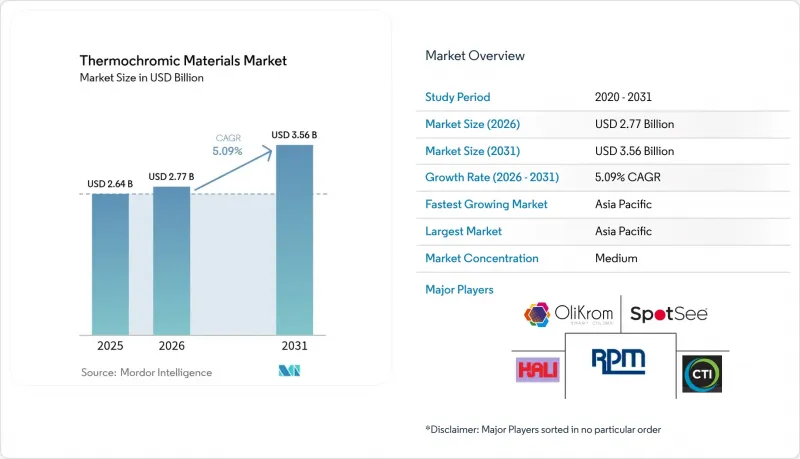
According to Mordor Intelligence, the thermochromic materials market size was valued at USD 2.64 billion in 2025 and estimated to grow from USD 2.77 billion in 2026 to reach USD 3.56 billion by 2031, at a CAGR of 5.09% during the forecast period (2026-2031).
This report is Segmented by Type (Reversible and Irreversible), Material (Liquid Crystal, Leuco Dyes, Pigments, and Other Materials), Application (Roof Coatings, Printing, Food Packaging, and More), End-User Industry (Building and Construction, Packaging, Consumer Goods, Automotive and Transportation, and More), and Geography (Asia Pacific, North America, Europe, South America, and Middle-East and Africa).
Global Thermochromic Materials Market Trends and Insights
Cool-roof Energy-saving Mandates Drive Market Expansion
Compliance measures such as California's Title 24 move thermochromic materials from niche to mainstream building supplies. Dynamic pigments allow a single coating to switch from dark gray to white at 25 °C, generating 20% to 30% yearly HVAC savings in field trials. European and Asian regulators are drafting parallel roof standards that mirror the solar-reflectance and emissivity thresholds already codified in the United States, anchoring long-term demand for color-adaptive roof finishes that curb peak electricity loads and shrink carbon footprints.
Packaging Anti-counterfeit Regulations Accelerate Adoption
Globally harmonized rules for pharmaceutical and food security labeling are steering brands toward inks that reveal tampering or temperature abuse. Thermochromic features satisfy those mandates while meeting EU Regulation 1935/2004 limits on migratory substances. Higher product integrity combined with simplified authentication workflows justifies premium pricing, translating directly into added value for label converters facing cost pressures.
High Formulation Cost Versus Conventional Pigments
A single kilogram of thermochromic powder can cost three to five times as much as a standard inorganic pigment, constraining usage in large-surface projects such as exterior facades. Process scaling and rising encapsulation yields are easing this premium, yet an upfront price hurdle endures for budget-driven buyers in emerging economies.
Other drivers and restraints analyzed in the detailed report include:
- Printable Smart-label Adoption Transforms Retail Applications
- Rapid Cost Decline in Micro-encapsulation Technology
- Photo and Thermo-fatigue Limiting Lifetime Performance
For complete list of drivers and restraints, kindly check the Table Of Contents.
Segment Analysis
Reversible systems contributed 62.78% of the thermochromic materials market in 2025 and continue to command attention because they endure thousands of switch cycles with minor chromatic drift. Such resilience underpins temperature labels for reusable containers and smart textiles that must react with every wear. Premium encapsulation films now shield leuco dyes from oxygen, retaining vivid hues beyond 10,000 heating-cooling rounds, a notable leap over prior generations.
Irreversible materials, although representing a smaller slice, are slated for 6.39% CAGR as brand owners adopt "once-only" color reveals for tamper evidence in pharmaceuticals and frozen-food logistics. Increased durability expectations motivate formulators to test bio-based shells and nano-additives that suppress fatigue without elevating cost. The thermochromic materials market benefits as reversible offerings migrate into consumer-oriented products such as mood-changing ceramics and interactive notebooks. Several appliance makers are also piloting reversible panels for stovetop safety cues, broadening application breadth and deepening volume potential.
Leuco dye chemistry accounted for 43.72% of total demand in 2025, thanks to its mature supply chain and competitive unit pricing. Ongoing adoption of formaldehyde-free shell systems means leuco dyes now meet stringent contact and emission caps in Europe and North America while preserving color-transition sharpness. In turn, hybrid capsules blend leuco dyes with liquid crystals or photochromic molecules to extend the activation window, drawing a projected 6.78% CAGR to 2031.
Liquid crystals sustain a niche for high-precision thermography tools where 0.1 °C resolution is mandatory, yet their comparatively high price constrains mass-market penetration. Pigment-based inorganic solutions hold steady in ceramic glazes and plastics that need specific shade stability. Collectively, these material tiers empower formulators to select fit-for-purpose chemistries, supporting the thermochromic materials market's breadth without compromising specialized performance.
Complete Report Scope:
- By Type
- Reversible
- Irreversible
- By Material
- Liquid Crystal
- Leuco Dyes
- Pigments
- Other Materials (Hybrid Capsules, etc.)
- By Application
- Roof Coatings
- Printing
- Food Packaging
- Cosmetics
- Other Applications (Textiles and Fashion, etc.)
- By End-User Industry
- Building and Construction
- Packaging
- Consumer Goods
- Automotive and Transportation
- Healthcare
- Other End user Industries (Oil and Gas, etc.)
- By Geography
- Asia Pacific
- China
- India
- Japan
- South Korea
- Rest of Asia Pacific
- North America
- United States
- Canada
- Mexico
- Europe
- Germany
- France
- United Kingdom
- Italy
- Rest of Europe
- South America
- Brazil
- Argentina
- Rest of South America
- Middle-East and Africa
- Saudi Arabia
- South Africa
- Rest of Middle-East and Africa
- Asia Pacific
Geography Analysis
Asia-Pacific retained leadership with 41.12% share in 2025 as China supplied cost-effective bulk volumes and India adopted smart inks for pharmaceuticals and automotive interiors. The thermochromic materials market size in Asia-Pacific is forecast to advance at 5.97% CAGR to 2031, abetted by electric-vehicle battery sensing demand across regional gigafactories. Japan funnels research and development into liquid-crystal solutions that command premium prices for laboratory diagnostic kits, demonstrating that high-tech and mass-volume segments can coexist within one geography.
North America sustains demand momentum on the back of Title 24-like building codes, stringent food-safety labeling, and consumers who value interactive packaging. Domestic formulators continue to refine formaldehyde-free shells to meet forthcoming FDA guidance while preserving vivid color transitions. Europe follows close behind, driven by its Green Deal agenda and urban retrofits that integrate adaptive facade coatings, whereas Middle-East and Africa, and South America show incremental uptake as construction booms and retail chains scale cold-chain operations.
Collectively, regional dynamics underscore that the thermochromic materials market remains both supply-centered, owing to APAC cost advantages, and compliance-centered, owing to Western regulatory drivers. This duality enables cross-regional technology transfer yet sustains price differentials that shape buyer sourcing strategies.
- Chromatic Technologies Inc.
- Color Change Glass
- FX Pigments Pvt Ltd
- Gem'Innov
- Global New Material International
- Good Life Innovations Ltd
- Hali Pigment Co. Ltd
- Kolorjet Chemicals Pvt Ltd
- Kolortek Co. Ltd
- L'Arca Srl
- SpotSee
- Matsui International Co. Inc.
- Mischtechnik Mischer AG
- NewColor Chemical Co. Ltd
- OliKrom
- QCR Solutions Corp.
- RPM International Inc. (Rust-Oleum)
- SFXC
- Shenzhen Hongye Jie Technology
- Smarol Industry Co. Ltd
- SPI Chemicals
Additional Benefits:
- The market estimate (ME) sheet in Excel format
- 3 months of analyst support
TABLE OF CONTENTS
1 Introduction
- 1.1 Study Assumptions and Market Definition
- 1.2 Scope of the Study
2 Research Methodology
3 Executive Summary
4 Market Landscape
- 4.1 Market Overview
- 4.2 Market Drivers
- 4.2.1 Cool-Roof Energy-Saving Mandates
- 4.2.2 Packaging Anti-Counterfeit Regulations
- 4.2.3 Printable Smart-Label Adoption in Retail
- 4.2.4 Rapid Cost Decline in Micro-Encapsulation (Under-The-Radar)
- 4.2.5 Emerging Demand from Battery Thermal Sensing (Under-The-Radar)
- 4.3 Market Restraints
- 4.3.1 High Formulation Cost Versus Conventional Pigments
- 4.3.2 Photo and Thermo-Fatigue Limiting Lifetime
- 4.3.3 Restricted Food?Contact Approvals in EU and US (Under-The-Radar)
- 4.4 Value/Supply-Chain Analysis
- 4.5 Regulatory Landscape
- 4.6 Technological Outlook
- 4.7 Porter's Five Forces
- 4.7.1 Threat of New Entrants
- 4.7.2 Bargaining Power of Buyers
- 4.7.3 Bargaining Power of Suppliers
- 4.7.4 Threat of Substitute Products
- 4.7.5 Degree of Competition
- 4.8 Raw Material Analysis
5 Market Size and Growth Forecasts (Value)
- 5.1 By Type
- 5.1.1 Reversible
- 5.1.2 Irreversible
- 5.2 By Material
- 5.2.1 Liquid Crystal
- 5.2.2 Leuco Dyes
- 5.2.3 Pigments
- 5.2.4 Other Materials (Hybrid Capsules, etc.)
- 5.3 By Application
- 5.3.1 Roof Coatings
- 5.3.2 Printing
- 5.3.3 Food Packaging
- 5.3.4 Cosmetics
- 5.3.5 Other Applications (Textiles and Fashion, etc.)
- 5.4 By End-User Industry
- 5.4.1 Building and Construction
- 5.4.2 Packaging
- 5.4.3 Consumer Goods
- 5.4.4 Automotive and Transportation
- 5.4.5 Healthcare
- 5.4.6 Other End user Industries (Oil and Gas, etc.)
- 5.5 By Geography
- 5.5.1 Asia Pacific
- 5.5.1.1 China
- 5.5.1.2 India
- 5.5.1.3 Japan
- 5.5.1.4 South Korea
- 5.5.1.5 Rest of Asia Pacific
- 5.5.2 North America
- 5.5.2.1 United States
- 5.5.2.2 Canada
- 5.5.2.3 Mexico
- 5.5.3 Europe
- 5.5.3.1 Germany
- 5.5.3.2 France
- 5.5.3.3 United Kingdom
- 5.5.3.4 Italy
- 5.5.3.5 Rest of Europe
- 5.5.4 South America
- 5.5.4.1 Brazil
- 5.5.4.2 Argentina
- 5.5.4.3 Rest of South America
- 5.5.5 Middle-East and Africa
- 5.5.5.1 Saudi Arabia
- 5.5.5.2 South Africa
- 5.5.5.3 Rest of Middle-East and Africa
- 5.5.1 Asia Pacific
6 Competitive Landscape
- 6.1 Market Concentration
- 6.2 Strategic Moves
- 6.3 Market Share(%)/Ranking Analysis
- 6.4 Company Profiles (includes Global-level Overview, Market-level Overview, Core Segments, Financials, Strategic Information, Market Rank/Share, Products and Services, Recent Developments)
- 6.4.1 Chromatic Technologies Inc.
- 6.4.2 Color Change Glass
- 6.4.3 FX Pigments Pvt Ltd
- 6.4.4 Gem'Innov
- 6.4.5 Global New Material International
- 6.4.6 Good Life Innovations Ltd
- 6.4.7 Hali Pigment Co. Ltd
- 6.4.8 Kolorjet Chemicals Pvt Ltd
- 6.4.9 Kolortek Co. Ltd
- 6.4.10 L'Arca Srl
- 6.4.11 SpotSee
- 6.4.12 Matsui International Co. Inc.
- 6.4.13 Mischtechnik Mischer AG
- 6.4.14 NewColor Chemical Co. Ltd
- 6.4.15 OliKrom
- 6.4.16 QCR Solutions Corp.
- 6.4.17 RPM International Inc. (Rust-Oleum)
- 6.4.18 SFXC
- 6.4.19 Shenzhen Hongye Jie Technology
- 6.4.20 Smarol Industry Co. Ltd
- 6.4.21 SPI Chemicals
7 Market Opportunities and Future Outlook
- 7.1 White-space and Unmet-Need Assessment

