PUBLISHER: Mordor Intelligence | PRODUCT CODE: 2114914

PUBLISHER: Mordor Intelligence | PRODUCT CODE: 2114914
Aluminum Pigment - Market Share Analysis, Industry Trends & Statistics, Growth Forecasts (2026 - 2031)
According to Mordor Intelligence, the aluminum pigment market size in 2026 is estimated at USD 757.81 million, growing from 2025 value of USD 729.22 million with 2031 projections showing USD 918.5 million, growing at 3.92% CAGR over 2026-2031.
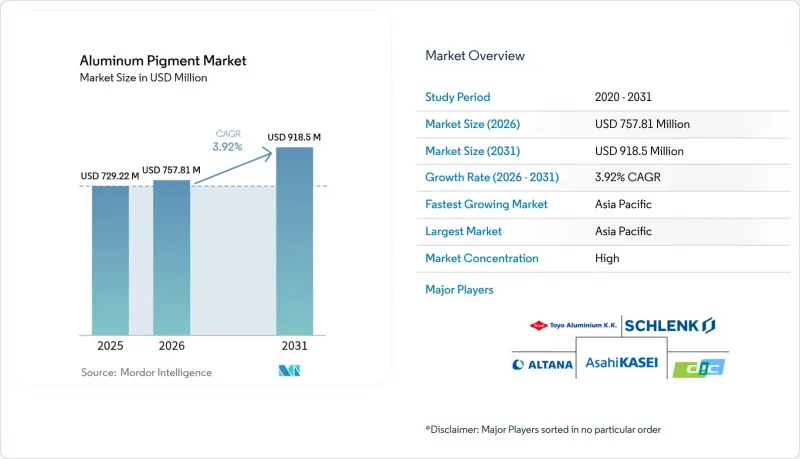
This report is Segmented by Form (Powder, Pellets, Paste, and Other Forms), Coating Type (Leafing and Non-Leafing), End-User Industry (Paints and Coatings, Plastics, Printing Inks, Personal Care, and Other End-User Industries), and Geography (Asia-Pacific, North America, Europe, South America, and Middle-East and Africa). The Market Forecasts are Provided in Terms of Value (USD).
Global Aluminum Pigment Market Trends and Insights
Growing Demand for Metallic Automotive Finishes
Regulatory limits on solvent emissions and consumer preference for premium styling push automakers toward metallic coatings that incorporate finely milled aluminum flakes. Electric-vehicle OEMs view these pigments as a dual-benefit material: they deliver eye-catching effects and improve thermal reflectivity, which lessens battery heat gain in warm climates. Autonomous-vehicle developers have added performance criteria around LiDAR and radar transparency, prompting suppliers to engineer narrow particle-size cuts that maintain reflectance without signal scatter. Automotive refinish suppliers also rely on aluminum pigments because repair jobs must match OEM shades while curing at temperatures low enough to protect plastic trims. Sector-wide, these requirements channel research and development budgets into tailored encapsulation methods that enhance corrosion resistance in waterborne formulations.
Rising Adoption of High-Performance Powder Coatings
Powder coatings eliminate VOC emissions, cut overspray waste, and offer single-coat coverage, making them the finish of choice for appliances, architecture, and wheels. Aluminum pigments enable bright metallic looks in these systems, but must retain brilliance after a 200 °C bake. Producers now suspend flakes in silica sol-gel or silicone shells to block oxidation, allowing glossy powder lines to pass salt-spray and humidity tests demanded by appliance brands.
Stringent EHS regulations on metal powders
Europe's revised CLP Regulation and the U.S. OSHA dust-combustion rules require upgraded ventilation, inert-gas milling, and ATEX-certified packaging lines. Compliance costs escalate fastest for producers under 5,000 t/y, encouraging mergers that pool capital and engineering know-how. Updated U.S. Subpart RRR limits hydrogen chloride and particulate releases from secondary smelters, affecting pigment plants that tap scrap streams for greener inputs. In turn, the aluminum pigment market experiences a near-term growth drag until upgraded plants come online.
Other drivers and restraints analyzed in the detailed report include:
- Expansion of Personal Care and Cosmetics with Effect Pigments
- Emerging Use of Aluminum Flakes in Additive Manufacturing Feedstocks
- Energy-Intensive Production Processes Under Decarbonization Pressure
For complete list of drivers and restraints, kindly check the Table Of Contents.
Segment Analysis
Powder held the largest 54.62% aluminum pigment market share in 2025 thanks to its ease of dispersion in automotive and industrial coatings. The aluminum pigment market size for powder formats is projected to grow steadily alongside high-performance powder coatings that cure faster and cut VOCs. In usage terms, low-oil-absorption grades enable thicker film builds without compromise on metallic sparkle, while dust-free granules improve worker safety during electrostatic application.
Other forms, chiefly flakes and vacuum-metallized pigments, represent the quickest 4.83% CAGR through 2031. Flakes mirror visible and near-infrared wavelengths efficiently, making them a staple in cool-roof and facade systems that demand both reflective function and design freedom. Vacuum-metallized pigments, produced by physical vapor deposition, deliver mirror-like brilliance prized in consumer electronics casings. Pellets and pastes remain niche but essential for waterborne or UV-cured formulations that need zero airborne dust.
Complete Report Scope:
- By Form
- Powder
- Pellets
- Paste
- Other Forms (Flakes, Vacuum Metallized Pigments, etc.)
- By Coating Type
- Leafing
- Non-Leafing
- By End-user Industry
- Paints and Coatings
- Plastics
- Printing Inks
- Personal Care
- Other End-user Industries (Automotive OEM and Refinish, Textile, etc.)
- By Geography
- Asia-Pacific
- China
- Japan
- India
- South Korea
- ASEAN Countries
- Rest of Asia-Pacific
- North America
- United States
- Canada
- Mexico
- Europe
- Germany
- United Kingdom
- France
- Italy
- Spain
- Russia
- NORDIC Countries
- Rest of Europe
- South America
- Brazil
- Argentina
- Rest of South America
- Middle-East and Africa
- Saudi Arabia
- South Africa
- Rest of Middle-East and Africa
- Asia-Pacific
Geography Analysis
Asia-Pacific controlled 46.35% of 2025 sales and is set to expand at a 4.55% CAGR through 2031. India's smelting output rose 11% to 4.016 million tons in 2024, underpinning domestic pigment feedstock security. Japan's auto-grade aluminum demand recovery also supports higher-value pigments for premium brands.
North America benefits from a carbon footprint roughly 50% below the global average, thanks to hydroelectric smelters in Canada and widespread recycling. Europe mirrors this drive, with Hydro partnering with Porsche in 2024 to supply low-carbon aluminum across vehicle lines. These moves stimulate demand for sustainably certified aluminum pigments in luxury branding.
South America, the Middle East, and Africa collectively display emerging demand curves tied to rising infrastructure spending and light-vehicle assembly. GCC construction codes now reference solar-reflective index thresholds, opening doors for NIR-reflective grades. In Brazil and Mexico, pickup and compact-SUV output serves as a pull factor for local pigment blending houses, although currency volatility keeps imports sensitive to metal price shocks.
- ALTANA
- Asahi Kasei Corporation
- AVL METAL POWDERS n.v.
- Carlfors Bruk
- DIC CORPORATION
- FX Pigments Pvt. Ltd.
- GEOTECH
- Hefei Sunrise Aluminium Pigments Co.,Ltd-
- Kolortek Co., Ltd.
- Metaflake Ltd
- Nippon Light Metal Co.,Ltd
- SCHLENK SE
- Shan Dong Jie Han Metal Material Co., Ltd
- TOYO ALUMINIUM K.K.
- Zhangqiu metallic pigment co.,ltd.
- ZuXing New Materials Co., Ltd.
Additional Benefits:
- The market estimate (ME) sheet in Excel format
- 3 months of analyst support
TABLE OF CONTENTS
1 Introduction
- 1.1 Study Assumptions and Market Definition
- 1.2 Scope of the Study
2 Research Methodology
3 Executive Summary
4 Market Landscape
- 4.1 Market Overview
- 4.2 Market Drivers
- 4.2.1 Growing Demand for Metallic Automotive Finishes
- 4.2.2 Rising Adoption of High-Performance Powder Coatings
- 4.2.3 Expansion of Personal Care and Cosmetics with Effect Pigments
- 4.2.4 Emerging Use of Aluminum Flakes in Additive Manufacturing Feedstocks
- 4.2.5 Reflective Cool-Roof Coatings for Urban Heat-Island Mitigation
- 4.3 Market Restraints
- 4.3.1 Stringent EHS Regulations on Metal Powders
- 4.3.2 Volatility in Primary Aluminum Prices and Supply
- 4.3.3 Energy-Intensive Production Processes Under Decarbonization Pressure
- 4.4 Value Chain Analysis
- 4.5 Porter's Five Forces Analysis
- 4.5.1 Bargaining Power of Suppliers
- 4.5.2 Bargaining Power of Buyers
- 4.5.3 Threat of New Entrants
- 4.5.4 Threat of Substitutes
- 4.5.5 Competitive Rivalry
5 Market Size and Growth Forecasts
- 5.1 By Form
- 5.1.1 Powder
- 5.1.2 Pellets
- 5.1.3 Paste
- 5.1.4 Other Forms (Flakes, Vacuum Metallized Pigments, etc.)
- 5.2 By Coating Type
- 5.2.1 Leafing
- 5.2.2 Non-Leafing
- 5.3 By End-user Industry
- 5.3.1 Paints and Coatings
- 5.3.2 Plastics
- 5.3.3 Printing Inks
- 5.3.4 Personal Care
- 5.3.5 Other End-user Industries (Automotive OEM and Refinish, Textile, etc.)
- 5.4 By Geography
- 5.4.1 Asia-Pacific
- 5.4.1.1 China
- 5.4.1.2 Japan
- 5.4.1.3 India
- 5.4.1.4 South Korea
- 5.4.1.5 ASEAN Countries
- 5.4.1.6 Rest of Asia-Pacific
- 5.4.2 North America
- 5.4.2.1 United States
- 5.4.2.2 Canada
- 5.4.2.3 Mexico
- 5.4.3 Europe
- 5.4.3.1 Germany
- 5.4.3.2 United Kingdom
- 5.4.3.3 France
- 5.4.3.4 Italy
- 5.4.3.5 Spain
- 5.4.3.6 Russia
- 5.4.3.7 NORDIC Countries
- 5.4.3.8 Rest of Europe
- 5.4.4 South America
- 5.4.4.1 Brazil
- 5.4.4.2 Argentina
- 5.4.4.3 Rest of South America
- 5.4.5 Middle-East and Africa
- 5.4.5.1 Saudi Arabia
- 5.4.5.2 South Africa
- 5.4.5.3 Rest of Middle-East and Africa
- 5.4.1 Asia-Pacific
6 Competitive Landscape
- 6.1 Market Concentration
- 6.2 Strategic Moves
- 6.3 Market Share (%)/Ranking Analysis
- 6.4 Company Profiles (includes Global level Overview, Market level overview, Core Segments, Financials as available, Strategic Information, Market Rank/Share for key companies, Products and Services, and Recent Developments)
- 6.4.1 ALTANA
- 6.4.2 Asahi Kasei Corporation
- 6.4.3 AVL METAL POWDERS n.v.
- 6.4.4 Carlfors Bruk
- 6.4.5 DIC CORPORATION
- 6.4.6 FX Pigments Pvt. Ltd.
- 6.4.7 GEOTECH
- 6.4.8 Hefei Sunrise Aluminium Pigments Co.,Ltd-
- 6.4.9 Kolortek Co., Ltd.
- 6.4.10 Metaflake Ltd
- 6.4.11 Nippon Light Metal Co.,Ltd
- 6.4.12 SCHLENK SE
- 6.4.13 Shan Dong Jie Han Metal Material Co., Ltd
- 6.4.14 TOYO ALUMINIUM K.K.
- 6.4.15 Zhangqiu metallic pigment co.,ltd.
- 6.4.16 ZuXing New Materials Co., Ltd.
7 Market Opportunities and Future Outlook
- 7.1 White-space and Unmet-Need Assessment

