PUBLISHER: Mordor Intelligence | PRODUCT CODE: 2114941

PUBLISHER: Mordor Intelligence | PRODUCT CODE: 2114941
United Kingdom Homeware - Market Share Analysis, Industry Trends & Statistics, Growth Forecasts (2026 - 2031)
According to Mordor Intelligence, the United Kingdom homeware market size is expected to grow from USD 40.25 billion in 2025 to USD 41.73 billion in 2026 and is forecast to reach USD 51.19 billion by 2031, reflecting a 4.17% CAGR over 2026-2031.
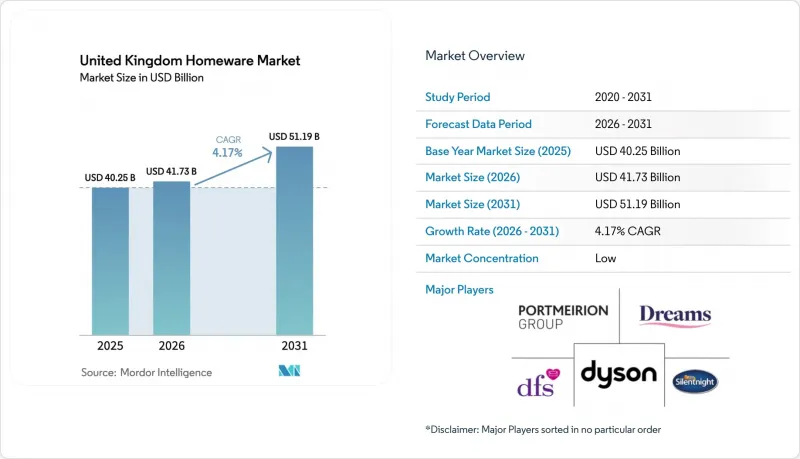
This report is Segmented by Product Category (Home Furniture, Home Textiles, Kitchen & Dining, Home Decor & Accessories, Home Fragrance & Candles, Home Appliances, Other Products), Distribution Channel (Hypermarkets and Supermarkets, Home Centers and Specialty Stores, Online, Other Distribution Channels), and Geography. Market Forecasts are Provided in Value (USD).
United Kingdom Homeware Market Trends and Insights
Rising E-Commerce Penetration and Channel Shift
The United Kingdom homeware market continues to migrate online as retailers invest in visual tools, stock transparency, and faster fulfillment to reduce friction in complex categories such as cabinets, sofas, and appliances. Digital execution is now central to growth since omnichannel operators that tie together data hubs, delivery optimization, and curated merchandising convert browsing into orders more efficiently than static storefronts. DFS reported higher-order intake in FY2025, supported by AI-enhanced marketing and machine-learning route scheduling, demonstrating how analytics-led logistics can improve conversion and on-time delivery at scale. Trade-focused networks are also blending proximity with digital visibility, as shown by Howdens' Live-Stock rollout and Click & Collect services that extend choice without losing depot speed advantages. Post-Brexit trade frictions shifted more inventory focus to domestic channels, reinforcing the digital shift by increasing online assortment depth that might otherwise have been reserved for export flows. As channel economics rebalance, the United Kingdom homeware market rewards operators that link real-time inventory with targeted recommendations and time-definite delivery promises, thereby reducing abandonment and increasing repeat purchase rates.
Home-Renovation Boom from Hybrid Working and Housing Turnover
Hybrid work has reshaped room planning and pushed more households to convert existing spaces into work zones, supporting steady demand for desks, storage, task lighting, modular seating, and fitted cabinetry in the United Kingdom homeware market. Evidence from European housing research shows that remote workers are more likely to move and adjust their dwelling choices, triggering repeat furnishing cycles during and after relocation. Professional-led renovations and trade specialist involvement remain important, as cabinet design, material selection, and installation quality drive outcomes that generalists struggle to match. England's higher housing turnover and retail density reinforce this upgrade loop by shortening the path from inspiration to installation for fitted and freestanding projects. When households postpone major moves, they still refresh decor and textiles between cycles, keeping baskets active across seasons even as mortgage rates slow transactions. Together, these behaviors extend a multi-year refurbishment runway for the United Kingdom homeware market as homeowners optimize comfort, productivity, and energy performance within existing footprints.
Inflation-Led Squeeze on Discretionary Spending
Inflation peaked in 2022 and eased into late 2025, improving planning visibility but not immediately restoring all discretionary categories to prior momentum. The CPI index showed annual inflation at 3.4% in December 2025, a level that still demanded careful pricing and promotion management for big-ticket homeware purchases. In this setting, the United Kingdom homeware market sees a split between value-driven essentials and well-targeted premium propositions where brand equity or innovation supports price realization. Appliance leaders continue to launch new features and designs to defend share through performance, which reduces direct price exposure while keeping upgrade cycles active. For retailers, a disciplined markdown strategy and bundling help maintain gross margin while aligning with consumer expectations as purchasing power resets across cohorts. The net effect is a gradual normalization path where promotions, financing, and product storytelling shape basket size more than simple list-price changes in the United Kingdom homeware market.
Other drivers and restraints analyzed in the detailed report include:
- Sustainability and Circular-Economy Demand Shaping Purchasing
- Multifunctional and Space-Saving Furniture for Urban Living
- Volatile Raw-Material & Freight Costs Pressuring Margins
For complete list of drivers and restraints, kindly check the Table Of Contents.
Segment Analysis
Home furniture captured 42.73% of the United Kingdom homeware market share in 2026, reflecting the scale of replacement and upgrade projects across living, bedroom, and workspace zones. The category remains a core basket driver because modular seating, storage, and cabinetry support evolving multiuse floor plans tied to hybrid working and family routines. Home textiles and soft furnishings extend refresh cycles between major purchases, while decor and lighting accentuate function-led reconfigurations that increase dwell time in renovated rooms. Circularity also comes into play as repair, reupholstery, and resale options gain prominence within brand and retailer propositions, helping defend premium positioning on quality. In appliances, innovation waves around air, cleaning, and compact storage create periodic step-change demand that sustains the higher-ticket end of the United Kingdom homeware market.
Home fragrance & candles is the fastest-growing product group with a 5.84% CAGR for 2026-2031, supported by wellness gifting and low-barrier refreshes that align with seasonal decor. Portmeirion's Wax Lyrical business posted strong growth and returned to profitability in FY2024, demonstrating how a portfolio mix and channel reach can unlock scale even in discretionary categories. The textiles and soft furnishings lane continues to adapt to regulatory expectations as EPR frameworks mature in the United Kingdom, a factor that is driving clearer labeling, improved recyclability, and take-back experimentation. Premium small appliances benefit from ongoing R&D investment that widens differentiation with each product cycle, as seen in Dyson's pipeline and engineering footprint expansion. Collectively, these product trends anchor the United Kingdom homeware industry to a balanced growth mix that combines core furniture demand with higher-velocity accessory and appliance refreshes.
Complete Report Scope:
- By Product Category
- Home Furniture
- Living Room and Dining Room Furniture
- Bedroom Furniture
- Kitchen Furniture
- Home Office Furniture
- Other Home Furniture
- Home Textiles
- Bed Linen
- Bath Linen
- Kitchen Linen
- Upholstery and Curtains
- Other Home Textiles
- Kitchen & Dining
- Cookware
- Dinnerware
- Others
- Home Decor & Accessories
- Vases
- Frames
- Decorative Lighting
- Wall Decor
- Others
- Home Fragrance & Candles
- Home Appliances
- Other Products (bathroom accessories, garden decor, etc.)
- Home Furniture
- By Distribution Channel
- Hypermarkets and Supermarkets
- Home Centers and Specialty Stores
- Online
- Other Distribution Channels
- By Region
- England
- Scotland
- Wales
- Northern Ireland
List of Companies Covered in this Report:
- DFS Furniture plc
- Dreams Ltd.
- Silentnight Group
- Hypnos Ltd.
- Ercol Furniture Ltd.
- Parker Knoll Ltd.
- G Plan Upholstery Ltd.
- Duresta Upholstery Ltd.
- Denby Pottery Company Ltd.
- Portmeirion Group PLC
- Churchill China PLC
- Joseph Joseph Ltd.
- Salter / Ultimate Products PLC
- Morphy Richards Ltd.
- Dualit Ltd.
- Dyson Ltd.
- AGA Rangemaster Group
- Howdens Joinery PLC
- Robert Welch Designs Ltd.
- LSA International*
Additional Benefits:
- The market estimate (ME) sheet in Excel format
- 3 months of analyst support
TABLE OF CONTENTS
1 Introduction
- 1.1 Study Assumptions & Market Definition
- 1.2 Scope of the Study
2 Research Methodology
3 Executive Summary
4 Market Landscape
- 4.1 Market Overview
- 4.2 Market Drivers
- 4.2.1 Rising E-Commerce Penetration And Channel Shift
- 4.2.2 Home-Renovation Boom From Hybrid Working & Housing Turnover
- 4.2.3 Sustainability and Circular-Economy Demand Shaping Purchasing
- 4.2.4 Multifunctional/Space-Saving Furniture for Urban Living
- 4.2.5 AI-Driven Personalisation Lifting Basket Size & Retention
- 4.2.6 Residential Micro-Unit Conversions Boosting Furnishing Need
- 4.3 Market Restraints
- 4.3.1 Inflation-Led Squeeze on Discretionary Spending
- 4.3.2 Volatile Raw-Material & Freight Costs Pressuring Margins
- 4.3.3 Post-Brexit Customs Frictions Hitting SME Import Flows
- 4.3.4 Tougher Reverse-Logistics & Disposal Rules Raising Costs
- 4.4 Industry Value Chain Analysis
- 4.5 Porter's Five Forces
- 4.5.1 Threat of New Entrants
- 4.5.2 Bargaining Power of Suppliers
- 4.5.3 Bargaining Power of Buyers
- 4.5.4 Threat of Substitutes
- 4.5.5 Competitive Rivalry
- 4.6 Insights into the Latest Trends and Innovations in the Industry
- 4.7 Insights on Recent Developments (New Product Launches, Investments, Partnerships, JVs, Expansion, M&As, etc.) in the Industry
5 Market Size & Growth Forecasts (Value)
- 5.1 By Product Category
- 5.1.1 Home Furniture
- 5.1.1.1 Living Room and Dining Room Furniture
- 5.1.1.2 Bedroom Furniture
- 5.1.1.3 Kitchen Furniture
- 5.1.1.4 Home Office Furniture
- 5.1.1.5 Other Home Furniture
- 5.1.2 Home Textiles
- 5.1.2.1 Bed Linen
- 5.1.2.2 Bath Linen
- 5.1.2.3 Kitchen Linen
- 5.1.2.4 Upholstery and Curtains
- 5.1.2.5 Other Home Textiles
- 5.1.3 Kitchen & Dining
- 5.1.3.1 Cookware
- 5.1.3.2 Dinnerware
- 5.1.3.3 Others
- 5.1.4 Home Decor & Accessories
- 5.1.4.1 Vases
- 5.1.4.2 Frames
- 5.1.4.3 Decorative Lighting
- 5.1.4.4 Wall Decor
- 5.1.4.5 Others
- 5.1.5 Home Fragrance & Candles
- 5.1.6 Home Appliances
- 5.1.7 Other Products (bathroom accessories, garden decor, etc.)
- 5.1.1 Home Furniture
- 5.2 By Distribution Channel
- 5.2.1 Hypermarkets and Supermarkets
- 5.2.2 Home Centers and Specialty Stores
- 5.2.3 Online
- 5.2.4 Other Distribution Channels
- 5.3 By Region
- 5.3.1 England
- 5.3.2 Scotland
- 5.3.3 Wales
- 5.3.4 Northern Ireland
6 Competitive Landscape
- 6.1 Market Concentration
- 6.2 Strategic Moves
- 6.3 Market Share Analysis
- 6.4 Company Profiles {(includes Global level Overview, Market level overview, Core Segments, Financials as available, Strategic Information, Market Rank/Share for key companies, Products & Services, and Recent Developments)}
- 6.4.1 DFS Furniture plc
- 6.4.2 Dreams Ltd.
- 6.4.3 Silentnight Group
- 6.4.4 Hypnos Ltd.
- 6.4.5 Ercol Furniture Ltd.
- 6.4.6 Parker Knoll Ltd.
- 6.4.7 G Plan Upholstery Ltd.
- 6.4.8 Duresta Upholstery Ltd.
- 6.4.9 Denby Pottery Company Ltd.
- 6.4.10 Portmeirion Group PLC
- 6.4.11 Churchill China PLC
- 6.4.12 Joseph Joseph Ltd.
- 6.4.13 Salter / Ultimate Products PLC
- 6.4.14 Morphy Richards Ltd.
- 6.4.15 Dualit Ltd.
- 6.4.16 Dyson Ltd.
- 6.4.17 AGA Rangemaster Group
- 6.4.18 Howdens Joinery PLC
- 6.4.19 Robert Welch Designs Ltd.
- 6.4.20 LSA International*
7 Market Opportunities & Future Outlook
- 7.1 Premiumization and Design-Focused Consumer Preferences
- 7.2 Opportunities in Home Office and Hybrid Work Furniture

