PUBLISHER: Mordor Intelligence | PRODUCT CODE: 2117338

PUBLISHER: Mordor Intelligence | PRODUCT CODE: 2117338
Furniture And Home Furnishing - Market Share Analysis, Industry Trends & Statistics, Growth Forecasts (2026 - 2031)
According to Mordor Intelligence, the furniture and home furnishing market size was valued at USD 0.93 trillion in 2025 and is estimated to grow from USD 1 trillion in 2026 to reach USD 1.43 trillion by 2031, at a CAGR of 7.39% during the forecast period (2026-2031).
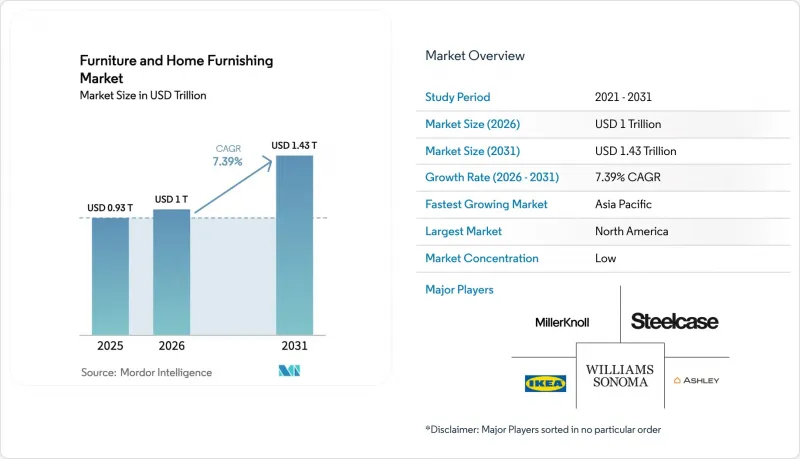
This report is Segmented by Application (Kitchen, Living Room, Bedroom, Bathroom, Outdoor, and Other Furniture), Material (Wood, Metal, Plastic, Fabric, Others), Distribution Channel (B2C/Retail and B2B/Project), and Geography (North America, South America, and More). The Market Forecasts are Provided in Terms of Value (USD).
Global Furniture And Home Furnishing Market Trends and Insights
Rapid Urbanization and Shrinking Living Spaces Propel Space-Efficient Furniture Demand
Rising urban density is compressing residential footprints in major metro areas, which heightens the appeal of modular and multifunctional designs that can reconfigure across daily routines. Government statistics show that in the Netherlands, the average living space per person in major cities like Amsterdam is about 49 square metres, compared with a national average of 65 square metres, reflecting smaller residential footprints in urban areas . This trend is most visible in compact floor plans where convertible sofas, folding desks, and vertical storage systems deliver real space utility. Product development cycles increasingly focus on knock-down designs that cut packaging volume and streamline last-mile handling while supporting lower-emission logistics. Global brands are adapting assortments and packaging to small-space living and urban delivery constraints, with compact series and room-by-room planning tools embedded into store formats. As more households prioritize adaptability and ease of assembly, the furniture and home furnishing market benefits from design innovations that meet the constraints of modern city housing while reducing waste in shipping and storage.
Rising Disposable Income in Emerging Economies Unlocks Premium Segment Growth
A larger middle class in high-growth Asian markets is supporting steady trading-up behaviour from basic to premium finishes, especially in living room and bedroom categories. In India, category expansion aligns with broad-based home formation and residential upgrades, where organized retail and online channels have widened access to branded offerings for urban households. Pradhan Mantri Awas Yojana - Urban (PMAY-U) 2.0 covers 5,206 towns, with 995 thousand houses sanctioned and 5.616 million households registered, across implementation verticals such as Beneficiary-Led Construction (BLC), Affordable Housing in Partnership (AHP), and In-Situ Slum Redevelopment (ISS). The scheme targets Economically Weaker Sections (EWS), Low-Income Groups (LIG), and Middle-Income Groups (MIG), with total central government assistance of USD 29.3 billion. This large-scale urban housing expansion is a key driver of increased demand for furniture and home furnishings. Certifications such as FSC and GREENGUARD have become buying criteria for upwardly mobile consumers, which directs demand toward cleaner materials and low-emission finishes that meet recognized ecolabel benchmarks. This preference is visible in both residential and project-driven purchases, as procurement teams standardize on third-party standards in corporate, hospitality, and education settings. As premiumization advances, the furniture and home furnishing market captures higher ticket sizes through better materials, curated collections, and services that reinforce perceived value.
Volatility in Raw-Material Prices Pressures Margins and Supply-Chain Stability
Lumber price volatility, duty changes, and supply curtailments have kept input costs unpredictable for wood-based categories and upstream suppliers. Framing lumber market movements since 2024 have challenged purchasing plans in sequential quarters, which complicates pricing and promotions for wood-heavy lines. In parallel, governments have tightened import protections on steel and derivative products, which elevates costs for metal frames, fittings, and components in seating and storage. These forces raise material-to-revenue ratios and require more focused cost control in freight, packaging, and returns to hold margins. As a result, brands are working earlier with suppliers on substitutions and design-to-value choices that stabilize lead times and costs in the furniture and home furnishing market.
Other drivers and restraints analyzed in the detailed report include:
- Growth of E-Commerce and Omnichannel Retailing Revolutionizes Furniture Purchasing Journeys
- Post-Pandemic Work-From-Home Demand Spike Sustains Ergonomic and Home-Office Furniture Growth
- Trade-Policy Uncertainties and Tariff Fluctuations Disrupt Sourcing Strategies
For complete list of drivers and restraints, kindly check the Table Of Contents.
Segment Analysis
Living Room furniture commanded 35.26% of applications in 2025 within the furniture and home furnishing market, supported by staples such as sectionals, entertainment units, and coordinated tables that anchor daily use in homes. The Outdoor category is the fastest-moving application with an 8.12% CAGR through 2031, which reflects the lasting adoption of backyard and balcony settings as extensions of indoor living. This mix underscores how households now balance core indoor replacements with exterior upgrades that emphasize weather-proof materials and easy care. The furniture and home furnishing market benefits from brands that align indoor aesthetics with outdoor durability, improving cross-category basket sizes and coordinated looks for patios and decks. Stronger materials performance and modular sets also aid retail execution by simplifying selection and reducing service calls after installation.
The acceleration in outdoor specifications continues in hospitality and multifamily settings as project buyers add terraces, rooftop lounges, and shared courtyards to amenity programs. These installations favor products with recycled content and certifications alongside UV-resistant finishes that retain color and structural strength over multiple seasons. As outdoor assortments mature, retailers integrate visualization and space-planning tools to support set selection by size, seating count, and storage for covers and cushions. Living room still anchors the furniture and home furnishing market with consistent replacement cycles and style-driven updates that lift upholstery, case goods, and soft furnishings together. This balance between durable indoor staples and growing outdoor use supports steady revenue across applications in both residential and commercial channels.
Complete Report Scope:
- By Application
- Kitchen
- Living Room
- Bedroom
- Bathroom
- Outdoor
- Other Furniture
- By Material
- Wood
- Metal
- Plastic
- Fabric
- Others
- By Distribution Channel
- B2C / Retail
- Home Centers
- Specialty Furniture Stores
- Online
- Other Distribution Channels
- B2B / Project
- B2C / Retail
- By Geography
- North America
- Canada
- United States
- Mexico
- South America
- Brazil
- Peru
- Chile
- Argentina
- Rest of South America
- Europe
- United Kingdom
- Germany
- France
- Spain
- Italy
- BENELUX (Belgium, Netherlands, Luxembourg)
- NORDICS (Denmark, Finland, Iceland, Norway, Sweden)
- Rest of Europe
- Asia-Pacific
- India
- China
- Japan
- Australia
- South Korea
- South East Asia (Singapore, Malaysia, Thailand, Indonesia, Vietnam, Philippines)
- Rest of Asia-Pacific
- Middle East and Africa
- United Arab Emirates
- Saudi Arabia
- South Africa
- Nigeria
- Rest of Middle East and Africa
- North America
Geography Analysis
North America held 28.41 % of the global furniture and home furnishing market in 2025, with price sensitivity rising due to input cost fluctuations and tariff-related adjustments. Retailers are responding by refining assortments and investing in value-engineered solutions to maintain competitiveness. Volatility in lumber and import protections for steel and wood components has increased production costs for metal-framed and wood-based items. To counter logistics complexity, many operators are relying on smaller-format planning stores and micro-fulfillment centers to reduce delivery times for priority lines. These strategies help improve service levels and protect market share despite ongoing price pressures.
Asia-Pacific is the fastest-growing region, projected to expand at an 8.01 % CAGR through 2031, driven by urbanization, home formation, and a growing middle class. Rising incomes are fueling demand for premium and durable furniture, with buyers showing stronger preferences for certified materials and long-lasting finishes. The expansion of organized retail and e-commerce is improving access to branded collections and planned spaces with reliable after-sales support. Companies with strong local supplier networks and design localization are scaling faster across diverse housing types and climatic zones. These dynamics support steady growth for both residential and contract furniture markets throughout the region.
Europe and the Middle East & Africa are also shaping the global market through regulatory and project-driven dynamics. In Europe, sustainability and circular economy regulations are influencing product design, sourcing, and material choices, while Digital Product Passports will simplify verification of compliance and end-of-life tracking. The UK shows steady replacement cycles for home-office and contract furniture, aided by hybrid work patterns and aligned procurement standards. In the Middle East and Africa, particularly the GCC, hospitality, residential, and mixed-use developments are driving demand for durable, high-performance contract furniture. Regional e-commerce growth and modular, specialty assortments are expanding consumer access, while aligning with project timelines and standards remains critical for scaling operations.
- Inter IKEA Group
- Ashley Furniture Industries
- Herman Miller (MillerKnoll)
- Steelcase
- Williams-Sonoma
- La-Z-Boy
- Kimball International
- HNI Corporation
- Wayfair
- Ikea Systems BV (Franchisor)
- Mohawk Industries
- Shaw Industries Group
- Haworth
- Duresta Upholstery
- Cisco Brothers
- Greenington
- Vermont Woods Studios
- Tempur-Sealy International
- Haverty Furniture
- Godrej Interio
Additional Benefits:
- The market estimate (ME) sheet in Excel format
- 3 months of analyst support
TABLE OF CONTENTS
1 Introduction
- 1.1 Study Assumptions & Market Definition
- 1.2 Scope of the Study
2 Research Methodology
3 Executive Summary
4 Market Landscape
- 4.1 Market Overview
- 4.2 Market Drivers
- 4.2.1 Rapid urbanization & shrinking living spaces
- 4.2.2 Rising disposable income in emerging economies
- 4.2.3 Growth of e-commerce & omnichannel furniture retailing
- 4.2.4 Post-pandemic work-from-home furniture demand spike
- 4.2.5 Surge in demand for modular, space-saving designs
- 4.2.6 Circular-economy mandates driving recycled material adoption
- 4.3 Market Restraints
- 4.3.1 Volatility in raw-material prices (wood, metals, fabrics)
- 4.3.2 Trade-policy uncertainties & tariff fluctuations
- 4.3.3 Supply-chain bottlenecks for specialty hardware
- 4.3.4 Rising reverse-logistics costs from e-commerce returns
- 4.4 Value / Supply-Chain Analysis
- 4.5 Regulatory Landscape
- 4.6 Technological Outlook
- 4.7 Porter's Five Forces
- 4.7.1 Threat of New Entrants
- 4.7.2 Bargaining Power of Buyers
- 4.7.3 Bargaining Power of Suppliers
- 4.7.4 Threat of Substitutes
- 4.7.5 Competitive Rivalry
5 Market Size & Growth Forecasts
- 5.1 By Application
- 5.1.1 Kitchen
- 5.1.2 Living Room
- 5.1.3 Bedroom
- 5.1.4 Bathroom
- 5.1.5 Outdoor
- 5.1.6 Other Furniture
- 5.2 By Material
- 5.2.1 Wood
- 5.2.2 Metal
- 5.2.3 Plastic
- 5.2.4 Fabric
- 5.2.5 Others
- 5.3 By Distribution Channel
- 5.3.1 B2C / Retail
- 5.3.1.1 Home Centers
- 5.3.1.2 Specialty Furniture Stores
- 5.3.1.3 Online
- 5.3.1.4 Other Distribution Channels
- 5.3.2 B2B / Project
- 5.3.1 B2C / Retail
- 5.4 By Geography
- 5.4.1 North America
- 5.4.1.1 Canada
- 5.4.1.2 United States
- 5.4.1.3 Mexico
- 5.4.2 South America
- 5.4.2.1 Brazil
- 5.4.2.2 Peru
- 5.4.2.3 Chile
- 5.4.2.4 Argentina
- 5.4.2.5 Rest of South America
- 5.4.3 Europe
- 5.4.3.1 United Kingdom
- 5.4.3.2 Germany
- 5.4.3.3 France
- 5.4.3.4 Spain
- 5.4.3.5 Italy
- 5.4.3.6 BENELUX (Belgium, Netherlands, Luxembourg)
- 5.4.3.7 NORDICS (Denmark, Finland, Iceland, Norway, Sweden)
- 5.4.3.8 Rest of Europe
- 5.4.4 Asia-Pacific
- 5.4.4.1 India
- 5.4.4.2 China
- 5.4.4.3 Japan
- 5.4.4.4 Australia
- 5.4.4.5 South Korea
- 5.4.4.6 South East Asia (Singapore, Malaysia, Thailand, Indonesia, Vietnam, Philippines)
- 5.4.4.7 Rest of Asia-Pacific
- 5.4.5 Middle East and Africa
- 5.4.5.1 United Arab Emirates
- 5.4.5.2 Saudi Arabia
- 5.4.5.3 South Africa
- 5.4.5.4 Nigeria
- 5.4.5.5 Rest of Middle East and Africa
- 5.4.1 North America
6 Competitive Landscape
- 6.1 Market Concentration
- 6.2 Strategic Moves
- 6.3 Market Share Analysis
- 6.4 Company Profiles (includes Global level Overview, Market level overview, Core Segments, Financials as available, Strategic Information, Market Rank/Share for key companies, Products & Services, and Recent Developments)
- 6.4.1 Inter IKEA Group
- 6.4.2 Ashley Furniture Industries
- 6.4.3 Herman Miller (MillerKnoll)
- 6.4.4 Steelcase
- 6.4.5 Williams-Sonoma
- 6.4.6 La-Z-Boy
- 6.4.7 Kimball International
- 6.4.8 HNI Corporation
- 6.4.9 Wayfair
- 6.4.10 Ikea Systems BV (Franchisor)
- 6.4.11 Mohawk Industries
- 6.4.12 Shaw Industries Group
- 6.4.13 Haworth
- 6.4.14 Duresta Upholstery
- 6.4.15 Cisco Brothers
- 6.4.16 Greenington
- 6.4.17 Vermont Woods Studios
- 6.4.18 Tempur-Sealy International
- 6.4.19 Haverty Furniture
- 6.4.20 Godrej Interio
7 Market Opportunities & Future Outlook
- 7.1 White-space & Unmet-Need Assessment

