PUBLISHER: Mordor Intelligence | PRODUCT CODE: 2114942

PUBLISHER: Mordor Intelligence | PRODUCT CODE: 2114942
Zinc Oxide - Market Share Analysis, Industry Trends & Statistics, Growth Forecasts (2026 - 2031)
According to Mordor Intelligence, zinc oxide market size in 2026 is estimated at 2.44 million tons, growing from 2025 value of 2.36 million tons with 2031 projections showing 2.92 million tons, growing at 3.58% CAGR over 2026-2031.
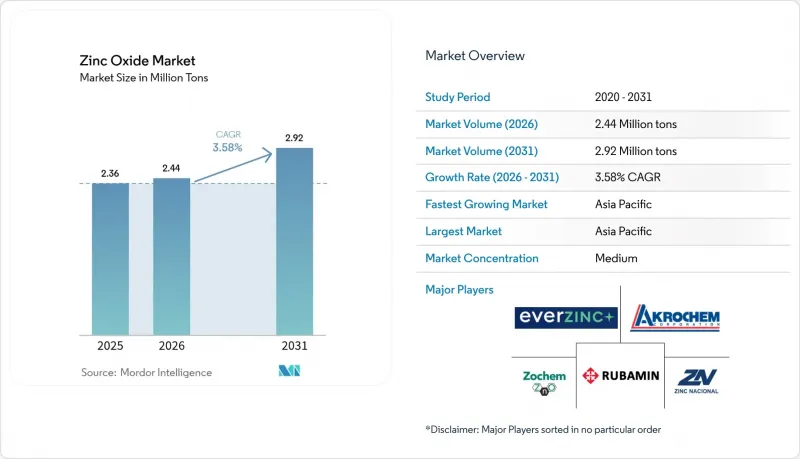
This report is Segmented by Process (Indirect Process, Direct Process, Wet-Chemical Process), Application (Rubber and Tires, Ceramics and Glass, Pharmaceuticals and Cosmetics, Agriculture, Paints and Coatings, Other Applications), and Geography (Asia-Pacific, North America, Europe, South America, Middle East and Africa). The Market Forecasts are Provided in Terms of Volume (Tons).
Global Zinc Oxide Market Trends and Insights
Robust Demand from Rubber and Tire Industry
Global tire makers rely on zinc oxide as a vulcanization activator that delivers weather resistance and mechanical durability, attributes that become more critical as electric vehicles increase curb weight and torque. JG Chemicals reports that automotive applications contribute roughly 30% of its 59,904 MTPA output, highlighting the segment's pull on Asian suppliers. Adoption of nano-grade zinc oxide allows up to 40% reduction in zinc dosage per compound while sustaining performance, helping tire makers meet tightening discharge targets without sacrificing mileage. Recycled-metal inputs now exceed 90% at several large plants, lowering both cost and carbon intensity. Coupled with a rebound in global vehicle production, these factors reinforce a steady upward trajectory for the zinc oxide market.
Expansion of Cosmetics and Sunscreen Formulations
Mineral UV filters enjoy tailwinds as regulators restrict chemicals such as oxybenzone. Zinc oxide's broad-spectrum protection, recognized as GRASE, drives formulators toward ultrafine grades that eliminate the historical white-cast hurdle. EverZinc's Zano portfolio, produced under GMP, offers transparent dispersions that carry Ecocert and Cosmos approvals, aligning with clean-beauty positioning. Surface-treated particles improve skin feel while maintaining high SPF, accelerating take-up across premium skincare lines in Asia-Pacific and reef-safe sun care in North America. Green synthesis methods using plant extracts further differentiate products for health-conscious consumers.
Zinc Concentrate Price Volatility
Supply disruptions and geopolitical tensions drove concentrate prices up 13% to USD 2,978.50 / t in 2024, squeezing smelter treatment charges and narrowing margins for oxide producers. The International Lead and Zinc Study Group now projects a 150,000-ton refined zinc surplus in 2025, yet freight bottlenecks and ore-quality variation sustain price swings that complicate procurement planning. U.S. producers, 73% reliant on imports, remain especially exposed to currency fluctuations and tariff risk. Larger firms respond by lengthening supply contracts and integrating recycling streams that already supply over 40% of their zinc input, whereas smaller firms encounter higher working-capital burdens, damping near-term growth in the zinc oxide market.
Other drivers and restraints analyzed in the detailed report include:
- Growth of Specialty Ceramics and Glass Applications
- Micronutrient-Rich Fertilizers in Precision Agriculture
- Tightening Discharge Regulations on ZnO Leachate
For complete list of drivers and restraints, kindly check the Table Of Contents.
Segment Analysis
Indirect (French) production delivered 70.62% of output in 2025, benefiting from decades of fine-tuning that anchor cost efficiency and consistent purity demanded by mass markets in rubber, ceramics, and pigments. Continuous furnace upgrades, heat-recovery loops, and waste-gas cogeneration further lower specific energy consumption, reinforcing the indirect route's competitiveness in the zinc oxide market. In parallel, wet-chemical operations are scaling quickly, recording a 4.02% CAGR thanks to their ability to engineer nano- or micro-level morphology with narrow size distributions essential for cosmetics, electronics, and precision agriculture. Plant retrofits now blend indirect calcination stages with wet-chemical precipitation for flexible grade portfolios that capture both high-volume and niche value segments.
Growing regulatory scrutiny accelerates adoption of green chemistry inside wet-chemical lines. Botanical extracts and microbial catalysts replace conventional alkali precipitants, producing bio-compatible nanoparticles suited for dermatological and biomedical products. Simultaneously, digital process-control algorithms monitor pH, temperature, and residence time in real time, minimizing batch-to-batch variance and improving yield. Collectively, these innovations broaden end-use fields and ensure that the zinc oxide market maintains a balanced process mix responsive to evolving customer specifications.
Complete Report Scope:
- By Process
- Indirect (French) Process
- Direct (American) Process
- Wet-chemical Process
- By Application
- Rubber and Tires
- Ceramics and Glass
- Pharmaceuticals and Cosmetics
- Agriculture
- Paints and Coatings
- Other Applications (Chemicals and Food, etc.)
- By Geography
- Asia-Pacific
- China
- Japan
- India
- South Korea
- ASEAN Countries
- Rest of Asia-Pacific
- North America
- United States
- Canada
- Mexico
- Europe
- Germany
- United Kingdom
- France
- Italy
- Spain
- Russia
- NORDIC Countries
- Rest of Europe
- South America
- Brazil
- Argentina
- Rest of South America
- Middle East and Africa
- Saudi Arabia
- South Africa
- Rest of Middle East and Africa
- Asia-Pacific
Geography Analysis
Asia-Pacific accounted for 45.10% of global volume in 2025 and is slated to outpace other regions with a 3.92% CAGR through 2031, powered by large downstream rubber and electronics sectors in China, India, and Southeast Asia. China alone consumes 0.3-0.5 million tons per year, equal to 5-10% of its refined-zinc usage, underscoring the material's strategic relevance to the region's manufacturing ecosystems. Regional producers leverage low-cost energy and integrated smelting-oxide chains to secure long-term contracts with global tire majors, a factor that consolidates Asia-Pacific's anchor role within the zinc oxide market.
North America trails in volume yet leads in application innovation, particularly in aerospace ceramics, medical devices, and optoelectronics that command high-purity or nano-engineered grades. However, a 73% import reliance on refined zinc leaves regional oxide makers exposed to forex swings and freight bottlenecks. Investment in secondary zinc recovery and battery-grade recycling aims to mitigate this exposure. In Europe, stringent life-cycle regulations spur adoption of closed-loop water systems and low-carbon smelting inputs such as EverZinc's use of over 40% recycled metal, reinforcing the region's image as a sustainability leader.
Emerging zones in South America and the Middle East & Africa benefit from infrastructure and construction booms that raise coatings and rubber volumes. Although these regions currently depend on imports, new smelting capacity in Peru and Oman signals a shift toward local production over the medium term. This diffusion spreads demand and invites regional customization, adding resilience to overall zinc oxide market growth.
- Akrochem Corporation
- American Chemet Corporation
- EverZinc
- GRILLO-Werke AG
- HAKUSUI TECH.
- HANIL
- Hindustan Zinc
- Pan-Continental Chemical Co., Ltd.
- RUBAMIN
- Silox India Pvt Ltd
- SURAJ UDYOG
- Zinc Nacional S.A.
- Zinc-o-India
- ZM SILESIA SA
- Zochem LLC
Additional Benefits:
- The market estimate (ME) sheet in Excel format
- 3 months of analyst support
TABLE OF CONTENTS
1 Introduction
- 1.1 Study Assumptions and Market Definition
- 1.2 Scope of the Study
2 Research Methodology
3 Executive Summary
4 Market Landscape
- 4.1 Market Overview
- 4.2 Market Drivers
- 4.2.1 Robust demand from rubber and tire industry
- 4.2.2 Expansion of cosmetics and sunscreen formulations
- 4.2.3 Growth of specialty ceramics and glass applications
- 4.2.4 Micronutrient-rich fertilizers in precision agriculture
- 4.2.5 Commercialisation of nano-ZnO in opto-electronics
- 4.3 Market Restraints
- 4.3.1 Zinc concentrate price volatility
- 4.3.2 Tightening discharge regulations on ZnO leachate
- 4.3.3 Substitution by Calcium or Zinc-free green-tire activators
- 4.4 Value Chain Analysis
- 4.5 Porter's Five Forces
- 4.5.1 Bargaining Power of Suppliers
- 4.5.2 Bargaining Power of Buyers
- 4.5.3 Threat of New Entrants
- 4.5.4 Threat of Substitutes
- 4.5.5 Degree of Competition
5 Market Size and Growth Forecasts (Volume)
- 5.1 By Process
- 5.1.1 Indirect (French) Process
- 5.1.2 Direct (American) Process
- 5.1.3 Wet-chemical Process
- 5.2 By Application
- 5.2.1 Rubber and Tires
- 5.2.2 Ceramics and Glass
- 5.2.3 Pharmaceuticals and Cosmetics
- 5.2.4 Agriculture
- 5.2.5 Paints and Coatings
- 5.2.6 Other Applications (Chemicals and Food, etc.)
- 5.3 By Geography
- 5.3.1 Asia-Pacific
- 5.3.1.1 China
- 5.3.1.2 Japan
- 5.3.1.3 India
- 5.3.1.4 South Korea
- 5.3.1.5 ASEAN Countries
- 5.3.1.6 Rest of Asia-Pacific
- 5.3.2 North America
- 5.3.2.1 United States
- 5.3.2.2 Canada
- 5.3.2.3 Mexico
- 5.3.3 Europe
- 5.3.3.1 Germany
- 5.3.3.2 United Kingdom
- 5.3.3.3 France
- 5.3.3.4 Italy
- 5.3.3.5 Spain
- 5.3.3.6 Russia
- 5.3.3.7 NORDIC Countries
- 5.3.3.8 Rest of Europe
- 5.3.4 South America
- 5.3.4.1 Brazil
- 5.3.4.2 Argentina
- 5.3.4.3 Rest of South America
- 5.3.5 Middle East and Africa
- 5.3.5.1 Saudi Arabia
- 5.3.5.2 South Africa
- 5.3.5.3 Rest of Middle East and Africa
- 5.3.1 Asia-Pacific
6 Competitive Landscape
- 6.1 Market Concentration
- 6.2 Strategic Moves
- 6.3 Market Share(%)/Ranking Analysis
- 6.4 Company Profiles (includes Global level Overview, Market level overview, Core Segments, Financials as available, Strategic Information, Market Rank/Share, Products and Services, Recent Developments)
- 6.4.1 Akrochem Corporation
- 6.4.2 American Chemet Corporation
- 6.4.3 EverZinc
- 6.4.4 GRILLO-Werke AG
- 6.4.5 HAKUSUI TECH.
- 6.4.6 HANIL
- 6.4.7 Hindustan Zinc
- 6.4.8 Pan-Continental Chemical Co., Ltd.
- 6.4.9 RUBAMIN
- 6.4.10 Silox India Pvt Ltd
- 6.4.11 SURAJ UDYOG
- 6.4.12 Zinc Nacional S.A.
- 6.4.13 Zinc-o-India
- 6.4.14 ZM SILESIA SA
- 6.4.15 Zochem LLC
7 Market Opportunities and Future Outlook
- 7.1 White-space and Unmet-Need Assessment

