PUBLISHER: Mordor Intelligence | PRODUCT CODE: 2114960

PUBLISHER: Mordor Intelligence | PRODUCT CODE: 2114960
Flexible Foam - Market Share Analysis, Industry Trends & Statistics, Growth Forecasts (2026 - 2031)
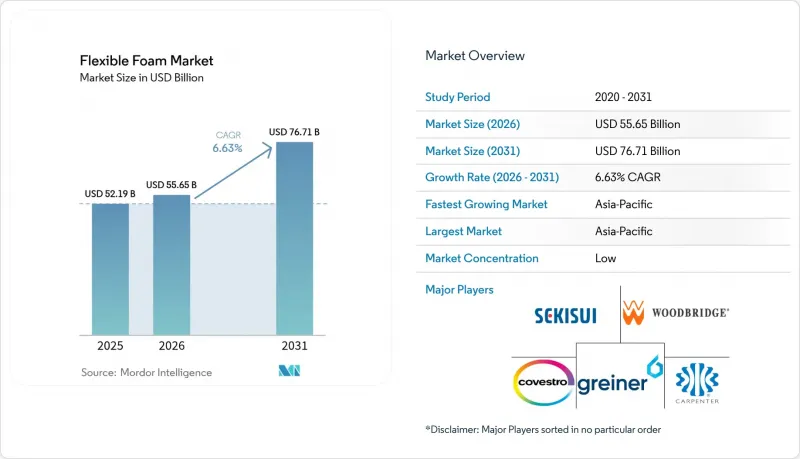
According to Mordor Intelligence, flexible foam market size in 2026 is estimated at USD 55.65 billion, growing from 2025 value of USD 52.19 billion with 2031 projections showing USD 76.71 billion, growing at 6.63% CAGR over 2026-2031.
This report is Segmented by Type (Polyurethane (Polyester, Polyether), Polyethylene (Cross-Linked, Non-Cross-Linked), and Polypropylene), Application (Furniture, Transportation, Construction, Consumer Goods, and Other Applications), and Geography (Asia-Pacific, North America, Europe, South America, and Middle East and Africa). The Market Forecasts are Provided in Terms of Value (USD).
Global Flexible Foam Market Trends and Insights
Surging E-Commerce Packaging Demand
Protective packaging needs for fragile electronics and premium direct-to-consumer deliveries are driving polyurethane foam volumes. The global packaging foam segment is set to move from USD 12.22 billion in 2025 to USD 15.36 billion by 2034, a 4.68% CAGR, underscoring polyurethane's shock-absorption advantage. Asia-Pacific leads this shift as device makers specify custom foam inserts for smartphones and tablets. Retailers differentiate through elevated unboxing experiences that rely on flexible foam solutions. Extended Producer Responsibility rules in Europe, however, push producers to design recyclable formats that may limit traditional formulations. Manufacturers with circular chemistries stand to win share as compliance deadlines near.
Furniture and Bedding Refresh Cycles in Mature Economies
Remote-work investments and wellness centricity are shortening furniture replacement timelines in developed markets. European furniture production rose 1.5% over the first four months of 2025 versus 2024, signaling continued recovery. Consumers demand premium seating and bedding that blend ergonomics with low-VOC profiles. Foam manufacturers able to deliver breathability, antimicrobial additives, and precision zoning capture premium margins. Yet spending remains sensitive to mortgage rates and housing turnover, potentially tempering growth in periods of macro stress.
Volatile Isocyanate and Polyol Feedstock Prices
MDI and TDI swings compress margins when pass-through pricing lags. BASF lifted select diols by USD 0.08-0.10 lb in April 2025 amid crude volatility. Dow's closure of an Argentina polyols site illustrates supply-demand imbalances that ripple through regional costs. U.S. consumption hit 434.9 million lb for pure MDI and 482.9 million lb for TDI in 2023, highlighting the market's raw-material exposure. Contract structures that lock in index-based formulas help larger processors mitigate shocks but smaller converters remain vulnerable.
Other drivers and restraints analyzed in the detailed report include:
- Lightweight Automotive Seating and NVH Requirements
- Adoption of CO2-Based Polyols and Circular Foam Chemistries
- Stricter VOC / Flame-Retardant Regulations
For complete list of drivers and restraints, kindly check the Table Of Contents.
Segment Analysis
Polyurethane held 55.72% of flexible foam market share in 2025 on the strength of its cost-to-performance balance. Polyester grades deliver durability for load-bearing mats while polyether variants retain hydrolytic stability in comfort seating. The segment is projected to post a 7.34% CAGR through 2031, cementing its role in the flexible foam market even as CO2-based chemistries gain ground. Ford's graphene-enhanced seat cushions demonstrate how nano-fillers can push compression strength up 20% while trimming weight 10%.
Polyethylene and polypropylene foams trail but carve niches in moisture-proof packaging and automotive headliners. Cross-linked polyethylene offers closed-cell moisture resistance, whereas non-cross-linked grades provide economical cushioning. Polypropylene's recyclability and chemical inertia secure opportunities in under-hood thermal shields. Together, alternative resins broaden the flexible foam market by enabling applications unsuited to polyurethane's thermoset nature.
Complete Report Scope:
- By Type
- Polyurethane
- Polyester
- Polyether
- Polyethylene
- Cross-linked
- Non-cross-linked
- Polypropylene
- Polyurethane
- By Application
- Furniture
- Transportation
- Construction
- Consumer Goods
- Other Applications (Packaging, Medical and Healthcare, etc.)
- By Geography
- Asia-Pacific
- China
- Japan
- India
- South Korea
- ASEAN Countries
- Rest of Asia-Pacific
- North America
- United States
- Canada
- Mexico
- Europe
- Germany
- United Kingdom
- France
- Italy
- Spain
- Russia
- NORDIC Countries
- Rest of Europe
- South America
- Brazil
- Argentina
- Rest of South America
- Middle East and Africa
- Saudi Arabia
- South Africa
- Rest of Middle East and Africa
- Asia-Pacific
Geography Analysis
Asia-Pacific controlled 45.60% of 2025 revenue and is projected to expand at a 7.35% CAGR through 2031, underscoring its central role in the flexible foam market. China's entrenched supply base partners with India's USD 87 billion petrochemical build-out, while ASEAN nations benefit from "China + 1" diversification. Sekisui Chemical's new INR 500 million Pune site signals ongoing localization for automotive seating foams.
North America maintains technological leadership despite cyclical dips in bedding and vehicle output. The U.S. leverages abundant natural gas feedstock, and Mexico now ranks as the fourth-largest polyurethane consumer thanks to near-shoring EV assembly. Regulations favor low-VOC and circular feedstocks, creating pull-through for CO2-based polyols.
Europe balances stringent environmental rules with innovation incentives. Dow's strategic review of its European polyurethane chain shows profitability strains amid high energy costs. Yet the bloc leads in circular foam adoption, driven by the 2024 Packaging and Packaging Waste Regulation mandating recyclability. South America and Middle East and Africa add incremental demand as infrastructure programs specify energy-efficient insulation, though currency volatility tempers investment.
- American Excelsior Company
- BASF
- Carpenter Co.
- Covestro AG
- Dow
- FXI
- Greiner AG
- Huntsman International LLC
- INOAC CORPORATION
- KANEKA CORPORATION
- ORSA foam SpA.
- Rogers Corporation
- SABIC
- SEKISUI CHEMICAL CO., LTD.
- Sheela Foam Ltd
- Vita Group
- Wm. T. Burnett Holding, LLC
- Woodbridge
Additional Benefits:
- The market estimate (ME) sheet in Excel format
- 3 months of analyst support
TABLE OF CONTENTS
1 Introduction
- 1.1 Study Assumptions and Market Definition
- 1.2 Scope of the Study
2 Research Methodology
3 Executive Summary
4 Market Landscape
- 4.1 Market Overview
- 4.2 Market Drivers
- 4.2.1 Surging E-Commerce Packaging Demand
- 4.2.2 Furniture and Bedding Refresh Cycles in Mature Economies
- 4.2.3 Lightweight Automotive Seating and NVH Requirements
- 4.2.4 Adoption of CO2-Based Polyols and Circular Foam Chemistries
- 4.2.5 Bed-In-A-Box Mattress Logistics Boom
- 4.3 Market Restraints
- 4.3.1 Volatile Isocyanate and Polyol Feedstock Prices
- 4.3.2 Stricter VOC / Flame-Retardant Regulations
- 4.3.3 Transition to Halogen-Free FR Systems Raises Cost And Complexity
- 4.4 Value Chain Analysis
- 4.5 Raw Material Analysis
- 4.6 Porter's Five Forces
- 4.6.1 Bargaining Power of Suppliers
- 4.6.2 Bargaining Power of Buyers
- 4.6.3 Threat of New Entrants
- 4.6.4 Threat of Substitute Products
- 4.6.5 Degree of Competition
5 Market Size and Growth Forecasts (Value)
- 5.1 By Type
- 5.1.1 Polyurethane
- 5.1.1.1 Polyester
- 5.1.1.2 Polyether
- 5.1.2 Polyethylene
- 5.1.2.1 Cross-linked
- 5.1.2.2 Non-cross-linked
- 5.1.3 Polypropylene
- 5.1.1 Polyurethane
- 5.2 By Application
- 5.2.1 Furniture
- 5.2.2 Transportation
- 5.2.3 Construction
- 5.2.4 Consumer Goods
- 5.2.5 Other Applications (Packaging, Medical and Healthcare, etc.)
- 5.3 By Geography
- 5.3.1 Asia-Pacific
- 5.3.1.1 China
- 5.3.1.2 Japan
- 5.3.1.3 India
- 5.3.1.4 South Korea
- 5.3.1.5 ASEAN Countries
- 5.3.1.6 Rest of Asia-Pacific
- 5.3.2 North America
- 5.3.2.1 United States
- 5.3.2.2 Canada
- 5.3.2.3 Mexico
- 5.3.3 Europe
- 5.3.3.1 Germany
- 5.3.3.2 United Kingdom
- 5.3.3.3 France
- 5.3.3.4 Italy
- 5.3.3.5 Spain
- 5.3.3.6 Russia
- 5.3.3.7 NORDIC Countries
- 5.3.3.8 Rest of Europe
- 5.3.4 South America
- 5.3.4.1 Brazil
- 5.3.4.2 Argentina
- 5.3.4.3 Rest of South America
- 5.3.5 Middle East and Africa
- 5.3.5.1 Saudi Arabia
- 5.3.5.2 South Africa
- 5.3.5.3 Rest of Middle East and Africa
- 5.3.1 Asia-Pacific
6 Competitive Landscape
- 6.1 Market Concentration
- 6.2 Strategic Moves
- 6.3 Market Share(%)/Ranking Analysis
- 6.4 Company Profiles (includes Global level Overview, Market level overview, Core Segments, Financials as available, Strategic Information, Market Rank/Share for key companies, Products and Services, and Recent Developments)
- 6.4.1 American Excelsior Company
- 6.4.2 BASF
- 6.4.3 Carpenter Co.
- 6.4.4 Covestro AG
- 6.4.5 Dow
- 6.4.6 FXI
- 6.4.7 Greiner AG
- 6.4.8 Huntsman International LLC
- 6.4.9 INOAC CORPORATION
- 6.4.10 KANEKA CORPORATION
- 6.4.11 ORSA foam SpA.
- 6.4.12 Rogers Corporation
- 6.4.13 SABIC
- 6.4.14 SEKISUI CHEMICAL CO., LTD.
- 6.4.15 Sheela Foam Ltd
- 6.4.16 Vita Group
- 6.4.17 Wm. T. Burnett Holding, LLC
- 6.4.18 Woodbridge
7 Market Opportunities and Future Outlook
- 7.1 White-space and Unmet-need Assessment

