PUBLISHER: Mordor Intelligence | PRODUCT CODE: 2114974

PUBLISHER: Mordor Intelligence | PRODUCT CODE: 2114974
Food Grade Lubricants - Market Share Analysis, Industry Trends & Statistics, Growth Forecasts (2026 - 2031)
According to Mordor Intelligence, the food grade lubricants market size was valued at 64.18 Million liters in 2025 and estimated to grow from 67.51 Million liters in 2026 to reach 86.95 Million liters by 2031, at a CAGR of 5.19% during the forecast period (2026-2031).
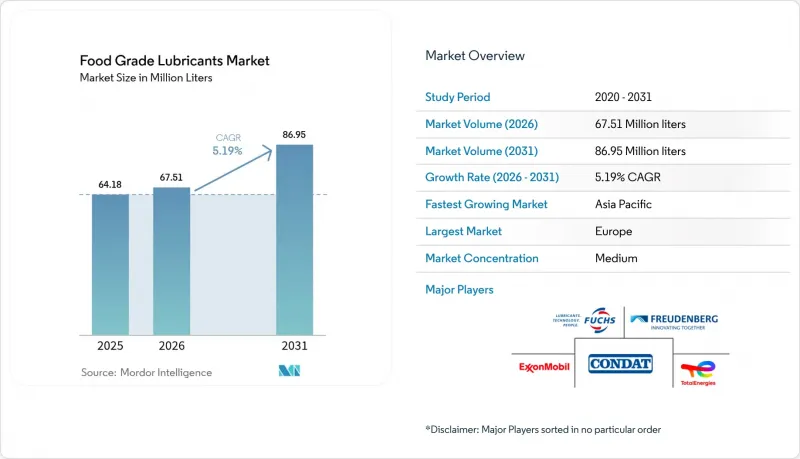
This report is Segmented by Classification (H1, H2, and H3), Base Oil (Mineral Oil, Synthetic Oil, and Bio-Based Oil), Product Type (Grease, Hydraulic Fluid, Gear Oil, and Other Products), End-User Industry (Food and Beverage, Cosmetics, Edible Oil, and Others), and Geography (Asia-Pacific, North America, Europe, South America, and Middle-East and Africa).
Global Food Grade Lubricants Market Trends and Insights
Increasing Food-Safety Regulations Tightening Globally
Governments are converging toward more rigorous food-contact rules, forcing lubricant suppliers to upgrade formulations or risk delisting. China's updated GB 2760-2024 extends the country's positive list and closes loopholes around processing aids, triggering demand for fully documented H1 fluids that align with NSF and ISO 21469 audits. In Europe, the EFSA evaluation of MOSH and MOAH has led processors to favor synthetic fluids that eliminate mineral-oil traces, while ISO 21469 certification now signals a higher assurance level than basic NSF registration. The U.S. FDA continues to police 21 CFR 178.3570, and more than 30 individual states have enacted PFAS bans that indirectly shape lubricant chemistry. Suppliers with global regulatory teams convert this complexity into value-added consulting for customers who lack in-house expertise. The cumulative effect lifts entry barriers and cements long-term contracts, fueling volume expansion across the food grade lubricants market.
Surge in Demand for Processed and Ready-To-Eat Foods Requiring Food-Grade Lubricants
Dietary patterns are pivoting to convenience meals, single-serve packages, and omnichannel grocery models that rely on high-throughput machinery. Food Industry 5.0 concepts, such as AI-enabled predictive maintenance, shorten acceptable downtime windows; lubricants, therefore, must deliver longer drain intervals and contamination immunity to justify their selection. As product SKU counts rise, changeover frequency increases, pushing lubricants to tolerate variable loads and temperatures. This synergy between convenience food growth and factory automation amplifies lubricant demand volume as well as performance expectations across the food-grade lubricants market.
High Price Premium Vs. Conventional Industrial Oils
Synthetic H1 fluids still carry a 25% surcharge relative to ordinary mineral oils, deterring small processors that operate on razor-thin margins. Bio-based greases, which make up only 1-5% of total volume, face steeper premiums despite biodegradability advantages. In regions with lower labor costs and longer equipment replacement cycles, management often delays lubricant upgrades until compelled by audits or large retail clients. The price hurdle is expected to erode gradually as local blending, higher base-oil yields, and competition compress margins across the food grade lubricants market.
Other drivers and restraints analyzed in the detailed report include:
- Rapid Automation of Food and Beverage Plants Intensifying Lubricant Duty Cycles
- Phase-Out of PFAS Chemicals Driving Reformulation Demand
- Proliferation of Counterfeit/Non-Certified "H1" Products
For complete list of drivers and restraints, kindly check the Table Of Contents.
Segment Analysis
H1 lubricants captured 64.70% of 2025 volume and are projected to widen their lead at 5.52% CAGR to 2031, cementing a dual role as dominant and fastest-growing segment in the food grade lubricants market share landscape. Processors favor H1 registration even for equipment deemed non-contact to offset contamination risk during maintenance or component failure. The food grade lubricants market size attributed to H1 products will therefore advance alongside more demanding ISO 21469 audits that now scrutinize biological as well as chemical hazards.
H2 fluids, once popular for sealed systems, now occupy a defensive niche as procurement teams prioritize universal compliance over theoretical exposure assessments. H3 soluble oils remain confined to specialized areas such as hook lubrication in meat plants where water-washability is paramount. The impending PFAS ban is indirectly reinforcing H1 loyalty because reformulated synthetics offer strong load capacity at wider operating temperatures, further eroding any perceived performance gap with H2 grades. As a result the classification mix is expected to tilt more heavily toward H1 throughout the forecast horizon, making certification expertise an indispensable pillar of competition within the food grade lubricants market.
Mineral oil blends retained 52.08% share in 2025, securing their role as the volume anchor of the food grade lubricants market. The position rests on well-established supply chains, predictable additive response, and unit costs that suit high-volume bakeries and dairies. Even so, adoption of bio-based alternatives is running ahead of synthetics in percentage terms, clocking a 5.86% CAGR that outpaces the broader market. The food grade lubricants market size linked to bio-based products therefore remains small but is scaling quickly, propelled by corporate carbon targets and retailer pressure for "planet-friendly" sourcing.
Synthetic base stocks, though premium priced, attract processors running 24/7 automation where downtime risks dwarf fluid costs. Superior thermal range and resistance to aggressive cleaners extend drain intervals, slicing total lubricant-related maintenance tasks by double-digit margins in many plants.
Complete Report Scope:
- By Classification
- H1 (Incidental contact)
- H2 (No contact)
- H3 (Soluble oils)
- By Base Oil
- Mineral Oil
- Synthetic Oil
- Bio-based Oil
- By Product Type
- Grease
- Hydraulic Fluid
- Gear Oil
- Other Products Types (Compressor Oil, Chain Oil, etc.)
- By End-user Industry
- Food and Beverage
- Cosmetics
- Edible Oil
- Other End-user Industries (Packaging and Logistics Equipment, etc.)
- By Geography
- Asia-Pacific
- China
- Japan
- India
- South Korea
- ASEAN Countries
- Rest of Asia-Pacific
- North America
- United States
- Canada
- Mexico
- Europe
- Germany
- United Kingdom
- France
- Italy
- Spain
- Russia
- NORDIC Countries
- Rest of Europe
- South America
- Brazil
- Argentina
- Rest of South America
- Middle-East and Africa
- Saudi Arabia
- South Africa
- Rest of Middle-East and Africa
- Asia-Pacific
Geography Analysis
Europe's 38.80% share in 2025 stems from decades-old regulatory depth, dense processing infrastructure, and continuous improvement cultures that reward premium formulations. EFSA scrutiny of MOSH and MOAH pushes processors toward fully synthetic, low-aromatic blends, driving above-average unit prices and early adoption of PFAS-free options.
Asia-Pacific, though smaller today, registers the fastest pace at 5.74% CAGR, fueled by industrialization, dietary shifts, and tightening standards. China's revised GB 2760-2024 elevates baseline compliance and favors multinational suppliers versed in multilayer certification. ASEAN food exporters are adopting international standards to gain EU and U.S. market access, broadening the addressable base for H1 fluids.
North America commands mature yet still dynamic demand, underpinned by FDA enforcement of incidental-contact rules and state-level PFAS bans that expedite formulation changeovers. Mexico's processor base leverages NAFTA supply chains and requires dual-certified lubricants to satisfy cross-border audits.
South America, and the Middle-East and Africa remain early-stage, yet infrastructure spending and supermarket expansion are catalyzing upgrades from generic industrial oils to certified products. Brazil's distribution partnership between Univar Solutions and Arxada underscores the race to establish credible supply in jurisdictions where counterfeit risk runs high.
- CITGO Petroleum Corporation
- Condat
- Dow
- DuPont
- Exxon Mobil Corporation
- Freudenberg SE
- FUCHS
- Interflon Belgium NV
- Lubrication Engineers
- Lubriplate Lubricants Company.
- Matrix Specialty Lubricants
- Petro-Canada Lubricants Inc.
- Renewable Lubricants, Inc.
- Schaeffer Manufacturing Co.,
- TotalEnergies
- UMW GRANTT International Sdn Bhd.
Additional Benefits:
- The market estimate (ME) sheet in Excel format
- 3 months of analyst support
TABLE OF CONTENTS
1 Introduction
- 1.1 Study Assumptions and Market Definition
- 1.2 Scope of the Study
2 Research Methodology
3 Executive Summary
4 Market Landscape
- 4.1 Market Overview
- 4.2 Market Drivers
- 4.2.1 Increasing Food-Safety Regulations Tightening Globally
- 4.2.2 Surge in Demand for Processed and Ready-to-Eat Foods Requiring Food-Grade Lubricants
- 4.2.3 Rapid Automation of Food and Beverage Plants Intensifying Lubricant Duty Cycles
- 4.2.4 Expanding Food Processing Infrastructure in Developing Regions
- 4.2.5 Phase-out of PFAS Chemicals Driving Reformulation Demand
- 4.3 Market Restraints
- 4.3.1 High Price Premium Vs. Conventional Industrial Oils
- 4.3.2 Limited User Awareness and Training in Emerging Economies
- 4.3.3 Proliferation of Counterfeit/Non-Certified H1 Products
- 4.4 Value Chain Analysis
- 4.5 Porter's Five Forces
- 4.5.1 Bargaining Power of Suppliers
- 4.5.2 Bargaining Power of Buyers
- 4.5.3 Threat of New Entrants
- 4.5.4 Threat of Substitutes
- 4.5.5 Competitive Rivalry
5 Market Size and Growth Forecasts (Volume)
- 5.1 By Classification
- 5.1.1 H1 (Incidental contact)
- 5.1.2 H2 (No contact)
- 5.1.3 H3 (Soluble oils)
- 5.2 By Base Oil
- 5.2.1 Mineral Oil
- 5.2.2 Synthetic Oil
- 5.2.3 Bio-based Oil
- 5.3 By Product Type
- 5.3.1 Grease
- 5.3.2 Hydraulic Fluid
- 5.3.3 Gear Oil
- 5.3.4 Other Products Types (Compressor Oil, Chain Oil, etc.)
- 5.4 By End-user Industry
- 5.4.1 Food and Beverage
- 5.4.2 Cosmetics
- 5.4.3 Edible Oil
- 5.4.4 Other End-user Industries (Packaging and Logistics Equipment, etc.)
- 5.5 By Geography
- 5.5.1 Asia-Pacific
- 5.5.1.1 China
- 5.5.1.2 Japan
- 5.5.1.3 India
- 5.5.1.4 South Korea
- 5.5.1.5 ASEAN Countries
- 5.5.1.6 Rest of Asia-Pacific
- 5.5.2 North America
- 5.5.2.1 United States
- 5.5.2.2 Canada
- 5.5.2.3 Mexico
- 5.5.3 Europe
- 5.5.3.1 Germany
- 5.5.3.2 United Kingdom
- 5.5.3.3 France
- 5.5.3.4 Italy
- 5.5.3.5 Spain
- 5.5.3.6 Russia
- 5.5.3.7 NORDIC Countries
- 5.5.3.8 Rest of Europe
- 5.5.4 South America
- 5.5.4.1 Brazil
- 5.5.4.2 Argentina
- 5.5.4.3 Rest of South America
- 5.5.5 Middle-East and Africa
- 5.5.5.1 Saudi Arabia
- 5.5.5.2 South Africa
- 5.5.5.3 Rest of Middle-East and Africa
- 5.5.1 Asia-Pacific
6 Competitive Landscape
- 6.1 Market Concentration
- 6.2 Strategic Moves
- 6.3 Market Share(%)/Ranking Analysis
- 6.4 Company Profiles (includes Global level Overview, Market level overview, Core Segments, Financials as available, Strategic Information, Market Rank/Share for key companies, Products and Services, Recent Developments)
- 6.4.1 CITGO Petroleum Corporation
- 6.4.2 Condat
- 6.4.3 Dow
- 6.4.4 DuPont
- 6.4.5 Exxon Mobil Corporation
- 6.4.6 Freudenberg SE
- 6.4.7 FUCHS
- 6.4.8 Interflon Belgium NV
- 6.4.9 Lubrication Engineers
- 6.4.10 Lubriplate Lubricants Company.
- 6.4.11 Matrix Specialty Lubricants
- 6.4.12 Petro-Canada Lubricants Inc.
- 6.4.13 Renewable Lubricants, Inc.
- 6.4.14 Schaeffer Manufacturing Co.,
- 6.4.15 TotalEnergies
- 6.4.16 UMW GRANTT International Sdn Bhd.
7 Market Opportunities and Future Outlook
- 7.1 White-space and Unmet-need Assessment

