PUBLISHER: Mordor Intelligence | PRODUCT CODE: 2114998

PUBLISHER: Mordor Intelligence | PRODUCT CODE: 2114998
Engineering Plastic Recycling - Market Share Analysis, Industry Trends & Statistics, Growth Forecasts (2026 - 2031)
According to Mordor Intelligence, the engineering plastic recycling market size is estimated at 16.11 Million tons in 2026, and is expected to reach 22.06 Million tons by 2031, at a CAGR of 6.49% during the forecast period (2026-2031).
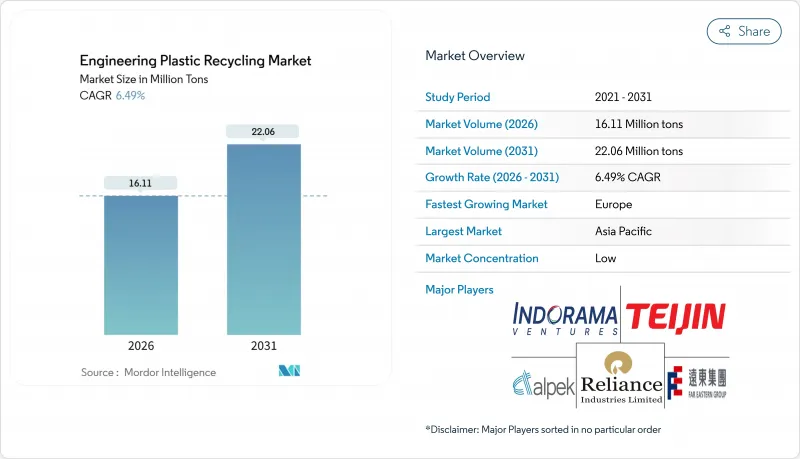
This report is Segmented by Plastic Type (PET, Fluoropolymers, and More), End-User Industry (Industrial Yarn, Packaging, Building and Construction, Automotive, Electrical and Electronics, and Other End-User Industries), and Geography (Asia-Pacific, North America, Europe, South America, and Middle-East and Africa). The Market Forecasts are Provided in Volume (Tons).
Global Engineering Plastic Recycling Market Trends and Insights
Policy-Mandated Recycled-Content Quotas Tightening After 2026
Binding targets in the EU's Packaging and Packaging Waste Regulation compel 30% recycled content in beverage bottles by 2030, rising to 65% by 2040, while France's AGEC law extends quotas to automotive and electronics parts. California's SB 54 exacts fines of USD 50,000 per day for non-compliance, converting recycled-content sourcing into a cost-avoidance measure. These mandates compressed the recycled-resin premium from 15-25% in 2024 to 5-10% by late 2025 as supply scaled. Capital flowed toward both mechanical and chemical lines, accelerating the engineering plastic recycling market expansion. As thresholds tighten after 2026, demand visibility improves and financing risk declines, reinforcing growth momentum.
Brand-Owner Pledges to Shift 25-50% of Engineering-Plastic Packaging to Recycled Feedstock by 2030
Unilever, Procter & Gamble, and Nestle have embedded recycled-content clauses in global procurement contracts, collectively requiring more than 600,000 tons of food-grade recycled PET annually from 2027. Long-term offtake agreements underpin mega-scale depolymerization plants such as Eastman's Tennessee site, enabling project finance exceeding USD 150 million per facility. Brand pressure cascades down supply chains, incentivizing converters to re-qualify recycled grades across barrier film, caps, and closures. The ripple effect sustains double-digit capacity growth in the engineering plastic recycling market during the near term.
Limited Food-Contact Approvals for Recycled Engineering Plastics in Many Jurisdictions
The FDA's letter-of-no-objection process costs USD 500,000 and can last up to 24 months per grade, constraining U.S. supply of food-grade recycled polycarbonate and polyamide. China lacks comprehensive guidelines, pushing brand owners toward virgin resin for dairy and beverage packaging. Segregated food-contact streams lower plant utilization and raise sortation costs by around 15%. Until regulatory convergence improves, this hurdle tempers near-term uptake in the engineering plastic recycling market.
Other drivers and restraints analyzed in the detailed report include:
- OEM Demand for Chemically Recycled PA and PC Grades in EV and Electronics Thermal-Management Parts
- Emergence of Digital Watermarking and AI-Vision Sorting Lines Boosting Yield of Mixed Streams
- Volatility in Bale Pricing Making ROI Unpredictable for Recyclers
For complete list of drivers and restraints, kindly check the Table Of Contents.
Segment Analysis
PET held 97.47% of engineering plastic recycling market share in 2025, and the segment is on track for 6.51% CAGR through 2031 as beverage and textile applications absorb rising recycled volumes. The engineering plastic recycling market size for PET is growing, supported by Indorama Ventures' 400,000-ton capacity additions and Europe's deposit-return schemes.
Polyamide demand growth is propelled by automotive and electronics OEM specifications for mechanically and chemically recycled grades with flame-retardant performance. ChemCycling-sourced PA commands a 40% price premium, offering recyclers margin resilience. Polycarbonate recycling advances through robotic disassembly trials that attain 85% purity, reducing processing cost curves. PMMA, ABS, SAN, and niche polymers such as PEEK remain at pilot-scale but present white-space opportunities as solvent-based depolymerization reaches commercial maturity.
Complete Report Scope:
- By Plastic Type
- PET
- Fluoropolymers
- Polycarbonate
- Polyacetal/ Polyoxymethylene
- Polymethyl Methacrylate (PMMA)
- Styrene Copolymers (ABS and SAN)
- Polyether Ether Ketone (PEEK)
- Polyamide
- By End-user Industry
- Industrial Yarn
- Packaging
- Building and Construction
- Automotive
- Electrical and Electronics
- Other End-User Industries
- By Geography
- Asia-Pacific
- China
- India
- Japan
- South Korea
- ASEAN Countries
- Rest of Asia-Pacific
- North America
- United States
- Canada
- Mexico
- Europe
- Germany
- United Kingdom
- France
- Italy
- Spain
- NORDIC Countries
- Rest of Europe
- South America
- Brazil
- Argentina
- Rest of South America
- Middle-East and Africa
- Saudi Arabia
- South Africa
- Rest of Middle-East and Africa
- Asia-Pacific
Geography Analysis
Asia-Pacific retained 56.39% share of the engineering plastic recycling market in 2025, buttressed by China's 12 million-ton PET-recycling build-out after the National Sword policy and by India's recent 500,000-ton capacity surge. Integrated fiber-spinning sites in Zhejiang and Gujarat convert flake directly into yarn, maximizing supply-chain efficiency. Japan's Jeplan, funded with USD 150 million in late 2024, scales PET depolymerization, underscoring regional technology diversification.
Europe records the fastest growth at 6.55% CAGR as the EUR 0.80/kg plastic-tax differential incentivizes brand owners to source recycled grades. Deposit-return schemes push PET collection above 90% in Germany and the Netherlands, supplying clean feedstock to Eastman's forthcoming 160,000-ton Normandy molecular-recycling complex. Government grants and low-interest green bonds facilitate plant financing, strengthening regional competitive positions.
North America trails in share yet accelerates capital deployment. Eight chemical-recycling plants under construction in Texas, Ohio, and Tennessee focus on polyamide and polycarbonate grades for EV and electronics OEMs. Federal tax credits for clean-manufacturing equipment and state-level recycled-content mandates narrow economics in favor of recycled resin. South America and the Middle East and Africa account for smaller volumes but register new projects such as Braskem-Valoren's Sao Paulo plant and ADNOC-Loop's Abu Dhabi pilot, reflecting global proliferation of the engineering plastic recycling market.
- Alpek S.A.B. de C.V.
- Avro India Limited
- BASF
- Clean Tech UK Ltd
- EF Plastics UK Ltd
- Euresi Plastics SL
- Far Eastern Group
- Indorama Corporation
- JFC Group
- Krones AG
- Petco
- Placon
- PolyClean Technologies
- Reliance Industries Limited
- REPRO-PET
- TEIJIN LIMITED
- UltrePET LLC
Additional Benefits:
- The market estimate (ME) sheet in Excel format
- 3 months of analyst support
TABLE OF CONTENTS
1 Introduction
- 1.1 Study Assumptions and Market Definition
- 1.2 Scope of the Study
2 Research Methodology
3 Executive Summary
4 Market Landscape
- 4.1 Market Overview
- 4.2 Market Drivers
- 4.2.1 Policy-Mandated Recycled-Content Quotas Tightening After 2026
- 4.2.2 Brand-Owner Pledges to Shift 25-50 % of Engineering-Plastic Packaging to Recycled Feedstock by 2030
- 4.2.3 OEM Demand for Chemically Recycled PA and PC Grades in EV And Electronics Thermal-Management Parts
- 4.2.4 Emergence of Digital Water-Marking and AI-Vision Sorting Lines Boosting Yield of Mixed Streams
- 4.2.5 Venture-Backed Solvent-Based Depolymerisation Plants Achieving 30 % Capex/Ton Cost Reduction
- 4.3 Market Restraints
- 4.3.1 Limited Food-Contact Approvals For R-Engineering Plastics in Many Jurisdictions
- 4.3.2 Volatility In Bale Pricing Making ROI Unpredictable for Recyclers
- 4.3.3 High Brominated-Flame-Retardant Content in WEEE Plastics Raising Processing Cost
- 4.4 Value Chain Analysis
- 4.5 Porter's Five Forces
- 4.5.1 Bargaining Power of Suppliers
- 4.5.2 Bargaining Power of Consumers
- 4.5.3 Threat of New Entrants
- 4.5.4 Threat of Substitute Products and Services
- 4.5.5 Degree of Competition
5 Market Size and Growth Forecasts (Volume)
- 5.1 By Plastic Type
- 5.1.1 PET
- 5.1.2 Fluoropolymers
- 5.1.3 Polycarbonate
- 5.1.4 Polyacetal/ Polyoxymethylene
- 5.1.5 Polymethyl Methacrylate (PMMA)
- 5.1.6 Styrene Copolymers (ABS and SAN)
- 5.1.7 Polyether Ether Ketone (PEEK)
- 5.1.8 Polyamide
- 5.2 By End-user Industry
- 5.2.1 Industrial Yarn
- 5.2.2 Packaging
- 5.2.3 Building and Construction
- 5.2.4 Automotive
- 5.2.5 Electrical and Electronics
- 5.2.6 Other End-User Industries
- 5.3 By Geography
- 5.3.1 Asia-Pacific
- 5.3.1.1 China
- 5.3.1.2 India
- 5.3.1.3 Japan
- 5.3.1.4 South Korea
- 5.3.1.5 ASEAN Countries
- 5.3.1.6 Rest of Asia-Pacific
- 5.3.2 North America
- 5.3.2.1 United States
- 5.3.2.2 Canada
- 5.3.2.3 Mexico
- 5.3.3 Europe
- 5.3.3.1 Germany
- 5.3.3.2 United Kingdom
- 5.3.3.3 France
- 5.3.3.4 Italy
- 5.3.3.5 Spain
- 5.3.3.6 NORDIC Countries
- 5.3.3.7 Rest of Europe
- 5.3.4 South America
- 5.3.4.1 Brazil
- 5.3.4.2 Argentina
- 5.3.4.3 Rest of South America
- 5.3.5 Middle-East and Africa
- 5.3.5.1 Saudi Arabia
- 5.3.5.2 South Africa
- 5.3.5.3 Rest of Middle-East and Africa
- 5.3.1 Asia-Pacific
6 Competitive Landscape
- 6.1 Market Concentration
- 6.2 Strategic Moves
- 6.3 Market Share/Ranking Analysis
- 6.4 Company Profiles (includes Global level Overview, Market level overview, Core Segments, Financials as available, Strategic Information, Market Rank/Share for key companies, Products and Services, and Recent Developments)
- 6.4.1 Alpek S.A.B. de C.V.
- 6.4.2 Avro India Limited
- 6.4.3 BASF
- 6.4.4 Clean Tech UK Ltd
- 6.4.5 EF Plastics UK Ltd
- 6.4.6 Euresi Plastics SL
- 6.4.7 Far Eastern Group
- 6.4.8 Indorama Corporation
- 6.4.9 JFC Group
- 6.4.10 Krones AG
- 6.4.11 Petco
- 6.4.12 Placon
- 6.4.13 PolyClean Technologies
- 6.4.14 Reliance Industries Limited
- 6.4.15 REPRO-PET
- 6.4.16 TEIJIN LIMITED
- 6.4.17 UltrePET LLC
7 Market Opportunities and Future Outlook
- 7.1 White-space and Unmet-Need Assessment

