PUBLISHER: Mordor Intelligence | PRODUCT CODE: 2115004

PUBLISHER: Mordor Intelligence | PRODUCT CODE: 2115004
Alpha Olefins - Market Share Analysis, Industry Trends & Statistics, Growth Forecasts (2026 - 2031)
According to Mordor Intelligence, the alpha olefins market size is estimated at 7.32 Million tons in 2026, and is expected to reach 9.40 Million tons by 2031, at a CAGR of 5.13% during the forecast period (2026-2031).
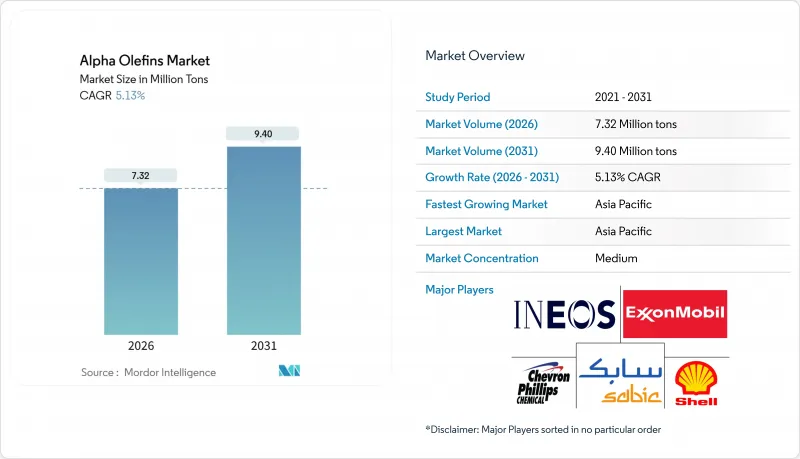
This report is Segmented by Type (C4 (1-Butene), C6 (1-Hexene), and More), Production Process (Ethylene Oligomerization, Fischer-Tropsch Synthesis, and Bio-Based Alcohol Dehydration), Application (Polyolefin Comonomers, Lubricants, and More), End-Use Industry (Packaging, Automotive, Oil and Gas, and More), and Geography (Asia-Pacific, North America, Europe, South America, and Middle-East and Africa).
Global Alpha Olefins Market Trends and Insights
Surging Polyethylene Comonomer Demand
Metallocene LLDPE grades require tighter molecular-weight control, elevating consumption of high-purity 1-hexene and 1-octene comonomers. Chevron Phillips Chemical expanded its Cedar Bayou cracker to 1.5 million tons-per-year ethylene capacity and co-located alpha-olefin trains to monetize the ethylene-to-C6/C8 spread. Shell's Monaca complex follows a similar integration model, ensuring captive comonomer supply for 1.6 million tons of polyethylene demand. E-commerce logistics accelerate stretch-film uptake, and brand owners prefer downgauged yet puncture-resistant films that only metallocene LLDPE can deliver. This downstream pull renders comonomer demand inelastic to modest price spikes. As new Asian LLDPE reactors switch from Ziegler-Natta to metallocene catalysts, alpha olefins market volumes receive a structural uplift.
Growth in Synthetic Lubricants
Poly-alpha-olefin base stocks achieve viscosity indices above 130 and pour points below -50 °C, enabling next-generation engine oils that satisfy API SP and ILSAC GF-6 specifications. Chevron Phillips Chemical broke ground in November 2025 on a PAO expansion in Beringen, Belgium, to service European automakers pursuing longer drain intervals and hybrid powertrains. EVs further amplify PAO demand, as direct battery-cell cooling requires fluids stable above 150 °C with high dielectric strength. Industrial gearboxes and compressors similarly upgrade to PAO to extend service life and reduce downtime. Economies of scale are narrowing the PAO-to-mineral-oil cost delta, hastening substitution in mid-tier lubricant formulations.
Ethylene Feedstock Price Volatility
Brent crude oscillated between USD 70 and USD 90 per barrel during 2024-2025, compressing naphtha cracker margins and disrupting oligomerization economics. Asian ethylene spot prices fluctuated USD 800-1,100 per ton, forcing comonomer suppliers to hedge through futures contracts that dilute profitability. European producers face an additional EUR 50-70 per ton carbon-cost headwind under the EU ETS. Consequently, standalone LAO units reliant on merchant ethylene are deferring capacity expansions, while integrated Gulf Coast complexes run at elevated rates.
Other drivers and restraints analyzed in the detailed report include:
- Shale-Ethane Cost Advantage in North America
- Capacity Additions in Emerging Economies
- Non-Biodegradability of Polyethylene
For complete list of drivers and restraints, kindly check the Table Of Contents.
Segment Analysis
C4 (1-Butene) captured 35.23% of 2025 volume on cost advantage and legacy Ziegler-Natta LLDPE use. Conversely, C6 (1-Hexene) grew at a 5.88% CAGR, steering alpha olefins market size expansion toward higher-value streams. Dow's AFFINITY plastomers leverage C8 (1-octene) for elastomeric films, commanding premiums of 15-20% over C4-based resins.
Metallocene catalysts require 1-hexene or 1-octene for narrow molecular-weight distributions, improving dart impact and stress-crack resistance. Higher carbon-number alpha olefins (C10-C20+) serve synthetic lubricants and plasticizer alcohols, sustaining margin diversity even as volume concentrates in C4-C8. Fischer-Tropsch-derived alpha olefins target multi-cut portfolios but remain below 10% of output due to capital intensity.
Ethylene oligomerization delivered 80.12% of 2025 production and is projected to expand at 5.67% CAGR, underpinned by catalyst selectivity surpassing 95% for 1-hexene. Chevron Phillips and INEOS capitalize on captive ethylene, achieving margin insulation against feedstock volatility. Fischer-Tropsch synthesis monetizes stranded gas in Qatar and coal in South Africa, yet remains subscale. Bio-alcohol dehydration pilot plants in Europe stay below 10,000 tons-per-year until catalyst lifetimes improve.
Integration economics favor oligomerization, as ethylene crackers can swing between LAO, polyethylene, and ethylene derivatives depending on spreads, preserving alpha olefins industry competitiveness across cycles.
Complete Report Scope:
- By Type
- C4 (1-Butene)
- C6 (1-Hexene)
- C8 (1-Octene)
- Other Types
- By Production Process
- Ethylene Oligomerization
- Fischer-Tropsch Synthesis
- Bio-based Alcohol Dehydration
- By Application
- Polyolefin Comonomers
- Lubricants
- Oil Field Chemicals
- Plasticizers
- Surfactants
- Other Applications
- By End-use Industry
- Packaging
- Automotive
- Oil and Gas
- Cosmetics and Personal Care
- Other End-user Industries
- By Geography
- Asia-Pacific
- China
- India
- Japan
- South Korea
- ASEAN Countries
- Rest of Asia-Pacific
- North America
- United States
- Canada
- Mexico
- Europe
- Germany
- United Kingdom
- Italy
- France
- NORDIC Countries
- Rest of Europe
- South America
- Brazil
- Argentina
- Rest of South America
- Middle-East and Africa
- Saudi Arabia
- South Africa
- Rest of Middle-East and Africa
- Asia-Pacific
Geography Analysis
Asia-Pacific controlled 40.45% of 2025 demand and is set to grow at a 6.89% CAGR, driven by China's USD 10 billion Sinopec-Aramco Fujian complex and India's 7% annual petrochemical consumption uptick. With local alpha olefin capacity trailing demand, regional imports from the Middle-East remain robust, yet upcoming Chinese and Saudi capacities reposition supply chains eastward. Japan and South Korea import high-purity C6/C8 for specialty LLDPE, whereas ASEAN polyolefin demand expands above 6% annually, absorbing incremental alpha olefins market volumes.
North America leverages shale-ethane pricing, enabling ethylene cash costs nearly 50% lower than European naphtha equivalents. Fourteen Gulf Coast crackers totaling 9.19 million tons of ethylene will support co-located LAO units, reinforcing the region's role as a net exporter. Canadian and Mexican deficits ensure cross-border flows, consolidating the continent's feedstock advantage into downstream competitiveness.
Europe faces structural headwinds: high naphtha costs, EU ETS carbon pricing, and plant closures such as SABIC's Geleen Olefins 3 and Teesside crackers removing 500,000 tons of ethylene capacity. The Middle-East, conversely, accelerates ethane-fed expansions like Yasref's planned 1.8 million tons-per-year cracker, bridging Asian demand. South America remains anchored by Braskem in Brazil, but macroeconomic volatility and limited upstream investment restrain growth potential.
- Braskem
- Chevron Phillips Chemical Company LLC
- China Petrochemical Corporation (Sinopec)
- CNOOC & Shell Petrochemicals Company Limited
- Dow
- Evonik Industries AG
- Exxon Mobil Corporation
- Idemitsu Kosan Co., Ltd.
- INEOS
- LG Chem
- Mitsui Chemicals, Inc.
- National Petrochemical Co. (Iran)
- PetroChina Company Limited
- Qatar Chemical Company Ltd
- SABIC
- Sasol Limited
- Shell plc
Additional Benefits:
- The market estimate (ME) sheet in Excel format
- 3 months of analyst support
TABLE OF CONTENTS
1 Introduction
- 1.1 Study Assumptions and Market Definition
- 1.2 Scope of the Study
2 Research Methodology
3 Executive Summary
4 Market Landscape
- 4.1 Market Overview
- 4.2 Market Drivers
- 4.2.1 Surging Polyethylene Comonomer Demand
- 4.2.2 Growth in Synthetic Lubricants
- 4.2.3 Shale-Ethane Cost Advantage in North America
- 4.2.4 Capacity Additions in Emerging Economies
- 4.2.5 EV Thermal Management Fluid Requirements
- 4.3 Market Restraints
- 4.3.1 Ethylene Feedstock Price Volatility
- 4.3.2 Non-Biodegradability of Polyethylene
- 4.3.3 Catalyst Deactivation in Bio-Based LAO Synthesis
- 4.4 Value Chain Analysis
- 4.5 Porter's Five Forces
- 4.5.1 Bargaining Power of Suppliers
- 4.5.2 Bargaining Power of Buyers
- 4.5.3 Threat of New Entrants
- 4.5.4 Threat of Substitutes
- 4.5.5 Degree of Competition
5 Market Size and Growth Forecasts (Volume)
- 5.1 By Type
- 5.1.1 C4 (1-Butene)
- 5.1.2 C6 (1-Hexene)
- 5.1.3 C8 (1-Octene)
- 5.1.4 Other Types
- 5.2 By Production Process
- 5.2.1 Ethylene Oligomerization
- 5.2.2 Fischer-Tropsch Synthesis
- 5.2.3 Bio-based Alcohol Dehydration
- 5.3 By Application
- 5.3.1 Polyolefin Comonomers
- 5.3.2 Lubricants
- 5.3.3 Oil Field Chemicals
- 5.3.4 Plasticizers
- 5.3.5 Surfactants
- 5.3.6 Other Applications
- 5.4 By End-use Industry
- 5.4.1 Packaging
- 5.4.2 Automotive
- 5.4.3 Oil and Gas
- 5.4.4 Cosmetics and Personal Care
- 5.4.5 Other End-user Industries
- 5.5 By Geography
- 5.5.1 Asia-Pacific
- 5.5.1.1 China
- 5.5.1.2 India
- 5.5.1.3 Japan
- 5.5.1.4 South Korea
- 5.5.1.5 ASEAN Countries
- 5.5.1.6 Rest of Asia-Pacific
- 5.5.2 North America
- 5.5.2.1 United States
- 5.5.2.2 Canada
- 5.5.2.3 Mexico
- 5.5.3 Europe
- 5.5.3.1 Germany
- 5.5.3.2 United Kingdom
- 5.5.3.3 Italy
- 5.5.3.4 France
- 5.5.3.5 NORDIC Countries
- 5.5.3.6 Rest of Europe
- 5.5.4 South America
- 5.5.4.1 Brazil
- 5.5.4.2 Argentina
- 5.5.4.3 Rest of South America
- 5.5.5 Middle-East and Africa
- 5.5.5.1 Saudi Arabia
- 5.5.5.2 South Africa
- 5.5.5.3 Rest of Middle-East and Africa
- 5.5.1 Asia-Pacific
6 Competitive Landscape
- 6.1 Market Concentration
- 6.2 Strategic Moves
- 6.3 Market Share (%)/Ranking Analysis
- 6.4 Company Profiles (includes Global-level Overview, Market-level Overview, Core Segments, Financials as available, Strategic Information, Products and Services, and Recent Developments)
- 6.4.1 Braskem
- 6.4.2 Chevron Phillips Chemical Company LLC
- 6.4.3 China Petrochemical Corporation (Sinopec)
- 6.4.4 CNOOC & Shell Petrochemicals Company Limited
- 6.4.5 Dow
- 6.4.6 Evonik Industries AG
- 6.4.7 Exxon Mobil Corporation
- 6.4.8 Idemitsu Kosan Co., Ltd.
- 6.4.9 INEOS
- 6.4.10 LG Chem
- 6.4.11 Mitsui Chemicals, Inc.
- 6.4.12 National Petrochemical Co. (Iran)
- 6.4.13 PetroChina Company Limited
- 6.4.14 Qatar Chemical Company Ltd
- 6.4.15 SABIC
- 6.4.16 Sasol Limited
- 6.4.17 Shell plc
7 Market Opportunities and Future Outlook
- 7.1 Development of Sustainable and Bio-based Alternatives
- 7.2 White-space and Unmet-need Assessment

