PUBLISHER: Mordor Intelligence | PRODUCT CODE: 2115006

PUBLISHER: Mordor Intelligence | PRODUCT CODE: 2115006
Dodecanedioic Acid (DDDA) - Market Share Analysis, Industry Trends & Statistics, Growth Forecasts (2026 - 2031)
According to Mordor Intelligence, dodecanedioic acid market size in 2026 is estimated at USD 635.54 million, growing from 2025 value of USD 605.16 million with 2031 projections showing USD 812.02 million, growing at 5.02% CAGR over 2026-2031.
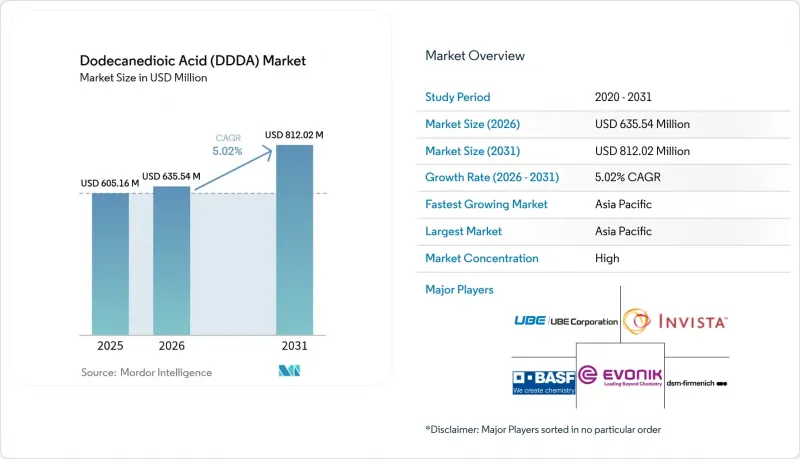
This report is Segmented by Production Process (Petro-Chemical, Bio-Based), Application (Resin, Powder Coating, Adhesives, Lubricants, Other Applications), End-User Industry (Automotive and Transportation, Electrical and Electronics, Industrial Machinery, Building and Construction, Healthcare and Personal Care), and Geography (Asia-Pacific, North America, Europe, South America, Middle East and Africa).
Global Dodecanedioic Acid (DDDA) Market Trends and Insights
Growth in High-Performance Nylon-12 & Nylon-6,12 Demand from Automotive Lightweighting
Automakers are setting tighter fleet-weight targets that translate into higher usage of high-performance polyamides, notably nylon-12 and nylon-6,12. BASF's USD 260 million commitment to new hexamethylenediamine capacity and INVISTA's recommissioning of HMD assets are emblematic of the supply-chain investments now underway. Vehicle manufacturers aim to trim 7-10% curb weight by 2030 without compromising crashworthiness, and integrated chemical suppliers offering DDDA-based polyamide formulations emerge as preferred partners. The driver adds 1.7 percentage points to forecast CAGR, with tangible demand growth visible in fuel-line, brake-hose, and battery-enclosure applications.
Expansion of Powder-Coated Consumer Electronics & Appliances
Consumer-electronics brands are migrating from solvent-borne to powder coatings to cut VOC emissions and secure thinner, scratch-resistant finishes. DDDA serves as a curing agent that supports ultra-thin acrylic powder layers, helping manufacturers meet miniaturization and sustainability targets. Regulatory pressure in Europe and North America complements the production-scale advantages enjoyed by Asia-Pacific electronics hubs, lifting demand for specialized DDDA grades. Powder-coated appliances and smartphones together propel a 0.8 percentage-point boost to overall CAGR.
Handling & Toxicological Hazards of DDDA
DDDA is classified as a serious eye irritant under REACH, and the 2025 revision tightens documentation and on-site audit requirements. Smaller firms without dedicated EH&S infrastructure face higher compliance costs, potentially lengthening product-approval cycles by up to 18 months. While the substance exhibits low acute toxicity and good biodegradability, mandatory risk management measures-eye-protection programs, automated loading systems, and continuous monitoring-raise operating expenses. The restraint subtracts 0.9 percentage points from projected growth.
Other drivers and restraints analyzed in the detailed report include:
- EV-Thermal-Management Lubricants Adopting DDDA-Based Esters
- Bio-Route Process Cost Decline via Synthetic Biology Breakthroughs
- Feedstock Price Volatility (Sebacic Acid / Cyclododecane)
For complete list of drivers and restraints, kindly check the Table Of Contents.
Segment Analysis
The petro-chemical pathway via cyclododecatriene held 60.58% of the dodecanedioic acid market share in 2025, supported by advantaged natural-gas economics in North America and the Middle East. Bio-based routes, while smaller in absolute tonnage, are forecast to post an 8.60% CAGR, capturing sustainability-driven premiums in automotive and electronics. Bio-producers leveraging engineered Wickerhamiella sorbophila strains have trimmed conversion costs by roughly one-third since 2024, setting the stage for further share accretion.
Competitive positioning now appears bifurcated: high-volume, cost-sensitive resin and adhesive grades continue to be met by petro-chemical output, while low-carbon, high-purity bio-grades win specification in EV lubricants, aerospace photopolymers and premium powder coatings. Capital allocation decisions therefore hinge on regional energy prices, regulatory trajectories and customer sustainability pledges. Firms with dual-route capabilities achieve optionality to swing production toward the more profitable pathway whenever feedstock spreads or carbon-pricing schemes shift materially.
Complete Report Scope:
- By Production Process
- Petro-chemical (cyclododecatriene route)
- Bio-based (sebacic-acid and microbial routes)
- By Application
- Resin
- Powder Coating
- Adhesives
- Lubricants
- Other Applications (Pharmaceutical, Cosmetics, etc.)
- By End-User Industry
- Automotive and Transportation
- Electrical and Electronics
- Industrial Machinery
- Building and Construction
- Healthcare and Personal Care
- By Geography
- Asia-Pacific
- China
- Japan
- India
- South Korea
- Rest of Asia-Pacific
- North America
- United States
- Canada
- Mexico
- Europe
- Germany
- United Kingdom
- France
- Italy
- Russia
- Rest of Europe
- South America
- Brazil
- Argentina
- Rest of South America
- Middle East and Africa
- Saudi Arabia
- South Africa
- Rest of Middle East and Africa
- Asia-Pacific
Geography Analysis
Asia-Pacific dominated the dodecanedioic acid market in 2025 with a 52.86% share and is expected to rise at a 5.28% CAGR to 2031. China's vast chemical-manufacturing base, coupled with Japan's advanced-materials ecosystem, positions the region for sustained capacity additions. Regional players benefit from integrated petro-chemical complexes, proximity to electronics and automotive export hubs, and skilled labor availability, partly offsetting feedstock-import volatility.
North America secured a smaller but resilient share, anchored by shale-gas cost advantages that favor petrochemical routes. The U.S. Department of Defense's USD 86.2 million sebacic-acid reshoring grant underscores regional supply-security concerns and may catalyze backward integration in key value chains. Producers are also channeling capex into high-value niche grades rather than bulk tonnage, reflecting a strategic shift toward differentiated products. Market participation is underpinned by comprehensive regulatory and intellectual-property frameworks that safeguard returns on R&D.
Europe represents a mature but innovation-driven landscape. Stringent REACH updates, higher energy costs, and the Green Deal's bio-content mandates collectively nudge manufacturers toward bio-based pathways and specialty applications. BASF's French site upgrades demonstrate commitment to local supply resilience despite structural cost pressures. While growth is slower than in Asia-Pacific, the region maintains technological leadership in advanced polyamides, EV fluids and circular-economy initiatives. South America and the Middle East & Africa together account for a modest share yet present pockets of opportunity linked to industrialization and infrastructure builds, tempered by currency volatility and political risk.
- Arkema
- BASF
- China Petroleum & Chemical Corporation
- DSM
- Evonik Industries AG
- Haihang Industry
- INVISTA
- Merck KGaA
- Shandong Guangtong New Materials Co.,Ltd.
- Tokyo Chemical Industry (India) Pvt. Ltd.
- UBE Corporation
- Verdezyne
Additional Benefits:
- The market estimate (ME) sheet in Excel format
- 3 months of analyst support
TABLE OF CONTENTS
1 Introduction
- 1.1 Study Assumptions and Market Definition
- 1.2 Scope of the Study
2 Research Methodology
3 Executive Summary
4 Market Landscape
- 4.1 Market Overview
- 4.2 Market Drivers
- 4.2.1 Growth in high-performance Nylon-12 and Nylon-6,12 demand from automotive lightweighting
- 4.2.2 Expansion of powder-coated consumer electronics and appliances
- 4.2.3 EV-thermal-management lubricants adopting DDDA-based esters
- 4.2.4 Bio-route process cost decline via synthetic biology breakthroughs
- 4.2.5 Adoption in aerospace 3-D printing photopolymers
- 4.3 Market Restraints
- 4.3.1 Handling and toxicological hazards of DDDA
- 4.3.2 Feedstock price volatility (sebacic acid / cyclododecane)
- 4.3.3 Supply-chain risk from cyclododecane outage incidents
- 4.4 Value Chain Analysis
- 4.5 Porter's Five Forces
- 4.5.1 Bargaining Power of Suppliers
- 4.5.2 Bargaining Power of Buyers
- 4.5.3 Threat of New Entrants
- 4.5.4 Threat of Substitutes
- 4.5.5 Degree of Competition
5 Market Size and Growth Forecasts (Value)
- 5.1 By Production Process
- 5.1.1 Petro-chemical (cyclododecatriene route)
- 5.1.2 Bio-based (sebacic-acid and microbial routes)
- 5.2 By Application
- 5.2.1 Resin
- 5.2.2 Powder Coating
- 5.2.3 Adhesives
- 5.2.4 Lubricants
- 5.2.5 Other Applications (Pharmaceutical, Cosmetics, etc.)
- 5.3 By End-User Industry
- 5.3.1 Automotive and Transportation
- 5.3.2 Electrical and Electronics
- 5.3.3 Industrial Machinery
- 5.3.4 Building and Construction
- 5.3.5 Healthcare and Personal Care
- 5.4 By Geography
- 5.4.1 Asia-Pacific
- 5.4.1.1 China
- 5.4.1.2 Japan
- 5.4.1.3 India
- 5.4.1.4 South Korea
- 5.4.1.5 Rest of Asia-Pacific
- 5.4.2 North America
- 5.4.2.1 United States
- 5.4.2.2 Canada
- 5.4.2.3 Mexico
- 5.4.3 Europe
- 5.4.3.1 Germany
- 5.4.3.2 United Kingdom
- 5.4.3.3 France
- 5.4.3.4 Italy
- 5.4.3.5 Russia
- 5.4.3.6 Rest of Europe
- 5.4.4 South America
- 5.4.4.1 Brazil
- 5.4.4.2 Argentina
- 5.4.4.3 Rest of South America
- 5.4.5 Middle East and Africa
- 5.4.5.1 Saudi Arabia
- 5.4.5.2 South Africa
- 5.4.5.3 Rest of Middle East and Africa
- 5.4.1 Asia-Pacific
6 Competitive Landscape
- 6.1 Market Concentration
- 6.2 Strategic Moves
- 6.3 Market Share (%)/ Ranking Analysis
- 6.4 Company Profiles (includes Global level Overview, Market level overview, Core Segments, Financials as available, Strategic Information, Market Rank/Share, Products and Services, Recent Developments)
- 6.4.1 Arkema
- 6.4.2 BASF
- 6.4.3 China Petroleum & Chemical Corporation
- 6.4.4 DSM
- 6.4.5 Evonik Industries AG
- 6.4.6 Haihang Industry
- 6.4.7 INVISTA
- 6.4.8 Merck KGaA
- 6.4.9 Shandong Guangtong New Materials Co.,Ltd.
- 6.4.10 Tokyo Chemical Industry (India) Pvt. Ltd.
- 6.4.11 UBE Corporation
- 6.4.12 Verdezyne
7 Market Opportunities and Future Outlook
- 7.1 White-space and Unmet-need Assessment

