PUBLISHER: Mordor Intelligence | PRODUCT CODE: 2115016

PUBLISHER: Mordor Intelligence | PRODUCT CODE: 2115016
Electronics And Electrical Ceramics - Market Share Analysis, Industry Trends & Statistics, Growth Forecasts (2026 - 2031)
According to Mordor Intelligence, the electronics and electrical ceramics market size was valued at USD 13.81 billion in 2025 and estimated to grow from USD 14.5 billion in 2026 to reach USD 18.49 billion by 2031, at a CAGR of 4.98% during the forecast period (2026-2031).
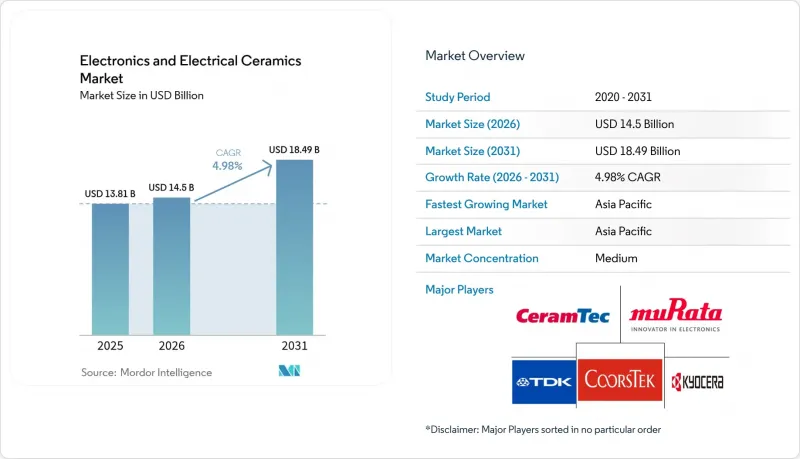
This report is Segmented by Material Type (Alumina Ceramics, Titanate Ceramics, and More), Product Type (Monolithic Ceramics, Ceramic Matrix Composites, and More), End-User Industry (Consumer Appliances, Power Grids, and More), and Geography (Asia-Pacific, North America, Europe, South America, and Middle-East and Africa). The Market Forecasts are Provided in Terms of Value (USD).
Global Electronics And Electrical Ceramics Market Trends and Insights
Surge in Consumer Electronics Demand
Miniaturization in smartphones, earbuds and smart watches has intensified requirements for high-Q multilayer ceramic capacitors, piezo actuators and heat-spreading substrates. Murata's launch of a 0.4 mm X 0.2 mm 100 V capacitor allows 5G RF modules to raise power density without losing signal integrity Electrocaloric solid-state coolers promise quieter, energy-saving alternatives to mini compressors in wearables, while TDK's CeraCharge solid-state micro-battery highlights how ceramic electrolytes enhance safety and cycle life in compact formats. As volumes grow, economies of scale are narrowing the cost gap with legacy materials, broadening adoption across mid-tier consumer devices and cementing the electronics and electrical ceramics market as a foundational enabler of connected lifestyles.
Expansion of 5G Infrastructure
Millimeter-wave base stations need low-loss substrates that standard FR-4 or PTFE laminates cannot provide above 24 GHz. LTCC substrates offer permittivity stability, integrated passive embedding and dimensional precision. Applied Materials has commercialized LTCC deposition and sintering equipment tailored for 5G antenna-in-package lines, underscoring how manufacturing accuracy drives RF performance. A typical 64T64R massive-MIMO radio consumes three to five times more ceramic capacitors than a 4G macro cell, multiplying demand for dielectric grades tuned for high-frequency loss tangents. National security concerns are pushing operators in the United States and Europe to dual-source ceramic passives locally, accelerating supply-chain regionalization within the electronics and electrical ceramics market.
Higher Unit Cost than Metals and Alloys
Ceramic substrates, housings and capacitors typically cost between two and five times more than stamped aluminum parts or polymer-based alternatives. The multi-stage sintering cycle, tight atmosphere control and post-firing metallization needed in ceramic processing drive energy use and capital intensity. While system-level benefits such as thermally induced reliability and weight reduction offset some of the extra expenditure, budget-constrained consumer device firms still default to cheaper metals where performance headroom allows. Greater production scale and line automation are incrementally lowering conversion cost, but price sensitivity remains a tangible drag on the electronics and electrical ceramics market in mass electronics.
Other drivers and restraints analyzed in the detailed report include:
- EV Traction Inverters' Thermal-Ceramic Demand
- Proliferation of LTCC mmWave AiP Modules
- Critical-Mineral (Alumina) Price Spikes
For complete list of drivers and restraints, kindly check the Table Of Contents.
Segment Analysis
Alumina retained 36.58% of the electronics and electrical ceramics market share in 2025 owing to its balanced dielectric strength, 20-25 W/mK thermal conductivity and favorable price-to-performance ratio. The material anchors multilayer ceramic capacitors, semiconductor packages and lamp substrates that ship in billions of units each year. Titanate ceramics held a smaller slice but are expanding at a 6.12% CAGR through 2031 as sensor makers exploit their strong piezoelectric coefficients for energy harvesting in Internet-of-Things nodes. The electronics and electrical ceramics market size for titanate compositions therefore shows the fastest segment-level rise, especially where self-powered wearables and structural health monitoring sensors require repeated mechanical-to-electrical conversion.
Research pushing alumina performance is equally vibrant. Journal of Advanced Ceramics detailed a boron-nitride microribbon reinforced grade that boosts thermal conductivity by 45.6% compared with baseline alumina while keeping volume resistivity above 1013 Ω*cm. Zirconia covers surgical implants and high-temperature sensors thanks to fracture-toughness exceeding 10 MPa*m1ᐟ2, whereas silica glasses protect laser and etching equipment from plasma erosion. Ultra-high-temperature ceramics based on ZrB2 and HfB2 borides are moving from lab scale toward hypersonic vehicle nosecone electronics, broadening the long-term canvas for the electronics and electrical ceramics market.
Complete Report Scope:
- By Material Type
- Alumina Ceramics
- Titanate Ceramics
- Zirconia Ceramics
- Silica Ceramics
- Other Types
- By Product Type
- Monolithic Ceramics
- Ceramic Matrix Composites
- Ceramic Coatings
- Other Product Types
- By End-user Industry
- Consumer Appliances
- Power Grids
- Medical Devices
- Other End-user Industries
- Geography
- Asia-Pacific
- China
- Japan
- India
- South Korea
- Rest of Asia-Pacific
- North America
- United States
- Canada
- Mexico
- Europe
- Germany
- United Kingdom
- France
- Italy
- Russia
- Rest of Europe
- South America
- Brazil
- Argentina
- Rest of South America
- Middle-East and Africa
- Saudi Arabia
- South Africa
- Rest of Middle-East and Africa
- Asia-Pacific
Geography Analysis
Asia-Pacific contributed 48.05% of global revenue in 2025 and is forecast to grow at 5.93% CAGR through 2031, combining extensive raw-material processing in mainland China, advanced component machining in Japan and high-volume capacitor assembly in South Korea. The region also hosts Guangzhou's biennial Ceramics China trade fair that spotlights powder innovations and kiln electrification roadmaps. Localized supply chains reduce logistics lead-times for smartphone and EV makers based in Shenzhen, Osaka and Seoul, thereby reinforcing the electronics and electrical ceramics market leadership in Asia.
North America trails in share yet enjoys strategic tailwinds from accelerated 5G mid-band deployments and federal incentives for domestic EV battery manufacturing. Saint-Gobain's 2025 decision to construct a NorPro plant in Wheatfield, New York, shows how capacity additions are re-balancing ceramic supply closer to United States automotive and aerospace hubs. The electronics and electrical ceramics market size in North America is therefore primed for low-single-digit share gains, fueled by procurement shifts tied to critical-material security.
Europe carries a longstanding ceramic heritage in Germany, Italy and France. Automotive regulation mandating hybrid powertrains and particulate-filter upgrades sustains substrate and sensor demand, while Horizon-Europe grants push research into recyclable ceramic composites. Emerging economies in South America and Middle-East Africa currently represent single-digit shares but exhibit rising imports of telecom backhaul gear and high-voltage insulators. Local assembly incentives in Brazil and the United Arab Emirates may gradually cultivate regional ceramic production, extending the electronics and electrical ceramics market footprint beyond traditional centers.
- 3M
- AdValue Technology
- CeramTec GmbH
- CoorsTek Inc.
- Heraeus Group
- IBIDEN
- KCM Corporation
- Kyocera Corporation
- MARUWA Co., Ltd.
- Murata Manufacturing Co., Ltd.
- NGK INSULATORS, LTD.
- NIPPON CARBIDE INDUSTRIES CO., INC.
- NORITAKE CO., LIMITED
- PI Ceramic GmbH
- Saint-Gobain Ceramics
- Sumitomo Chemical Co., Ltd.
- TDK Corporation
Additional Benefits:
- The market estimate (ME) sheet in Excel format
- 3 months of analyst support
TABLE OF CONTENTS
1 Introduction
- 1.1 Study Assumptions and Market Definition
- 1.2 Scope of the Study
2 Research Methodology
3 Executive Summary
4 Market Landscape
- 4.1 Market Overview
- 4.2 Market Drivers
- 4.2.1 Surge in Consumer Electronics Demand
- 4.2.2 Expansion of 5G Infrastructure
- 4.2.3 EV Traction Inverters' Thermal-Ceramic Demand
- 4.2.4 Proliferation of LTCC Mmwave AiP Modules
- 4.2.5 Wearable Solid-State Batteries using Ceramic Electrolytes
- 4.3 Market Restraints
- 4.3.1 Higher Unit Cost than Metals And Alloys
- 4.3.2 Critical-Mineral (Alumina) Price Spikes
- 4.3.3 Tightening PM 2.5 Emission Norms for Ceramic Powders
- 4.4 Value Chain Analysis
- 4.5 Porter' Five Forces
- 4.5.1 Bargaining Power of Suppliers
- 4.5.2 Bargaining Power of Buyers
- 4.5.3 Threat of New Entrants
- 4.5.4 Threat of Substitutes
- 4.5.5 Degree of Competition
5 Market Size and Growth Forecasts (Value)
- 5.1 By Material Type
- 5.1.1 Alumina Ceramics
- 5.1.2 Titanate Ceramics
- 5.1.3 Zirconia Ceramics
- 5.1.4 Silica Ceramics
- 5.1.5 Other Types
- 5.2 By Product Type
- 5.2.1 Monolithic Ceramics
- 5.2.2 Ceramic Matrix Composites
- 5.2.3 Ceramic Coatings
- 5.2.4 Other Product Types
- 5.3 By End-user Industry
- 5.3.1 Consumer Appliances
- 5.3.2 Power Grids
- 5.3.3 Medical Devices
- 5.3.4 Other End-user Industries
- 5.4 Geography
- 5.4.1 Asia-Pacific
- 5.4.1.1 China
- 5.4.1.2 Japan
- 5.4.1.3 India
- 5.4.1.4 South Korea
- 5.4.1.5 Rest of Asia-Pacific
- 5.4.2 North America
- 5.4.2.1 United States
- 5.4.2.2 Canada
- 5.4.2.3 Mexico
- 5.4.3 Europe
- 5.4.3.1 Germany
- 5.4.3.2 United Kingdom
- 5.4.3.3 France
- 5.4.3.4 Italy
- 5.4.3.5 Russia
- 5.4.3.6 Rest of Europe
- 5.4.4 South America
- 5.4.4.1 Brazil
- 5.4.4.2 Argentina
- 5.4.4.3 Rest of South America
- 5.4.5 Middle-East and Africa
- 5.4.5.1 Saudi Arabia
- 5.4.5.2 South Africa
- 5.4.5.3 Rest of Middle-East and Africa
- 5.4.1 Asia-Pacific
6 Competitive Landscape
- 6.1 Market Concentration
- 6.2 Strategic Moves
- 6.3 Market Share Analysis
- 6.4 Company Profiles (includes Global level Overview, Market level overview, Core Segments, Financials as available, Strategic Information, Market Rank/Share, Products and Services, Recent Developments)
- 6.4.1 3M
- 6.4.2 AdValue Technology
- 6.4.3 CeramTec GmbH
- 6.4.4 CoorsTek Inc.
- 6.4.5 Heraeus Group
- 6.4.6 IBIDEN
- 6.4.7 KCM Corporation
- 6.4.8 Kyocera Corporation
- 6.4.9 MARUWA Co., Ltd.
- 6.4.10 Murata Manufacturing Co., Ltd.
- 6.4.11 NGK INSULATORS, LTD.
- 6.4.12 NIPPON CARBIDE INDUSTRIES CO., INC.
- 6.4.13 NORITAKE CO., LIMITED
- 6.4.14 PI Ceramic GmbH
- 6.4.15 Saint-Gobain Ceramics
- 6.4.16 Sumitomo Chemical Co., Ltd.
- 6.4.17 TDK Corporation
7 Market Opportunities and Future Outlook
- 7.1 White-space and Unmet-Need Assessment

