PUBLISHER: Mordor Intelligence | PRODUCT CODE: 2115051

PUBLISHER: Mordor Intelligence | PRODUCT CODE: 2115051
Non-PVC IV Bags - Market Share Analysis, Industry Trends & Statistics, Growth Forecasts (2026 - 2031)
According to Mordor Intelligence, the non-PVC IV bags market size is expected to grow from USD 1.89 billion in 2025 to USD 2.02 billion in 2026 and is forecast to reach USD 2.82 billion by 2031 at 6.91% CAGR over 2026-2031.
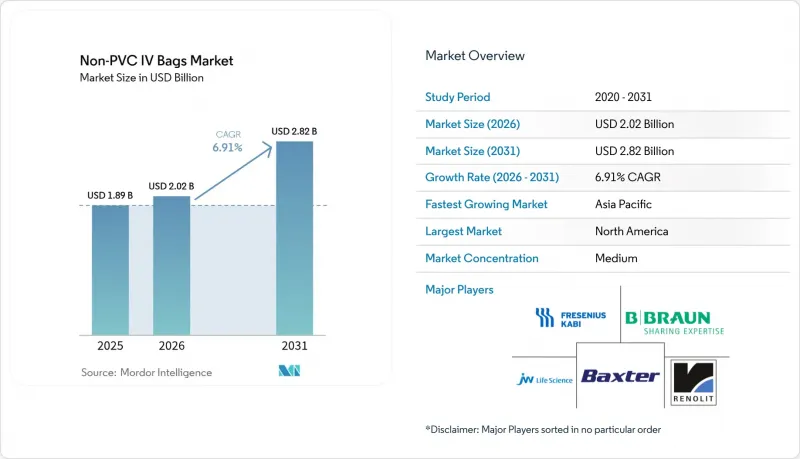
This report is Segmented by Material (EVA, PP, COPE, Others), Product (Single-Chamber, Multi-Chamber), Content (Liquid, Frozen), End-User (Hospitals, Specialty Clinics, Ascs, Others), and Geography (North America, Europe, Asia-Pacific, MEA, South America). Market Forecasts are Provided in Terms of Value (USD).
Global Non-PVC IV Bags Market Trends and Insights
Declining PVC Acceptance in Mature Markets
Procurement teams in large academic hospitals are actively retiring PVC devices as evidence of phthalate toxicity spreads across clinical networks. Cleveland Clinic's pledge to remove PVC and DEHP from two high-volume supply categories by 2025 has become a bellwether for sustainability benchmarking among US health systems . The US FDA's advisory to minimise DEHP exposure in neonatal and paediatric settings elevated non-PVC alternatives from optional to essential in critical care. Purchasing consortia now evaluate bids against lifecycle risk metrics rather than unit price alone, pushing vendors to deliver compliant solutions at scale .In the European Union, the REACH Restrictions Roadmap targeting PVC additives gives manufacturers regulatory certainty to retool production lines. As peer institutions publicise progress reports, a network effect is rapidly normalising DEHP-free IV procurement across North America and Western Europe.
Rapid Biologics & Oncology Infusion Growth
The oncology pipeline is driving demand for bags that will not leach plasticisers or compromise biologic potency. Sources projects more than 100 new cancer therapies to debut over the next five years, many requiring non-PVC containers to preserve drug stability. Antibody-drug conjugates alone generated USD 14.9 billion sales in 2024 at a 40% compound growth rate. These high-value therapeutics make price a secondary concern to safety and compatibility, favouring non-PVC formats even in cost-sensitive institutions. Radioligand and personalised therapies need containers with superior chemical inertness; EVA and emerging copolyesters fit this requirement. Investments in dedicated oncology infusion suites ensure hospitals continue to stock premium DEHP-free bags, while home-based chemotherapy services use the same specifications to extend treatment beyond inpatient wards.
15-20% Price Premium vs PVC Equivalents
Even where legislation mandates DEHP removal, procurement managers must reconcile higher unit prices with flat operating budgets. PVC enjoys decades of process optimisation that deliver scale efficiencies; by contrast non-PVC bag lines still carry smaller batch sizes and higher resin costs. Large-volume commodities such as 0.9% saline amplify the absolute cost delta when hospitals purchase millions of units. Some systems postpone conversion until final rule-making deadlines remove low-cost PVC options entirely. Promisingly, Dow-Mitsui Polychemicals introduced biomass-derived EVA in 2024, signalling a route to eventual cost parity as bio-feedstock volumes rise. As environmental, health and disposal costs become line-item charges in value-based tenders, the apparent premium narrows, yet price remains a near-term hurdle in low-resource settings.
Other drivers and restraints analyzed in the detailed report include:
- Rise of Home- & Ambulatory-Care Infusion
- Stringent EU REACH / US Prop-65 DEHP Bans
- Supply-Chain Reliance on EVA Resin Imports
For complete list of drivers and restraints, kindly check the Table Of Contents.
Segment Analysis
EVA retained 47.05% non-PVC IV bags market share in 2025, benefiting from its flexibility and optical clarity that echo legacy PVC performance while eliminating DEHP. Nonetheless, the polypropylene subsegment is advancing at a 7.32% CAGR to 2031, powered by lower resin prices, better recyclability and simpler sterilisation protocols. The non-PVC IV bags market is witnessing innovation in bio-based EVA grades that match mechanical properties yet cut cradle-to-gate emissions by up to 75%. In cost-constrained public hospitals of emerging Asia, polypropylene's price advantage is winning tenders even where EVA dominates in premium oncology centres. Regulatory dossiers show both resins meet USP (661.1) extractables limits, leaving procurement teams to trade off flexibility versus cost. Over the forecast horizon, the segment may converge toward a two-horse race unless copolyester ether (COPE) makers unlock mass-production pricing.
EVA suppliers are countering polypropylene's momentum by highlighting cold-temperature crack resistance and longer sterilisation window. Multi-national resin producers are also investing in closed-loop take-back programs to collect and re-process used bags, creating a circularity narrative attractive to hospital sustainability officers. Where governments assign extended-producer-responsibility fees, these programs could offset EVA's price premium, extending the resin's dominance in the non-PVC IV bags market.
Single-chamber bags generated 65.10% of the non-PVC IV bags market size in 2025 on the back of broad application in hydration, antibiotics and analgesics. That said, multi-chamber variants are projected to post a 7.45% CAGR through 2031 as parenteral nutrition protocols become more sophisticated. Clinical studies link pre-filled triple-chamber nutrition bags to fewer compounding errors and improved calorie accuracy. Hospitals without 24-hour pharmacy services appreciate room-temperature shelf lives of up to 24 months, reducing wastage. B. Braun's DUPLEX drug-delivery system, cleared by the US FDA in April 2025, demonstrated a 54% reduction in medication errors, illustrating the safety premium driving adoption.
Nevertheless, a practitioner survey reported in ECRI found that one-third of clinicians had encountered at least one error using multi-chamber parenteral nutrition, spotlighting the need for robust in-service training. Manufacturers are embedding colour-coded activation ports and audible snap indicators to address usability challenges. As hospital pharmacy budgets tighten, cost calculators showing labour savings from ready-to-use bags strengthen the commercial case, supporting double-digit penetration gains within the non-PVC IV bags market.
Complete Report Scope:
- By Material
- Ethylene Vinyl Acetate (EVA)
- Polypropylene (PP)
- Copolyester Ether (COPE)
- Others
- By Product
- Single-Chamber Bags
- Multi-Chamber Bags
- By Content
- Liquid Mixtures
- Frozen Mixtures
- By End-User
- Hospitals
- Specialty Clinics
- Ambulatory Surgical Centers
- Others
- By Geography
- North America
- United States
- Canada
- Mexico
- Europe
- Germany
- United Kingdom
- France
- Italy
- Spain
- Rest of Europe
- Asia-Pacific
- China
- Japan
- India
- Australia
- South Korea
- Rest of Asia-Pacific
- Middle East and Africa
- GCC
- South Africa
- Rest of Middle East and Africa
- South America
- Brazil
- Argentina
- Rest of South America
- North America
Geography Analysis
North America led with 40.85% of global revenue in 2025 as early DEHP bans and hospital sustainability charters created assured demand for compliant products. Widespread adoption in high-acuity neonatal intensive-care units underpins baseline volume, while state-level legislation such as California's Toxic-Free Medical Devices Act removes residual PVC products from formularies. Growth now hinges on penetrating smaller community hospitals and Veteran Affairs facilities where budget sensitivity remains significant.
Europe follows as a mature but steadily expanding arena. The delayed EU cut-off date of July 2030 grants institutions ample transition time, enabling orderly retirement of PVC inventories. Procurement frameworks increasingly evaluate carbon-footprint disclosures alongside clinical performance, giving a boost to closed-loop recycling pilots led by Baxter in the United Kingdom. Variations in national reimbursement constrain rapid uptake in Southern Europe, but Nordic and German hospitals continue to set aggressive plastic-reduction benchmarks that ripple across continental group purchasing organisations.
Asia-Pacific is the fastest-growing territory, registering a 7.60% CAGR through 2031. Population-weighted healthcare capacity additions, particularly in China, India and Southeast Asia, are enlarging baseline demand for infusion disposables. Regional governments have announced incentives for domestic clean-room manufacturing plants, attracting joint ventures between global resin suppliers and local contract manufacturers. Meanwhile, fragmented regulatory oversight necessitates country-specific registrations, elongating approval timelines for foreign brands. Companies adept at technology transfer and local-content sourcing stand to capture above-market gains, accelerating broader adoption of the non-PVC IV bags market across the region.
- Baxter
- Fresenius
- B. Braun
- JW Life Science
- RENOLIT
- POLYCINE
- Technoflex SA
- Shanghai Xin Gen Eco-Technologies
- Sichuan Kelun Pharma
- SSY Group Ltd.
- Kraton
- ICU Medical
- Otsuka Pharmaceutical Factory
- Haemotronic SpA
- Terumo Corp.
- Amcor Flexibles Healthcare
- Sealed Air (Healthcare Films)
- MacoPharma
- Wipak Medical
- CareFusion
Additional Benefits:
- The market estimate (ME) sheet in Excel format
- 3 months of analyst support
TABLE OF CONTENTS
1 Introduction
- 1.1 Study Assumptions & Market Definition
- 1.2 Scope of the Study
2 Research Methodology
3 Executive Summary
4 Market Landscape
- 4.1 Market Overview
- 4.2 Market Drivers
- 4.2.1 Declining PVC acceptance in mature markets
- 4.2.2 Rapid biologics & oncology infusion growth
- 4.2.3 Rise of home- & ambulatory-care infusion
- 4.2.4 Stringent EU REACH / U.S. Prop-65 DEHP bans
- 4.2.5 Embedded RFID & e-label innovations
- 4.2.6 Hospital decarbonisation procurement targets
- 4.3 Market Restraints
- 4.3.1 15-20 % price premium vs. PVC equivalents
- 4.3.2 Supply-chain reliance on EVA resin imports
- 4.3.3 Qualification inertia in low-income countries
- 4.3.4 End-of-life recycling bottlenecks
- 4.4 Value / Supply-Chain Analysis
- 4.5 Regulatory Landscape
- 4.6 Porter's Five Forces Analysis
- 4.6.1 Threat of New Entrants
- 4.6.2 Bargaining Power of Buyers
- 4.6.3 Bargaining Power of Suppliers
- 4.6.4 Threat of Substitutes
- 4.6.5 Intensity of Competitive Rivalry
5 Market Size & Growth Forecasts (Value, USD)
- 5.1 By Material
- 5.1.1 Ethylene Vinyl Acetate (EVA)
- 5.1.2 Polypropylene (PP)
- 5.1.3 Copolyester Ether (COPE)
- 5.1.4 Others
- 5.2 By Product
- 5.2.1 Single-Chamber Bags
- 5.2.2 Multi-Chamber Bags
- 5.3 By Content
- 5.3.1 Liquid Mixtures
- 5.3.2 Frozen Mixtures
- 5.4 By End-User
- 5.4.1 Hospitals
- 5.4.2 Specialty Clinics
- 5.4.3 Ambulatory Surgical Centers
- 5.4.4 Others
- 5.5 By Geography
- 5.5.1 North America
- 5.5.1.1 United States
- 5.5.1.2 Canada
- 5.5.1.3 Mexico
- 5.5.2 Europe
- 5.5.2.1 Germany
- 5.5.2.2 United Kingdom
- 5.5.2.3 France
- 5.5.2.4 Italy
- 5.5.2.5 Spain
- 5.5.2.6 Rest of Europe
- 5.5.3 Asia-Pacific
- 5.5.3.1 China
- 5.5.3.2 Japan
- 5.5.3.3 India
- 5.5.3.4 Australia
- 5.5.3.5 South Korea
- 5.5.3.6 Rest of Asia-Pacific
- 5.5.4 Middle East and Africa
- 5.5.4.1 GCC
- 5.5.4.2 South Africa
- 5.5.4.3 Rest of Middle East and Africa
- 5.5.5 South America
- 5.5.5.1 Brazil
- 5.5.5.2 Argentina
- 5.5.5.3 Rest of South America
- 5.5.1 North America
6 Competitive Landscape
- 6.1 Market Concentration
- 6.2 Market Share Analysis
- 6.3 Company Profiles (includes Global level Overview, Market level overview, Core Segments, Financials as available, Strategic Information, Market Rank/Share for key companies, Products & Services, and Recent Developments)
- 6.3.1 Baxter International Inc.
- 6.3.2 Fresenius Kabi
- 6.3.3 B. Braun Melsungen AG
- 6.3.4 JW Life Science
- 6.3.5 RENOLIT SE
- 6.3.6 Polycine GmbH
- 6.3.7 Technoflex SA
- 6.3.8 Shanghai Xin Gen Eco-Technologies
- 6.3.9 Sichuan Kelun Pharma
- 6.3.10 SSY Group Ltd.
- 6.3.11 Kraton Corporation
- 6.3.12 ICU Medical Inc.
- 6.3.13 Otsuka Pharmaceutical Factory
- 6.3.14 Haemotronic SpA
- 6.3.15 Terumo Corp.
- 6.3.16 Amcor Flexibles Healthcare
- 6.3.17 Sealed Air (Healthcare Films)
- 6.3.18 Macopharma SA
- 6.3.19 Wipak Medical
- 6.3.20 CareFusion
7 Market Opportunities & Future Outlook
- 7.1 White-Space & Unmet-Need Assessment

