PUBLISHER: Mordor Intelligence | PRODUCT CODE: 2115060

PUBLISHER: Mordor Intelligence | PRODUCT CODE: 2115060
Automotive Digital Cockpit - Market Share Analysis, Industry Trends & Statistics, Growth Forecasts (2026 - 2031)
According to Mordor Intelligence, automotive digital cockpit market size in 2026 is estimated at USD 29.81 billion, growing from 2025 value of USD 26.61 billion with 2031 projections showing USD 52.56 billion, growing at 12.02% CAGR over 2026-2031.
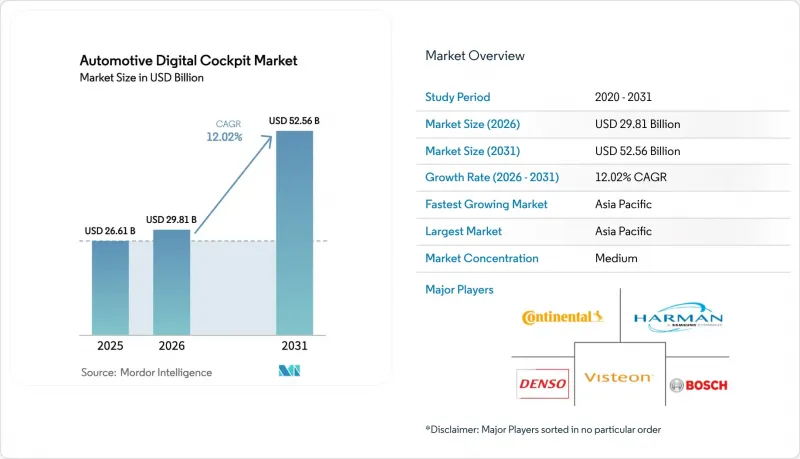
This report is Segmented by Type (Heads-Up Display (HUD), Digital Instrument Cluster, Center Stack Display, and More), Vehicle Type (Passenger Cars, Light Commercial Vehicles, and More), Propulsion (Internal Combustion Engine (ICE) and More), Sales Channel (OEM-Fitted and Aftermarket Retro-Fit), and Geography. The Market Forecasts are Provided in Terms of Value (USD).
Global Automotive Digital Cockpit Market Trends and Insights
Surging Consumer Appetite for Immersive Infotainment
Carmakers are designing cabins around multi-screen layouts and AI voice assistants that mimic smartphone experiences. TCL CSOT's panoramic HUD and 32:9 center displays preview the next design language, while Honda's forthcoming ASIMO OS embeds machine-learning personalization. Content partnerships, such as Visteon-TuneIn, add streaming media to the dashboard. Premium brands further reinforce the trend. For instance, Audi's A6 Sportback e-tron combines an 11.9-inch virtual cluster with a 14.5-inch OLED touch screen for vivid graphics.
Mandatory ADAS and Safety Regulations
Regulatory mandates are catalyzing the integration of advanced driver assistance systems with digital cockpit platforms, creating synergies that enhance both safety and user experience while reducing system complexity. EU General Safety Regulation II updates require mandatory advanced driver-assistance features in all passenger vehicles, all of which must present intuitive, real-time alerts. Qualcomm and Bosch responded with a mixed-criticality computer that hosts infotainment and ADAS workloads on one SoC, reducing latency and wiring. This convergence is further accelerated by functional safety standards like ISO 26262 ASIL-B compliance requirements, which are driving innovation in display technologies and LED driver architectures.
High Upfront System and Validation Cost
Achieving ISO 26262 ASIL-B for cockpit displays demands redundant power rails, fault-injection testing, and exhaustive software audits, all of which inflate non-recurring engineering spend. HARMAN alone employs more than 500 engineers on cockpit programs, underscoring the labor intensity. Smaller OEMs delay rollouts, and some legacy models were withdrawn in Europe when new cybersecurity rules took effect in 2024.
Other drivers and restraints analyzed in the detailed report include:
- EV Platforms Favoring Software-Defined Cockpits
- Centralized Domain Controllers Slashing BOM Cost
- Escalating Vehicle-Cybersecurity and Data-Privacy Liabilities
For complete list of drivers and restraints, kindly check the Table Of Contents.
Segment Analysis
In 2025, digital instrument clusters commanded a 37.45% of the automotive digital cockpit market share, serving as the primary interface for speed, range, and ADAS alerts. Heads-up displays, however, are setting the pace with an 18.05% CAGR, pushed by OEM demand for augmented-reality overlays that keep drivers' eyes forward. The digital cockpit market is also shifting toward panoramic CIDs, passenger-indulgent PIDs, and camera-based driver-monitoring modules that help satisfy Euro NCAP driver-attention ratings.
Center stack screens now stretch beyond 15 inches, enabled by higher pixel densities and low-power LTPO backplanes that limit heat. Envisics' second-generation holographic HUD debuted in GM's 2024 Cadillac Lyriq, highlighting cross-segment trickle-down of once-premium tech. TCL CSOT's 32:9 combo display merges cluster and infotainment on a single surface, heralding further component consolidation. Growing demand for immersive experiences guarantees that multi-display packages remain a growth lever for the digital cockpit market.
In 2025, passenger cars led the automotive digital cockpit market, securing a 68.89% share and witnessing a 13.92% annual growth. Consumers now expect the same cloud-linked services in a compact hatchback that they once saw only in luxury sedans, forcing volume brands to stretch cockpit feature lists. Digital cockpit market adoption in light commercial vehicles is quickening as fleets seek telematics integration that pairs route planning with driver-condition monitoring.
Medium and heavy trucks increasingly require electronic logging devices, and domain-controller cockpits satisfy this mandate while supporting predictive maintenance analytics. BYD's roll-out of 21 models with self-developed cockpit chips demonstrates how cost-optimized designs are scaling into workhorse vans and pickups. This divergence means light commercial vehicles may outpace passenger cars in incremental unit growth, even though the latter still dominate the digital cockpit market size.
Complete Report Scope:
- By Type
- Heads-up Display (HUD)
- Digital Instrument Cluster
- Center Stack Display
- Advanced Driver-Monitoring Camera
- Telematics/Connectivity Control Unit
- By Vehicle Type
- Passenger Cars
- Light Commercial Vehicles
- Medium and Heavy Commercial Vehicles
- By Propulsion
- Internal Combustion Engine (ICE)
- Battery Electric Vehicle (BEV)
- Hybrid and Plug-in Hybrid (HEV/PHEV)
- By Sales Channel
- OEM-fitted
- Aftermarket Retro-fit
- By Geography
- North America
- United States
- Canada
- Rest of North America
- South America
- Brazil
- Argentina
- Rest of South America
- Europe
- Germany
- United Kingdom
- France
- Italy
- Spain
- Rest of Europe
- Asia-Pacific
- China
- Japan
- South Korea
- India
- Rest of Asia-Pacific
- Middle East and Africa
- United Arab Emirates
- Saudi Arabia
- Morocco
- South Africa
- Rest of the Middle East and Africa
- North America
Geography Analysis
In 2025, the Asia-Pacific region dominated the digital cockpit market, accounting for 39.42% of global revenues. Projections indicate a robust growth rate of 14.44% CAGR for the region, extending through 2031. China's EV boom, propelled by aggressive subsidies and local component ecosystems, has turned domestic brands into cockpit technology exporters; Volkswagen, GM, and Nissan have licensed Chinese HMI stacks for local-market variants. Japan reinforces the region's software push: DENSO plans to quadruple software revenue to JPY 800 billion by 2035, and Toyota's Arene OS aims to deliver cross-model cabin experiences.
Europe is projected to maintain a medium pace, driven by the continent's leadership in premium marques that anchor cockpit R&D budgets. EU General Safety Regulation II forces the adoption of smart clusters capable of presenting mandatory warnings. Yet compliance costs remain high; several low-volume models exited production in 2024 after cybersecurity rules took effect. German OEMs counter by concentrating resources on digital-first platforms such as BMW's NEUE KLASSE, which prioritizes user-centric HUDs over analog gauges.
North America is expected to deliver a steady 8.94% CAGR. The region's large SUV and pickup segments demand high-brightness displays visible under direct sunlight, spurring innovation in optical bonding and anti-reflective coatings. NHTSA's broadened NCAP adds blind-spot, lane-keep, and pedestrian braking criteria, effectively mandating advanced HMIs. Meanwhile, Stellantis' USD-denominated software revenue goals illustrate how cockpit-tied digital services can become a core margin contributor.
- Continental AG
- Robert Bosch GmbH
- DENSO Corporation
- Visteon Corporation
- Harman International (Samsung)
- Panasonic Holdings Corp.
- Aptiv PLC
- Hyundai Mobis
- Nippon Seiki Co., Ltd.
- Faurecia SE
- LG Electronics Inc.
- Qualcomm Technologies Inc.
- NVIDIA Corp.
- Magna International Inc.
- Marelli Holdings
- Pioneer Corp.
- Alps Alpine Co., Ltd.
- Valeo SA
- Yazaki Corp.
- Panasonic Automotive Systems
Additional Benefits:
- The market estimate (ME) sheet in Excel format
- 3 months of analyst support
TABLE OF CONTENTS
1 Introduction
- 1.1 Study Assumptions and Market Definition
- 1.2 Scope of the Study
2 Research Methodology
3 Executive Summary
4 Market Landscape
- 4.1 Market Overview
- 4.2 Market Drivers
- 4.2.1 Surging consumer appetite for immersive infotainment and always-on connectivity
- 4.2.2 Mandatory ADAS and safety regulations accelerating integration of multi-display clusters
- 4.2.3 EV platforms favouring software-defined cockpits and zonal architectures
- 4.2.4 Centralized domain controllers slashing BOM cost
- 4.2.5 Subscription revenue (IVI, games, video) incentivizing OEM cockpit upgrades
- 4.2.6 Android Automotive and open-source stacks lowering entry barriers for Tier-2 OEMs
- 4.3 Market Restraints
- 4.3.1 High upfront system and validation cost
- 4.3.2 Escalating vehicle-cybersecurity and data-privacy liabilities
- 4.3.3 Automotive-grade advanced-node SoC supply tightness
- 4.3.4 Driver-distraction scrutiny spurring display size restrictions
- 4.4 Value / Supply-Chain Analysis
- 4.5 Regulatory Landscape
- 4.6 Technological Outlook
- 4.7 Porter's Five Forces Analysis
- 4.7.1 Threat of New Entrants
- 4.7.2 Bargaining Power of Buyers/Consumers
- 4.7.3 Bargaining Power of Suppliers
- 4.7.4 Threat of Substitute Products
- 4.7.5 Intensity of Competitive Rivalry
5 Market Segmentation
- 5.1 By Type
- 5.1.1 Heads-up Display (HUD)
- 5.1.2 Digital Instrument Cluster
- 5.1.3 Center Stack Display
- 5.1.4 Advanced Driver-Monitoring Camera
- 5.1.5 Telematics/Connectivity Control Unit
- 5.2 By Vehicle Type
- 5.2.1 Passenger Cars
- 5.2.2 Light Commercial Vehicles
- 5.2.3 Medium and Heavy Commercial Vehicles
- 5.3 By Propulsion
- 5.3.1 Internal Combustion Engine (ICE)
- 5.3.2 Battery Electric Vehicle (BEV)
- 5.3.3 Hybrid and Plug-in Hybrid (HEV/PHEV)
- 5.4 By Sales Channel
- 5.4.1 OEM-fitted
- 5.4.2 Aftermarket Retro-fit
- 5.5 By Geography
- 5.5.1 North America
- 5.5.1.1 United States
- 5.5.1.2 Canada
- 5.5.1.3 Rest of North America
- 5.5.2 South America
- 5.5.2.1 Brazil
- 5.5.2.2 Argentina
- 5.5.2.3 Rest of South America
- 5.5.3 Europe
- 5.5.3.1 Germany
- 5.5.3.2 United Kingdom
- 5.5.3.3 France
- 5.5.3.4 Italy
- 5.5.3.5 Spain
- 5.5.3.6 Rest of Europe
- 5.5.4 Asia-Pacific
- 5.5.4.1 China
- 5.5.4.2 Japan
- 5.5.4.3 South Korea
- 5.5.4.4 India
- 5.5.4.5 Rest of Asia-Pacific
- 5.5.5 Middle East and Africa
- 5.5.5.1 United Arab Emirates
- 5.5.5.2 Saudi Arabia
- 5.5.5.3 Morocco
- 5.5.5.4 South Africa
- 5.5.5.5 Rest of the Middle East and Africa
- 5.5.1 North America
6 Competitive Landscape
- 6.1 Market Concentration
- 6.2 Strategic Moves
- 6.3 Market Share Analysis
- 6.4 Company Profiles (includes Global Level Overview, Market Level Overview, Core Segments, Financials as Available, Strategic Information, Market Rank/Share for Key Companies, Products and Services, SWOT Analysis, and Recent Developments)
- 6.4.1 Continental AG
- 6.4.2 Robert Bosch GmbH
- 6.4.3 DENSO Corporation
- 6.4.4 Visteon Corporation
- 6.4.5 Harman International (Samsung)
- 6.4.6 Panasonic Holdings Corp.
- 6.4.7 Aptiv PLC
- 6.4.8 Hyundai Mobis
- 6.4.9 Nippon Seiki Co., Ltd.
- 6.4.10 Faurecia SE
- 6.4.11 LG Electronics Inc.
- 6.4.12 Qualcomm Technologies Inc.
- 6.4.13 NVIDIA Corp.
- 6.4.14 Magna International Inc.
- 6.4.15 Marelli Holdings
- 6.4.16 Pioneer Corp.
- 6.4.17 Alps Alpine Co., Ltd.
- 6.4.18 Valeo SA
- 6.4.19 Yazaki Corp.
- 6.4.20 Panasonic Automotive Systems
7 Market Opportunities and Future Outlook

