PUBLISHER: Mordor Intelligence | PRODUCT CODE: 2115069

PUBLISHER: Mordor Intelligence | PRODUCT CODE: 2115069
Locomotive - Market Share Analysis, Industry Trends & Statistics, Growth Forecasts (2026 - 2031)
According to Mordor Intelligence, the locomotive market size is expected to grow from USD 6.37 billion in 2025 to USD 6.63 billion in 2026 and is forecast to reach USD 8.07 billion by 2031 at a 4.01% CAGR over 2026-2031.
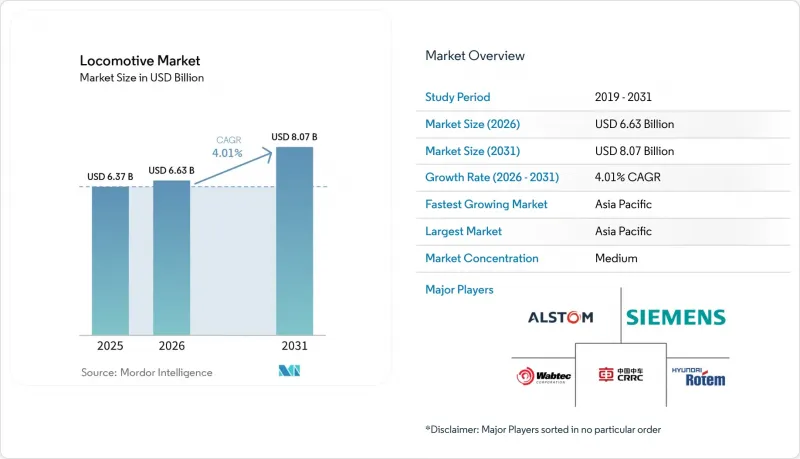
This report is Segmented by Propulsion Type (Diesel, Electric, and Hybrid), Technology (IGBT Module, GTO Thyristor, and More), Component (Rectifier, Inverter, and More), Locomotive Type (Freight, Passenger, and More), Power Rating (Below 2, 000 KW, 2, 000 To 4, 000 KW, and More), and Geography. The Market Forecasts are Provided in Terms of Value (USD) and Volume (Units).
Global Locomotive Market Trends and Insights
Government-Led Rail Electrification and Infrastructure Spend
Public spending has significantly increased, with India making a substantial commitment to support the complete electrification and deployment of Vande Bharat trainsets . The United States has allocated a considerable amount under its Infrastructure Investment and Jobs Act, with a portion designated explicitly for the Northeast Corridor, favoring electric or hydrogen traction. Europe's TEN-T initiative aims to achieve a high level of electrification on its primary routes, necessitating the installation of extensive new catenary infrastructure. Payback periods are shorter when freight volumes reach higher thresholds, prompting main-line projects to adopt overhead power, while branch lines focus on batteries or hydrogen. China has expanded its influence by financing electrified export corridors, strategically bundling CRRC locomotives with infrastructure loans to Southeast Asia.
Growing Freight and Passenger Rail Volumes Worldwide
Global rail freight experienced significant growth, driven by supply-chain re-shoring that shifted cargo to land bridges and North American Class I networks . Passenger traffic also rebounded strongly, nearing pre-pandemic levels, supported by increased demand in India's suburban areas and the expansion of high-speed services in China. Rising volumes are fueling procurement activities, with major freight operators placing substantial orders for locomotives to meet higher utilization thresholds. North American main lines, operating at high capacity, are replacing older fleets with advanced models that significantly reduce fuel consumption. Urban ridership spikes in cities such as Delhi, Mumbai, and Jakarta are driving additional orders for suburban EMUs, emphasizing the importance of maintaining a diversified traction portfolio.
High Upfront Procurement and Lifecycle Service Costs
Electric freight locomotives are significantly more expensive than Tier 4 diesel locomotives. Additionally, long-term service agreements further increase the overall cost over their operational lifespan. Battery-electric units require depot chargers, which involve substantial installation costs and can support multiple units. Tenders in emerging markets are often supported by sovereign guarantees, which can lead to delays in contract awards. Electric units also face higher residual-value risks due to concerns among secondary buyers about potential changes in grid standards and the obsolescence of inverters, which negatively impact resale prices. Smaller operators, unable to justify the investment in in-house maintenance facilities, often delay electrification despite the rising costs of fuel.
Other drivers and restraints analyzed in the detailed report include:
- Advancements in High-Efficiency Traction Electronics
- Modular Battery-Electric and Dual-Mode Retrofit Solutions
- Limited High-Power Battery Supply Chain for Heavy-Haul Use
For complete list of drivers and restraints, kindly check the Table Of Contents.
Segment Analysis
Diesel propulsion captured 76.13% of the locomotive traction system market share in 2025, supported by an installed base of 120,000 diesel-electric units and partial network electrification. Battery-electric models grow at a 4.61% CAGR as 7 MWh retrofit kits strip idle fuel burn from yard duties and improve air quality. In Europe and North America, tighter EPA Tier 5 and Euro Stage VI regulations are significantly increasing the costs of new diesel units. As a result, government mandates and escalating diesel after-treatment expenses are reducing the appeal of diesel propulsion relative to electric overhead and hydrogen fuel-cell alternatives.
In India and China, the electrification of main lines supports a steady demand for 25 kV AC systems. Meanwhile, hybrid battery-catenary designs effectively address gaps in networks that are only partially wired. The market for battery-electric units in the locomotive traction system is expected to grow, driven by increasing retrofit activities within the North American switcher fleet. Additionally, hydrogen prototypes, like Alstom's Coradia iLint, highlight the untapped potential for regional routes that currently lack overhead power.
IGBT modules accounted for 64.22% of the revenue in 2025, thanks to mature supply chains and lower pricing. Silicon-carbide modules, though costlier, expand at a 4.75% CAGR by delivering lower switching losses and lighter traction packages. As high-speed and heavy-haul operators prioritize life-cycle energy savings, the locomotive traction system market associated with SiC inverters is expected to experience significant growth in the coming years. Upcoming ecodesign efficiency thresholds are set to accelerate this substitution.
While gate-turn-off thyristors remain in legacy fleets, they're being phased out during mid-life overhauls. Hybrid IGBT-SiC topologies, developed by Siemens and Wabtec, achieve a substantial portion of the SiC efficiency gain at a fraction of the full-SiC cost, facilitating a smoother adoption. However, redesigning components for gate drivers and cooling demands considerable engineering time, underscoring the advantage of vertically integrated suppliers.
Complete Report Scope:
- By Propulsion Type
- Diesel
- Electric (Overhead)
- Hybrid
- By Technology
- IGBT Module
- GTO Thyristor
- SiC Module
- MOSFET Module
- By Component
- Traction Motor
- Inverter
- Rectifier
- Alternator
- Transformer
- Battery Pack
- Fuel Cell Stack
- By Locomotive Type
- Freight
- Passenger
- Shunting / Switcher
- High-Speed
- By Power Rating (kW)
- Below 2,000 kW
- 2,000 to 4,000 kW
- Above 4,000 kW
- By Geography
- North America
- United States
- Canada
- Rest of North America
- South America
- Brazil
- Argentina
- Rest of South America
- Europe
- Germany
- United Kingdom
- France
- Italy
- Russia
- Rest of Europe
- Asia-Pacific
- China
- India
- Japan
- South Korea
- Australia
- Rest of Asia-Pacific
- Middle East and Africa
- Saudi Arabia
- United Arab Emirates
- Egypt
- Turkey
- South Africa
- Rest of Middle East and Africa
- North America
Geography Analysis
Asia-Pacific generated 42.17% of global revenue in 2025 and is expected to compound at 4.45% through 2031, supported by India's 100% broad-gauge electrification and China's Belt and Road export financing. India has allocated significant funding for dedicated freight corridors, aiming to enhance its rail infrastructure. China has expanded its high-speed rail network, driving regional demand for advanced power packages. Australia is advancing its iron-ore operations, and Japan is upgrading its Shinkansen services, contributing to overall growth. Local content rules in India, Indonesia, and South Korea are extending procurement timelines but are also strengthening domestic manufacturing capabilities.
Europe holds a substantial share of the market revenue. A major initiative is targeting the development of extensive new catenary lines. Germany has made significant investments in fleet upgrades. France has placed orders for new high-speed train sets, and Italy is transitioning to hydrogen-powered units to replace diesel on non-electrified routes. Electrification delays in the UK are driving demand for bi-mode and battery-powered units. Sanctions on Russia are shifting its production focus to meet domestic requirements.
North America represents a notable portion of market spending. A central infrastructure act is channeling funding into rail projects, prioritizing electric and hydrogen solutions for key corridors. Class I operators are managing a large fleet of predominantly diesel locomotives but are testing battery hybrids to comply with upcoming environmental regulations. Canada is exploring hydrogen-powered intercity services, while Mexico is gradually upgrading its freight rail systems.
South America, along with the Middle East and Africa, contributes a smaller share of the market revenue. Brazil has placed orders for electric locomotives. Saudi Arabia is considering expanding its high-speed rail network. Egypt and Turkey are making gradual improvements to their rail systems, though financial challenges often cause delays.
- CRRC Corporation Limited
- Alstom SA
- Siemens AG
- Wabtec Corporation
- Hyundai Rotem
- Kawasaki Heavy Industries Ltd.
- Stadler Rail AG
- Hitachi Rail Ltd.
- Progress Rail (Caterpillar Inc.)
- Toshiba Corporation
- CAF S.A.
- Vossloh Locomotives
- Bombardier Transportation (Alstom)
- Mitsubishi Heavy Industries Ltd.
- Bharat Heavy Electricals Ltd.
- Sinara Transport Machines (Ural Locomotives)
- Titagarh Rail Systems Ltd.
Additional Benefits:
- The market estimate (ME) sheet in Excel format
- 3 months of analyst support
TABLE OF CONTENTS
1 Introduction
- 1.1 Study Assumptions and Market Definition
- 1.2 Scope of the Study
2 Research Methodology
3 Executive Summary
4 Market Landscape
- 4.1 Market Overview
- 4.2 Market Drivers
- 4.2.1 Growing Freight and Passenger Rail Volumes Worldwide
- 4.2.2 Government-led Rail Electrification and Infrastructure Spend
- 4.2.3 Advancements in High-efficiency Traction Electronics (IGBT, SiC)
- 4.2.4 Modular Battery-electric and Dual-mode Retrofit Solutions
- 4.2.5 Carbon-credit and ESG Financing Lowers Cost of Low-emission Fleets
- 4.2.6 Predictive Maintenance Analytics Boosts Fleet Availability
- 4.3 Market Restraints
- 4.3.1 High Upfront Procurement and Lifecycle Service Costs
- 4.3.2 Tightening Emission Rules Raise Diesel Compliance Cost
- 4.3.3 Limited High-power Battery Supply Chain for Heavy-haul Use
- 4.3.4 Grid-capacity Bottlenecks Along Main Freight Corridors
- 4.4 Value / Supply-Chain Analysis
- 4.5 Regulatory Landscape
- 4.6 Technological Outlook
- 4.7 Porter's Five Forces
- 4.7.1 Bargaining Power of Suppliers
- 4.7.2 Bargaining Power of Buyers / Consumers
- 4.7.3 Threat of New Entrants
- 4.7.4 Threat of Substitute Products
- 4.7.5 Intensity of Competitive Rivalry
5 Market Size & Growth Forecasts (Value (USD) and Volume (Units))
- 5.1 By Propulsion Type
- 5.1.1 Diesel
- 5.1.2 Electric (Overhead)
- 5.1.3 Hybrid
- 5.2 By Technology
- 5.2.1 IGBT Module
- 5.2.2 GTO Thyristor
- 5.2.3 SiC Module
- 5.2.4 MOSFET Module
- 5.3 By Component
- 5.3.1 Traction Motor
- 5.3.2 Inverter
- 5.3.3 Rectifier
- 5.3.4 Alternator
- 5.3.5 Transformer
- 5.3.6 Battery Pack
- 5.3.7 Fuel Cell Stack
- 5.4 By Locomotive Type
- 5.4.1 Freight
- 5.4.2 Passenger
- 5.4.3 Shunting / Switcher
- 5.4.4 High-Speed
- 5.5 By Power Rating (kW)
- 5.5.1 Below 2,000 kW
- 5.5.2 2,000 to 4,000 kW
- 5.5.3 Above 4,000 kW
- 5.6 By Geography
- 5.6.1 North America
- 5.6.1.1 United States
- 5.6.1.2 Canada
- 5.6.1.3 Rest of North America
- 5.6.2 South America
- 5.6.2.1 Brazil
- 5.6.2.2 Argentina
- 5.6.2.3 Rest of South America
- 5.6.3 Europe
- 5.6.3.1 Germany
- 5.6.3.2 United Kingdom
- 5.6.3.3 France
- 5.6.3.4 Italy
- 5.6.3.5 Russia
- 5.6.3.6 Rest of Europe
- 5.6.4 Asia-Pacific
- 5.6.4.1 China
- 5.6.4.2 India
- 5.6.4.3 Japan
- 5.6.4.4 South Korea
- 5.6.4.5 Australia
- 5.6.4.6 Rest of Asia-Pacific
- 5.6.5 Middle East and Africa
- 5.6.5.1 Saudi Arabia
- 5.6.5.2 United Arab Emirates
- 5.6.5.3 Egypt
- 5.6.5.4 Turkey
- 5.6.5.5 South Africa
- 5.6.5.6 Rest of Middle East and Africa
- 5.6.1 North America
6 Competitive Landscape
- 6.1 Market Concentration
- 6.2 Strategic Moves
- 6.3 Market Share Analysis
- 6.4 Company Profiles (Includes Global Level Overview, Market Level Overview, Core Segments, Financials as Available, Strategic Information, Market Rank/Share for Key Companies, Products and Services, SWOT Analysis, and Recent Developments)
- 6.4.1 CRRC Corporation Limited
- 6.4.2 Alstom SA
- 6.4.3 Siemens AG
- 6.4.4 Wabtec Corporation
- 6.4.5 Hyundai Rotem
- 6.4.6 Kawasaki Heavy Industries Ltd.
- 6.4.7 Stadler Rail AG
- 6.4.8 Hitachi Rail Ltd.
- 6.4.9 Progress Rail (Caterpillar Inc.)
- 6.4.10 Toshiba Corporation
- 6.4.11 CAF S.A.
- 6.4.12 Vossloh Locomotives
- 6.4.13 Bombardier Transportation (Alstom)
- 6.4.14 Mitsubishi Heavy Industries Ltd.
- 6.4.15 Bharat Heavy Electricals Ltd.
- 6.4.16 Sinara Transport Machines (Ural Locomotives)
- 6.4.17 Titagarh Rail Systems Ltd.
7 Market Opportunities & Future Outlook
- 7.1 White-space & Unmet-need Assessment

