PUBLISHER: Mordor Intelligence | PRODUCT CODE: 2115070

PUBLISHER: Mordor Intelligence | PRODUCT CODE: 2115070
Europe Automotive Seat - Market Share Analysis, Industry Trends & Statistics, Growth Forecasts (2026 - 2031)
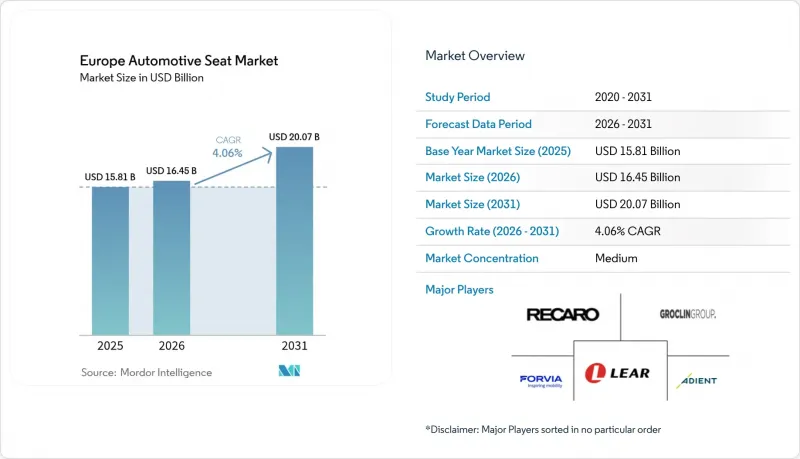
According to Mordor Intelligence, the Europe automotive seat market size was valued at USD 15.81 billion in 2025 and estimated to grow from USD 16.45 billion in 2026 to reach USD 20.07 billion by 2031, at a CAGR of 4.06% during the forecast period (2026-2031).
This report is Segmented by Material (Genuine Leather, Synthetic Leather PU, and More), Technology (Standard/Manual, Powered/Adjustable, and More), Vehicle Type (Passenger Car and Commercial Vehicle), Seat Component (Frame & Structures, Foam & Padding, and More), Sales Channel (OEM and Aftermarket), and Geography. The Market Forecasts are Provided in Terms of Value (USD).
Europe Automotive Seat Market Trends and Insights
Rapid Electrification Creating New Thermal-Management Seat Features
A high BEV share means cabin heating no longer taps engine waste heat. Vitesco data show 48 V seat heaters slash whole-vehicle HVAC load by one-third, raising winter-range credibility-vital in Nordic sub-zero climates EV-centric seats gain active ventilation, zonal micro-climate control, and self-diagnosing power electronics. Design teams juggle electromagnetic-compatibility constraints next to battery cabling, triggering fresh material stack-ups and conductive-foam trials. Thermal specialists can validate long-cycle vibration and temperature swings and see demand surge, propelling the European automotive seat market toward higher electronic content per unit.
EU General Safety Regulation 2019/2144 Mandating Advanced Seat Sensors
Since July 2024, every new European vehicle must host occupant-status detection and belt reminders rooted in innovative seat electronics. Pressure mats, weight classifiers, and camera-assisted posture tracking now ship standard on mass-market trims. FORVIA and Lear embed redundant CAN nodes to guarantee data integrity for ADAS stacks, turning the seat into a real-time occupant-intelligence hub. Certification labs note a two-fifths increase in seat-related EMC tests, extending program timelines yet assuring compliance. The regulation sparks aftermarket retrofits for fleet vehicles, further stretching the supply of sensor kits across the European automotive seat market.
Seat-Electronics Chip Shortages and Price Spikes
Smart seats may host up to 15 microcontrollers and power drivers; however, automotive-grade MCU lead times ballooned from 14 to 38 weeks in 2024. Premium SUV lines in Slovakia idled for nine shifts when occupancy-sensor ASICs ran dry. Some suppliers redesign boards to consolidate functions onto readily available processors, cutting chip count by one-eight but raising R&D spend. Firms with dual-sourcing in Taiwan and Europe ride out volatility better, capturing urgently rerouted OEM volumes in the European automotive seat market. Long-term, localized semiconductor fabs could dilute this restraint, yet capacity additions will not ease shortages before 2027.
Other drivers and restraints analyzed in the detailed report include:
- Rise in OEM Demand for Lightweight, Mixed-Material Seat Frames
- Sustainability Push for Circular Upholstery (Recycled PET & Bio-PU)
- Volatile Polyurethane & Leather Input Costs
For complete list of drivers and restraints, kindly check the Table Of Contents.
Segment Analysis
Synthetic PU leather controlled 43.02% of the European automotive seat market size in 2025, thanks to its uniform surface quality, design latitude, and lower scrap rates than genuine hides. Bio-based PU, although niche, is climbing at a 4.12% CAGR as OEMs publish life-cycle reports quantifying 25% carbon savings. Recycled PET fabric innovations allow manufacturers to meet European end-of-life directives without sacrificing abrasion resistance, a key metric for ride-hailing interiors. Genuine leather persists in flagship trims, but hexavalent-chrome restrictions elevate finishing costs, nudging volume brands toward vegan alternatives. Composite and 3D-knit seat skins shrink mass and uplift breathability, supporting stringent EV range targets.
Europe automotive seat market participants now pair water-borne PU coatings with low-VOC backing adhesives, eliminating most of the process water and cutting curing energy. Supply chains diversify, with Eastern European mills spinning recycled yarns to offset Western labor costs. While raw-material volatility remains, long-term contracts for bio-based feedstocks stabilize input pricing. Sustainable textile labels bolster showroom messaging, reinforcing consumer acceptance and thus accelerating material-mix transition across the European automotive seat market.
Smart ADAS-integrated seats will clock a 4.15% CAGR to 2031 as EU GSR 2019/2144 forces occupant-monitoring deployment on every new model. Powered and adjustable mechanisms still own 36.20% of the European automotive seat market share, owing to entrenched consumer expectations for multi-way comfort. Nordic winters sustain elevated demand for heated cushions, whereas Mediterranean climates steer ventilated-perforation take-rates. Premium OEMs bundle massage and posture-correction algorithms that log driver fatigue and then share data with cloud analytics for predictive health services.
Europe's automotive seat industry pioneers now co-package seat ECUs with zonal controllers, trimming wiring weight by 800 g per vehicle. Over-the-air firmware updates allow remote comfort-curve edits, positioning seats as software-defined features. Modular electronics ease compliance updates when safety rules evolve, a competitive lever that underpins recurring revenue models through subscription-based massage sequences. As semiconductor availability normalizes, ADAS seat content will spread into C-segment crossovers, deepening electronic value capture inside the European automotive seat market.
Complete Report Scope:
- By Material
- Genuine Leather
- Synthetic Leather - PU
- Synthetic Leather - PVC
- Fabric
- Composite/3D-knit
- Others
- By Technology
- Standard/Manual
- Powered/Adjustable
- Heated
- Ventilated
- Massage
- Smart ADAS-integrated
- Child Safety Seats
- By Vehicle Type
- Passenger Car
- Hatchback
- Sedan
- SUV/Crossover
- MPV
- Commercial Vehicle
- Light Commercial Vehicle
- Heavy Truck
- Bus/Coach
- Passenger Car
- By Seat Component
- Frame & Structures
- Foam & Padding
- Upholstery & Trim
- Motors & Actuators
- Sensors & ECUs
- Airbags & Restraints
- By Sales Channel
- Original Equipment Manufacturer (OEM)
- Aftermarket
- By Country
- Germany
- United Kingdom
- France
- Italy
- Spain
- Netherlands
- Poland
- Sweden
- Russia
- Rest of Europe
List of Companies Covered in this Report:
- Adient plc
- Lear Corporation
- Forvia SE (Faurecia SE)
- Magna International Inc.
- Brose Fahrzeugteile SE & Co. KG
- Toyota Boshoku Corporation
- TACHI-S CO., LTD.
- TS Tech Co. Ltd.
- Gentherm Inc.
- RECARO Automotive Italy S.r.l.
- Sparco SpA
- Britax Romer
- Maxi-Cosi (Dorel)
- RENNTech Seats
- Grammer AG
- Groclin SA
- Kongsberg Automotive
- Hyundai Transys
- Johnson Controls (Trimlines)
Additional Benefits:
- The market estimate (ME) sheet in Excel format
- 3 months of analyst support
TABLE OF CONTENTS
1 Introduction
- 1.1 Study Assumptions & Market Definition
- 1.2 Scope of the Study
2 Research Methodology
3 Executive Summary
4 Market Landscape
- 4.1 Market Overview
- 4.2 Market Drivers
- 4.2.1 Rapid Electrification Creating New Thermal-Management Seat Features
- 4.2.2 EU General Safety Regulation 2019/2144 Mandating Advanced Seat Sensors
- 4.2.3 Rise In OEM Demand For Lightweight, Mixed-Material Seat Frames
- 4.2.4 Sustainability Push For Circular Upholstery (Recycled PET & Bio-PU)
- 4.2.5 Aftermarket Customization Boom Via E-Commerce Platforms
- 4.2.6 Growing Fleet/Ride-Hailing Refurb Cycles For Durable, Easy-Clean Seats
- 4.3 Market Restraints
- 4.3.1 Seat-Electronics Chip Shortages And Price Spikes
- 4.3.2 Volatile Polyurethane & Leather Input Costs
- 4.3.3 Under-Utilised European Assembly Capacity Amid EV-Production Swings
- 4.3.4 Stricter EU Chemical Rules On Hexavalent-Chrome Tannery Effluents
- 4.4 Value / Supply-Chain Analysis
- 4.5 Regulatory Landscape
- 4.6 Technological Outlook
- 4.7 Porter's Five Forces
- 4.7.1 Threat of New Entrants
- 4.7.2 Bargaining Power of Buyers
- 4.7.3 Bargaining Power of Suppliers
- 4.7.4 Threat of Substitutes
- 4.7.5 Intensity of Rivalry
5 Market Size & Growth Forecasts (Value (USD))
- 5.1 By Material
- 5.1.1 Genuine Leather
- 5.1.2 Synthetic Leather - PU
- 5.1.3 Synthetic Leather - PVC
- 5.1.4 Fabric
- 5.1.5 Composite/3D-knit
- 5.1.6 Others
- 5.2 By Technology
- 5.2.1 Standard/Manual
- 5.2.2 Powered/Adjustable
- 5.2.3 Heated
- 5.2.4 Ventilated
- 5.2.5 Massage
- 5.2.6 Smart ADAS-integrated
- 5.2.7 Child Safety Seats
- 5.3 By Vehicle Type
- 5.3.1 Passenger Car
- 5.3.1.1 Hatchback
- 5.3.1.2 Sedan
- 5.3.1.3 SUV/Crossover
- 5.3.1.4 MPV
- 5.3.2 Commercial Vehicle
- 5.3.2.1 Light Commercial Vehicle
- 5.3.2.2 Heavy Truck
- 5.3.2.3 Bus/Coach
- 5.3.1 Passenger Car
- 5.4 By Seat Component
- 5.4.1 Frame & Structures
- 5.4.2 Foam & Padding
- 5.4.3 Upholstery & Trim
- 5.4.4 Motors & Actuators
- 5.4.5 Sensors & ECUs
- 5.4.6 Airbags & Restraints
- 5.5 By Sales Channel
- 5.5.1 Original Equipment Manufacturer (OEM)
- 5.5.2 Aftermarket
- 5.6 By Country
- 5.6.1 Germany
- 5.6.2 United Kingdom
- 5.6.3 France
- 5.6.4 Italy
- 5.6.5 Spain
- 5.6.6 Netherlands
- 5.6.7 Poland
- 5.6.8 Sweden
- 5.6.9 Russia
- 5.6.10 Rest of Europe
6 Competitive Landscape
- 6.1 Market Concentration
- 6.2 Strategic Moves
- 6.3 Market Share Analysis
- 6.4 Company Profiles (Includes Global Level Overview, Market Level Overview, Core Segments, Financials as Available, Strategic Information, Market Rank/Share for Key Companies, Products and Services, SWOT Analysis, and Recent Developments)
- 6.4.1 Adient plc
- 6.4.2 Lear Corporation
- 6.4.3 Forvia SE (Faurecia SE)
- 6.4.4 Magna International Inc.
- 6.4.5 Brose Fahrzeugteile SE & Co. KG
- 6.4.6 Toyota Boshoku Corporation
- 6.4.7 TACHI-S CO., LTD.
- 6.4.8 TS Tech Co. Ltd.
- 6.4.9 Gentherm Inc.
- 6.4.10 RECARO Automotive Italy S.r.l.
- 6.4.11 Sparco SpA
- 6.4.12 Britax Romer
- 6.4.13 Maxi-Cosi (Dorel)
- 6.4.14 RENNTech Seats
- 6.4.15 Grammer AG
- 6.4.16 Groclin SA
- 6.4.17 Kongsberg Automotive
- 6.4.18 Hyundai Transys
- 6.4.19 Johnson Controls (Trimlines)
7 Market Opportunities & Future Outlook
- 7.1 White-space & Unmet-Need Assessment

