PUBLISHER: Mordor Intelligence | PRODUCT CODE: 2115083

PUBLISHER: Mordor Intelligence | PRODUCT CODE: 2115083
Port Equipment - Market Share Analysis, Industry Trends & Statistics, Growth Forecasts (2026 - 2031)
According to Mordor Intelligence, port equipment market size in 2026 is estimated at USD 21.66 billion, growing from 2025 value of USD 20.55 billion with 2031 projections showing USD 28.16 billion, growing at 5.39% CAGR over 2026-2031.
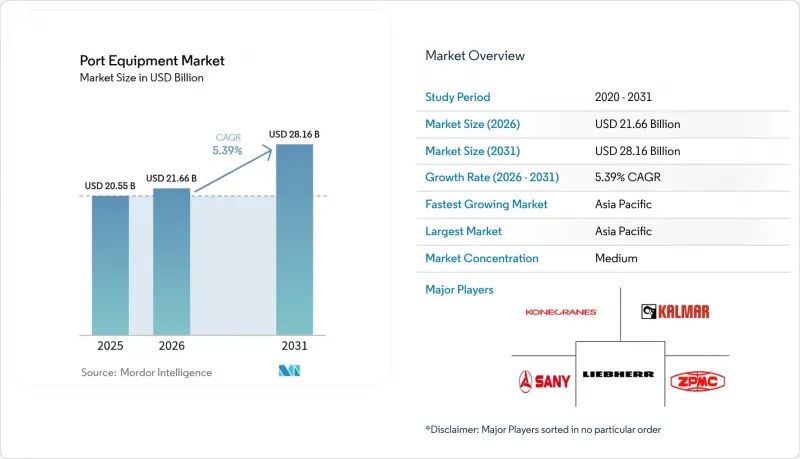
This report is Segmented by Equipment Type (Cranes, Trucks, and More), Application (Container Handling, and More), Fuel Type (Diesel, Electric, and Hybrid, and More), Operation Mode (Conventional (Manual/Semi-Auto) and Fully Autonomous), and Geography (North America, and More). The Market Forecasts are Provided in Terms of Value (USD) and Volume (Units).
Global Port Equipment Market Trends and Insights
Surge in Container Ship Sizes Driving Demand for Mega-STS And ASC Cranes
Ultra-large container vessels now measure 400 m and carry up to 23,000 TEU, forcing terminals to procure quay cranes with outreach beyond 74 m to clear 24 rows. Each call can require 3,800 trucks and 50 freight trains, straining gate, yard, and rail assets as seen at Hamburg. The Port of Savannah recently took delivery of the East Coast's largest STS cranes to handle 16,000 TEU ships, adding around 1.5 million TEU of annual capacity. Yet crane productivity has climbed only 90% in two decades versus a 202% jump in bay size, widening operational bottlenecks and stimulating demand for automation and twin-lift spreaders.
Stricter Port-Side Decarbonization Mandates are Accelerating Electric and Hybrid Fleets
California requires 90% zero-emission cargo-handling equipment by 2036, a rule affecting about 33,500 drayage trucks and thousands of terminal assets . Terminals are reacting: APM Suape allocated USD 47 million for 28 all-electric units to become South America's first fully electrified site by 2026. An electric STS crane can save USD 3.3 million in diesel and cut 776 t of CO2 yearly, bolstering the business case. The Zero Emission Port Alliance expects 94% of member purchases to be battery-electric by 2035, underpinning standards for tractors and straddle carriers.
Multi-Million-Dollar CAPEX and Long ROI Cycles
Automating a terminal can demand USD 500 million-USD 1 billion, with breakeven volumes exceeding 544,000 TEU in a nine-berth design. More than 50% of equipment is now financed externally, and leasing is rising as operators seek to avoid heavy upfront cash outflows . Extended ROI horizons curb purchasing appetite, giving momentum to equipment-as-a-service contracts that bundle maintenance yet potentially reduce fresh unit sales.
Other drivers and restraints analyzed in the detailed report include:
- Rapid Terminal Automation to Offset Labor Shortages and Boost Throughput
- Tariff Threat on Chinese Cranes Reshaping Regional Sourcing Strategies
- Raw-Material Price Volatility
For complete list of drivers and restraints, kindly check the Table Of Contents.
Segment Analysis
The port equipment market size for cranes accounted for 55.76% share in 2025 and is on track for a 6.97% CAGR through 2031. Ship-to-shore models top purchase lists as operators retrofit outreach beyond 74 m to serve 24-row vessels. Projects such as Port Tanjung Pelepas' five new ULCV quay cranes illustrate the rush to future-proof waterfront assets.Automated stacking cranes are gaining momentum; Hutchison BEST's seven-block extension lifted yard capacity 25% while lowering truck re-handles. Rubber-tired and rail-mounted gantries are rapidly electrifying, with PSA Halifax contracting eight battery RTGs from Konecranes to create North America's first fully electric yard. Trucks remain the fastest-growing sub-class as AGVs and terminal tractors integrate autonomy, vision sensors, and clean drivetrains. Toyota's plan to ship Nagoya-proven AGVs abroad underscores the export potential of Asia-developed technology.
Container handling absorbed 54.22% of the port equipment market share in 2025 revenue, thanks to record volume expansion and mega-ship cascades. Newbuild STS cranes, yard automatons, and twin-lift spreaders dominate capex plans as ports chase berth productivity gains and shorter vessel dwell. Warehouse logistics, however, is projected to rise at an 8.03% CAGR as e-commerce-driven cross-docking boosts demand for automated mobile robots and intelligent conveyor systems.Bulk cargo handling keeps steady momentum in mineral-rich regions, supported by higher-capacity grabs and continuous ship-unloaders. Ship servicing-mooring, Ro-Ro and passenger terminals, receives targeted investments where cruise and vehicle trades rebound. Port infrastructure construction cycles create episodic spikes in heavy pile-drivers, dredgers, and lifting solutions as governments roll out economic stimulus packages.
Complete Report Scope:
- By Equipment Type
- Cranes
- Ship-to-Shore (STS)
- Rubber-Tyred Gantry (RTG)
- Rail-Mounted Gantry (RMG)
- Automated Stacking Cranes (ASC)
- Mobile Harbor Cranes
- Trucks
- Terminal Tractors
- Towing Tractors
- Automated Guided Vehicles (AGV)
- Reach Stackers
- Forklifts
- Others
- Cranes
- By Application
- Container Handling
- Bulk Cargo Handling
- Ship Handling (Mooring, Ro-Ro)
- Port Infrastructure Construction
- Warehouse and Yard Logistics
- By Fuel Type
- Diesel
- Electric and Hybrid
- Hydrogen Fuel-Cell
- By Operation Mode
- Conventional (Manual/Semi-Auto)
- Fully Autonomous
- By Geography
- North America
- United States
- Canada
- Rest of North America
- South America
- Brazil
- Argentina
- Rest of South America
- Europe
- Germany
- United Kingdom
- France
- Spain
- Italy
- Netherlands
- Russia
- Rest of Europe
- Asia-Pacific
- China
- India
- Japan
- South Korea
- Australia
- Rest of Asia-Pacific
- Middle East and Africa
- United Arab Emirates
- Saudi Arabia
- Turkey
- South Africa
- Egypt
- Rest of Middle East and Africa
- North America
Geography Analysis
Asia Pacific accounted for 45.88% of the port equipment market in 2025 and is forecast to expand at a 6.18% CAGR through 2031. China anchors the region with 52 automated terminals processing 16.04 billion t of cargo a year, reinforcing the port equipment market's growth engine. Singapore's PSA Tuas Port typifies regional ambition as it targets 65 million TEU annual capacity through AI-enabled automation. India's restrictions on Chinese crane purchases are opening opportunities for domestic and non-Chinese suppliers to gain share.
North America generated demand spikes after Washington announced tariffs on Chinese cranes alongside a USD 20 billion incentive for local manufacturing. The United States Coast Guard's cybersecurity directives are pushing ports to retrofit or replace roughly 200 Chinese-made units, creating a parallel services market. Canada is prioritizing electrification, with PSA Halifax ordering eight battery RTGs as part of a nationwide zero-emission strategy. Together, these factors are reshaping sourcing models and accelerating technology upgrades across the continent.Europe held a substantial revenue share in the port equipment market in 2024 and continues to drive sustainability and digital integration agendas. EUROGATE has rolled out a 5G campus network across Hamburg, Bremerhaven and Wilhelmshaven to support remote operations and real-time diagnostics. The Middle East and Africa are emerging as high-growth zones as governments deploy sovereign infrastructure funds to modernize gateways. DP World has pledged USD 3 billion for African terminal projects, while Saudi Arabia's NEOM port is installing automated cranes ahead of a 2026 launch. Egypt has also attracted USD 700 million from Hutchison Ports for new facilities at Sokhna and Alexandria, underscoring the region's rising equipment appetite.
- Kalmar (Cargotec)
- Konecranes Oyj
- Liebherr Group
- ZPMC (Shanghai)
- Sany Heavy Industry Co., Ltd.
- Hyster-Yale Group
- Cavotec
- Paceco Corp.
- Terex Corporation
- Manitowoc
- Taylor Machine Works
- Toyota Material Handling
- TTS Group
- Famur Famak
- OUCO Industry
- Anupam Industries
- Mi-Jack Products
Additional Benefits:
- The market estimate (ME) sheet in Excel format
- 3 months of analyst support
TABLE OF CONTENTS
1 Introduction
- 1.1 Study Assumptions & Market Definition
- 1.2 Scope of the Study
2 Research Methodology
3 Executive Summary
4 Market Landscape
- 4.1 Market Overview
- 4.2 Market Drivers
- 4.2.1 Surge in Container Ship Sizes Driving Demand for Mega-STS And ASC Cranes
- 4.2.2 Stricter Port-Side Decarbonization Mandates are Accelerating Electric and Hybrid Fleets
- 4.2.3 Rapid Terminal Automation to Offset Labor Shortages and Boost Throughput
- 4.2.4 Tariff Threat on Chinese Cranes Reshaping Regional Sourcing Strategies
- 4.2.5 OT-Cyber-Security Compliance Fueling Retrofit Of "Secure-By-Design" Equipment
- 4.2.6 Autonomous, Remotely Operated Vehicles Are Improving Safety and Night-Shift Productivity
- 4.3 Market Restraints
- 4.3.1 Multi-Million-Dollar Capex And Long ROI Cycles
- 4.3.2 Raw-Material Price Volatility
- 4.3.3 Equipment-Leasing Boom Cannibalizing New-Build Sales
- 4.3.4 Geopolitical Export Controls Limiting Tech Transfer and Service Access
- 4.4 Value/Supply-Chain Analysis
- 4.5 Regulatory Landscape
- 4.6 Technological Outlook
- 4.7 Porter's Five Forces
- 4.7.1 Threat of New Entrants
- 4.7.2 Bargaining Power of Buyers
- 4.7.3 Bargaining Power of Suppliers
- 4.7.4 Threat of Substitutes
- 4.7.5 Intensity of Competitive Rivalry
5 Market Size & Growth Forecasts (Value (USD) and Volume (Units))
- 5.1 By Equipment Type
- 5.1.1 Cranes
- 5.1.1.1 Ship-to-Shore (STS)
- 5.1.1.2 Rubber-Tyred Gantry (RTG)
- 5.1.1.3 Rail-Mounted Gantry (RMG)
- 5.1.1.4 Automated Stacking Cranes (ASC)
- 5.1.1.5 Mobile Harbor Cranes
- 5.1.2 Trucks
- 5.1.2.1 Terminal Tractors
- 5.1.2.2 Towing Tractors
- 5.1.2.3 Automated Guided Vehicles (AGV)
- 5.1.3 Reach Stackers
- 5.1.4 Forklifts
- 5.1.5 Others
- 5.1.1 Cranes
- 5.2 By Application
- 5.2.1 Container Handling
- 5.2.2 Bulk Cargo Handling
- 5.2.3 Ship Handling (Mooring, Ro-Ro)
- 5.2.4 Port Infrastructure Construction
- 5.2.5 Warehouse and Yard Logistics
- 5.3 By Fuel Type
- 5.3.1 Diesel
- 5.3.2 Electric and Hybrid
- 5.3.3 Hydrogen Fuel-Cell
- 5.4 By Operation Mode
- 5.4.1 Conventional (Manual/Semi-Auto)
- 5.4.2 Fully Autonomous
- 5.5 By Geography
- 5.5.1 North America
- 5.5.1.1 United States
- 5.5.1.2 Canada
- 5.5.1.3 Rest of North America
- 5.5.2 South America
- 5.5.2.1 Brazil
- 5.5.2.2 Argentina
- 5.5.2.3 Rest of South America
- 5.5.3 Europe
- 5.5.3.1 Germany
- 5.5.3.2 United Kingdom
- 5.5.3.3 France
- 5.5.3.4 Spain
- 5.5.3.5 Italy
- 5.5.3.6 Netherlands
- 5.5.3.7 Russia
- 5.5.3.8 Rest of Europe
- 5.5.4 Asia-Pacific
- 5.5.4.1 China
- 5.5.4.2 India
- 5.5.4.3 Japan
- 5.5.4.4 South Korea
- 5.5.4.5 Australia
- 5.5.4.6 Rest of Asia-Pacific
- 5.5.5 Middle East and Africa
- 5.5.5.1 United Arab Emirates
- 5.5.5.2 Saudi Arabia
- 5.5.5.3 Turkey
- 5.5.5.4 South Africa
- 5.5.5.5 Egypt
- 5.5.5.6 Rest of Middle East and Africa
- 5.5.1 North America
6 Competitive Landscape
- 6.1 Market Concentration
- 6.2 Strategic Moves
- 6.3 Market Share Analysis
- 6.4 Company Profiles (Includes Global Level Overview, Market Level Overview, Core Segments, Financials as Available, Strategic Information, Market Rank/Share for Key Companies, Products and Services, SWOT Analysis, and Recent Developments)
- 6.4.1 Kalmar (Cargotec)
- 6.4.2 Konecranes Oyj
- 6.4.3 Liebherr Group
- 6.4.4 ZPMC (Shanghai)
- 6.4.5 Sany Heavy Industry Co., Ltd.
- 6.4.6 Hyster-Yale Group
- 6.4.7 Cavotec
- 6.4.8 Paceco Corp.
- 6.4.9 Terex Corporation
- 6.4.10 Manitowoc
- 6.4.11 Taylor Machine Works
- 6.4.12 Toyota Material Handling
- 6.4.13 TTS Group
- 6.4.14 Famur Famak
- 6.4.15 OUCO Industry
- 6.4.16 Anupam Industries
- 6.4.17 Mi-Jack Products
7 Market Opportunities & Future Outlook
- 7.1 White-space & Unmet-Need Assessment

