PUBLISHER: Mordor Intelligence | PRODUCT CODE: 2115088

PUBLISHER: Mordor Intelligence | PRODUCT CODE: 2115088
GCC Business Jet - Market Share Analysis, Industry Trends & Statistics, Growth Forecasts (2026 - 2031)
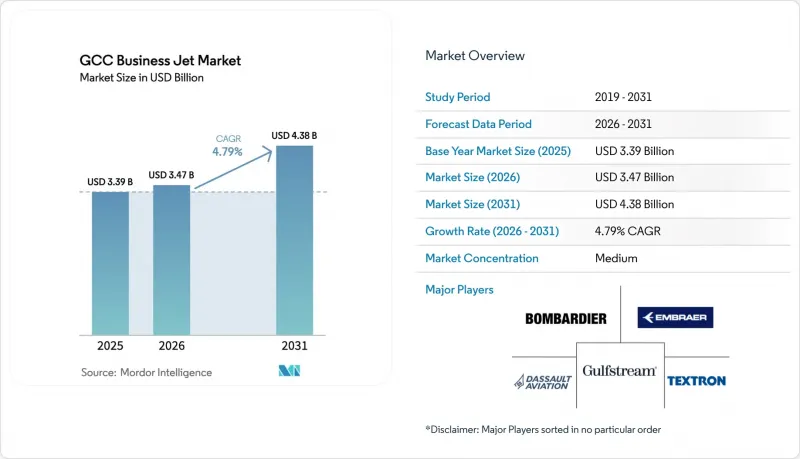
According to Mordor Intelligence, the GCC business jet market size is expected to grow from USD 3.39 billion in 2025 to USD 3.47 billion in 2026 and is forecasted to reach USD 4.38 billion by 2031 at a 4.79% CAGR over 2026-2031.
This report is Segmented by Body Type (Large Jet, Mid-Size Jet, and Light/Very-Light Jet), End User (Individual Owners, Businesses and Corporate Entities, Charter/Air-Taxi Operators, and More), Ownership Model (New Aircraft Purchase, Pre-Owned Purchase, Fractional Ownership, and More), and Geography (Saudi Arabia, Oman, Qatar, Bahrain, and More). The Market Forecasts are Provided in Terms of Value (USD).
GCC Business Jet Market Trends and Insights
Rising UHNW and Family-Office Wealth Concentration
In 2025, UAE billionaires controlled USD 169 billion, while their Saudi counterparts managed USD 81 billion. Additionally, heirs are expected to inherit an additional USD 153 billion within the next 15 years, ensuring steady demand for private aviation. Dubai is home to 120 family offices overseeing approximately USD 1.2 trillion in assets, with these entities perceiving aircraft as tools for deal execution rather than luxury items. According to Knight Frank, the UAE experienced an inflow of 7,200 millionaires in 2024, driving sustained demand for seat hours and indicating that the GCC business jet market remains resilient to short-term macroeconomic fluctuations. The need for mobility is further emphasized by the fact that 36% of regional billionaires have relocated at least once, making private jets a practical safeguard against geopolitical uncertainties. Cross-border investment roadshows also contribute to increased flight activity, particularly on routes connecting Dubai, Riyadh, London, and Singapore.
Vision-2030-Linked Corporate Mobility Programs
Saudi Arabia recorded 23,612 business-jet movements in 2024, representing a 24% year-over-year increase, driven by the headquarters rule requiring multinationals to establish senior teams in Riyadh. The regulatory roadmap aims to develop a USD 2 billion general aviation economy and create 35,000 jobs by 2030, including the establishment of six dedicated business-aviation airports and nine terminals. The liberalization of cabotage in May 2025 allowed foreign carriers to operate domestic city pairs, with VistaJet being the first to capitalize on this opportunity, achieving a 32% increase in Saudi Program Members during the first half of 2025. Riyadh now accounts for approximately two-thirds of private-jet traffic, strengthening hub-and-spoke patterns that boost charter hours and MRO activities. King Salman International Airport, projected to handle 120 million passengers by 2030, includes a private-aviation apron, underscoring the government's view of the sector as essential infrastructure rather than a niche luxury.
Slot and Airspace Congestion at Key GCC Hubs
Dubai International imposes restrictions on general aviation movements during peak periods. It applies a 50% surcharge on landing fees, encouraging operators to use Dubai World Central, where five FBOs compete for available slots. Airport Coordination Limited classifies Dubai, Abu Dhabi, and 26 Saudi airports as Level 3, indicating significant capacity constraints. The planned transition of commercial flights to Dubai World Central by 2030 is expected to further limit slot availability in the interim, while King Salman International Airport in Riyadh is not anticipated to be fully operational until later in the decade. Secondary hubs such as Sharjah, AlUla, and Muscat are already handling overflow traffic; however, repositioning flights to these locations increases crew and fuel costs. In the short term, congestion remains the primary operational challenge for the GCC business jet market.
Other drivers and restraints analyzed in the detailed report include:
- Expansion of Dedicated FBO and MRO Infrastructure
- OEM Supply-Chain Bottlenecks Pushing Pre-Owned Uptake
- High Import Tariffs/VAT on Pre-Owned Imports
For complete list of drivers and restraints, kindly check the Table Of Contents.
Segment Analysis
Large-cabin airframes accounted for 51.24% of the GCC business jet market share in 2025, driven by their ability to connect GCC capitals with destinations like London, New York, and Singapore in a single flight. This segment represents the upper tier of the GCC business jet market, with fleets such as Qatar Executive's six G700s and 15 G650ERs contributing to a 26% revenue increase over the past 12 months. Demand remains strong due to the preference of sovereign entities, energy companies, and global banks for nonstop range and conference-style cabin configurations.
Light and very-light jets are expected to grow at a rate of 5.34% through 2031, benefiting from lower operating costs and faster turnaround times at congested airports. Embraer's Phenom 300 maintained its position as the world's best-selling light jet for the eleventh consecutive year, with regional buyers favoring it for owner-operated missions or short-haul charters.
Mid-size jets, such as Bombardier's Challenger 604 and Dassault's Falcon 2000 families, offer a balance between capacity and cost for intra-GCC routes. Additionally, Dassault's upcoming Falcon 10X, with a 7,500 nm range and a 16.2-m cabin, is set to address ultra-long-haul routes upon its entry into service in 2027.
Complete Report Scope:
- By Body Type
- Large Jet
- Mid-Size Jet
- Light/Very-Light Jet
- By End User
- Individual Owners
- Businesses and Corporate Entities
- Charter/Air-Taxi Operators
- Training and Academic Institutions
- Government and Special Mission Operators
- By Ownership Model
- New Aircraft Purchase
- Pre-Owned Purchase
- Fractional Ownership
- Jet Cards/Membership
- By Geography
- Saudi Arabia
- United Arab Emirates
- Qatar
- Bahrain
- Oman
- Kuwait
List of Companies Covered in this Report:
- Airbus SE
- Bombardier Inc.
- Cirrus Design Corporation (Aviation Industry Corporation of China)
- Dassault Aviation SA
- Embraer S.A.
- Gulfstream Aerospace Corporation (General Dynamics Corporation)
- Honda Aircraft Company (Honda Motor Co., Ltd.)
- Pilatus Aircraft Ltd.
- Textron Inc.
- The Boeing Company
- Eclipse Aerospace, Inc.
- SyberJet LLC
Additional Benefits:
- The market estimate (ME) sheet in Excel format
- 3 months of analyst support
TABLE OF CONTENTS
1 INTRODUCTION
- 1.1 Study Assumptions and Market Definition
- 1.2 Scope of the Study
2 RESEARCH METHODOLOGY
3 EXECUTIVE SUMMARY
4 KEY INDUSTRY TRENDS
- 4.1 High-Net-Worth Individual (HNWI) Population Trend
- 4.1.1 Saudi Arabia
- 4.1.2 United Arab Emirates
- 4.1.3 Qatar
- 4.1.4 Bahrain
- 4.1.5 Oman
- 4.1.6 Kuwait
5 MARKET LANDSCAPE
- 5.1 Market Overview
- 5.2 Market Drivers
- 5.2.1 Rising UHNW and family-office wealth concentration
- 5.2.2 Vision-2030 linked corporate mobility programs
- 5.2.3 Expansion of dedicated FBO and MRO infrastructure
- 5.2.4 OEM supply-chain bottlenecks pushing pre-owned uptake
- 5.2.5 SAF-ready long-range jets favored by ESG-conscious firms
- 5.2.6 Islamic finance-backed operating lease structures
- 5.3 Market Restraints
- 5.3.1 Slot and airspace congestion at key GCC hubs
- 5.3.2 High import tariffs/VAT on pre-owned imports
- 5.3.3 Emerging carbon-accounting mandates on corporate travel
- 5.3.4 Qualified pilot shortage in Arabic-language ATP pool
- 5.4 Value Chain Analysis
- 5.5 Regulatory Landscape
- 5.6 Technological Outlook
- 5.7 Porter's Five Forces Analysis
- 5.7.1 Bargaining Power of Buyers
- 5.7.2 Bargaining Power of Suppliers
- 5.7.3 Threat of New Entrants
- 5.7.4 Threat of Substitutes
- 5.7.5 Competitive Rivalry
6 MARKET SIZE AND GROWTH FORECASTS (VALUE)
- 6.1 By Body Type
- 6.1.1 Large Jet
- 6.1.2 Mid-Size Jet
- 6.1.3 Light/Very-Light Jet
- 6.2 By End User
- 6.2.1 Individual Owners
- 6.2.2 Businesses and Corporate Entities
- 6.2.3 Charter/Air-Taxi Operators
- 6.2.4 Training and Academic Institutions
- 6.2.5 Government and Special Mission Operators
- 6.3 By Ownership Model
- 6.3.1 New Aircraft Purchase
- 6.3.2 Pre-Owned Purchase
- 6.3.3 Fractional Ownership
- 6.3.4 Jet Cards/Membership
- 6.4 By Geography
- 6.4.1 Saudi Arabia
- 6.4.2 United Arab Emirates
- 6.4.3 Qatar
- 6.4.4 Bahrain
- 6.4.5 Oman
- 6.4.6 Kuwait
7 COMPETITIVE LANDSCAPE
- 7.1 Market Concentration
- 7.2 Strategic Moves
- 7.3 Market Share Analysis
- 7.4 Company Profiles (includes Global level Overview, Market level overview, Core Segments, Financials as available, Strategic Information, Market Rank/Share for key companies, Products and Services, and Recent Developments)
- 7.4.1 Airbus SE
- 7.4.2 Bombardier Inc.
- 7.4.3 Cirrus Design Corporation (Aviation Industry Corporation of China)
- 7.4.4 Dassault Aviation SA
- 7.4.5 Embraer S.A.
- 7.4.6 Gulfstream Aerospace Corporation (General Dynamics Corporation)
- 7.4.7 Honda Aircraft Company (Honda Motor Co., Ltd.)
- 7.4.8 Pilatus Aircraft Ltd.
- 7.4.9 Textron Inc.
- 7.4.10 The Boeing Company
- 7.4.11 Eclipse Aerospace, Inc.
- 7.4.12 SyberJet LLC
8 MARKET OPPORTUNITIES AND FUTURE OUTLOOK
- 8.1 White-space and Unmet-Need Assessment

