PUBLISHER: Mordor Intelligence | PRODUCT CODE: 2155335

PUBLISHER: Mordor Intelligence | PRODUCT CODE: 2155335
South America Business Jet - Market Share Analysis, Industry Trends & Statistics, Growth Forecasts (2026 - 2031)
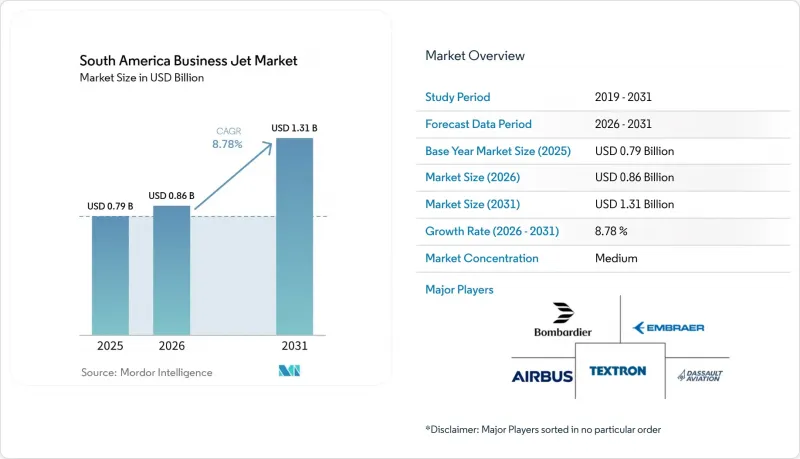
According to Mordor Intelligence, the South America business jet market size was valued at USD 0.79 billion in 2025, and is forecast to grow from USD 0.86 billion in 2026 to USD 1.31 billion by 2031, registering an 8.78% CAGR during the forecast period (2026-2031).
South America Business Jet Market Trends and Insights
Rising High-Net-Worth Individual and Corporate Wealth
Business aviation demand is broadening beyond traditional corporate travel departments. A June 2025 Airbus Corporate Jets survey of 62 senior professionals found that business aviation represented 55% of business air travel among participating corporate executives. The share reached 69% among private equity and hedge fund managers and 74% among family offices. The survey also found that 63% of participating organizations expected business jet usage to rise by 50% to 75% within 2 years. All participating private equity firms and family offices expected growth in the number of global offices and cross-country family distributions over 3 years. The South America business jet market can therefore see greater demand for aircraft with larger cabins and longer ranges from buyers with higher travel needs and longer planning horizons.
Gaps in Scheduled-Airline Connectivity Across Dispersed Business Centers
Gaps in airline networks create a continuing need for direct access to interior business locations. Airbus Corporate Jets reported that commercial airlines served fewer than 130 of Brazil's 5,500 municipalities in 2025. The same June 2025 survey found that 82% of participating senior executives lacked a viable commercial-flight alternative for at least 25% of their corporate routes. Mountainous terrain also limits same-day access to mining, energy, and agricultural sites in Chile, Peru, Colombia, and Argentina. Rising flight activity can allow operators to earn more from existing aircraft before adding capacity. Secondary cities that handle substantial business aviation activity can also need more FBO, handling, and maintenance support.
Import Taxes, Customs Delays, and Regulatory Bureaucracy
Import structures remain a constraint on fleet expansion because aircraft rules differ by country. Argentina's luxury tax applies to aircraft under the existing statute regardless of operational purpose. Argentina's ANAC issued Resolution 235/2025 to require automatic import permits for aeronautical products within 4 working days through the Plataforma de Tramites a Distancia. Colombia's DIAN issued Concept No. 2026006074 in April 2026 on national consumption tax treatment for aircraft imports when the buyer is the final consumer. Brazil provides duty treatment for certain certified air taxi operators, but policy time limits can create planning uncertainty. These requirements add cost and administrative work for aircraft owners, lessors, and operators across the South America business jet market.
Other drivers and restraints analyzed in the detailed report include:
- Agribusiness-Driven Demand for Regional and Remote-Location Access
- Growth of Shared Ownership and Fractional-Access Models
- Uneven MRO, FBO, Parts, and Ground-Support Coverage
For complete list of drivers and restraints, kindly check the Table Of Contents.
Segment Analysis
Light/very-light jets commanded 58.49% of the South America business jet market size in 2025. Their position reflects demand for secondary-city routes, short-runway interior airports, and mid-range domestic travel. These aircraft generally have lower acquisition costs and simpler operating requirements than larger models. Mid-size jets serve users who need more capability than light aircraft but do not require a large cabin. They also support a material share of pre-owned replacement activity. Embraer's Praetor series benefits from regional manufacturing and established support coverage. Embraer entered 2026 with a record backlog after executive aviation revenue increased by 64% year over year in the second quarter of 2025.
Large jets are forecast to grow at a 9.59% CAGR through 2031. The South America business jet industry is seeing more demand from corporate and high-net-worth buyers traveling to Asia and Europe. These trips require a nonstop or limited-stop range that light aircraft cannot provide. Brazil's ANAC issued a type certificate for the Gulfstream G700 in June 2025. Brazil became the first South American country to authorize the operation of that model. The certification can support deliveries of ultra-long-range aircraft to regional clients. The South America business jet market may therefore shift toward large and mid-size aircraft even when unit growth is slower.
Complete Report Scope:
- By Body Type
- Large Jets
- Mid-Size Jets
- Light/Very-Light Jets
- By End User
- Individual Owners
- Businesses and Corporate Entities
- Charter/Air-Taxi Operators
- Training and Academic Institutions
- Government and Special-Mission Operators
- By Ownership Model
- New Aircraft Purchases
- Pre-Owned Purchases
- Fractional Ownership
- Jet Cards/Membership
- By Geography
- Brazil
- Argentina
- Chile
- Colombia
- Venezuela
- Peru
- Rest of South America
List of Companies Covered in this Report:
- Bombardier Inc.
- Embraer S.A.
- Textron Aviation Inc.
- Gulfstream Aerospace Corporation (General Dynamics Corporation)
- Dassault Aviation SA
- Airbus SE
- Honda Aircraft Company (Honda Motor Co., Ltd.)
- The Boeing Company
- Pilatus Aircraft Ltd.
- Voar Aviation
- Lider Aviacao
- TAM Aviacao Executiva
- Avantto
Additional Benefits:
- The market estimate (ME) sheet in Excel format
- 3 months of analyst support
TABLE OF CONTENTS
1 INTRODUCTION
- 1.1 Study Assumptions and Market Definition
- 1.2 Scope of the Study
- 1.3 Research Methodology
2 EXECUTIVE SUMMARY
3 MARKET LANDSCAPE
- 3.1 Market Overview
- 3.2 Market Drivers
- 3.2.1 Rising HNWI population and corporate wealth
- 3.2.2 Growth of shared ownership and fractional-access models
- 3.2.3 Gaps in scheduled-airline connectivity across dispersed business centers
- 3.2.4 Agribusiness-driven demand for regional and remote-location access
- 3.2.5 Airport and air-traffic infrastructure development
- 3.2.6 Fleet renewal driven by aging aircraft
- 3.3 Market Restraints
- 3.3.1 Import taxes, customs delays, and regulatory bureaucracy
- 3.3.2 Uneven MRO, FBO, parts, and ground-support coverage
- 3.3.3 Limited availability and high premium for SAF
- 3.3.4 Pilot, technician, and safety-management workforce shortages
- 3.4 Value Chain Analysis
- 3.5 Technological Outlook
- 3.6 Porter's Five Forces Analysis
- 3.6.1 Threat of New Entrants
- 3.6.2 Bargaining Power of Suppliers
- 3.6.3 Bargaining Power of Buyers
- 3.6.4 Threat of Substitutes
- 3.6.5 Intensity of Competitive Rivalry
4 MARKET SIZE AND GROWTH FORECASTS (VALUE)
- 4.1 By Body Type
- 4.1.1 Large Jets
- 4.1.2 Mid-Size Jets
- 4.1.3 Light/Very-Light Jets
- 4.2 By End User
- 4.2.1 Individual Owners
- 4.2.2 Businesses and Corporate Entities
- 4.2.3 Charter/Air-Taxi Operators
- 4.2.4 Training and Academic Institutions
- 4.2.5 Government and Special-Mission Operators
- 4.3 By Ownership Model
- 4.3.1 New Aircraft Purchases
- 4.3.2 Pre-Owned Purchases
- 4.3.3 Fractional Ownership
- 4.3.4 Jet Cards/Membership
- 4.4 By Geography
- 4.4.1 Brazil
- 4.4.2 Argentina
- 4.4.3 Chile
- 4.4.4 Colombia
- 4.4.5 Venezuela
- 4.4.6 Peru
- 4.4.7 Rest of South America
5 COMPETITIVE LANDSCAPE
- 5.1 Market Concentration
- 5.2 Strategic Moves
- 5.3 Market Share Analysis
- 5.4 Company Profiles (includes Global level Overview, Market level overview, Core Segments, Financials as available, Strategic Information, Market Rank/Share for key companies, Products and Services, and Recent Developments)
- 5.4.1 Bombardier Inc.
- 5.4.2 Embraer S.A.
- 5.4.3 Textron Aviation Inc.
- 5.4.4 Gulfstream Aerospace Corporation (General Dynamics Corporation)
- 5.4.5 Dassault Aviation SA
- 5.4.6 Airbus SE
- 5.4.7 Honda Aircraft Company (Honda Motor Co., Ltd.)
- 5.4.8 The Boeing Company
- 5.4.9 Pilatus Aircraft Ltd.
- 5.4.10 Voar Aviation
- 5.4.11 Lider Aviacao
- 5.4.12 TAM Aviacao Executiva
- 5.4.13 Avantto
6 MARKET OPPORTUNITIES AND FUTURE OUTLOOK
- 6.1 White-space and Unmet-Need Assessment

