PUBLISHER: Mordor Intelligence | PRODUCT CODE: 2115108

PUBLISHER: Mordor Intelligence | PRODUCT CODE: 2115108
Europe Essential Oils - Market Share Analysis, Industry Trends & Statistics, Growth Forecasts (2026 - 2031)
According to Mordor Intelligence, the Europe essential oils market size is expected to grow from USD 3.47 billion in 2025 to USD 3.74 billion in 2026 and is forecast to reach USD 5.60 billion by 2031 at 8.41% CAGR over 2026-2031.
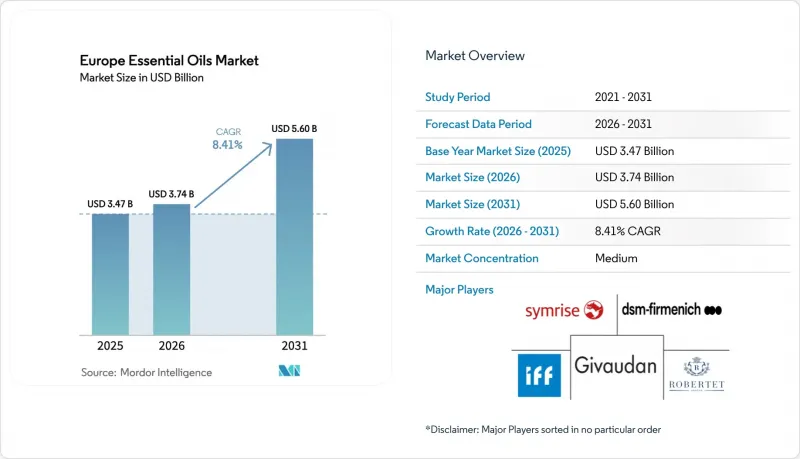
This report is Segmented by Ingredient Type (Lavender Oil, Orange Oil, Eucalyptus Oil, and More), Source (Flowers, Leaves, Bark, Roots, and Others), Application (Food and Beverages, Aromatherapy, Pharmaceuticals, Cosmetics and Personal Care, and Others), and Geography (Germany, United Kingdom, Italy, and More). The Market Forecasts are Provided in Terms of Value (USD) and Volume (Units).
Europe Essential Oils Market Trends and Insights
Rising demand for natural and organic ingredients in various industries
Consumer demand for transparency and simpler ingredients is encouraging formulators to replace synthetic additives with botanically derived alternatives. This trend has been further amplified by social media scrutiny of product labels. Organic-certified essential oils now account for approximately 32% of lavandin acreage and 25% of lavender acreage in France, which is significantly higher than the national average of 11% for all crops . This demonstrates that growers of aromatic crops are responding to premium pricing opportunities. Beyond cosmetics, this shift is also evident in the food and beverage industry, where natural flavorings derived from citrus, mint, and spice oils are increasingly replacing artificial compounds due to retailer requirements and clean-label certification programs. The European Union's organic production framework, governed by Regulation 2018/848, enforces traceability and restricts synthetic inputs. This creates both barriers to entry and a competitive advantage for certified suppliers. Compliance with ECOCERT (Ecological and Organic Certification) and USDA (United States Department of Agriculture) Organic standards has become essential for accessing premium distribution channels. However, smaller distillers face challenges such as high audit costs and extensive documentation requirements, which has led to a concentration of organic supply among mid-sized cooperatives and vertically integrated flavor producers.
Expansion of spa and wellness centers using essential oil-based therapies
Aromatherapy has evolved from a niche wellness offering to a mainstream feature in the hospitality industry, with European spa operators increasingly integrating essential oils into their signature treatments to enhance guest experiences and justify higher session pricing. Popular oils such as lavender, eucalyptus, and ylang-ylang are widely used, with lavender favored in French and Mediterranean spas for its calming effects, while eucalyptus is commonly utilized in Nordic saunas and hammams (Turkish baths) for its respiratory benefits. The professionalization of aromatherapy training and the expansion of certification programs have reduced liability concerns, enabling spa chains to broaden their essential oil offerings without significant increases in insurance costs. Germany and France, as leaders in spa density and per-capita wellness spending, create concentrated demand hubs that source supplies from Provence lavender estates and Moroccan eucalyptus distillers. This channel also facilitates brand-building, as spa guests frequently purchase retail-sized essential oil bottles for home use, benefiting direct-to-consumer brands and artisanal distillers with engaging brand narratives. Supporting this trend, data from the United Kingdom Spa Association (UKSA) reported a 60% increase in daily spa visits in 2024, reflecting strong consumer interest in physical and emotional well-being .
Stringent European Union regulatory frameworks increase compliance burden for essential oils
The European Union's regulatory framework, which includes the Registration, Evaluation, Authorisation and Restriction of Chemicals (REACH), Classification, Labelling and Packaging (CLP), Cosmetics Regulation 1223/2009, and the Nagoya Protocol on Access and Benefit Sharing, imposes extensive documentation, testing, and labeling requirements. These regulations place a significant burden on small distillers and artisanal producers. For instance, Commission Regulation 2023/1545 has expanded the list of fragrance allergens requiring mandatory labeling from 26 to over 86 substances. This change has forced the reformulation of existing products and increased analytical costs for batch testing. Additionally, REACH registration fees and dossier preparation costs can exceed EUR 50,000 per substance for mid-volume chemicals. Many single-estate distillers are unable to absorb these costs, leading them to exit direct sales and instead supply larger aggregators that can distribute compliance costs across broader portfolios. Furthermore, the Scientific Committee on Consumer Safety's ongoing reviews of terpene peroxides and other oxidation products have created regulatory uncertainty. Some buyers are preemptively delisting oils while awaiting final rulings. This situation benefits vertically integrated flavor-and-fragrance companies with in-house regulatory affairs teams, while independent distillers, lacking the necessary scale, face significant challenges in adapting to the evolving compliance landscape.
Other drivers and restraints analyzed in the detailed report include:
- Shift toward clean-label formulations with plant-derived oils
- Increased use of essential oils in premium personal care and cosmetics
- Restrictions on allergenic constituents such as limonene and linalool limit product formulation
For complete list of drivers and restraints, kindly check the Table Of Contents.
Segment Analysis
Orange oil is anticipated to account for a 29.90% market share in 2025, supported by its well-established applications in food flavoring, household cleaning, and aromatherapy. Cold-pressed Valencia and Brazilian oils are commonly used due to their cost efficiency and availability, often preferred over regional-specific characteristics. Geranium oil is expected to grow at a compound annual growth rate (CAGR) of 8.72% through 2031, driven by its increasing use by perfumers as a cost-effective substitute for Bulgarian rose otto. Egyptian and South African geranium oils are becoming more prominent in natural perfumery and premium skincare products.
Lavender oil, despite its strong association with Provence, is facing challenges in maintaining margins due to oversupply and competition from Bulgarian producers. French lavender production decreased by 30% in 2023, primarily due to pest infestations and drought conditions. Peppermint and spearmint oils are witnessing growing demand in pharmaceutical applications, particularly in Germany's Apotheke (pharmacy) channel, where menthol-based topical analgesics and digestive aids are sold at premium prices. Eucalyptus oil continues to be a key ingredient in Nordic spa treatments and over-the-counter (OTC) respiratory remedies, with Australian and Portuguese sources dominating the supply chain.
Complete Report Scope:
- By Ingredient Type
- Lavender Oil
- Orange Oil
- Eucalyptus Oil
- Peppermint Oil
- Spearmint Oil
- Lemon Oil
- Rosemary Oil
- Geranium Oil
- Tea Tree Oil
- Other Oils
- By Source
- Flowers
- Leaves
- Bark
- Roots
- Others
- By Application
- Food and Beverage
- Aromatherapy
- Pharmaceuticals
- Cosmetics and Personal Care
- Others
- By Geography
- Germany
- United Kingdom
- Italy
- France
- Spain
- Netherlands
- Poland
- Belgium
- Sweden
- Rest of Europe
List of Companies Covered in this Report:
- Givaudan SA
- Symrise AG
- DSM-Firmenich AG
- International Flavors & Fragrances Inc.
- Robertet Group
- Sensient Technologies
- doTERRA International LLC
- Young Living
- Biolandes
- Farotti Srl
- First Natural Brands Ltd
- AOS Products Pvt Ltd
- Rocky Mountain Oils
- Hermitage Oils
- NOW Foods
- Puressentiel
- Ultra International
- Pranarom SA
- Albert Vieille SAS
- Eternis Fine Chemicals
Additional Benefits:
- The market estimate (ME) sheet in Excel format
- 3 months of analyst support
TABLE OF CONTENTS
1 INTRODUCTION
- 1.1 Study Assumptions and Market Definition
- 1.2 Scope of the Study
2 RESEARCH METHODOLOGY
3 EXECUTIVE SUMMARY
4 MARKET LANDSCAPE
- 4.1 Market Overview
- 4.2 Market Drivers
- 4.2.1 Rising demand for natural and organic ingredients in various industries
- 4.2.2 Expansion of spa and wellness centers using essential oil-based therapies
- 4.2.3 Shift toward clean-label formulations with plant-derived oils
- 4.2.4 Increased use of essential oils in premium personal care and cosmetics
- 4.2.5 Rising health consciousness boosting demand for natural relief products
- 4.2.6 Growth of organic farming and sustainable sourcing for aromatic crops
- 4.3 Market Restraints
- 4.3.1 Stringent European Union regulatory frameworks increase compliance burden for essential oils
- 4.3.2 Restrictions on allergenic constituents such as limonene and linalool limit product formulation
- 4.3.3 Safety concerns regarding dermal irritation and sensitization from undiluted or improperly used oils reduce adoption among risk-averse consumers
- 4.3.4 Issues of adulteration, dilution, and mislabeling harm brand credibility and complicate efforts to establish long-term consumer trust
- 4.4 Supply Chain Analysis
- 4.5 Regulatory Outlook
- 4.6 Porter's Five Forces
- 4.6.1 Threat of New Entrants
- 4.6.2 Bargaining Power of Buyers/Consumers
- 4.6.3 Bargaining Power of Suppliers
- 4.6.4 Threat of Substitute Products
- 4.6.5 Intensity of Competitive Rivalry
5 MARKET SIZE AND GROWTH FORECASTS (VALUE AND VOLUME)
- 5.1 By Ingredient Type
- 5.1.1 Lavender Oil
- 5.1.2 Orange Oil
- 5.1.3 Eucalyptus Oil
- 5.1.4 Peppermint Oil
- 5.1.5 Spearmint Oil
- 5.1.6 Lemon Oil
- 5.1.7 Rosemary Oil
- 5.1.8 Geranium Oil
- 5.1.9 Tea Tree Oil
- 5.1.10 Other Oils
- 5.2 By Source
- 5.2.1 Flowers
- 5.2.2 Leaves
- 5.2.3 Bark
- 5.2.4 Roots
- 5.2.5 Others
- 5.3 By Application
- 5.3.1 Food and Beverage
- 5.3.2 Aromatherapy
- 5.3.3 Pharmaceuticals
- 5.3.4 Cosmetics and Personal Care
- 5.3.5 Others
- 5.4 By Geography
- 5.4.1 Germany
- 5.4.2 United Kingdom
- 5.4.3 Italy
- 5.4.4 France
- 5.4.5 Spain
- 5.4.6 Netherlands
- 5.4.7 Poland
- 5.4.8 Belgium
- 5.4.9 Sweden
- 5.4.10 Rest of Europe
6 COMPETITIVE LANDSCAPE
- 6.1 Market Concentration
- 6.2 Strategic Moves
- 6.3 Market Ranking Analysis
- 6.4 Company Profiles (includes Global-level Overview, Market-level Overview, Core Segments, Financials (if available), Strategic Information, Market Rank/Share, Products and Services, Recent Developments)
- 6.4.1 Givaudan SA
- 6.4.2 Symrise AG
- 6.4.3 DSM-Firmenich AG
- 6.4.4 International Flavors & Fragrances Inc.
- 6.4.5 Robertet Group
- 6.4.6 Sensient Technologies
- 6.4.7 doTERRA International LLC
- 6.4.8 Young Living
- 6.4.9 Biolandes
- 6.4.10 Farotti Srl
- 6.4.11 First Natural Brands Ltd
- 6.4.12 AOS Products Pvt Ltd
- 6.4.13 Rocky Mountain Oils
- 6.4.14 Hermitage Oils
- 6.4.15 NOW Foods
- 6.4.16 Puressentiel
- 6.4.17 Ultra International
- 6.4.18 Pranarom SA
- 6.4.19 Albert Vieille SAS
- 6.4.20 Eternis Fine Chemicals
7 MARKET OPPORTUNITIES AND FUTURE OUTLOOK

