PUBLISHER: Mordor Intelligence | PRODUCT CODE: 2115110

PUBLISHER: Mordor Intelligence | PRODUCT CODE: 2115110
Asia-Pacific Essential Oils - Market Share Analysis, Industry Trends & Statistics, Growth Forecasts (2026 - 2031)
According to Mordor Intelligence, the Asia-Pacific essential oils market size is expected to increase from USD 2.46 billion in 2025 to USD 2.65 billion in 2026 and reach USD 3.94 billion by 2031, growing at a compound annual growth rate (CAGR) of 8.26% over 2026-2031.
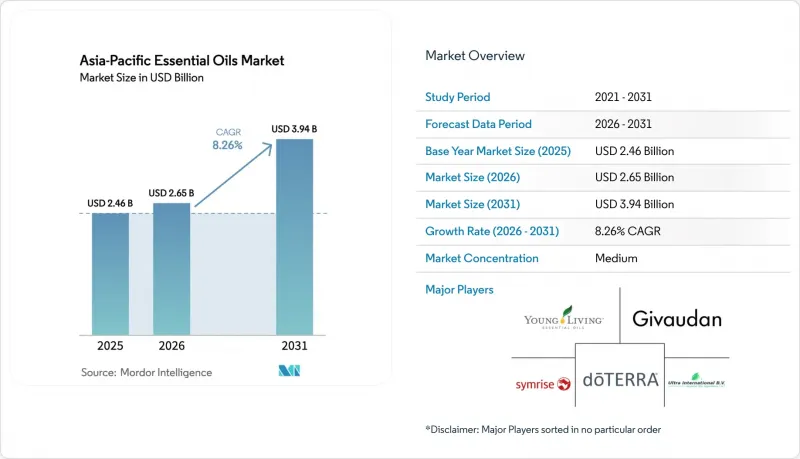
This report is Segmented by Ingredient Type (Lavender Oil, Orange Oil, Eucalyptus Oil, Peppermint Oil, Spearmint Oil, and More), Source (Flowers, Leaves, Bark, Roots, and Others), Application (Food and Beverages, Aromatherapy, Pharmaceuticals, and More), and Geography (China, India, Japan, and More). The Market Forecasts are Provided in Terms of Value (USD) and Volume (Liters).
Asia-Pacific Essential Oils Market Trends and Insights
Growing preference for natural and organic ingredients across consumer products
Consumer goods manufacturers across the Asia-Pacific region are making significant changes to their personal care, food, and household product lines by replacing synthetic fragrances and preservatives with steam-distilled essential oils. This transition has been driven by regulatory requirements in countries like China and South Korea, which now mandate full ingredient disclosure on cosmetic labels. In 2024, China's National Medical Products Administration expanded its cosmetic-ingredient negative list to include 27 synthetic musks and phthalates. As a result, brands have started using essential oils such as geranium, rose, and sandalwood in premium skincare products. Similarly, in 2025, India's Bureau of Indian Standards revised its specifications for organic essential oils under Indian Standard 210, introducing stricter residue limits for pesticides and heavy metals. While these changes have increased compliance costs, they have also provided a competitive edge for National Accreditation Board for Testing and Calibration Laboratories (NABL)-accredited distillers by ensuring higher quality standards. At the same time, there is a growing awareness among the middle class about ingredient safety. A survey conducted in 2025 found that 68% of urban Chinese consumers checked cosmetic labels for natural claims before making a purchase. This preference for natural ingredients is not limited to cosmetics but also extends to the food and beverage industry. For instance, clean-label mandates in Australia and Singapore have encouraged beverage manufacturers to replace artificial citrus flavors with cold-pressed orange and lemon oils, offering both flavor authenticity and marketing appeal. Additionally, organic certification schemes such as United States Department of Agriculture (USDA) Organic and European Union (EU) Organic are gaining popularity in export-oriented markets. Indian and Thai distillers are increasingly investing in these certifications to access premium price points in markets like Japan and Australia.
Rapid expansion of aromatherapy and wellness practices
The adoption of aromatherapy is growing significantly across Japan, South Korea, and urban China, driven by an aging population, workplace stress reduction programs, and its integration into traditional wellness practices. In Japan, the Ministry of Health, Labour and Welfare approved 12 new essential-oil-based aromatherapy products for over-the-counter sale in 2025, recognizing their role in reducing stress and improving sleep among the aging population. In South Korea, the wellness tourism sector, which attracted 4.2 million visitors in 2025, now includes essential-oil massages and diffuser experiences in 73% of spa facilities, incorporating oils such as lavender, eucalyptus, and peppermint into hospitality services. In China, the State Administration of Traditional Chinese Medicine endorsed aromatherapy as a complementary approach in its 2024 guidelines for integrative health clinics, prompting provincial governments to subsidize essential-oil diffusers in eldercare facilities across Jiangsu and Zhejiang provinces. Meanwhile, India's Ayurvedic wellness centers, which numbered over 8,000 in 2025, are increasingly incorporating steam-distilled oils such as sandalwood, vetiver, and jasmine into therapeutic treatments, supported by research from the Council of Scientific and Industrial Research's Central Institute of Medicinal and Aromatic Plants. Additionally, direct-selling networks such as doTERRA and Young Living expanded their distributor bases in Southeast Asia by 18% in 2025, leveraging social media education and home-party models to make aromatherapy more accessible beyond urban elite markets.
High production costs and volatile raw material prices
Essential-oil production continues to face significant cost pressures due to labor-intensive harvesting, energy-intensive distillation processes, and climate-induced yield variability, which disrupt supply chains and reduce margins for distillers. In 2024, lavender cultivation in China's Xinjiang region and India's Kashmir valley experienced yield declines of 18% and 23%, respectively, caused by unseasonal frost and erratic monsoon patterns. These factors drove spot prices for lavender oil from USD 45 per kilogram in January 2024 to USD 68 per kilogram by December 2025. Citrus-peel oil production, which depends on by-product streams from juice manufacturing, remains susceptible to fluctuations in fruit prices. A drought in 2025 in China's Jiangxi province reduced orange harvests by 14%, tightening the supply of cold-pressed orange oil and increasing prices by 22% year-on-year. Additionally, steam-distillation energy costs, which constitute 30 to 40% of production expenses, rose sharply in 2025. Natural gas and electricity tariffs increased by 12% and 9%, respectively, in India and Indonesia, further squeezing margins for small-scale distillers who lack access to renewable energy infrastructure. Labor scarcity adds to these challenges, particularly for crops like jasmine, rose, and ylang-ylang, which require 200 to 300 person-hours per hectare for hand-harvesting. Wage inflation in Thailand and Vietnam, where agricultural labor costs rose by 8% in 2025, forced some growers to abandon low-yield plots. These conditions benefit vertically integrated players who manage cultivation, distillation, and formulation processes, while creating significant barriers for new entrants and commodity traders reliant on spot markets.
Other drivers and restraints analyzed in the detailed report include:
- Increasing use of essential oils in natural and clean beauty formulations
- Rising awareness of therapeutic and functional benefits in traditional medicine
- Quality control problems, adulteration, and dilution in the supply chain
For complete list of drivers and restraints, kindly check the Table Of Contents.
Segment Analysis
Advancements in cold-press extraction methods and the utilization of by-products have enabled orange oil to account for 30.31% of the ingredient type segment in 2025. Lavender oil, on the other hand, is projected to grow at a compound annual growth rate (CAGR) of 8.72% through 2031, driven by increased cultivation in China and India. Orange oil benefits from its integration with citrus juice production, where peel waste from China's 7.5 million metric tons of orange production in 2025 is used in cold-press mills. This process yields d-limonene-rich oil at a lower cost compared to standalone distillation methods . Food and beverage applications account for 58% of orange oil consumption, with beverage manufacturers in Japan and Australia replacing synthetic citrus esters to comply with clean-label requirements. Lavender oil's growth is supported by expanded cultivation in Xinjiang, where 12,000 hectares began production in 2024 and 2025, and in Kashmir, where state subsidies facilitated the planting of 3,400 hectares. These developments have reduced import dependence and lowered procurement costs for domestic aromatherapy brands.
Peppermint oil and spearmint oil, primarily used in pharmaceutical and oral-care applications, are witnessing growth driven by increasing demand for menthol in India's cough-drop and analgesic-balm industries. Eucalyptus oil, sourced mainly from Australia's 28,000 hectares of plantation forests, is expanding due to its antimicrobial applications in household cleaners and pharmaceutical inhalants. Tea tree oil, a niche segment concentrated in New South Wales and Queensland, is growing as Korean and Japanese cosmetic brands include it in acne treatments and scalp-care products, bolstered by clinical studies demonstrating effectiveness against Propionibacterium acnes. Lemon oil, rosemary oil, and geranium oil support fragrance and flavor applications where distinct sensory profiles command premium pricing in specialized formulations.
Complete Report Scope:
- By Ingredient Type
- Lavender Oil
- Orange Oil
- Eucalyptus Oil
- Peppermint Oil
- Spearmint Oil
- Lemon Oil
- Rosemary Oil
- Geranium Oil
- Tea Tree Oil
- Other Oils
- By Source
- Flowers
- Leaves
- Bark
- Roots
- Others
- By Application
- Food and Beverage
- Aromatherapy
- Pharmaceuticals
- Cosmetics and Personal Care
- Others
- By Geography
- China
- India
- Japan
- Australia
- Indonesia
- South Korea
- Thailand
- Singapore
- Rest of Asia-Pacific
List of Companies Covered in this Report:
- doTERRA International, LLC
- Young Living Essential Oils, LC
- Ultra International
- Givaudan SA
- Symrise AG
- Firmenich
- IFF
- Robertet
- Takasago
- Biolandes
- Sydney Essential Oil Co.
- Australian Botanical Products
- AWO (Australian Wholesale Oils)
- BMV Fragrances
- Synthite Industries
- VedaOils
- Florihana
- Moksha Lifestyle Products
- Oshadhi
- Essential Oils of New Zealand
Additional Benefits:
- The market estimate (ME) sheet in Excel format
- 3 months of analyst support
TABLE OF CONTENTS
1 INTRODUCTION
- 1.1 Study Assumptions and Market Definition
- 1.2 Scope of the Study
2 RESEARCH METHODOLOGY
3 EXECUTIVE SUMMARY
4 MARKET LANDSCAPE
- 4.1 Market Overview
- 4.2 Market Drivers
- 4.2.1 Growing preference for natural and organic ingredients across consumer products
- 4.2.2 Rapid expansion of aromatherapy and wellness practices
- 4.2.3 Increasing use of essential oils in natural and clean beauty formulations
- 4.2.4 Rising awareness of therapeutic and functional benefits in traditional medicine
- 4.2.5 Innovation in flavors for food and beverage applications
- 4.2.6 Shift toward chemical-free household and home-care products
- 4.3 Market Restraints
- 4.3.1 High production costs and volatile raw material prices
- 4.3.2 Quality control problems, adulteration, and dilution in the supply chain
- 4.3.3 Limited standardization of grades, specifications, and certification schemes
- 4.3.4 Competition from cheaper synthetic fragrances and flavours
- 4.4 Supply Chain Analysis
- 4.5 Regulatory Outlook
- 4.6 Technological Outlook
- 4.7 Porter's Five Forces
- 4.7.1 Threat of New Entrants
- 4.7.2 Bargaining Power of Buyers/Consumers
- 4.7.3 Bargaining Power of Suppliers
- 4.7.4 Threat of Substitute Products
- 4.7.5 Intensity of Competitive Rivalry
5 MARKET SIZE AND GROWTH FORECASTS (VALUE AND VOLUME)
- 5.1 By Ingredient Type
- 5.1.1 Lavender Oil
- 5.1.2 Orange Oil
- 5.1.3 Eucalyptus Oil
- 5.1.4 Peppermint Oil
- 5.1.5 Spearmint Oil
- 5.1.6 Lemon Oil
- 5.1.7 Rosemary Oil
- 5.1.8 Geranium Oil
- 5.1.9 Tea Tree Oil
- 5.1.10 Other Oils
- 5.2 By Source
- 5.2.1 Flowers
- 5.2.2 Leaves
- 5.2.3 Bark
- 5.2.4 Roots
- 5.2.5 Others
- 5.3 By Application
- 5.3.1 Food and Beverage
- 5.3.2 Aromatherapy
- 5.3.3 Pharmaceuticals
- 5.3.4 Cosmetics and Personal Care
- 5.3.5 Others
- 5.4 By Geography
- 5.4.1 China
- 5.4.2 India
- 5.4.3 Japan
- 5.4.4 Australia
- 5.4.5 Indonesia
- 5.4.6 South Korea
- 5.4.7 Thailand
- 5.4.8 Singapore
- 5.4.9 Rest of Asia-Pacific
6 COMPETITIVE LANDSCAPE
- 6.1 Market Concentration
- 6.2 Strategic Moves
- 6.3 Market Ranking Analysis
- 6.4 Company Profiles (includes Global-level Overview, Market-level Overview, Core Segments, Financials (if available), Strategic Information, Market Rank/Share, Products and Services, Recent Developments)
- 6.4.1 doTERRA International, LLC
- 6.4.2 Young Living Essential Oils, LC
- 6.4.3 Ultra International
- 6.4.4 Givaudan SA
- 6.4.5 Symrise AG
- 6.4.6 Firmenich
- 6.4.7 IFF
- 6.4.8 Robertet
- 6.4.9 Takasago
- 6.4.10 Biolandes
- 6.4.11 Sydney Essential Oil Co.
- 6.4.12 Australian Botanical Products
- 6.4.13 AWO (Australian Wholesale Oils)
- 6.4.14 BMV Fragrances
- 6.4.15 Synthite Industries
- 6.4.16 VedaOils
- 6.4.17 Florihana
- 6.4.18 Moksha Lifestyle Products
- 6.4.19 Oshadhi
- 6.4.20 Essential Oils of New Zealand
7 MARKET OPPORTUNITIES AND FUTURE OUTLOOK

