PUBLISHER: Mordor Intelligence | PRODUCT CODE: 2115126

PUBLISHER: Mordor Intelligence | PRODUCT CODE: 2115126
Asia-Pacific Wireless Audio - Market Share Analysis, Industry Trends & Statistics, Growth Forecasts (2026 - 2031)
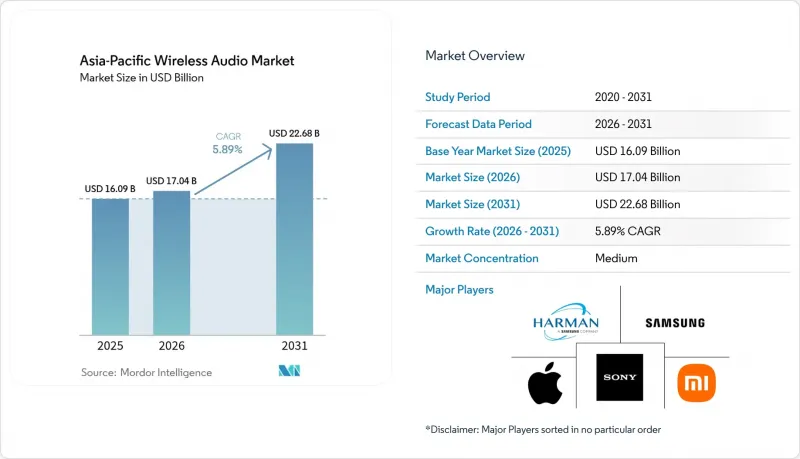
According to Mordor Intelligence, the Asia-Pacific wireless audio market size is expected to grow from USD 16.09 billion in 2025 to USD 17.04 billion in 2026 and is forecast to reach USD 22.68 billion by 2031 at 5.89% CAGR over 2026-2031.
This report is Segmented by Device Type (Wireless Speakers, Wireless Earphones, and More) Connectivity Technology (Bluetooth Only, Wi-Fi/AirPlay, and More), Application (Residential/Consumer, Fitness and Sports, and More), Distribution Channel (Online, Offline Retail, and More), Price Band (8. 93%, Mid-Range, Premium), and Country. The Market Forecasts are Provided in Terms of Value (USD).
Asia-Pacific Wireless Audio Market Trends and Insights
Rising Adoption of True Wireless Stereo Earbuds
TWS earbuds are redefining personal listening across the region, with India recording 4% shipment growth in Q1 2025 despite wider device softness. Asia-Pacific vendors, led by Xiaomi, Realme, and Oppo, are driving the development of hybrid active noise cancellation that exceeds 50 decibels, spatial audio, and AI-enhanced call clarity. Budget models under USD 25 captured fast-moving volume, while premium models above USD 59 expanded by 1.4 times year-over-year, illustrating a bifurcated yet inclusive price ladder. Physical retail remains essential for first-time buyers seeking to try on and purchase fit and sound products, even as e-commerce accounts for the majority of sales value. The cadence of feature rollouts shortens product lifecycles and raises R&D requirements, compelling brands to innovate or face rapid commoditization.
Advancements in Bluetooth LE Audio and LC3 Codec
Bluetooth LE Audio introduces lower power draw, higher fidelity at reduced bit rates, and multi-stream audio that supports Auracast broadcasting to unlimited receivers. The Bluetooth Special Interest Group anticipates 3 billion LE Audio-equipped devices will ship by 2028, with Japan alone expected to deploy 1.3 billion units. Flagship smartphones and earbuds from Samsung, Sony, LG, and Xiaomi already support the standard, and over 100 commercially available Auracast devices are cataloged in the SIG registry. Reduced latency benefits gaming and automotive infotainment, while Auracast unlocks silent gyms, multilingual museum tours, and gate announcements, widening addressable use cases for the Asia-Pacific wireless audio market.
Spectrum Congestion in Dense Metro Areas
Rapid device proliferation in Shanghai, Mumbai, Tokyo, and Seoul is crowding the 2.4 GHz and 5 GHz bands that Bluetooth and Wi-Fi share. Packet collisions and interference reduce effective throughput, resulting in audio dropouts that compromise the user experience during calls, gaming, and in-car streaming. Automotive cabins illustrate the challenge: simultaneous Bluetooth hands-free, wireless CarPlay, and rear-seat video can slash practical bandwidth to under half of theoretical capacity. Hardware makers are adding adaptive frequency hopping and dual-band Wi-Fi radios, but these fixes raise bill-of-materials costs and lengthen design cycles. Until more spectrum or wider adoption of ultra-wideband materializes, congestion will cap audio-device density in the region's largest cities.
Other drivers and restraints analyzed in the detailed report include:
- Growth of Online Music Streaming Services
- Bundled audio ecosystems with IoT devices
- Price Sensitivity in Emerging Markets
For complete list of drivers and restraints, kindly check the Table Of Contents.
Segment Analysis
The Asia-Pacific wireless audio market size for TWS reached 45.62% of the revenue in 2025 and is slated to expand at a 7.42% CAGR through 2031. Budget TWS shipments rose 52% on the back of sub-USD 25 pricing, yet premium TWS boasting spatial audio and lossless transmission posted the fastest value growth. Wireless speakers accounted for approximately one-quarter of revenue, although China's smart speaker shipments declined 25.6% to 15.7 million units, indicating a decline in traction for stationary devices. Over-ear wireless headsets and neckband formats remain viable among office workers and gamers who seek extended battery life; however, their mid-single-digit growth underscores a consumer migration to fully cord-free earbuds. Continuous feature trickle-down encompassing noise cancellation, AI processing, and high-resolution codecs supports market expansion while heightening differentiation challenges.
Pioneering launches emphasize the escalating specification race. Regional manufacturers showcased Wi-Fi streaming earbuds capable of lossless playback, surpassing the limitations of Bluetooth codecs, while portable speakers entered the niche wearables market, including audio-enabled sunglasses with IP54 ratings and open-ear acoustics. This evolution reinforces a user preference for mobility, personalization, and cross-device continuity, core demand pillars that will continue to drive the Asia-Pacific wireless audio market on an upward trajectory.
Bluetooth-only devices delivered 68.55% of 2025 revenue, reaffirming the protocol's ubiquity. Yet, ultra-wideband is racing forward at a 8.87% CAGR, propelled by sub-10 nanosecond ranging accuracy, which is vital for automotive digital keys and head-tracked spatial audio in competitive gaming. Bluetooth and Wi-Fi combo chipsets are becoming increasingly popular in premium earbuds, enabling seamless handoffs between local lossless streaming and traditional Bluetooth listening. Wi-Fi or AirPlay speakers, which account for roughly 8% of revenue, cater to multi-room home audio enthusiasts who demand higher bitrates. Near-field communication mostly eases pairing but is evolving into an authentication tool for premium content. As LE Audio proliferates, Bluetooth's continued dominance is assured; however, its newer low-latency, multi-stream profile will increasingly blur the lines with ultra-wideband for high-precision use cases.
Complete Report Scope:
- By Device Type
- Wireless Speakers
- Bluetooth-Only
- Smart Speakers
- Wi-Fi Speakers
- Wireless Earphones
- Wireless Headsets
- True Wireless Stereo
- Wireless Speakers
- By Connectivity Technology
- Bluetooth Only
- Bluetooth plus Wi-Fi Combo
- Wi-Fi/AirPlay
- Near Field Communication
- Ultra-Wideband
- By Application
- Residential/Consumer
- Commercial (Retail, Hospitality)
- Automotive Infotainment
- Fitness and Sports
- Gaming and E-Sports
- By Distribution Channel
- Online
- Offline Retail
- Direct Corporate Sales
- By Price Band
- Budget (Less than USD 50)
- Mid-Range (USD 50-150)
- Premium (Above USD 150)
- By Country
- China
- South Korea
- Japan
- India
- Southeast Asia
List of Companies Covered in this Report:
- Apple Inc.
- Samsung Electronics Co. Ltd
- Harman International Industries Incorporated
- Sony Group Corporation
- Xiaomi Corporation
- Bose Corporation
- Alibaba Group Holding Limited
- Baidu Inc.
- Amazon.com Inc.
- Google LLC
- Realme Chongqing Mobile Telecommunications Corp. Ltd
- Huawei Device Co. Ltd
- GN Audio AS
- Skullcandy Inc.
- Edifier Technology Co. Ltd
- Anker Innovations Limited
- TPV Technology Limited
- Oppo Guangdong Mobile Communication Co. Ltd
- Nothing Technology Limited
- Sennheiser Electronic GmbH and Co KG
- Logitech International SA
- Transsion Holdings
Additional Benefits:
- The market estimate (ME) sheet in Excel format
- 3 months of analyst support
TABLE OF CONTENTS
1 INTRODUCTION
- 1.1 Study Assumptions and Market Definition
- 1.2 Scope of the Study
2 RESEARCH METHODOLOGY
3 EXECUTIVE SUMMARY
4 MARKET LANDSCAPE
- 4.1 Market Overview
- 4.2 Market Drivers
- 4.2.1 Rising Adoption of True Wireless Stereo Earbuds
- 4.2.2 Increasing Smart Speaker Penetration in Urban Households
- 4.2.3 Advancements in Bluetooth LE Audio and LC3 Codec
- 4.2.4 Growth of Online Music Streaming Services
- 4.2.5 Bundled Audio Ecosystems with IoT Devices
- 4.2.6 Localization of Audio SoC Manufacturing in India and Vietnam
- 4.3 Market Restraints
- 4.3.1 Spectrum Congestion in Dense Metro Areas
- 4.3.2 Price Sensitivity in Emerging Markets
- 4.3.3 Stricter E-Waste Recycling Regulations
- 4.3.4 Health Concerns Over Prolonged RF Exposure
- 4.4 Impact of Macroeconomic Factors on the Market
- 4.5 Value-Chain Analysis
- 4.6 Regulatory Landscape
- 4.7 Technological Outlook
- 4.8 Porter's Five Forces Analysis
- 4.8.1 Threat of New Entrants
- 4.8.2 Bargaining Power of Buyers/Consumers
- 4.8.3 Bargaining Power of Suppliers
- 4.8.4 Threat of Substitute Products
- 4.8.5 Intensity of Competitive Rivalry
5 MARKET SIZE AND GROWTH FORECASTS (VALUE)
- 5.1 By Device Type
- 5.1.1 Wireless Speakers
- 5.1.1.1 Bluetooth-Only
- 5.1.1.2 Smart Speakers
- 5.1.1.3 Wi-Fi Speakers
- 5.1.2 Wireless Earphones
- 5.1.3 Wireless Headsets
- 5.1.4 True Wireless Stereo
- 5.1.1 Wireless Speakers
- 5.2 By Connectivity Technology
- 5.2.1 Bluetooth Only
- 5.2.2 Bluetooth plus Wi-Fi Combo
- 5.2.3 Wi-Fi/AirPlay
- 5.2.4 Near Field Communication
- 5.2.5 Ultra-Wideband
- 5.3 By Application
- 5.3.1 Residential/Consumer
- 5.3.2 Commercial (Retail, Hospitality)
- 5.3.3 Automotive Infotainment
- 5.3.4 Fitness and Sports
- 5.3.5 Gaming and E-Sports
- 5.4 By Distribution Channel
- 5.4.1 Online
- 5.4.2 Offline Retail
- 5.4.3 Direct Corporate Sales
- 5.5 By Price Band
- 5.5.1 Budget (Less than USD 50)
- 5.5.2 Mid-Range (USD 50-150)
- 5.5.3 Premium (Above USD 150)
- 5.6 By Country
- 5.6.1 China
- 5.6.2 South Korea
- 5.6.3 Japan
- 5.6.4 India
- 5.6.5 Southeast Asia
6 COMPETITIVE LANDSCAPE
- 6.1 Market Concentration
- 6.2 Strategic Moves
- 6.3 Market Share Analysis
- 6.4 Company Profiles (includes Global Level Overview, Market Level Overview, Core Segments, Financials as available, Strategic Information, Market Rank/Share for key companies, Products and Services, and Recent Developments)
- 6.4.1 Apple Inc.
- 6.4.2 Samsung Electronics Co. Ltd
- 6.4.3 Harman International Industries Incorporated
- 6.4.4 Sony Group Corporation
- 6.4.5 Xiaomi Corporation
- 6.4.6 Bose Corporation
- 6.4.7 Alibaba Group Holding Limited
- 6.4.8 Baidu Inc.
- 6.4.9 Amazon.com Inc.
- 6.4.10 Google LLC
- 6.4.11 Realme Chongqing Mobile Telecommunications Corp. Ltd
- 6.4.12 Huawei Device Co. Ltd
- 6.4.13 GN Audio AS
- 6.4.14 Skullcandy Inc.
- 6.4.15 Edifier Technology Co. Ltd
- 6.4.16 Anker Innovations Limited
- 6.4.17 TPV Technology Limited
- 6.4.18 Oppo Guangdong Mobile Communication Co. Ltd
- 6.4.19 Nothing Technology Limited
- 6.4.20 Sennheiser Electronic GmbH and Co KG
- 6.4.21 Logitech International SA
- 6.4.22 Transsion Holdings
7 MARKET OPPORTUNITIES AND FUTURE OUTLOOK
- 7.1 White-Space and Unmet-Need Assessment

