PUBLISHER: Mordor Intelligence | PRODUCT CODE: 2117222

PUBLISHER: Mordor Intelligence | PRODUCT CODE: 2117222
India Wireless Audio - Market Share Analysis, Industry Trends & Statistics, Growth Forecasts (2026 - 2031)
According to Mordor Intelligence, India wireless audio market size in 2026 is estimated at USD 3.86 billion, growing from 2025 value of USD 3.28 billion with 2031 projections showing USD 8.68 billion, growing at 17.61% CAGR over 2026-2031.
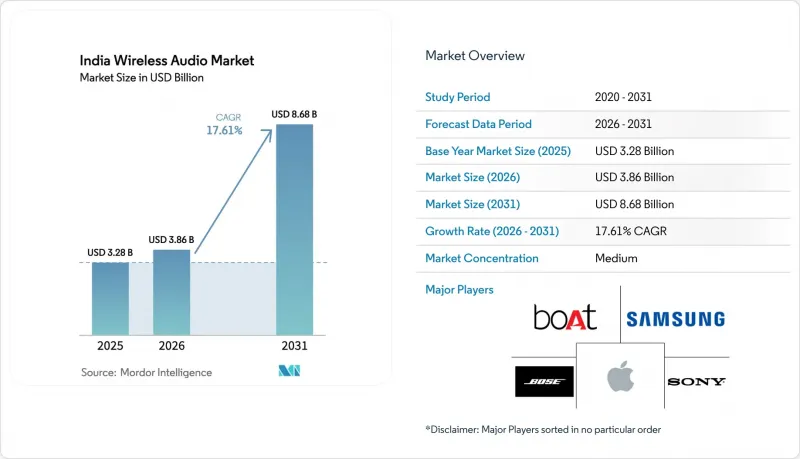
This report is Segmented by Product Type (True Wireless Earbuds, Wireless Earphones (Neckband), and More), Distribution Channel (Online, Offline), Price Band (Entry (less Than INR 1500), Mid-Range (INR 1500-4999), Premium (Above INR 5000)), End-User (Consumer, Enterprise/Professional, Sports & Fitness), and Geography. The Market Forecasts are Provided in Terms of Value (USD).
India Wireless Audio Market Trends and Insights
Smartphone Penetration and 5G Affordability Drive Mass Adoption
India's 750 million smartphone users convert the India wireless audio market into an indispensable peripheral landscape rather than a luxury accessory segment. Telecom operators prioritize tier-2 rollouts, Jaipur, Lucknow, and Chandigarh saw pilot 5G networks during 2024, narrowing the urban-rural divide and enabling lossless streaming that validates wireless upgrades. Policy frameworks under the National Digital Communications Policy further reduce coverage gaps, thereby reinforcing user expectations for seamless audio connectivity. As battery efficiency improves, entry-level devices achieve day-long playback, meeting the functional must-have criteria of first-time buyers. The resulting multiplier effect elevates device replacement cycles, pulling forward demand and supporting the 17.9% CAGR for the India wireless audio market.
E-commerce Expansion Reshapes Distribution Economics
Online dominance at 74% illuminates deep structural shifts in buyer behavior within the India wireless audio market. Flipkart and Amazon integrate same-day and next-day delivery promises across 20 top cities, stripping physical retailers of immediacy advantages. Domestic labels leverage direct-to-consumer models to harvest feedback, iterate designs quarterly, and push firmware updates that unlock new codec support, reinforcing brand stickiness. Quick-commerce players tap under-two-hour delivery windows for impulse buys tied to music launches or sporting events. The economics favor large-scale sellers able to absorb logistics fees while preserving razor-thin margins characteristic of the entry price band. This environment forces international brands to recalibrate retail mark-ups or risk share erosion to agile local competitors.
Health Concerns Create Regulatory Compliance Challenges
The Directorate General of Health Services' February 2025 advisory recommending sub-50 dB listening for under two hours daily elevates safety features to compliance checkpoints certification (IS 616:2017) now scrutinizes output pressure, forcing firmware-level volume-cap enforcement that increases validation costs. Tamil Nadu's state-level alert on rising youth hearing loss signals potential patchwork regulations, compelling nationwide brands to pre-emptively standardize to the strictest rule set to avoid recall risks. As educational campaigns gain traction, some consumers may reduce daily listening hours, softening replacement demand and shaving 2.1 percentage points from the forecast CAGR of the India wireless audio market.
Other drivers and restraints analyzed in the detailed report include:
- Domestic Brands Leverage Aggressive Pricing Strategies
- PLI Scheme Catalyzes Manufacturing Ecosystem Development
- Price Sensitivity Limits Premium Segment Growth
For complete list of drivers and restraints, kindly check the Table Of Contents.
Segment Analysis
True wireless earbuds dominated with 64.85% share of the India wireless audio market size in 2025 and are forecast to post a 19.05% CAGR through 2031. Their untethered form factor aligns with Gen Z lifestyle expectations of seamless portability and on-the-go content capture. Neckband earphones held 22.35% share, appealing to cost-sensitive users who value battery longevity and physical security. Over-ear and on-ear headphones serve specialized segments such as gaming and studio mixing, retaining the balance of share under niche demand profiles.
Battery density, hybrid ANC, and low-latency gaming modes head the innovation roadmap as brands squeeze premium features into entry tiers to protect share. Local EMS partners introduce semi-automated SMT lines for compact driver assemblies that lower defect rates, supporting higher volume throughput. Meanwhile, multinational flagships position spatial audio as an aspirational upgrade path, hoping to extract value from audiophile niches. Regulatory testing under IS 616:2017 now spans all form factors, promoting a baseline quality that narrows perceived gaps between domestic and imported offerings, thus fuelling substitution within the India wireless audio market.
Online storefronts contributed 73.60% to India wireless audio market size in 2025 and are projected to grow at 18.70% CAGR until 2031. Flash sales during festival seasons spike unit volumes, and embedded video reviews accelerate conversion by substituting in-store demos. Offline retail retained 26.40% share, particularly in tier-3 towns where experiential touch-and-feel remains critical before purchase.
Cash-on-delivery, EMIs, and no-cost returns lower adoption hurdles and build trust among first-time buyers. Same-day logistics extend beyond metros into 120 tier-2 locations, shrinking the historical delivery gap. In response, national retail chains launch store-within-store brand pods, providing live ANC comparisons to preserve relevance. Hybrid strategies emerge; brands push inventory via e-commerce while using pop-up kiosks at transit hubs for discovery. This omnichannel matrix strengthens reach and stabilizes unit flow across festival and wedding cycles, insulating revenue seasonality in the India wireless audio market.
Complete Report Scope:
- By Product Type
- True Wireless Earbuds
- Wireless Earphones (Neckband)
- Wireless Headphones (Over / On-ear)
- By Distribution Channel
- Online
- Offline
- By Price Band
- Entry (less than INR 1,500)
- Mid-range (INR 1,500 - 4,999)
- Premium (above INR 5,000)
- By End-User
- Consumer
- Enterprise / Professional
- Sports and Fitness
List of Companies Covered in this Report:
- Imagine Marketing Ltd (boAt)
- Samsung Electronics Co Ltd (Samsung, AKG, Infinity, JBL)
- Apple Inc.
- Xiaomi Corp.
- BBK Electronics (Oppo, Vivo, Realme, DIZO, OnePlus)
- Sony Group Corporation
- Bose Corporation
- Sennheiser Electronic GmbH
- Anker Innovations (Soundcore)
- Skullcandy Inc.
- Harman International
- Logitech International SA (Jaybird, Ultimate Ears)
- Noise (Firefly Future Tech)
- Zebronics India Pvt Ltd
- Blaupunkt India
- Portronics Digital Pvt Ltd
- Boult Audio
- pTron (Palred Tech)
- Wings Lifestyle
- Philips Domestic Appliances India
- Marshall Group
- Poly (HP Inc.)
- Jabra (GN Audio)
- Nothing Technology Ltd
- U&I Entertainment Pvt Ltd
- Fire-Boltt (Imagine Marketing Vision)
- Mivi
- Shokz
Additional Benefits:
- The market estimate (ME) sheet in Excel format
- 3 months of analyst support
TABLE OF CONTENTS
1 INTRODUCTION
- 1.1 Study Assumptions and Market Definition
- 1.2 Scope of the Study
2 RESEARCH METHODOLOGY
3 EXECUTIVE SUMMARY
4 MARKET LANDSCAPE
- 4.1 Market Overview
- 4.2 Market Drivers
- 4.2.1 Smartphone penetration and 5G affordability
- 4.2.2 Expansion of e-commerce and quick-commerce logistics
- 4.2.3 Domestic brands aggressive TWS pricing
- 4.2.4 PLI scheme spurring local hearables manufacturing
- 4.2.5 Rise of vernacular audio OTT and podcast platforms
- 4.2.6 Audio-quality differentiation (Dolby Atmos, spatial audio) in mid-range smartphones
- 4.3 Market Restraints
- 4.3.1 Hearing-health concerns from prolonged usage
- 4.3.2 High price-sensitivity and grey-import competition
- 4.3.3 Chipset shortages delaying LC3 / LE-Audio roll-out
- 4.3.4 Stricter e-waste and battery-disposal compliance costs
- 4.4 Value Chain Analysis
- 4.5 Regulatory Landscape
- 4.6 Technological Outlook
- 4.7 Porter's Five Forces
- 4.7.1 Bargaining Power of Suppliers
- 4.7.2 Bargaining Power of Buyers
- 4.7.3 Threat of New Entrants
- 4.7.4 Threat of Substitutes
- 4.7.5 Intensity of Competitive Rivalry
5 MARKET SIZE AND GROWTH FORECASTS (VALUE)
- 5.1 By Product Type
- 5.1.1 True Wireless Earbuds
- 5.1.2 Wireless Earphones (Neckband)
- 5.1.3 Wireless Headphones (Over / On-ear)
- 5.2 By Distribution Channel
- 5.2.1 Online
- 5.2.2 Offline
- 5.3 By Price Band
- 5.3.1 Entry (less than INR 1,500)
- 5.3.2 Mid-range (INR 1,500 - 4,999)
- 5.3.3 Premium (above INR 5,000)
- 5.4 By End-User
- 5.4.1 Consumer
- 5.4.2 Enterprise / Professional
- 5.4.3 Sports and Fitness
6 COMPETITIVE LANDSCAPE
- 6.1 Market Concentration
- 6.2 Strategic Moves
- 6.3 Market Share Analysis
- 6.4 Company Profiles (includes Global level Overview, Market level overview, Core Segments, Financials as available, Strategic Information, Market Rank/Share for key companies, Products and Services, and Recent Developments)
- 6.4.1 Imagine Marketing Ltd (boAt)
- 6.4.2 Samsung Electronics Co Ltd (Samsung, AKG, Infinity, JBL)
- 6.4.3 Apple Inc.
- 6.4.4 Xiaomi Corp.
- 6.4.5 BBK Electronics (Oppo, Vivo, Realme, DIZO, OnePlus)
- 6.4.6 Sony Group Corporation
- 6.4.7 Bose Corporation
- 6.4.8 Sennheiser Electronic GmbH
- 6.4.9 Anker Innovations (Soundcore)
- 6.4.10 Skullcandy Inc.
- 6.4.11 Harman International
- 6.4.12 Logitech International SA (Jaybird, Ultimate Ears)
- 6.4.13 Noise (Firefly Future Tech)
- 6.4.14 Zebronics India Pvt Ltd
- 6.4.15 Blaupunkt India
- 6.4.16 Portronics Digital Pvt Ltd
- 6.4.17 Boult Audio
- 6.4.18 pTron (Palred Tech)
- 6.4.19 Wings Lifestyle
- 6.4.20 Philips Domestic Appliances India
- 6.4.21 Marshall Group
- 6.4.22 Poly (HP Inc.)
- 6.4.23 Jabra (GN Audio)
- 6.4.24 Nothing Technology Ltd
- 6.4.25 U&I Entertainment Pvt Ltd
- 6.4.26 Fire-Boltt (Imagine Marketing Vision)
- 6.4.27 Mivi
- 6.4.28 Shokz
7 MARKET OPPORTUNITIES AND FUTURE OUTLOOK
- 7.1 White-space and Unmet-Need Assessment

