PUBLISHER: Mordor Intelligence | PRODUCT CODE: 2115148

PUBLISHER: Mordor Intelligence | PRODUCT CODE: 2115148
United States Landscaping - Market Share Analysis, Industry Trends & Statistics, Growth Forecasts (2026 - 2031)
According to Mordor Intelligence, the United States landscaping market size is expected to grow from USD 186 billion in 2025 to USD 196.16 billion in 2026 and is forecast to reach USD 255.74 billion by 2031 at 5.46% CAGR over 2026-2031.
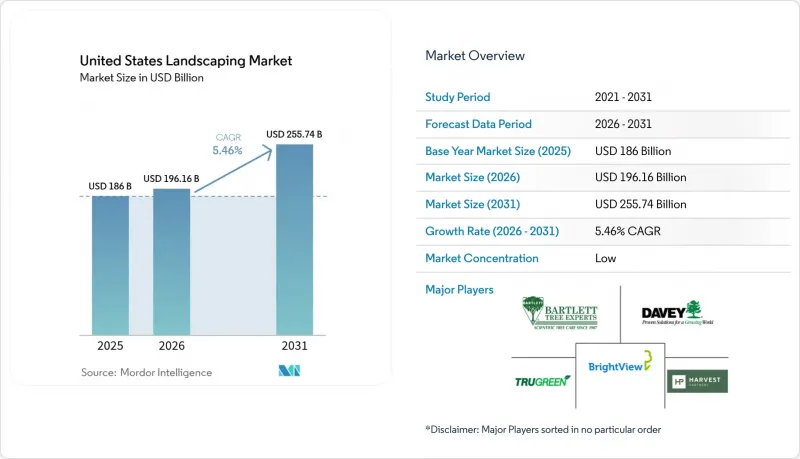
This report is Segmented by Service Type (Maintenance Services, Development Services, and Ancillary Services) and Application (Commercial, Residential, and Municipal/Institutional). The Report Offers Market Forecasts in Terms of Value (USD).
United States Landscaping Market Trends and Insights
Surge in Demand for Lawn-Care Subscriptions
Subscription contracts now anchor revenue growth as households prioritize predictable budgeting and automated visit scheduling. Leading providers report that recurring agreements account for more than three-quarters of new residential bookings, elevating customer lifetime value and smoothing seasonal cash-flow swings. Bulk deals signed by homeowner associations further strengthen route density, lowering per-stop fuel expense and carbon footprint. Operators leverage dedicated mobile apps to send service reminders, upsell aeration, and collect digital payments, reinforcing retention. As suburban migration continues, this model supports the steady expansion of the United States landscaping market.
AI-Driven Estimation and Robotic Mowing Adoption
Autonomous mowers and cloud-based takeoff software are gaining traction among contractors seeking relief from persistent labor shortages. Commercial sites with large open turf areas see the fastest payback because a single robot can trim several acres daily with minimal supervision. AI sensors measure lot dimensions from drone images, generate precise material lists, and price bids within minutes, cutting the average estimation cycle by 65%. Training investments remain essential to ensure battery management and safety compliance, yet early adopters report margin lifts of 2-4 percentage points in their maintenance divisions.
Severe Seasonal Labor Shortages (H-2B Caps)
Contractors requested 97,000 seasonal visas for 2025, yet secured fewer than 65,000 approvals, forcing many to curtail spring workloads. Higher overtime payments inflate wage bills and compress small-operator margins. Companies respond by cross-training crews and prioritizing high-value accounts, but unmet demand still suppresses potential revenue. Many firms implement referral bonuses to attract domestic hires, yet uptake remains limited because landscaping wages trail those of construction trades. As a result, project backlogs lengthen during peak growing weeks, resetting customer expectations and lowering service quality scores.
Other drivers and restraints analyzed in the detailed report include:
- Growing Commercial Retrofits for Environmental, Social, and Governance (ESG) Compliance
- Expansion of Outdoor Living Wellness Spaces
- Heightened Drought Regulation on Irrigation Use
For complete list of drivers and restraints, kindly check the Table Of Contents.
Segment Analysis
Maintenance generated the largest share of the United States landscaping market, accounting for 44.32% share in 2025, reflecting client preference for predictable, contract-based services that cover turf mowing, fertilization, and weed control. Fleet standardization and route optimization allow multi-regional providers to schedule dense stops and maximize crew utilization. Upselling soil-health assessments and smart-irrigation retrofits raise ticket size while deepening account stickiness. Design-build installs, ranging from patios to retaining walls, rank as the fastest-growing revenue pool with a CAGR of 8.35% in the forecast period, propelled by homeowner demand for multifunctional outdoor spaces.
Subscription maintenance models underpin stable cash flow and reduce customer acquisition costs. Fertilizer and weed-control programs command higher margins than basic mowing because licensing and chemical handling rules deter new entrants. Design-build remains cyclical, but benefits from elevated housing equity and commercial ESG retrofits. Niche services such as snow management and arboriculture add off-season earnings, further diversifying the United States landscaping market.
Complete Report Scope:
- By Service Type
- Maintenance Services
- Turf mowing
- Fertilization and weed control
- Development/Design-Build Services
- Hardscaping
- Soft-scaping
- Ancillary Services
- Snow and ice management
- Tree care and arborist
- Maintenance Services
- By Application
- Residential
- Commercial
- Municipal/Institutional
List of Companies Covered in this Report:
- BrightView Holdings Inc.
- TruGreen Inc. (TruGreen Holding Corporation)
- The Davey Tree Expert Company
- The F.A. Bartlett Tree Expert Company
- Yellowstone Landscape (Harvest Partners)
- SavATree, LLC (Apax Partners)
- Ruppert Landscape, Inc. (Knox Lane)
- LandCare USA LLC
- Park West Companies
- Aspen Grove Landscape Group
- Gothic Landscape
- Lawn Doctor Inc. (Happinest Brands, Inc.)
- Mariani Enterprises, LLC
- U.S. Lawns, Inc. (EverSmith Brands)
- Landscape Workshop LLC
Additional Benefits:
- The market estimate (ME) sheet in Excel format
- 3 months of analyst support
TABLE OF CONTENTS
1 Introduction
- 1.1 Study Assumptions and Market Definition
- 1.2 Scope of the Study
2 Research Methodology
3 Executive Summary
4 Market Landscape
- 4.1 Market Overview
- 4.2 Market Drivers
- 4.2.1 Surge in demand for lawn-care subscriptions
- 4.2.2 AI-driven estimation and robotic mowing adoption
- 4.2.3 Growing commercial retrofits for Environmental, Social and Governance (ESG) compliance
- 4.2.4 Expansion of outdoor living wellness spaces
- 4.2.5 Post-pandemic housing starts and remodeling uptick
- 4.2.6 Private Equity (PE)-backed roll-ups accelerating service coverage
- 4.3 Market Restraints
- 4.3.1 Severe seasonal labor shortages (H-2B caps)
- 4.3.2 Rising fuel, fertilizer and hardscape input costs
- 4.3.3 Heightened drought regulation on irrigation use
- 4.3.4 Fragmented pricing pressure from gig platforms
- 4.4 Regulatory Landscape
- 4.5 Technological Outlook
- 4.6 Porter's Five Forces Analysis
- 4.6.1 Bargaining Power of Suppliers
- 4.6.2 Bargaining Power of Buyers
- 4.6.3 Threat of New Entrants
- 4.6.4 Threat of Substitutes
- 4.6.5 Intensity of Competitive Rivalry
5 Market Size and Growth Forecasts (Value)
- 5.1 By Service Type
- 5.1.1 Maintenance Services
- 5.1.1.1 Turf mowing
- 5.1.1.2 Fertilization and weed control
- 5.1.2 Development/Design-Build Services
- 5.1.2.1 Hardscaping
- 5.1.2.2 Soft-scaping
- 5.1.3 Ancillary Services
- 5.1.3.1 Snow and ice management
- 5.1.3.2 Tree care and arborist
- 5.1.1 Maintenance Services
- 5.2 By Application
- 5.2.1 Residential
- 5.2.2 Commercial
- 5.2.3 Municipal/Institutional
6 Competitive Landscape
- 6.1 Market Concentration
- 6.2 Strategic Moves
- 6.3 Market Share Analysis
- 6.4 Company Profiles (Includes Global-level Overview, Market-level Overview, Core Segments, Financials as available, Strategic Information, Market Rank/Share, Products and Services, Recent Developments)
- 6.4.1 BrightView Holdings Inc.
- 6.4.2 TruGreen Inc. (TruGreen Holding Corporation)
- 6.4.3 The Davey Tree Expert Company
- 6.4.4 The F.A. Bartlett Tree Expert Company
- 6.4.5 Yellowstone Landscape (Harvest Partners)
- 6.4.6 SavATree, LLC (Apax Partners)
- 6.4.7 Ruppert Landscape, Inc. (Knox Lane)
- 6.4.8 LandCare USA LLC
- 6.4.9 Park West Companies
- 6.4.10 Aspen Grove Landscape Group
- 6.4.11 Gothic Landscape
- 6.4.12 Lawn Doctor Inc. (Happinest Brands, Inc.)
- 6.4.13 Mariani Enterprises, LLC
- 6.4.14 U.S. Lawns, Inc. (EverSmith Brands)
- 6.4.15 Landscape Workshop LLC
7 Market Opportunities and Future Outlook

