PUBLISHER: Mordor Intelligence | PRODUCT CODE: 2115158

PUBLISHER: Mordor Intelligence | PRODUCT CODE: 2115158
Landscaping And Gardening Service - Market Share Analysis, Industry Trends & Statistics, Growth Forecasts (2026 - 2031)
According to Mordor Intelligence, the landscaping and gardening service market size is expected to grow from USD 118.5 billion in 2025 to USD 125.77 billion in 2026 and is forecast to reach USD 169.36 billion by 2031 at 6.13% CAGR over 2026-2031.
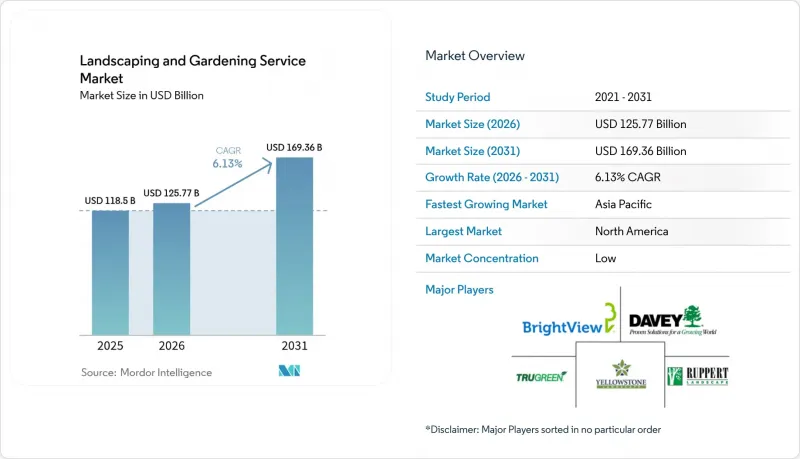
This report is Segmented by Type (Landscape and Garden Design, Construction and Landscape Management, Landscape and Garden Maintenance, Landscape and Garden Enhancements, and Other Types), by End User (Commercial, Residence, and Other End Users), and by Geography (North America, Europe, Asia Pacific, South America, Middle East and Africa). The Market Forecasts are Provided in Terms of Value (USD).
Global Landscaping And Gardening Service Market Trends and Insights
Aging-In-Place Demand Boosts Residential Landscaping
In the United States, 40% of households headed by individuals aged 65 and above now plan to implement accessibility upgrades that include outdoor areas. This has led to increased spending on barrier-free pathways, native plantings, and automated irrigation systems . Baby-boom migration into smaller rural towns is raising local service needs and enlarging contractor addressable markets . This trend is particularly pronounced in suburban markets where aging homeowners prefer to retrofit existing properties rather than relocate to assisted living facilities. Similarly, safety-oriented landscaping preferences are emerging in Hong Kong, confirming global relevance. Research from Hong Kong demonstrates that older adults prioritize landscape elements providing comfort, safety, and protection from severe weather, creating demand for specialized design services that integrate therapeutic horticulture principles with universal design standards.
Corporate Net-Zero Commitments Require Green Campuses
Microsoft's water-positive and carbon-negative pledges demonstrate how large enterprises incorporate biodiversity corridors, rain gardens, and habitat restoration into their master planning. Europe's Nature Restoration Law, effective August 2024, mandates ecosystem renewal across 20% of Europe Union land and sea, compelling facility owners to procure specialized ecological landscaping. Universities are adopting similar strategies, signaling a broad institutional demand. These corporate commitments create demand for specialized services, including carbon footprint assessments, biodiversity monitoring, and ecosystem service quantification, which command premium pricing compared to traditional maintenance contracts.
Acute Shortage of Skilled Horticultural Labor
The landscaping industry confronts an unprecedented labor crisis that threatens service capacity and drives operational costs beyond sustainable levels for many contractors. Landscaping accounted for 31.3% of all H-2B visas in 2023, yet the statutory cap remains 66,000, forcing companies to raise wages 6.8% on average while absorbing new compliance costs. DHS (United States Department of Homeland Security) added 64,716 extra permits for 2025, but demand still exceeds supply. Automation adoption partially offsets these gaps but requires an upfront capital investment. The aging domestic workforce and declining interest among younger Americans in physically demanding outdoor work exacerbate these shortages, forcing companies to increase wages, improve benefits, and invest in retention programs that compress profit margins. Compliance with the new H-2 Final Rule introduces additional administrative costs and enhanced worker protection requirements that further strain operational budgets.
Other drivers and restraints analyzed in the detailed report include:
- Increasing Demand for Outdoor Aesthetics and Recreational Spaces
- Rising Urbanization and Infrastructure Development
- Water-Use Restrictions in Drought-Prone Regions
For complete list of drivers and restraints, kindly check the Table Of Contents.
Segment Analysis
Landscape and garden maintenance accounted for the largest 41.08% of the landscaping and gardening service market share in 2025, primarily due to subscription-style lawn care, pruning, and seasonal cleanup contracts that ensure a steady monthly income. Construction and Landscape Management revenues track public and private infrastructure cycles, especially in the Asia-Pacific region, where new city districts often specify green roofs and bioswales from the outset. Design services are consolidating into integrated design-build portfolios, enabling single-source accountability and accelerating project timelines. Recurring maintenance cash flows underpin contractor valuations, a key driver behind private-equity roll-ups that aim to blend predictable earnings with higher-margin enhancements. BrightView derived most of its USD 2.767 billion in 2024 revenue from maintenance routes, yet reported a double-digit margin premium on enhancements tied to smart-technology upgrades.
Landscape and garden enhancement services are projected to deliver the fastest 8.32% CAGR through 2031, as homeowners and facility managers invest in premium features such as outdoor kitchens, low-voltage lighting, and app-controlled irrigation. Landscape and Garden Design services are experiencing consolidation as clients increasingly prefer design-build contractors who can manage projects from conception through installation and ongoing maintenance, reducing coordination complexity and ensuring design intent preservation. As robotic mowers and sensor-based irrigation systems gain traction, contractors are integrating hardware leasing and data analytics into their maintenance plans, further enhancing customer lifetime value and differentiating service bundles within the landscaping and gardening services market.
Complete Report Scope:
- By Type
- Landscape and Garden Design
- Construction and Landscape Management
- Landscape and Garden Maintenance
- Landscape and Garden Enhancements
- Other Types
- By End User
- Commercial
- Residential
- Other End Users
- By Geography
- North America
- United States
- Canada
- Mexico
- Rest of North America
- South America
- Brazil
- Argentina
- Rest of South America
- Europe
- Germany
- United Kingdom
- France
- Italy
- Spain
- Netherlands
- Denmark
- Rest of Europe
- Asia-Pacific
- China
- India
- Australia
- Malaysia
- South Korea
- Rest of Asia-Pacific
- Middle East
- Saudi Arabia
- United Arab Emirates
- Turkey
- Rest of Middle East
- Africa
- South Africa
- Egypt
- Rest of Africa
- North America
Geography Analysis
North America retained the largest share of 39.42% in the landscaping and gardening services market in 2025, driven by mature maintenance penetration, robust discretionary spending, and early adoption of labor-saving robotics. Growth nevertheless moderates relative to emerging regions because baseline coverage is already high. The region benefits from favorable demographic trends, including aging-in-place preferences and corporate sustainability investments that drive consistent demand for both maintenance and enhancement services.
The Asia-Pacific region is forecast to record the fastest growth at a 7.28% CAGR, driven by China's massive urban infrastructure pipeline and India's smart city programs, which mandate rooftop gardens, public parks, and roadside tree canopies. Major developers award bundled design-build-maintain contracts to global and domestic specialists capable of meeting strict environmental guidelines, driving rapid revenue scaling. Europe advances steadily on the back of the Nature Restoration Law and widening municipal bans on pesticide and water use. Contractors possessing biodiversity assessment skills and ISO (International Organization for Standardization) 14001 certification secure premium fees.
The Middle East, led by Saudi Arabia's NEOM and UAE (United Arab Emirates) eco-districts, delivers high-value but technically challenging projects requiring desert-adapted planting palettes and desalinated water irrigation. Africa and South America remain nascent yet show upside as urban centers prioritize green infrastructure to mitigate heat-island effects. Africa shows emerging potential driven by urbanization trends and infrastructure development, though market development remains constrained by economic conditions and limited access to specialized equipment and materials in many regions.
- BrightView Holdings, Inc.
- idverde Group
- The Davey Tree Expert Company
- TruGreen Limited
- Yellowstone Landscape Group, Inc.
- Park West Companies, Inc
- Ruppert Landscape Management, Inc
- Gothic Landscape, Inc.
- LandCare USA, LLC
- Juniper Landscaping of Florida, LLC
- Pacific Landscape Management, LLC
- Denison Landscaping, Inc.
- Chapel Valley Landscape Company, Inc.
- The F.A. Bartlett Tree Expert Company
- Asia Flora and Landscape Sdn Bhd
Additional Benefits:
- The market estimate (ME) sheet in Excel format
- 3 months of analyst support
TABLE OF CONTENTS
1 Introduction
- 1.1 Study Assumptions and Market Definition
- 1.2 Scope of the Study
2 Research Methodology
3 Executive Summary
4 Market Landscape
- 4.1 Market Overview
- 4.2 Market Drivers
- 4.2.1 Aging-in-place demand boosts residential landscaping
- 4.2.2 Corporate net-zero commitments require green campuses
- 4.2.3 Increasing demand for outdoor aesthetics and recreational spaces
- 4.2.4 Rising urbanization and infrastructure development
- 4.2.5 Growing environmental awareness and sustainability trends
- 4.2.6 AI-enabled robotic mowers cut labor costs and spur adoption
- 4.3 Market Restraints
- 4.3.1 Acute shortage of skilled horticultural labor
- 4.3.2 High installation and maintenance costs
- 4.3.3 Seasonal and weather-dependent nature of services
- 4.3.4 Water-use restrictions in drought-prone regions
- 4.4 Regulatory Landscape
- 4.5 Technological Outlook
- 4.6 Porter's Five Forces Analysis
- 4.6.1 Bargaining Power of Suppliers
- 4.6.2 Bargaining Power of Buyers
- 4.6.3 Threat of New Entrants
- 4.6.4 Threat of Substitute Products
- 4.6.5 Intensity of Competitive Rivalry
5 Market Size and Growth Forecasts (Value)
- 5.1 By Type
- 5.1.1 Landscape and Garden Design
- 5.1.2 Construction and Landscape Management
- 5.1.3 Landscape and Garden Maintenance
- 5.1.4 Landscape and Garden Enhancements
- 5.1.5 Other Types
- 5.2 By End User
- 5.2.1 Commercial
- 5.2.2 Residential
- 5.2.3 Other End Users
- 5.3 By Geography
- 5.3.1 North America
- 5.3.1.1 United States
- 5.3.1.2 Canada
- 5.3.1.3 Mexico
- 5.3.1.4 Rest of North America
- 5.3.2 South America
- 5.3.2.1 Brazil
- 5.3.2.2 Argentina
- 5.3.2.3 Rest of South America
- 5.3.3 Europe
- 5.3.3.1 Germany
- 5.3.3.2 United Kingdom
- 5.3.3.3 France
- 5.3.3.4 Italy
- 5.3.3.5 Spain
- 5.3.3.6 Netherlands
- 5.3.3.7 Denmark
- 5.3.3.8 Rest of Europe
- 5.3.4 Asia-Pacific
- 5.3.4.1 China
- 5.3.4.2 India
- 5.3.4.3 Australia
- 5.3.4.4 Malaysia
- 5.3.4.5 South Korea
- 5.3.4.6 Rest of Asia-Pacific
- 5.3.5 Middle East
- 5.3.5.1 Saudi Arabia
- 5.3.5.2 United Arab Emirates
- 5.3.5.3 Turkey
- 5.3.5.4 Rest of Middle East
- 5.3.6 Africa
- 5.3.6.1 South Africa
- 5.3.6.2 Egypt
- 5.3.6.3 Rest of Africa
- 5.3.1 North America
6 Competitive Landscape
- 6.1 Market Concentration
- 6.2 Strategic Moves
- 6.3 Market Share Analysis
- 6.4 Company Profiles (Includes Global Level Overview, Market Level Overview, Core Segments, Financials as Available, Strategic Information, Market Rank/Share for Key Companies, Products and Services, and Recent Developments)
- 6.4.1 BrightView Holdings, Inc.
- 6.4.2 idverde Group
- 6.4.3 The Davey Tree Expert Company
- 6.4.4 TruGreen Limited
- 6.4.5 Yellowstone Landscape Group, Inc.
- 6.4.6 Park West Companies, Inc
- 6.4.7 Ruppert Landscape Management, Inc
- 6.4.8 Gothic Landscape, Inc.
- 6.4.9 LandCare USA, LLC
- 6.4.10 Juniper Landscaping of Florida, LLC
- 6.4.11 Pacific Landscape Management, LLC
- 6.4.12 Denison Landscaping, Inc.
- 6.4.13 Chapel Valley Landscape Company, Inc.
- 6.4.14 The F.A. Bartlett Tree Expert Company
- 6.4.15 Asia Flora and Landscape Sdn Bhd
7 Market Opportunities and Future Outlook

