PUBLISHER: Mordor Intelligence | PRODUCT CODE: 2115149

PUBLISHER: Mordor Intelligence | PRODUCT CODE: 2115149
Europe Helicopters - Market Share Analysis, Industry Trends & Statistics, Growth Forecasts (2026 - 2031)
According to Mordor Intelligence, the Europe helicopters market size stood at USD 12.53 billion in 2026 and is projected to reach USD 16.39 billion by 2031, advancing at a 5.51% CAGR.
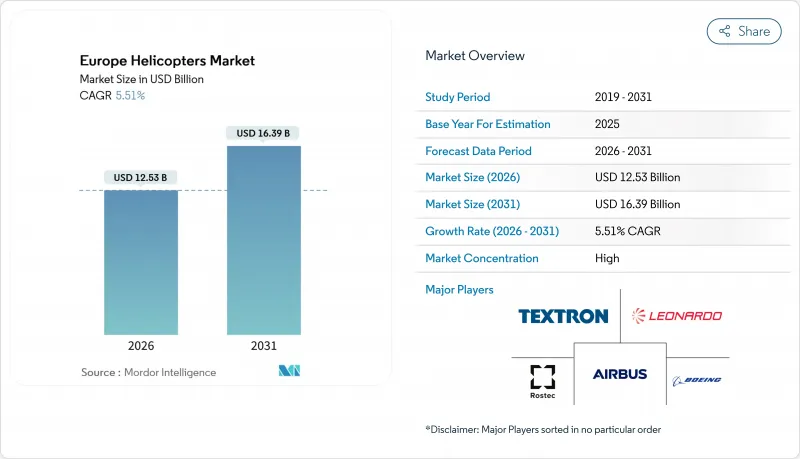
This report is Segmented by Maximum Take-Off Weight (Light, Medium, and Heavy), Application (Military, and Civil and Commercial), Engine Type (Piston Engine and Turboshaft Engine), End-Use Sector (Combat, Offshore Energy, Emergency Medical Services, Law Enforcement and Public Safety, ISR, and More), and Geography (United Kingdom, France, and More). The Market Forecasts are Provided in Terms of Value (USD).
Europe Helicopters Market Trends and Insights
Fleet Modernization to Meet EU Stage 3/4 Noise and Emission Rules
EASA CS-36 noise standards and Stage 3/4 emission thresholds are accelerating the retirement of older rotorcraft in urban HEMS and offshore routes where community noise complaints intensify. ReFuelEU Aviation mandates a 2% sustainable aviation fuel blend from 2025, which increases to 6% by 2030 and 70% by 2050, resulting in fuel bills that are two to five times higher than those of Jet A-1. Operators therefore gravitate toward twin-engine types such as the H145 and H160, whose five-blade bearingless rotors and Fenestron tails reduce external noise by up to 50%. NHV validated the feasibility by flying 40% SAF blends on North Sea sectors during 2025, proving that energy clients absorb higher logistics tariffs to hit carbon targets. Germany embedded low-acoustic signatures in its 82-unit H145M order, underscoring how compliance is now a key consideration in request-for-proposal criteria, rather than being treated as retrofit work.
Surge in HEMS Contracts and EU-Funded Medevac Programs
Central and Eastern Europe utilized structural funds to bridge trauma-care gaps, where sparse road networks lengthen response times. Bulgaria signed a EUR 50.8 million (USD 59.26 million) nationwide air-ambulance package in 2024, which is expected to reach full service by mid-2026. The rescEU framework earmarked EUR 140 million (USD 163.32 million) for a pooled fleet serving Slovakia, Czechia, and Romania, an early example of asset sharing that trims life-cycle costs across borders. Commission Regulation 2023/1020 harmonized crew training and medical-equipment baselines, eliminating patchwork compliance hurdles and enlarging tender pools for private operators.
Rising Operating Costs from SAF Blending Mandates
Sustainable aviation fuel prices ran two to five times higher than Jet A-1 during 2025. High-utilization offshore fleets consume thousands of liters per day, incurring annual cost increases of EUR 0.5-2 million (USD 0.58-2.33 million) per aircraft, which squeezes margins under fixed-price service contracts. HEMS operators cannot fully pass costs through to health ministry budgets, forcing route consolidation. While oil majors subsidized NHV's 40% SAF flights in the North Sea, civil clients without carbon budgets resist similar premiums.
Other drivers and restraints analyzed in the detailed report include:
- Offshore Wind-Farm Build-out in North Sea and Baltic Sea
- Defense Rotorcraft Replacement Cycles
- Persistent Pilot and Technician Shortage in Western Europe
For complete list of drivers and restraints, kindly check the Table Of Contents.
Segment Analysis
Light helicopters captured training and leisure recovery tailwinds, expanding at a 6.89% CAGR through 2031. The medium class retained the single most significant slice of the European helicopters market share at 47.76% in 2025, anchored by defense lift and offshore contracts that value payload and twin-engine redundancy. The absolute European helicopter market size for light models is expected to expand as Mediterranean sightseeing operators refresh their fleets and schools add lower-cost aircraft to accelerate pilot throughput. Robinson's R66 remains the best-selling turbine single in Spain and Italy due to acquisition pricing of EUR 900,000 (USD 1.04 million), while Leonardo's AW09 targets the same niche but faces certification delays. Germany's 3.7-tonne H145M blurs the light-medium lines by offering modular weapon kits, as illustrated by its adoption by special forces.
Demand for heavy rotorcraft remains tied to specialized North Sea platforms such as H225 and AW189. Growth lags at 4.2% CAGR, constrained by waning oil production and the pivot to fixed-wing crew change flights on ultra-long routes. Medium twins, especially the AW139 and H175, maintain outsized contract visibility because they can satisfy 300-nautical-mile round-trip operating envelopes and integrate 40% SAF blends without requiring hardware modifications.
Military programs controlled 60.77% of Europe's helicopter market share in 2025, as deliveries of the Tiger MkIII, H145M, and New Medium Helicopter reached their early run-rate. The civil and commercial sectors, however, are projected to post a 7.32% CAGR, surpassing defense growth after 2029. Emergency medical services, offshore energy, and tourism reopenings underpin the uplift. Offshore logistics dependence rises in tandem with wind farm capacity; contractual clauses now incorporate the use of SAF and carbon accounting. Tourism charter hours in Italy and Spain increased by 25% year-over-year in 2025, restoring pre-pandemic traffic levels amid the expansion of coastal helipads. Law enforcement frameworks in the UK, France, and Germany are shifting toward H145 and AW169 platforms, featuring sensor suites that integrate seamlessly with secure ground networks. Utility and aerial work operators are introducing unmanned systems for routine inspections, reserving manned sorties for complex lifts, thereby flattening demand curves in that sub-segment.
Complete Report Scope:
- By Maximum Take-off Weight
- Light
- Medium
- Heavy
- By Application
- Military
- Civil and Commercial
- By Engine Type
- Piston Engine
- Turboshaft Engine
- By End-Use Sector
- Combat
- Offshore Energy
- Emergency Medical Services
- Law Enforcement and Public Safety
- Tourism and VIP Charter
- Search and Rescue
- Utility and Aerial Work
- Intelligence, Surveillance, and Reconnaissance (ISR)
- By Geography
- Europe
- United Kingdom
- France
- Germany
- Italy
- Spain
- Russia
- Rest of Europe
- Europe
List of Companies Covered in this Report:
- Airbus SE
- Leonardo S.p.A
- Textron Inc.
- The Boeing Company
- Rostec
- Robinson Helicopter Company
- MD Helicopters, LLC
- Enstrom Helicopter Corporation
- ALPI AVIATION SRL
- Kaman Corporation
- NH Industries
- Kawasaki Heavy Industries, ltd.
Additional Benefits:
- The market estimate (ME) sheet in Excel format
- 3 months of analyst support
TABLE OF CONTENTS
1 INTRODUCTION
- 1.1 Study Assumptions and Market Definition
- 1.2 Scope of the Study
2 RESEARCH METHODOLOGY
3 EXECUTIVE SUMMARY
4 MARKET LANDSCAPE
- 4.1 Market Overview
- 4.2 Market Drivers
- 4.2.1 Fleet Modernization to Meet EU Stage 3/4 Noise and Emission Rules
- 4.2.2 Surge in HEMS Contracts and EU-funded Medevac Programs
- 4.2.3 Offshore Wind-farm Build-out in North Sea and Baltic Sea
- 4.2.4 Defense Rotorcraft Replacement Cycles (France TIGER III, UK New Medium Helicopter)
- 4.2.5 Rise of Hybrid-Electric Rotorcraft R&D Grants (Clean Aviation JU)
- 4.2.6 Heightened border-security and SAR requirements along Europe's eastern frontiers
- 4.3 Market Restraints
- 4.3.1 Rising Operating Costs from SAF Blending Mandates
- 4.3.2 Persistent Pilot and Technician Shortage in Western Europe
- 4.3.3 Civil Airspace Congestion and Stricter Slot Allocations
- 4.3.4 Export License Restrictions on Russian Powerplants and Components
- 4.4 Value Chain Analysis
- 4.5 Regulatory Outlook
- 4.6 Technological Outlook
- 4.7 Porter's Five Forces Analysis
- 4.7.1 Bargaining Power of Suppliers
- 4.7.2 Bargaining Power of Buyers/Consumers
- 4.7.3 Threat of New Entrants
- 4.7.4 Threat of Substitute Products
- 4.7.5 Intensity of Competitive Rivalry
5 MARKET SIZE AND GROWTH FORECASTS (VALUE)
- 5.1 By Maximum Take-off Weight
- 5.1.1 Light
- 5.1.2 Medium
- 5.1.3 Heavy
- 5.2 By Application
- 5.2.1 Military
- 5.2.2 Civil and Commercial
- 5.3 By Engine Type
- 5.3.1 Piston Engine
- 5.3.2 Turboshaft Engine
- 5.4 By End-Use Sector
- 5.4.1 Combat
- 5.4.2 Offshore Energy
- 5.4.3 Emergency Medical Services
- 5.4.4 Law Enforcement and Public Safety
- 5.4.5 Tourism and VIP Charter
- 5.4.6 Search and Rescue
- 5.4.7 Utility and Aerial Work
- 5.4.8 Intelligence, Surveillance, and Reconnaissance (ISR)
- 5.5 By Geography
- 5.5.1 Europe
- 5.5.1.1 United Kingdom
- 5.5.1.2 France
- 5.5.1.3 Germany
- 5.5.1.4 Italy
- 5.5.1.5 Spain
- 5.5.1.6 Russia
- 5.5.1.7 Rest of Europe
- 5.5.1 Europe
6 COMPETITIVE LANDSCAPE
- 6.1 Market Concentration
- 6.2 Strategic Moves
- 6.3 Market Share Analysis
- 6.4 Company Profiles {(includes Global level Overview, Market level overview, Core Segments, Financials as available, Strategic Information, Market Rank/Share for key companies, Products and Services, and Recent Developments)}
- 6.4.1 Airbus SE
- 6.4.2 Leonardo S.p.A
- 6.4.3 Textron Inc.
- 6.4.4 The Boeing Company
- 6.4.5 Rostec
- 6.4.6 Robinson Helicopter Company
- 6.4.7 MD Helicopters, LLC
- 6.4.8 Enstrom Helicopter Corporation
- 6.4.9 ALPI AVIATION SRL
- 6.4.10 Kaman Corporation
- 6.4.11 NH Industries
- 6.4.12 Kawasaki Heavy Industries, ltd.
7 MARKET OPPORTUNITIES AND FUTURE OUTLOOK
- 7.1 White-space and Unmet-need Assessment

